
by James A. Bacon

Another day, another study highlighting a racial “disparity.” In this case the study, published by Julian, a civil-rights and international and international human-rights organization, focuses on racial disparities in traffic-stop outcomes in Virginia.
The findings have been uncritically reported by Radio IQ — headline: “Race is a factor when police stop drivers in more than 90 Virginia communities” — as well as the VA Scope newsletter, WVEC in Norfolk, and what surely must be an AI-generated recapitulation by MSN for national distribution.
The authors, Charles Meire and Saman De Silva with Julian, dig into data on 3.2 million traffic stops compiled since the Virginia Community Policing Act mandated its collection in 2020. The underlying supposition of the enabling legislation was that racial disparities were evidence of “bias-based profiling,” and such is the underlying premise of this report as well.
The only thing that can safely said about the conclusions in the study, “Disparate Impact: A Statistical Analysis of Virginia Police Stop Outcomes,” is that racial disparities in the incidence of traffic stops and outcomes from those stops do exist. But the interpretation of those disparities is very open to debate.
What constitutes a “disparity”? The authors imply, but do not say explicitly, that a disparity exists when certain traffic-related incidents and outcomes occur at different rates between Whites and Blacks as a percentage of their population. But which population? The United States as a whole? Virginia as a state? The metropolitan region? Or the locality or neighborhood in which the incidents occurred? We are never told.
The study never addresses a critical variable affecting disparities in traffic-stop incomes: age. Young people — young males, in particular — are notoriously more likely to engage in risky driving, get stopped more frequently, behave in a volatile manner, and get arrested more frequently. That’s why they have the highest insurance rates. Why does that matter? Because the median age of Blacks in the U.S. in 2022 was 32.1 years. The average age of Whites is 44. What do the racial “disparities” look like on an age-adjusted basis? Who knows? The Julian authors never ask.
A third — and fatal — methodological flaw is that the authors assume that all disparities in outcomes are attributed to police behavior. But traffic stops that escalate into incidents leading to arrest often occur as the result of the interaction between the motorist and the police officer. In a society in which Blacks are told repeatedly that police are racially biased — in some quarters, that “All Police Are Bastards” — it can reasonably be inferred that a few are more primed to respond in a negative and hostile manner toward what they perceive as police injustice, thus triggering an escalation of a routine traffic stop into a person search, vehicle search, or arrest.
Remarkably, this kind of statistical analysis been admitted into the courts and in at least one case in Richmond, used to exonerate someone. The authors cite as an inspiration for their work the U.S. vs. Moore case in the Eastern District of Virginia, in which the racial disparities in stop outcomes were allegedly so severe, Julian writes, that, when combined with a historical analysis of racial bias in Richmond’s government, the judge dismissed a criminal indictment against a Black driver.
That federal judge, John A. Gibney, admitted as evidence into the case analysis by Virginia Commonwealth University criminology professor Eli Coston that showed profound disparities. Julian quotes him as saying:
This data was essential to this case. It shows a disgraceful disparity in enforcement of traffic laws, with Black drivers getting the short end of the stick. Richmond is not the only locality with this problem; the state wide statistics show a remarkable record of picking on Black drivers. And subsequent reports by the Commonwealth show that the trend continues. One would think that Virginia’s citizens would cry out in protest over this situation, but they don’t.
“The case, US v. Moore, has the potential to be a landmark in equal protection law,” opines Julian.
Julian used Coston’s methodology, with minor modifications, as the basis for the study just published.
I will credit the authors with this: They diligently lay out their methodology and explain the limitations of their analysis. They even go so far as to say, “The data in this report is unlikely to convince a court of selective enforcement. To be sufficient, it would require a practitioner to perform the rigorous statistical evaluation in Moore. That, we did not do here.” The report goes on to make several useful recommendations of data that should be collected to enable sounder conclusions.
That caveat does not appear in the news reports.
The authors also note certain judgment calls that might have influenced the presentation of the data. For instance, they limited their comparisons to individuals identified as Black and non-Hispanic White only. By almost every measure of behavior, Asian-Americans are more law-abiding than other race/ethnicities and less likely to have negative encounters with the law. But if the system is biased against all “people of color,” as is often asserted (though not by the authors of this study) and Asians have the lowest negative outcomes of all, one would have to ask if the motorists‘ behavior was as determinative as police biases and behavior.
The authors also eliminate data from checkpoints on the grounds that traffic stops leave less room for officer discretion and exercise of bias. That strikes me as arbitrary. Stopping cars and checking for sobriety at foreordained checkpoints might not leave much discretion to officers, but follow-up actions — issuing tickets, searching persons, searching cars, arresting people — are very discretionary. It would be interesting to know if racial disparities exist in those situations.
The authors follow the Coston methodology of assigning a numerical value to racial differences in outcomes. If Black people experience an outcome at the same rate as White people, they authors assign a score of 1.0. If Black people experience the outcome at a higher rate, the ratio is expressed as a number greater than 1.0. Accordingly, a ratio of 3.12 would mean that Blacks experience the selected outcome at a rate 3.12 times higher than Whites. If Whites experience the outcome at a higher rate, a score would be assigned less than 1.0.
Here is the study’s high-level data summary:
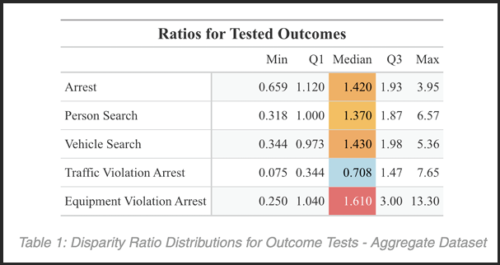
Thus, we can see that Blacks are more likely than Whites to be the subject of personal searches, vehicle searches, arrests, and equipment violation arrests. Curiously — and the authors do not devote much attention to this finding — it appears that Whites are more likely to be arrested for traffic violations.
If there is systemic bias in Virginia police departments, why would police be more likely to arrest Whites for traffic violations but more likely to arrest Blacks for equipment violations? Are police more likely to express their bias in one circumstance and less in another?
Or are there other variables at work that simply are not explored here?
That is the nub of the problem. If you examine a racial disparity with the presupposition that race is the critical variable, you don’t look at other variables. You don’t look at average age. You don’t look at socioeconomic status, which assuredly is related to the phenomenon of people driving around with equipment violations. (Poor people are more unable to afford to get their cars repaired in a timely manner. Blacks are disproportionately poor., so they’re more likely to ignore equipment violations. The disparity arises because they’re poor, not because they’re Black.)
There’s one other finding from the data that the authors should have explored but didn’t. Why is it that some of the worst disparities occur in localities that are run by woke Democratic councils and boards, typically have Blacks serving as police chiefs, and make police officers undergo bias training? And why is it that rural localities with White working-class Bubbas running law enforcement have among the lowest disparities?
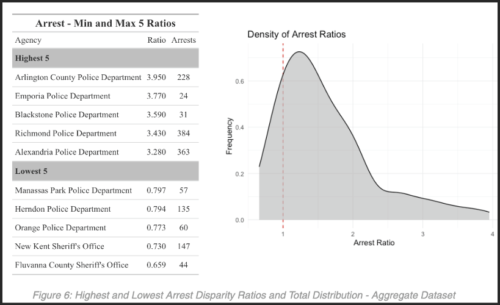
This chart from the study shows the five law-enforcement agencies with the most lopsided arrest ratios. The top of the list is the uber-woke People’s Republic of Arlington County, where Blacks are almost four times more likely to be arrested than Whites. It is followed in the No. 4 and 5 spot by the City of Richmond and the City of Alexandria.
By comparison look at the lowest five localities, where Whites are disproportionately arrested: It includes three Trump-voting counties — Orange, New Kent, and Fluvanna — where one would expect anti-Black bias would be most prevalent.
The authors confront none of these contradictions. They use race as the only explanatory variable and get the results their own ideological bias presupposes them to get. It’s bad enough that such social science is blindly distributed through legacy media and social media. Those stories are a thousand times more likely to be seen than a Bacon’s Rebellion blog post. The prospect that this kind of analysis can find its way into the court system is even scarier.
Leave a Reply
You must be logged in to post a comment.