
by James A. Bacon
A couple of years ago, I had a conversation with a University of Virginia alumnus that has stuck with me. This man, a major donor who had given his time and wisdom on various boards, was concerned about the direction UVA had taken under President Jim Ryan but cautioned against any effort to remove him. Ryan was not dogmatic. Rather he was “malleable” and could be reasoned with, the alumnus suggested. Additionally, he noted, sacking Ryan would follow the firing and reinstallation of Teresa Sullivan as UVA president in 2012. Any qualified candidate would have to wonder if there was something toxic in the water in Charlottesville. Who’d want the job?
That was two years ago, back when the idea of removing Ryan seemed so remote that very few took it seriously. It was before the Trump administration launched an investigation into racial preferences at UVA that led to Ryan’s resignation, sparking a backlash among Democrats. It was before state Senate Majority Leader Scott Surovell, D-Fairfax, declared that if UVA board members knew what was good for them, they’d better wait until Virginia had a new governor (presumably Democrat nominee Abigail Spanberger) to pick a new president. It was, in other words, before the battle for UVA’s soul became a hyper-partisan fracas.
Finding a candidate capable of meeting UVA’s high expectations will be only more difficult now.
Under better circumstances, UVA’s board would appoint an interim president — typically the provost — to run things while a national search was underway. But the provost, Ian Baucom, resigned this spring to take a job as president of Middlebury College.
Meanwhile, the BoV leadership is in transition. Today is Robert Hardie’s last day as rector. Tomorrow Rachel Sheridan, a Northern Virginia corporate attorney and old chum of Governor Glenn Youngkin, takes over. Four old hands appointed by former Governor Ralph Northam rotate off, and four Youngkin-nominated newbies rotate on. A fifth nominee, Ken Cuccinelli, has served only a couple of months, and Senate Democrats, having preemptively nixed him, asserts that he cannot legally continue to sit on the board through the end of the year, as Youngkin insists he can.
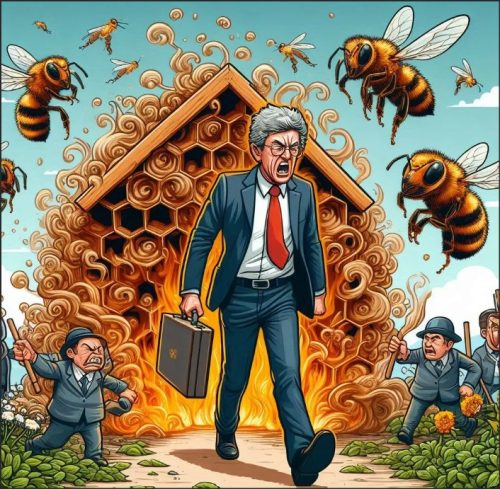
To say that any new UVA president would be walking into a hornet’s nest would be an understatement. A nest of angry, killer hornets, perhaps. Killer hornets that suck your blood and leave your corpse a desiccated husk.
The Teresa Sullivan affair was tame compared to the situation today. For starters, the partisan stakes were much lower. Then-Rector Helen Dragas and her board allies faulted Sullivan for failing to articulate a vision for the future at a time when technology — in particular distance learning — showed signs of disrupting the higher-ed industry. It was an important issue, but not one calculated to get the political juices flowing. As the University community rallied around Sullivan, then-Governor Bob McDonnell, a Republican, did not want to get embroiled in the controversy. Staying above the fray, he demanded that the Board of Visitors figure it out…. which it eventually did, re-elevating Sullivan to her presidential perch.
Today the stakes are much bigger. The issue is not about UVA’s technocratic future. It’s far more combustible. It’s a battle for UVA’s soul. The institution is dominated ideologically by the far left. Leftists declare UVA to be “their” institution reflecting “their” values and they deem any outsider — governors, alumni, mega-donors, the Department of Justice, whomever — as intruders seeking to impose an alien ideology. Conservatives view UVA as an intellectual monoculture more dedicated to indoctrinating students with leftist orthodoxy than teaching them to think rigorously and independently. UVA, they say, belongs to the state of Virginia and serves its citizens, not habitués of the Charlottesville bubble.
Traditionally, Virginia governors haven’t immersed themselves in university governance. The hands-off attitude changed when Governor Ralph Northam sacked Virginia Military Institute Superintendent J.H. Binford Peay III after widespread but flimsy accusations that VMI was a racist and sexist institution in desperate need of reform. Succeeding Northam, Youngkin stacked the boards of public universities with nominees who, to a greater or lesser degree, were sympathetic to rolling back the Diversity, Equity & Inclusion initiatives enshrined at almost every Virginia university on Northam’s watch.
Academia is, of course, a key constituency of the Democratic Party, and DEI, the issue that precipitated Ryan’s resignation, is inseparable from the social-justice vision of “equity” that animates most Democrats. Fearing a Trump- and Youngkin-orchestrated reversal of DEI across Virginia’s entire public education system, state Senate leadership is treating Ryan’s departure as an existential threat.
Governors and lawmakers alike are meddling like never before in the affairs of higher ed, not just nationally, as seen in the Trump administration’s attack on Harvard, but here in Virginia. Here in the Old Dominion power is distributed fairly evenly between Republicans, who dominate the three statewide offices, and Democrats, who control both houses of the General Assembly. This fall’s election could change the balance of power. But it’s hard to imagine any scenario in which the battle over higher ed miraculously becomes depoliticized.
Who would want to become UVA president under such circumstances? Who would uproot themselves to take a job that could be snatched away a few months later? I can’t imagine anyone signing up for the job until the dust settles from the November election. In that way, Surovell’s warning to UVA’s board to defer picking a president, was a brilliant stroke politically. From a policy standpoint, Ryan’s departure may not prove to bring about much change at all.
James A. Bacon serves on the board of the Jefferson Council. The opinions expressed here are his alone.
Leave a Reply
You must be logged in to post a comment.