
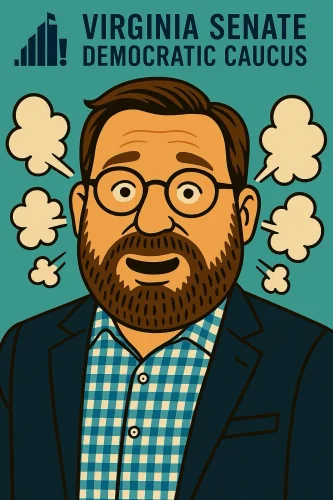
Bedlam compounded.
by Gordon C. Morse
A long time ago, in a city far, far away (Richmond during the 1970s) there existed AM radio station WGOE. It combined the progressive rock of Frank Zappa and Captain Beefheart with a collection of on-air personalities who you knew – just knew – were stoned from morning to night. Minutes of dead air would go by when you heard nothing at all, save a scratchy needle hitting the end of a record, and finally someone would push the right button.
That was the quality of Saturday morning’s Virginia Senate Democratic Caucus on-line press conference. It was something less than a public confidence-builder.
It did answer one question: How do we take the UVA situation –- a university presidency soon to be vacated and the leadership of its all-important health care system already driven off –- and make things much, much worse not only for the University of Virginia, but also for Virginia higher education generally?
Answer: Blow up everything. Clean house. Reboot all the boards of all Virginia’s colleges and universities. Yeah, come January, just machine gun everyone in sight and burn down their homes. So spake Scott Surovell, the Senate Majority Leader.
Other questions were left hanging, besides the obvious issue of what to do on Day Two.
The Virginia Senate long provided institutional reassurance and continuity. It was the steady hand. The tempered response. But now the Senate Democratic Caucus threatened to replace the chaos of today with mayhem tomorrow.
So if you wreak havoc with the academic governing boards, how does that address the events of last week? President Trump rests his actions upon an interpretation of the U.S. Constitution that has been affirmed by the U.S. Supreme Court. You don’t agree? Well, he obviously doesn’t care.
As a practical matter, Trump either has it right or he does not. Spirited references to “Project 2025” and a thundering parade of anti-Trump cliches will not advance the cause.
But here’s where it gets worse. Last week, after the U.S. Justice successfully pressured UVA president Jim Ryan to step down, the President didn’t appear on TV to spike the ball nor did Attorney General Pam Bondi. (There’s always tomorrow, of course.)
Instead, out came Harmeet Kaur Dhillon, the Assistant Attorney General for the Civil Rights Division. She’s both the first Republican woman and the first Republican of Indian descent to lead the division.
Born in Chandigarh, India (1968/1969), Dhillon’s family moved to London and then to the United States. After first settling in The Bronx, New York, they lived in Smithfield, North Carolina.
Dhillon graduated from high school at age 16 and attended Dartmouth College, where she became editor-in-chief of The Dartmouth Review. She later earned her J.D. from the University of Virginia School of Law and clerked for Judge Paul V. Niemeyer of the U.S. Court of Appeals for the Fourth Circuit.
She then went out and made a name for herself working on civil liberties, free speech, and election law. Fox News likes her bunches.
But none of all that is the real problem for the Senate Democrats. It’s how she comes across on TV. She’s calm. She speaks in whole sentences. She confidently conveys the attributes of someone comfortable with authority and justified in its deployment.
Look for yourself:
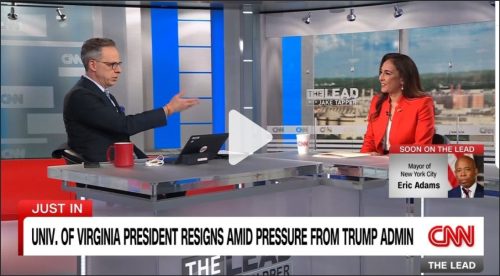
Then compare that to this:
Glasses askew, Surovell casts his eyes side to side, occasionally rolling them, tries to do a rift on Thomas Jefferson, constitutional theory and the American Way and never once addresses the core of what’s at issue.
At one point, the Majority Leader claimed that current college and university boards are not acting with sufficient independence. The evidence of that? None offered. More likely Surovell would have the Youngkin-appointed board members just think and act as Democrats do.
Whatever the issues involved with the Trump administration’s approach to UVA (there are many, many), it takes only modest effort to see how deeply DEI had been intertwined into the school’s administrative structure. You don’t find it here and there, but nearly everywhere. UVA cultured it, nurtured it and believed in it.
It still does. This is a straight-up fight, no question. That’s why the root canal came to town.
Were the Senate Democrats attempting to show they have it all under control? That’s a hard sell. They seem not to grasp any point of view other than their own. Being dismissive is not being persuasive.
Still, they can do a lot of damage and may yet, based on their stated intentions.
Nearly three decades ago, Republican Gov. Jim Gilmore tried something along the same line by seeding the governing boards with performance artists and populist nincompoops. He said he was acting on behalf of “the people” and doubtless the Senate Democrats would have themselves so perceived.
The Democrats would dramatically alter the status quo and appear to favor some arrangement more directly answerable to legislative control and, in fact, there are workable variations along those lines. Getting there, however, requires thinking of a more constructive variety.
In 1998, for instance, the exiting head of the Virginia State Council of Higher Education, Gordon Davies, penned a valedictory and anticipated future pressures. “The governance of Virginia’s colleges and universities requires steady commitment to objectives over long periods of time,” Davies wrote.
“Most important objectives take years to achieve, and building strong colleges and universities always takes time. Unfortunately, institutions are easier to damage than to build.”
Davies made for a pretty good prophet.
He then pointed out that the Governor and General Assembly had reached agreement that economic development should be insulated from politics and “that the state needed a long-range strategy and the staying power to make it happen.”
Out of that agreement, in 1995, emerged the Virginia Economic Development Partnership, a notably successful, quasi-independent state entity that transcends administrations and the election cycle. It laid a basis for collaboration and provided a means for success.
Could Virginia do the same for higher education? That’s what Davies wondered.
Why not try? Let the General Assembly directly participate in the naming of board college and university members, but not all of them. Quash the legislative confirmation business, which historically has never been taken seriously by Virginia lawmakers. They tend to step in arbitrarily, based on political considerations, and that practice almost never yields an agreeable, beneficial ending.
The governor would still play a role, but you could also have an independent citizen’s commission contribute the names of people who meet some base-line set of credentials, too. Create a pool of qualified people and go from there.
The idea is to insulate board appointments, to the greatest extent possible, from partisan politics.
At a minimum, don’t act in anger and frustration. Don’t flail away. Don’t bark, “All options are on the table.” Go down that route and the public may very well find options of its own.
And, please (just a suggestion) avoid Zoom. Don’t do that stuff anymore. On Saturday, the Senate Democrats summoned up enough video goodies to keep their political opposition happy and productive for a very long time.
Gordon C. Morse has been writing commentary and speeches in Virginia since 1983. This column his republished with permission from his Substack account Heart’s Desire.
Leave a Reply
You must be logged in to post a comment.