
by Todd Truitt
As Virginia’s new Democratic Governor, Abigail Spanberger will soon shape the direction of public education statewide through five appointments to the Virginia Board of Education. Based on her longstanding focus on transparency and eliminating conflicts of interest, her administration can chart a different course with respect to a recent Virginia practice.

The Spanberger administration will have to consider an important question in choosing these appointees: Should current school district or school officials serve on the very board that regulates them?
As a licensed attorney and Certified Public Accountant—professions governed by strict conflict-of-interest rules—I strongly believe the answer should be no.
This is not about personal character. It is about institutional design, good governance, national best practices and, in particular, public confidence in our public school system.
What the State Board of Education Does
The Virginia Board of Education is not advisory. It is regulatory, vested with the general supervision of the public school system.
The Board is also established in the Virginia Constitution. That matters. When an institution is embedded in the Constitution, it signals that its role is foundational and meant to be independent. The oversight of public education was elevated beyond ordinary statute for a reason.
The Board is the state’s highest authority on K–12 education policy, charged with setting:
- Academic standards
- Accreditation and accountability rules
- Graduation requirements
- Teacher licensure standards
- The regulatory framework for all local school divisions
Its decisions shape curriculum, assessment, discipline policy, school quality ratings, and the standards by which every school system across the Commonwealth is evaluated. Every public school district answers to the Board, which identifies for the governor and legislature any school divisions that have failed to maintain schools meeting its prescribed standards.
A constitutional regulator of this magnitude needs to be structurally independent.
The Conflict: Real and Perceived
When a sitting superintendent, school board member, district executive, or senior administrator serves on the Board, the regulated becomes the regulator. Even if the individual acts in perfect good faith, that structure creates an inherent conflict—both real and perceived. Board decisions directly affect the official’s own district, reputation, and professional interests.
This is not a critique of individuals. It is a concern for institutional integrity.
In fields like law, accounting, and corporate governance, such role-blending would be flatly prohibited. The principle is simple: regulatory independence is essential to credibility.
Virginia already recognizes this principle locally: school division employees cannot serve on the school board that governs their own division. The same logic should apply statewide with respect to school management and its regulator.
Public trust depends not only on ethical people, but on ethical structures.
Examples of Such Conflicts in the Past Two Administrations
Virginia’s recent Board of Education history provides clear examples of this structural conflict:
- A former member appointed by Governor Ralph Northam concurrently served as the head academic officer at one of Virginia’s largest school districts for half of his term and as superintendent of another large school district for the other half.
- A former member appointed by Governor Glenn Youngkin concurrently served as head of government affairs at one of Virginia’s largest school districts.
Knowing both former Board members personally, I hold them in high regard.
However, even when individuals are capable and act in complete good faith, placing a sitting senior school district or administrator on a state regulatory board overseeing their own system and school(s) creates an unavoidable conflict — in fact and in appearance.
Strong governance avoids those conflicts in the first place.
Vast Majority of States Do Not Have Such Conflicts
To better understand the national landscape on conflicts of interest and state boards of education, I reviewed the composition of state boards of education in 48 states plus the District of Columbia (Minnesota and Wisconsin do not have state boards).
The results were striking – the overwhelming majority of state boards of education do not include concurrent school district officials among their members.
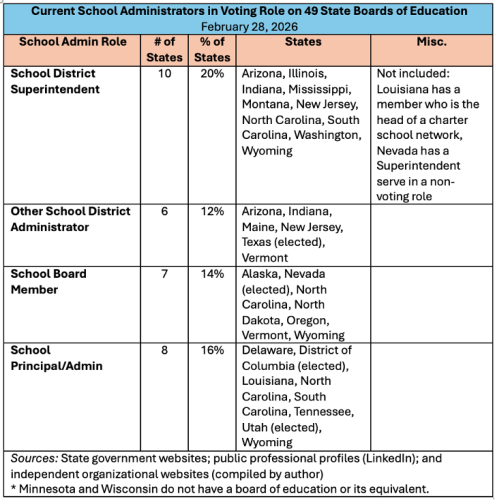
Most states appear to recognize the need for a bright line between school system management and its regulatory body.
Virginia has plenty of highly qualified former superintendents, principals, school board members and district officials who could bring deep experience to the Board without carrying active conflicts. Moreover, current school officials already have powerful lobbying organizations that vigorously advocate for their perspectives in Richmond.
There is no shortage of insight. There is a need for independence.
Governor Spanberger’s Commitment to Eliminating Conflicts of Interest
Board members serve staggered four-year terms and are appointed by the governor, subject to General Assembly confirmation.
In recent years, lawmakers have rejected late-term nominees of outgoing governors of the other party, accelerating majority control for incoming administrations. This new tradition deters qualified persons from serving on the Board of Education if nominated in the last year of a governor’s term. While I believe Virginia should reform its Board of Education structure to fix this issue and its overall alignment with national best practices, the absence of such reform does not change the core issue in the near term:
Who should be eligible to serve?
Governor Spanberger has made government transparency and ethics central themes of her public service. Her administration’s website explicitly emphasizes “eliminating conflicts of interest.”
In Congress, she advocated for banning stock trading by members of Congress to prevent lawmakers from shaping policy that could benefit their personal finances.
The same principle applies here.
Just as lawmakers trading stocks creates incentives for personal gain, school officials serving on a state board of education can shape policies that directly affect their own districts, careers, and professional networks.
In both cases, the problem is structural. It erodes public trust, weakens accountability, and blurs institutional lines that exist for good reason.
A Simple, Principled Standard
The General Assembly should legislatively adopt a clear, sensible standard as part of an overall reform of the Board of Education, which a Spanberger administration can implement in the meantime:
No current school district or school officials should serve on the Virginia Board of Education.
Former officials and school board members? Absolutely. Retired superintendents and school administrators? Yes. Policy experts, teachers, parents, researchers, business leaders, and civic figures? Certainly.
But active district executives should not regulate the systems they manage.
Such a standard would align Virginia with best practices nationwide, reinforce the independence of a constitutional body and strengthen public confidence—while honoring Governor Spanberger’s stated commitment to ethical government.
Our public schools are too important—and public trust too fragile—to accept anything less.
Leave a Reply
You must be logged in to post a comment.