
by Steve Haner
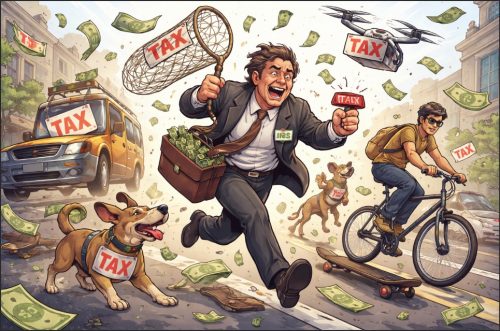
The tax increase proposals still pending at the 2026 General Assembly will extract another $4 to $5 billion annually from Virginians if enacted, shared between the state and the local governments.
The Democrats in political control have taken a bow for producing competing budget proposals that are not dependent on major tax increases, and for killing the large income tax increase and sales tax expansions some of their members proposed. That does not mean there will be no tax increases forwarded to Governor Abigail Spanberger (D) for approval.
Three proposals will impact most households and one of them was already signed by Spanberger, with the other two endorsed by her and expected to be signed. There are at least five other pending bills which will produce revenue from specific transactions that only some Virginians will have to pay, transactions they can choose to avoid.
The most unusual and noteworthy of those is a state gross receipts tax on the sale of firearms or ammunition of 11 percent, a far higher tax rate than any sales tax imposed anywhere in Virginia and far higher than the gross receipts taxes imposed on retailers by Virginia local governments.
The tax would be imposed on the manufacturers, not the buyers, but of course the cost would ultimately be paid by the final customers. House Bill 763 is punitive and not about revenue but based on the fiscal impact statement the House of Delegates did include about $70 million in revenue in its budget plan.
The transactions would still be subject to the relevant sales tax, of course, and the manufacturers selling into Virginia might owe income tax. The analysis from the Department of Taxation has helpful hints on how to also impose the gross receipts tax on out of state middleman distributors, which could show up in the final bill version and capture more transactions in the net.
The three tax proposals with widespread impact have been discussed here before often and indeed were predicted to emerge from this session. The one Spanberger has already approved is the Regional Greenhouse Gas Initiative with its related carbon tax paid by electricity generators. She signed budget language rejoining RGGI, but a bill is also now on its way to her desk.
That will work the same way as the gross receipts tax on guns and ammo, with the business entity passing the cost along to customers somehow. The fiscal impact statement on RGGI predicts tax revenue approaching $500 million, but a new RGGI carbon auction is happening next week, and a new, higher carbon price might be set and revealed next Friday.
The second tax of widespread impact coming is the payroll tax that will finance the state-provided income replacement under the Family and Medical Leave Insurance program. The impact statement on one version, Senate Bill 2, predicted that benefits of $2 billion may be paid out by 2030, and predicted an initial tax rate of about eight-tenths of one percent of payroll.
It would apply to all compensation without a cap. But really the tax rate is still to be determined once actuaries have designed the program. In other states the early predictions proved optimistic. It will have to cover the benefits and overhead and as salaries grow, so will the benefits and related tax.
The third tax with widespread impact is authorization from the state for localities to add another one percent onto the sales tax for their schools. This was approved before but vetoed by Governor Glenn Youngkin (R) (as were the family leave insurance and RGGI for that matter.) The local tax would need voter approval.
The House has passed a bill to authorize the local tax, and the Senate has included the authorization language in its budget bill. The fiscal impact statement makes no prediction on the revenue, but the Department of Taxation annual report tells us that in 2025 the current 1 percent local share of the sales tax collected almost $1.9 billion.
A handful of localities already have the extra surcharge, so put the impact of expanding it in all the others at $1.8 billion initially, soon to reach $2 billion annually thanks to inflation. Few if any will reject it.
The annual combined collection from the three taxes of widespread impact easily exceeds $4 billion once they are fully in place. A slightly larger payroll deduction buried on your pay stub, an invisible jump in tax on your daily transactions, some amount deep in the fine print of your power bill — few will even notice them.
As noted, some smaller, specialized taxes will add to government collections, but only on voluntary transactions. They should bring in hundreds of millions of dollars more, based on their official fiscal impact projections. It could be substantially more money than that.
The pending gross receipts tax on firearms and ammo has been mentioned and accounts for $70 million of that. Should the Assembly agree to the Senate’s legislation on creating and taxing licensed retail cannabis outlets (Senate Bill 542), the annual projected revenue from that is $100 million by 2030, divided between the state and local treasuries. That amount should keep growing.
Playing “skill” game machines dotted around the state is also a customer choice. House Bill 1272 places the Virginia Lottery in charge of managing them and of collecting a 25 percent tax that is projected to bring in from $125 million to $485 million for the state and localities. The fiscal impact statement admits only a guess at the revenue is possible given how this industry has blossomed outside state control.
The Lottery agency would also manage the regulation and taxation of authorized internet gaming platforms in the state under Senate Bill 118. The fiscal impact estimate on that projects the revenue off a 20 percent tax could reach $1 billion by the early 2030s, but the net impact this new gambling choice would have is hard to predict, as other authorized outlets including the Lottery and casinos could lose sales as a result.
Those tax takes dwarf the $1.25 million in revenue projected to come from another tax bill mentioned earlier on Bacon’s Rebellion. The tax on digital fantasy games, such as fantasy baseball leagues, is still alive in House Bill 145. The bill generated an unusual fiscal impact statement from the Joint Legislative Audit and Review Commission.
JLARC breaks the bad (but obvious) news that imposing the big license fees and 10 percent tax is likely to drive some if not most of the game operators out of Virginia entirely, which might give some legislators pause. Maybe not. RGGI is intended to discourage hydrocarbons. The goal of the new gross receipts tax is certainly to drive away the firearms industry. The power to tax has always included the power to destroy.
These are all on top of the billion dollars plus the state and localities might collect if a sales tax exemption for data centers expires, as the Senate has voted for. Hey, what’s another $5 billion a year out of Virginians’ pockets as long as the rhetoric on affordability stays front and center when they call their news conferences and email their constituents?
Leave a Reply
You must be logged in to post a comment.