
by James A. Bacon
Responding to a report from the Task Force on Religious Diversity and Belonging, the University of Virginia Board of Visitors passed a resolution at a special board meeting Thursday, directing the administration to “ensure that there is zero tolerance for harassment, bias, and discrimination based on religious differences on University Grounds.”
Formed in December after the University was engulfed in controversy over the conflict in Israel and Gaza, the task force had made a series of recommendations on how the University can “foster greater connection and understanding within and between different religious groups.” Those recommendations are summarized in UVA Today and detailed in the task force’s Final Report.
The underlying assumption of the report is that to enhance “belonging,” the University needs to grant greater accommodations to students, faculty, and staff of “minoritized” and “marginalized” religions.
At no point did the report consider the possibility that the University places too much emphasis on students’ “identity” or that the organized cultivation of grievances by multifarious oppressed minorities might contribute to the very alienation among Muslims and Jews that the task force was asked to address.
At UVA the answer to every perceived problem invites solutions that only administrators and faculty members can deliver. Thus, the task force’s proposed remedies entail more administrative “communication,” more administratively abetted “dialogue,” more courses on religious topics, and more accommodations on Grounds for religious practices.
Provost Ian Baucom set up the task force December 5 as an 11-person advisory group to President Jim Ryan. Christa Davis Acampora, dean of the College of Arts & Sciences, served as chair. The group was given several charges:
- examine the extent to which Jews and Muslims (and to a lesser extent other religious minorities) experience a sense of “belonging” at UVA;
- assess reports of antisemitic and Islamophobic incidents going back to 2017, the year of the infamous Unite the Right rally;
- evaluate educational offerings about religion, including the history and impact of antisemitism, Islamophobia, and other forms of religious bigotry; and
- incorporate its findings into the broader framework of the university’s commitment to Diversity, Equity & Inclusion.
The University of Virginia was founded as a secular institution, states the report. “Two of Thomas Jefferson’s proudest accomplishments were authorship of the Virginia Statute for Religious Freedom, ensuring religious liberty in the state, and the founding of the University of Virginia, which placed not a church but a library at its center.” Jefferson’s vision originally excluded the teaching of theology, as was common at most other universities in his time.
While noting that UVA operated within “an implicitly Protestant Christian framework” — using “the calendar” (because it was based on an early Christian reckoning??), building a non-denominational Christian chapel, and accepting religion as a distinct and separate sphere of life — UVA remained a religious “neutral space.” It fostered a curriculum that allowed the study of many different religions, and it permitted a diverse array of religiously affiliated groups to organize. “For all its inadequacies,” states the report, “the founding vision of a modern, secular university is of enduring value.”
The report does not make clear what those “inadequacies” are.
To examine “engagement,” the task force availed itself of student survey data dating back to 2018. It also organized 11 focus-group sessions: five with student affinity groups. Two other sessions were canceled for a lack of interest. The total of 96 participants effectively spoke for 25,000 graduate and undergraduate students.
When polled between the antisemitic rhetoric of the 2017 Unite the Right rally in Charlottesville and the anti-Zionist rhetoric of the 2023 pro-Palestinian demonstrations, Jewish students felt the strongest sense of “belonging” at UVA, and Muslims the lowest, the study says. By contrast, both groups were at the bottom of the list (which included agnostics/atheists, Christians, Buddhists, Hindus and others) of those who felt “respected.”
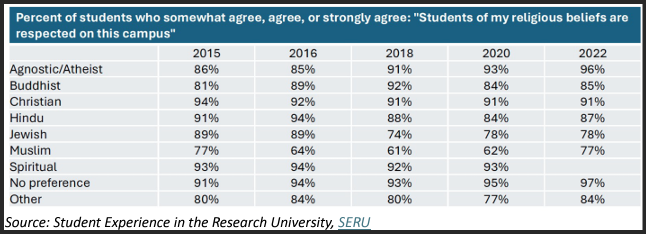
The report narrative did not take note of the fact that 77% of Muslims and 78% of Jews did believe their religious beliefs are respected.
Among those who felt disrespected, what form did the disrespect take? The report provides no insight. It provides no quotes from the focus groups. The only indirect clues come from a summary of information about formal complaints that had been brought to the attention of the administration through the “just report it” system for filing anonymous charges of bias, discrimination and harassment, through incidents investigated by the Equal Opportunity and Civil Rights (OECR) office, and through threat assessment cases.
The OECR office logged 56 bias incidents in 2023 through May 2024, of which 33 were reported by Jews, nine by Muslims, two by Christians, and one by a Hindu. That compared to only 22 incidents logged in 2022, of which nine were against Jews and six against Muslims. Of the 29 religion-related incidents brought to the attention of the Threat Assessment Team, none posed a serious threat, and only one required ongoing assessment.
The task force found no lack of resources for students to maintain their religious practices. “Students by and large are able to connect with their own communities of faith and related cultural affinity groups, and are supported in doing so,” the report says. “Undergraduates benefit from myriad student groups and activities to support religious life and identity.”
The biggest void, the report found, was in institutions that encouraged students of different religions to interact with one another. “Those resources that exist for undergraduates are focused primarily on religious identity rather than inter-religious understanding.”
UVA also offers students many opportunities to learn about their religion academically. The report Identified three dozen courses in Spring 2024 and more than 75 over the period of the past academic year across numerous academic departments. “These courses address religious cultures, traditions, and forms of bigotry.”
The report did not ask why students at a university supposedly dedicated to diversity, inclusiveness and the broadening of intellectual horizons might choose to sequester themselves with others of like religious identity rather than interact with others different from them.
The list of task force recommendations is long. The report assumes that the onus is on UVA as an educational institution to remedy any dissatisfaction the students might experience. Here are highlights:
- Prayer space. Ensure access to prayer/meditation spaces in the living, learning, and working spaces of the University;
- Food preparation. Explore opportunities to enhance food preparation facilities and options in dining and residence halls consistent with the religious diversity of the University (i.e., kosher, halal, faith-specific fast-breaking foods, etc.);
- Calendar. A calendar that is more responsive to minority religious holidays;
- Chaplaincy. Devise a sustainable chaplaincy/faith advisor program. ”The need for a chaplaincy position for Muslim students has clearly arisen, and/or partnership with a privately run and funded Muslim Life Program”;
- Incident reporting. Refine incident coding processes concerning reported instances of bias, harassment, and discrimination based on religion;
- Academic offerings. Expand the range of academic offerings—courses and other programming—that provide students opportunities to engage differences within and across religious traditions;
- Institutional support. Enhance opportunities for faculty/staff support for religious student groups, including providing resources, development, and training;
- Faculty support. Expand hiring of new faculty, support for graduate students, and creation of new courses that would contribute to deepening engagement with a variety of religious traditions, histories, and identities.
Notably not on the list:
- Private action. Communicate clearly to students that they are in America where they have the freedom to practice any religion they choose. However, there is separation between church/temple/mosque and state. Furthermore, UVA is an agency of the Commonwealth of Virginia, and Americans have a long tradition of hostility toward state-supported religions. If students wish to practice their religion on their own time and in their own place, they are free to do so. There are abundant privately supported organizations in Charlottesville to help them do so.
Christian students have the support of various churches and associations in the Charlottesville area. Jewish students have off-Grounds support in the form of the Hillel House and Chabad House. On Grounds, the Muslims have a Muslim Students Association, a Muslim Institute for Leadership and Empowerment, and a Graduate and Professional Muslims Association. Off-Grounds, there is an Islamic Society of Central Virginia.


Leave a Reply
You must be logged in to post a comment.