
As Virginia celebrates the 250th anniversary of the Declaration of Independence, there’s another anniversary we should honor as well: the Wilderness Campaign.
by Shaun Kenney
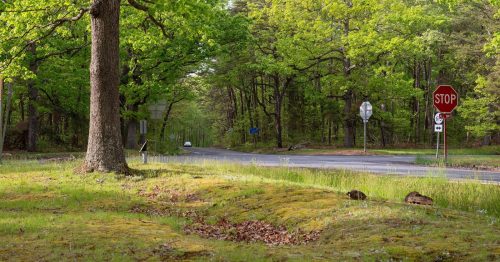
“They came to a crossroads in the track out of the eastern reaches of The Wilderness. If they turned left it would mean they were heading north. If they turned right — south. And from their throats burst a tremendous shout of exultation. It was in the darkness and dust that they had what they later remembered as a rebirth of themselves as men and as an army. Through their ranks came Ulysses S. Grant, and they shouted for him and waved their hats in the air for him.”
— Gene Smith, “Lee and Grant” (p. 201)
While I have no idea why Virginia 250 is sputtering, I am absolutely shocked to see that Virginia isn’t doing anything cohesive to celebrate and promote the founding of America.
Not to put too fine a point on it, but America is a Virginian idea, created by Virginians, bled for by Virginians, where Virginia conceded her western claims which entitled her to be a nation unto herself, where Virginians — Jefferson among them, but George Mason and George Wythe as well — articulated the reasons for the separation with Great Britain, where the American War for Independence resolved itself at Yorktown, where Virginians led by James Madison forged the U.S. Constitution, and where the Virginia Dynasty from Washington through Monroe led the early republic for 32 of its first 36 years.
What is little disputed is that the two bonds that kept the United States together were the words Liberty and Union — “Liberty and Union, Now and Forever, One and Inseparable!” was Senator Daniel Webster’s reply to South Carolina’s John Calhoun when the prospect of nullification, an idea floated by Jefferson and Madison in the Virginia and Kentucky Resolves, hovered around the debate between states’ rights and the scope of the federal government. President Andrew Jackson threatened to call up the troops and South Carolina submitted to the Union, for a time.
That time would end in rupture by December 1860 when South Carolina — too small to be a republic, too large to be an insane asylum — finally cast its die for secession. Virginia at first refused to join the slaveholding states, but when Lincoln called up 90,000 troops to put down the rebellion, Virginia joined the ranks of the Confederacy and with it went her leadership class — most notable among them General Robert E. Lee.
For two years, Lee would thwart a series of Union generals: McClellan, Pope, McClellan again, Burnside, Hooker, Meade all unable to wield the Army of the Potomac as a force against Richmond. Yet in the west, an unemployed store clerk by the name of Ulysses S. Grant scored victory after victory. Gettysburg is often thought of as the turning point of the Civil War; Vicksburg thought the more strategic victory than Gettysburg.
Yet it was the Battle of the Wilderness in 1864 which proved to be the real turning point after the Army of Northern Virginia once again smashed Union soldiers in the thickets and undergrowth around Spotswood and Catherine Furnace. Abandoning his reputation as a defensive strategist, Longstreet nearly replicated Stonewall Jackson’s feats at Chancellorsville a year before, only to nearly meet the same demise as Confederate soldiers confused Longstreet for Federal cavalry, shooting him in the neck and nearly costing him his life.
The early morning of May 7th saw the Army of the Potomac with its back against the Rappahannock, unable to deploy its artillery, having sat the night listening to the woods burn the bodies of the dead amidst the screams of the wounded. McCellan would have retreated. Hooker would have retreated. With his communication lines to Washington cut, with the Army of the Potomac suffering 15,000 casualties in just two day, Grant issued the following orders to General Meade:
May 7, 1864, 6.30 A.M.
MAJOR-GENERAL MEADE, Commanding A. P.
Make all preparations during the day for a night march to take position at Spottsylvania C. H. with one army corps, at Todd’s Tavern with one, and another near the intersection of the Piney Branch and Spottsylvania road with the road from Alsop’s to Old Court House. (excerpt)
The Army of the Potomac was marched down Brock Road to the intersection with the Old Plank Road. Which way? The troops wondered as they got closer and closer.
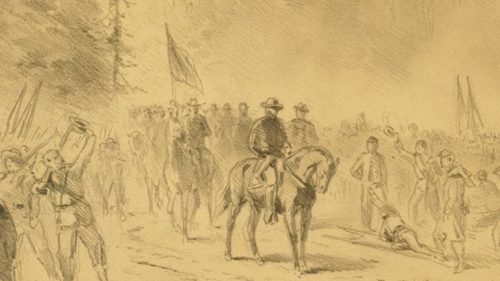
Grant instead turned his army south towards Spotsylvania Courthouse. The Yankee troops — used to sacrifice followed by retreat — erupted in cheers.
If Grant had turned north, the story of America might have been very different. Yet that morning of May 7th, 1864 was the morning where Grant chose to “fight it out on this line if it takes all summer” and pursue a different kind of warfare — not the set piece Napoleonic warfare of the past, but the grinding and methodical trench warfare presaging the First World War.
Because Grant turned south, the pressures on the Army of Northern Virginia prevented the Confederacy from reinforcing Atlanta. With Sherman’s victory, not only was the Confederacy doomed but Lincoln was redeemed against his Democratic challenger and one-time war chief — none other than General George McClellan.
Lincoln would go on to win in a landslide in a victory. Yet that victory and the enormous political capital it gave him was just barely enough to get the 13th Amendment to the U.S. Constitution through Congress, ultimately abolishing slavery as the states ratified the amendment in December 1865 after Lincoln’s assassination.
All of that could have changed if Grant turned left.
Instead, Grant commitment to prosecuting the war was the fulfillment of the promise Daniel Webster so succinctly argued — Liberty and Union — in a war not fought to preserve slavery but ostensibly to liberate an entire race of human beings and in preservation of the Union which Virginia gave to America.
In many ways, America has not fulfilled the promise of Jefferson’s document. In many other ways, no other nation in history has done more to spread the idea of liberty across the world.
We should all be sad to see that no one at Virginia 250 had the vision or the narrative to lead Virginia Tourism on a narrative that began in May with the Wilderness Campaign through Fredericksburg and Richmond, took us through June to Petersburg, and ended in July at Williamsburg. The public narrative that Virginia history is not a perfect one, but nowhere on the globe has the public contract “to form a more perfect Union” — not a perfect one, but a better one — played out on such a stage as our own. We did more to celebrate Jamestown and the 400th anniversary of Virginia. This is worth an investment of the public trust precisely because these are the things that make us all Virginians.
Not lost opportunity, but lost vision.
Here’s hoping you are celebrating America’s 250th birthday. Even if and perhaps even in spite of our so-called leaders who seem to have forgotten what makes Virginians and our history so special indeed.
SHAUN KENNEY is the senior editor for The Republican Standard. This column has been republished with permission from The Republican Standard.
Leave a Reply
You must be logged in to post a comment.