State Money for Private Schools

by Dick Hall-Sizemore
University of Richmond

The state of Virginia spends more than $100 million annually for Virginia students to attend private colleges and universities in the state.

The program is the Tuition Assistance Grant program, commonly known as TAG, authorized in Sec. 23.1-628 through 23.1-635 of the Code of Virginia. There is no need or merit requirement. The student only needs to be a Virginia resident attending a Virginia accredited, private, nonprofit school. The program is available to undergraduate and graduate students.

The amount available per student is set out in the Appropriation Act. For the current biennium, the basic annual grant is $5,125 the first year and $5,250 the second year. The amount for graduate and medical students is $5,000 for both the first year and second year. Totally on-line students receive half of those amounts; students attending a Historically Black College and University can receive $7,500 annually.

The school that received the most, by far, was Liberty University, with $11.5 million distributed in the fall of 2024. Next was Virginia Union University in Richmond, at $5.7 million, followed by Shenandoah University in Winchester, with $4.2 million. The full list, provided by the State Council of Higher Education for Virginia, which administers the program, can be found here.

My Soapbox

The existence of this program raises some questions. First, what is the justification for it? The program was first authorized in 1972. A few years after that I heard a legislator explaining that it saved the state money because it would cost the state more if those students went to state higher- ed institutions rather than private schools. There is some evidence that was at least part of the reason for the program’s authorization. There is language in the statutes prohibiting the amount of a grant from exceeding the average amount of general fund appropriation for students in Virginia higher-ed institutions.

However justified the TAG program was when it was initiated, the situation is much different now. Then there was a growing demand for college admissions. Now, there are Virginia colleges and universities for which applications and admissions are declining. Does it make sense for the Commonwealth to be providing over $100 million a year for students to attend private colleges and universities when there are public higher-ed institutions that are struggling financially due to declining enrollments?

Another question is one of equity. Why should state taxpayers subsidize parents who can afford to send their kids to schools such as Washington and Lee University and the University of Richmond, both of which cost more than $80,000 annually (before financial aid is considered)?

For those participants of this blog who complain generally that state employees are unresponsive and don’t care about doing a good job, I submit, as an example of how most state employees do their job, the staff person at SCHEV who responded to my request for data on the TAG program. (I am not using his name because I have not asked permission to use it.) I sent my email request on Sunday, Jan. 5. I got a response today, Jan. 9. Just before 5:00 this afternoon, I sent another email asking for some clarification. He responded at 6:35 p.m.


ADVERTISEMENT

(comments below)


Comments


Comments

6 responses to “State Money for Private Schools”

  1. Stephen Haner Avatar
    Stephen Haner

    Another question. Given this established program, and its bipartisan popularity, what is the issue with similar grants to K-12 students who choose a private school? Could that be the reason you are now questioning TAG? ๐Ÿ™‚

  2. Eric the half a troll Avatar
    Eric the half a troll

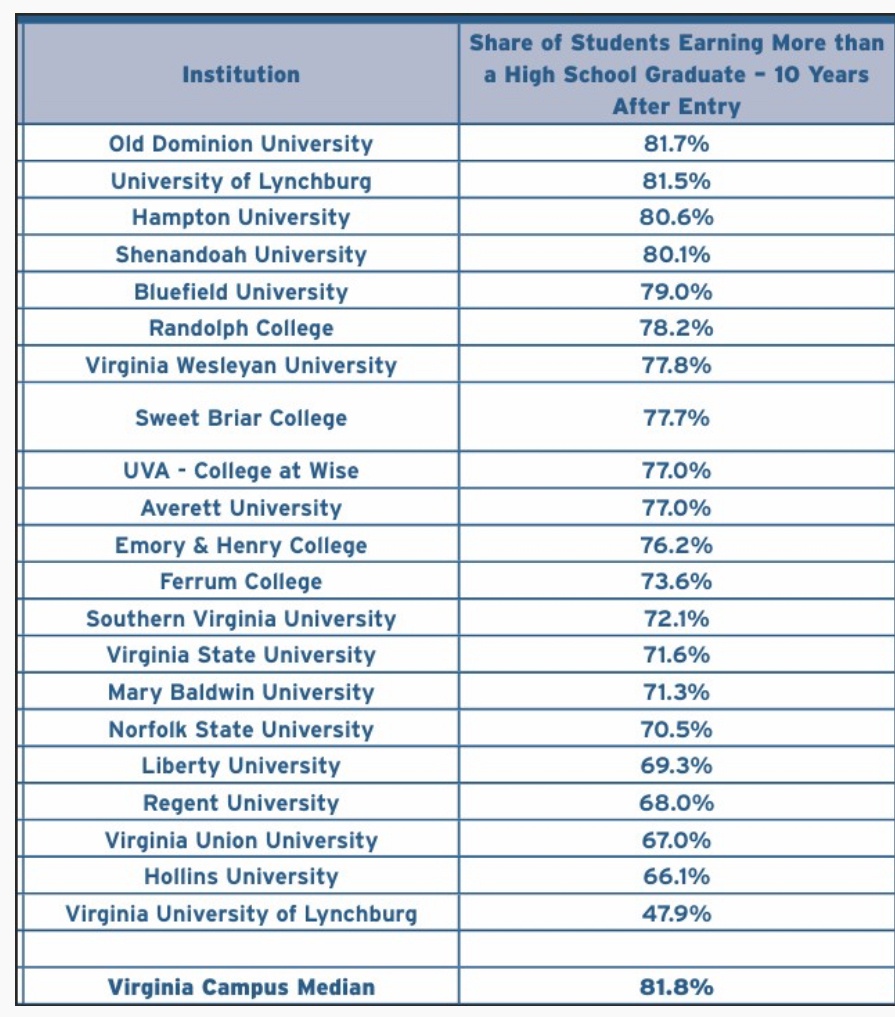
    โ€œThe school that received the most, by far, was Liberty University, with $11.5 million distributed in the fall of 2024โ€

    Boy, JAB didnโ€™t even mention LU when he cited the ODU study on graduate earnings vs high school graduateโ€ฆ but they are certainly not soaring (relative to their peers)โ€ฆ is Liberty over producing elitesโ€ฆ?

    https://uploads.disquscdn.com/images/1b685afd1e589905150249973d2d36de586190fe3d5d0ba72677af95c21c7d5b.jpg

    I am sure JAB will put out a piece soon questioning the value of our tax dollar investment in the institution. He did end his piece with this paragraph: https://www.baconsrebellion.com/crunching-the-numbers-on-elite-overproduction/
    โ€œBut Virginia (and other states) donโ€™t invest billions of dollars in their public systems of higher education so students can engage in four years of partying, finding themselves, or appreciating other cultures. They invest billions of dollars (1) to equip citizens with the skills to thrive in the increasingly knowledge-based economy, and (2) to provide a ladder of social mobility for the poor and minoritiesโ€

  3. Eric the half a troll Avatar
    Eric the half a troll

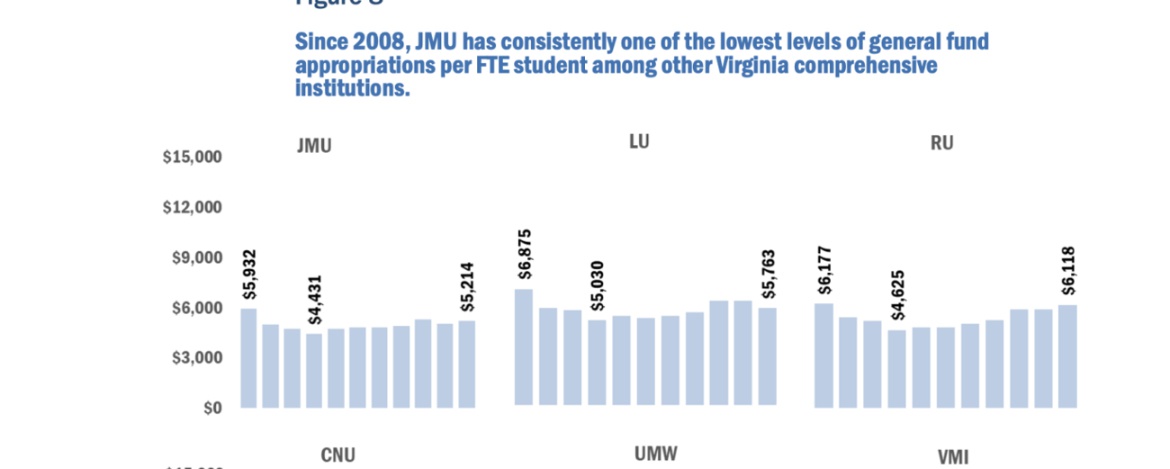
    Found this table for JMU which compares its state funding levels to LUโ€ฆ bottom line is that we are funding private universities at the same level that we are funding public universities through tax dollars but these universities are in no way answerable to the publicโ€ฆ I am sure Conservatives are just fine either way thisโ€ฆ

    https://uploads.disquscdn.com/images/e56484f796f3b551b2f83dc03067660f4be684e713b4c5bbf6f26ca02b94d15a.jpg

  4. LarrytheG Avatar

    re: " Does it make sense for the Commonwealth to be providing over $100 million a year for students to attend private colleges and universities when there are public higher-ed institutions that are struggling financially due to declining enrollments?

    Another question is one of equity. Why should state taxpayers subsidize parents who can afford to send their kids to schools such as Washington and Lee University and the University of Richmond, both of which cost more than $80,000 annually (before financial aid is considered)?"

    Indeed.

    And my suspects are than any K-12 voucher program would work similarly.
    IOW, subsidies for those who can afford the total tuition and tough luck for
    those than cannot and thus can't afford to attend and won't get subsidies.

    Smacks of the k-12 "academy" era of Virginia.

  5. Dick raises good questions. Instead of subsidizing institutions (whether public or private) how about having the money follow the student?

    Why should students attending four-year colleges get bigger state subsidies than students attending two-year colleges?

    Why not give everyone attending a Virginia institution of higher-ed the same financial assistance?

  6. DJRippert Avatar

    "I sent my email request on Sunday, Jan. 5. I got a response today, Jan. 9."

    Wow! Only 4 workdays to answer an e-mail. Put whoever that was in for the same medal that Biden just gave Liz Chaney.

Leave a Reply


ADVERTISEMENT