
by James A. Bacon
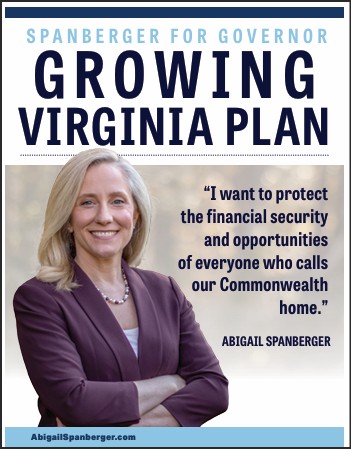
Abigail Spanberger, the Democratic candidate for governor, has released her “Growing Virginia Plan” for economic development. I’ll save you the trouble of reading it and boil it down for you: Do more of what Virginia is already doing.
The only new thought reflected in this compendium of business-as-usual practices is to denounce the “chaos in Washington” unleashed by the Trump administration’s tariffs and DOGE initiative. Translation: Whatever ails Virginia is Trump’s fault.
Otherwise, the “plan” does little more than restate the aims of existing state programs in workforce development, international trade and marketing. There is no analysis of Virginia’s economic challenges (other than taking note of Trump-generated chaos), no data, no goals, no vision, and nothing remotely original or fresh. As governor, it appears, Spanberger would consign economic development to the existing bureaucratic apparatus without changing a thing.
Unfortunately, the Republican challenger Winsome Earle-Sears, who has yet to issue her own plan, boggled the response. Her campaign issued a statement referred to Spanberger as “Spendberger” and likened her program to an “arsonist’s plan on fire safety.” While rhetorically colorful, the response ignored the “Growing Virginia Plan” in favor of attacking her track record as a congresswoman who supported inflationary Biden initiatives. Translation: Whatever ails Virginia is Spanberger’s and Biden’s fault.
What seems evident is that neither candidate has much new or useful to contribute about how to update Virginia’s economic development strategy in a globally competitive economy disrupted by revolutionary technologies. For all its limitations, the recently published vision for Northern Virginia just released by the Fairfax County Chamber of Commerce has something interesting to say. Most importantly, it addresses Artificial Intelligence and data centers. The Spanberger plan contains only one brief mention of AI and none of data centers.
There’s not one word in the “Virginia Growth Plan” about the cost and reliability of Virginia’s electricity as the state and nation undergo a $1 trillion build-out of energy-intensive AI infrastructure while simultaneously engineering a risky transition to a net-zero grid.
The Spanberger plan does talk about building a “competitive business climate” and making Virginia “America’s Top State for Business” after falling to the No. 4 slot in CNBC’s top states ranking. But the document provides no clue what Spanberger thinks Virginia needs to become more competitive. It certainly does not address how she would reconcile competitiveness with the endless demands of General Assembly Democrats for more spending, regulations and business mandates to further social justice and “equity.”
Essentially, “the Growing Virginia Plan” is a vague, platitude-laden, business-as-usual document that checks all the bureaucratic boxes and reassures Virginia’s version of the administrative state that it has nothing to fear from a Spanberger administration.
Here is a sampling.
Growing Virginia’s workforce. Create more internships and apprenticeships. Let high school kids earn college credits. Encourage creation of high-school career academies. Develop a plan to prepare students by leveraging artificial intelligence and emerging technologies. Streamline workforce development initiatives. Address workforce shortages. Fight for legal protections for fired federal workers.
There’s a lot of planning, coordinating and collaborating here, but nothing new or substantive — other than “directing the full power of the Governor’s office to fight for all Virginians when it comes to Washington, D.C.”
Growing business investment. Bolster the Virginia Economic Development Authority’s marketing efforts. Strengthen the existing Virginia Business Ready Sites Program. Increase investments in utilities and infrastructure. Bolster federal-state-research-business partnerships. Work with businesses and localities to support small business. Boost tourism through existing programs. Streamline permitting processes.
Again, there’s a lot of planning, collaborating, partnering and program maintenance here, but not much else.
Growing trade opportunities. Continue investments in the Port of Virginia. Coordinate strategies for promoting forestry and agricultural products. Encourage coordination between agencies to promote small-business exports. Strengthen existing partnerships with trade partners. Increase participation in air shows to pitch Virginia to international defense companies. Fight unlawful actions by the federal government that hurts small business (without specifying what those actions are). And then this head scratcher:
Make Virginia a leader in the production of dual use technologies that serve both military and civilian purposes, thus diversifying our supply chain while responding to global threats around the world.
Huh? Could the plan mention at least one such technology… just to give us a hint of what they heck it is talking about?
In summary, other than fighting Trump and promoting “dual use technologies,” there is absolutely nothing new in the trade realm. Even the recommended “investments” aren’t new, just a promise to continue pumping money into existing programs.
If you really want to know how a Spanberger administration would impact economic growth in Virginia, review all the Democrat-sponsored bills vetoed by Governor Glenn Youngkin, tally up all the costs to taxpayers and business, and ask yourself which ones Spanberger would have signed.
Update. Those costs would be extensive. As Steve Haner rightfully chided me in the comments, I omitted a critical paragraph from the plan.
Reduce barriers to work and support the creation of quality jobs. Establish a statewide paid family and medical leave program, enforce Virginia’s prevailing wage laws, increase supply of and access to affordable
housing, utilize Project Labor Agreements for large state-funded projects, guarantee paid sick leave, raise the minimum wage to $15 per hour, and increase reliable access to affordable childcare.
The Plan is not a nothing burger at all. It would cost billions. It’s classic tax and spend. “SpendOtherPeoplesMoneyberger” might be a bit of a mouthful. But “Spendberger” would fit just fine.
Leave a Reply
You must be logged in to post a comment.