
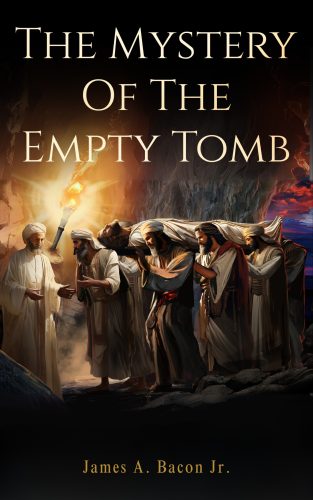
by James A. Bacon
Easter, the holiest day of the Christian calendar, marks the resurrection of Jesus Christ. The historic underpinnings of Christian doctrine have long fascinated me, and I have spent many years of amateur study of Jesus’ life and times in an effort to achieve a greater understanding of this seminal moment in human history.
The result is my new novel, The Mystery of the Empty Tomb, which tells the story of Jesus’ entry into Jerusalem in the year 33 C.E. (Common Era), his arrest by the temple priests, his trial and crucifixion by Pontius Pilate, his burial, and the disappearance of his body from the tomb. The story is narrated by Nicolaus, a Greek by culture, native of Caesarea, and aide to Pilate. Grave robbery was endemic in the ancient world and the purloining of corpses was forbidden by imperial decree, so Roman authorities would have immediately assumed that the body had been stolen. The conceit of the novel is that Pilate puts Nicolaus in charge of identifying the culprits and tracking them down.
Nicolaus’ investigations take him from the palace of Herod the Great to the Temple of Jerusalem (the greatest of the ancient world), into the mansions of the high priests, through the streets and marketplaces of Jerusalem, and to the cities and villages of Galilee and Samaria. Through Nicolaus, the reader learns about the power struggle between Pilate and the priests, the rivalries between Sadducees and Pharisees (and among factions of Pharisees), the ethnic tensions between Jews, Greeks and Samaritans, and the revolutionary aspirations of the anti-Roman zealots. As Nicolaus probes deeper into the sects and doctrines of the Jews, he introduces readers to the mysteries of throne mysticism and arcane practices of sorcery.
The scholarly literature devoted to the historical Jesus is vast. No other historical figure has inspired so much research. There is an abundance of source material to draw from — the Gospels, the works of the Jewish historian Flavius Josephus, early Christian writings, an abundance of archeological evidence, and an extensive corpus of Jewish writings such as those found in the Qumran archive. Yet many questions remain, leaving wide latitude for interpretation.
As the German scholar Albert Schweitzer observed more than a century ago, each generation reinterprets the historical Jesus in light of its own convictions and prejudices. Nothing has changed. While Schweitzer concluded that Jesus was essentially the man described in the Gospels — a Jew who called for his fellow Jews to prepare for the imminent coming of God’s kingdom on earth — many contemporary scholars regard him in almost secular terms: as a pacifist social reformer or a revolutionary bent upon overthrowing Roman colonial domination.
I’m firmly in Schweitzer’s camp: Jesus preached the imminent coming of the end of times and exhorted Jews to prepare for the miraculous transformation of society in accordance with God’s laws. Many of his fellow Jews saw him as the long-awaited messiah. In God’s kingdom, justice would be restored, the wealthy and powerful laid low, and the poor and dispossessed made whole.
But there’s soooo much more to the Jesus story.
It has been a dominant trope of New Testament/Second Temple historiography in the post-World War II era to view Jesus as a Jew whose views and actions fell within the mainstream of the Judaism of his time. I embrace that interpretation. I see Jesus not only as a Jew, but a Galilean Jew who shared the Galileans’ ambivalence toward the temple cult in Jerusalem. Similarly, I insist, the trial and crucifixion of Jesus can be understood only in the context of the power politics of the era.
Contrary to a Christian calumny common in the Middle Ages that has persisted into modern times, Jesus was not crucified by “the Jews.” He was not even slain at the behest of the “temple priests.” In my interpretation, as seen through the eyes of Nicolaus, Jesus antagonized a particular faction of the priests associated with the House of Annas. The Roman prefect Pilate, in my interpretation, had his own disagreements with the high priest Caiaphas and his father-in-law Annas and used Jesus as a foil to frustrate them until it was no longer convenient to do so.
I also differ from mainstream scholarship by viewing Jesus as a mystic: a practitioner of the merkabah, a secret discipline in which practitioners entered into trances and, by using words and names of power, thought themselves to be ascending through the seven layers of heaven and looking upon the chariot-throne of God. I don’t claim originality here. I have drawn from scholars who have highlighted this side of Jesus, but it is a perspective that is rarely emphasized in New Testament scholarship, yet I view as essential to understanding Jesus.
Nicolaus’ solution to the question of how Jesus’ body came to be removed from the tomb is mine alone. Nicolaus’ findings are consistent with neglected passages in the Gospels and details found in obscure early-Christian works known as the Clementine Recognitions and Clementine Homilies. The details in the novel are entirely fictional, of course, and even the broader theory is ultimately unprovable. But the solution to the empty tomb is eminently plausible and, I truly believe, as close to historical reality as we are ever likely to get.
My hope is that, agree or disagree with Nicolaus’ (and my) conclusions, readers will find the tour through the lands of the 1st-century Jews to be educational and a jolly good read. When you put down the book, you will walk away with a greater appreciation for what is arguably the most fascinating period of human history.
You can read more about the historical Jesus at my website, www.mysteryoftheemptytomb.com where I have republished book reviews and interviews with historical-Jesus scholars from my old website, The Jesus Archive.
You can purchase The Mystery of the Empty Tomb on Amazon.com.
A request to Bacon’s Rebellion readers
I am self-publishing this book, and I’m counting on Bacon’s Rebellion readers to make it successful. You can help not only by purchasing a copy (available both in paperback and Kindle-reader format) but by leaving reviews on Amazon.com. Once I have enough views (hopefully positive) I will be in a position to promote the book through advertising. Until I get 15 to 25 views, there is no point in advertising; Amazon’s algorithms will not treat me kindly.
Leave a Reply
You must be logged in to post a comment.