
by Dick Hall-Sizemore
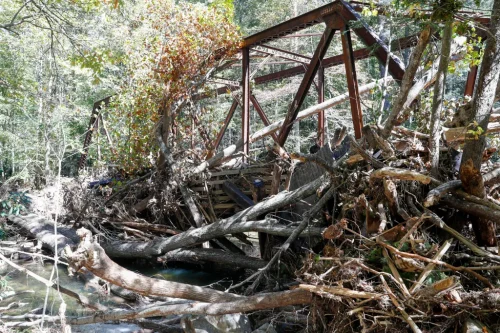
Photo Credit: Cardinal News
Earlier this year, I had an article in Bacon’s Rebellion discussing the concerns of U.S. Senator Mark Warner about a possible hold-up of federal disaster funds meant for the repair of the damage to the Virginia Creeper Trail caused by Hurricane Helene. Several readers expressed their consternation, and rightly so, at the cost estimate of $660 million for the trail’s repair.
It is a lot of money and seems an unreasonable amount to repair a walking trail, even if those repairs include replacing numerous trestles and relocating the trail in some areas. It was with some chagrin that I had to admit that I had not focused on the cost. Subsequently, I decided to find out the basis for that cost estimate.
It has sometimes been a frustrating search but a fascinating one overall. Before going any further, some background might be helpful.
Virginia Creeper Trail background
The Virginia Creeper Trail is an example of the “Rail to Trail” movement in which abandoned railroad rights-of-way have been converted to trails—walking, biking, horseback riding, etc. The right-of-way was originally purchased and cleared in the 1880’s by a company hoping to build a rail line to haul iron ore out of the mountains east of Abingdon. That effort was abandoned.
The right-of-way passed among several entities until Norfolk and Western Railroad acquired it. The company carried passengers and freight for many years until it finally abandoned the line in 1977. With major assistance from the U.S. Forest Service, a determined group of civic leaders, backed by numerous volunteers, managed to cobble together funding from numerous sources and acquire the right-of-way and build the trail. It opened in 1989. (For a more detailed history, see here.)
Today the trail is 34 miles long and connects the upper part of Virginia’s second highest mountain, White Top (next to Mt. Rogers) to Abingdon. It is maintained by a public-private partnership including the Forest Service, the towns of Abingdon and Damascus, and a volunteer organization, the “Creeper Keepers.”
Hurricane Helene
In September 2024, the flooding caused by the intense rainfall of Hurricane Helene significantly damaged that portion of the Virginia Creeper Trail running from White Top Mountain to Damascus. Thirty-one trestles were either destroyed or severely damaged. Portions of the trail were washed out entirely.
A legitimate question would be why so much attention is being focused on a hiking trail. Governor Youngkin emphasized the importance of the trail in his letter to President Biden seeking additional assistance to address the damage caused by the hurricane. Regarding the Virginia Creeper Trail, he told the President:
One vital priority…is the Virginia Creeper Trail—a celebrated tourism asset and key driver of economic stability for the region. While local sections of the trail have reopened, the U.S. Forest Service-managed portion remains closed due to extensive damage, including the destruction of multiple trestles. The continued closure of this 17-mile section threatens the economic vitality of Southwest Virginia, as tourism and related businesses depend on the trail’s accessibility. Recognizing the Creeper Trail serves as the economic engine for numerous communities in the region, the U.S. Department of Agriculture has included a specific funding request with the interest of expediting the return of this critical regional asset. We strongly support adequate and immediate funding to ensure that this occurs in the most expedited manner possible.
In December 2024, President Biden signed the American Relief Act, 2025, passed overwhelmingly by Congress. The provision of that legislation relevant to this article was a supplemental appropriation of $100 billion to provide recovery assistance from various natural disasters. Out of that total, the U.S. Forest Service was allocated $1.2 billion to deal with the damage created by Hurricane Helene in Virginia.
The repair cost
Several media outlets, including Cardinal News, put a price tag of $660 million on the repair and rebuilding of the Virginia Creeper Trail. Asked the source of that number, they said they got it from U.S. Senators Warner and Kaine.
Sure enough, the two Virginia Senators issued a joint press release on the day of the signing of the American Relief Act, which included this statement: “The disaster supplemental provides full federal funding to rebuild the Virginia Creeper Trail, which is currently estimated to cost approximately $660 million.” Asked where they got that number, the staffs of the Senators said their source was the U.S. Forest Service and referred me to the Senate Appropriations Committee staff who had put together that section of the bill.
Several attempts to contact the relevant staff member of the Senate Appropriations Committee went unanswered. The staff from Warner’s and Kaine’s office did not respond to a request for “any documentation of this estimate [$660 million] from the Forest Service” that it might have.
The Forest Service was somewhat more helpful. Asked about the cost of repairing the Virginia Creeper Trail, a public affairs officer for the George Washington and Jefferson National Forests responded on March 18, “The repair costs have yet to be determined.” Pressed on data on the allocations for that region or for the trail itself, the Forest Service provided only the $1.2 billion allocation for Virginia.
The most plausible explanation was offered by Robert Ward, Governor Glenn Youngkin’s Chief Information Officer. In an interview, he explained that the $660 million referred to the total amount allocated to the Forest Service for the George Washington and Jefferson National Forests, which would include the cost of repairing the Virginia Creeper Trail.
Of course, that explanation is significantly different from the statement by Warner and Kaine. Also, in preparing for, and allocating, large sums of money, normally, a lot of estimates for individual projects are used to come up with a grand total. Finally, in his letter to Biden, Youngkin referred to a “specific funding request” for the trail that had been submitted by the U.S. Dept. of Agriculture, which is the parent agency of the Forest Service. However, the Forest Service could not or would not answer my questions regarding how much of the total amount allocated to Virginia was for those national forests or a projected cost of repairing the Virginia Creeper Trail.
Despite the reluctance of the Forest Service to address my questions, an agency representative recently confirmed Ward’s hypothesis. In late March, representatives of the Forest Service told Cardinal News that “the $660 million approved was not just for the trail; it will also cover watershed and forest restorations.” They estimated $200 to $300 million for trail repairs.
In summary, the Forest Service does not know yet how much it will cost to repair the Virginia Creeper Trail. It has a working estimate of $200 million to $300 million. As for that $660 million figure, its source is still a mystery. If the Forest Service included it in its initial estimates that it provided Congress for the preparation of what became the American Relief Act 2025, those who would know aren’t talking.
My Soapbox
The Virginia Dept. of Emergency Management (VDEM) is normally the lead agency for responding to natural disasters. However, last fall Gov. Youngkin issued an executive directive establishing the Office of Hurricane Helene Recovery and Rebuilding within the Office of the Governor. The function of the new office was “to advise on efforts to coordinate and lead recovery and rebuilding efforts in areas affected by Hurricane Helene.” Separately, the Governor designated the Chief Information Officer as the head of this new office.
During my research for this article, Robert Ward, the Chief Transformation Officer, was very responsive to my inquiries and follow-up questions, I am happy to report. We had several phone conversations while he was on the road in late February in Southwest Virginia touring areas hit by recent floods.
He explained that the new “office” established by the governor consisted mainly of him. It was not the intent that this new entity within the Office of the Governor would take over any of the functions or role of VDEM. VDEM would still remain as the agency chiefly responsible for responding to natural disasters and emergencies and would be the primary liaison with the Federal Emergency Management Agency (FEMA). The role of the office, Ward said, would be to help localities work with all the other federal agencies that would be involved in providing grants and funding to localities in recovering from natural disasters, such as Housing and Urban Development, Small Business Administration, etc.
While preparing this article, I sometimes felt as if I were working in parallel universes. In one universe, the Trump administration and DOGE are freezing grant funds, eliminating programs, and making plans for large cuts to federal spending, which Gov. Glenn Youngkin calls “necessary changes that are being made in Washington to restore fiscal discipline to America.” Also in that universe, U.S Rep. Ben Cline (R-Va. 6th District), who also chairs the Republican Study Committee’s Budget and Spending Taskforce, issues a press release decrying the federal debt and proposing a plan that would balance the federal budget in seven years by cutting federal spending by $16.3 trillion over ten years.
In the other universe, Gov. Youngkin asks President Biden for $4.4 billion in federal funding to help Virginia recover from the damages caused by Hurricane Helene. Also in that universe, the governor’s Chief Transformation Officer talks optimistically about helping localities find and qualify for federal grants to help them recover from Hurricane Helene.
Actually, that second universe has recently learned the realities of the first universe. Generally, federal disaster assistance is provided on a reimbursement basis. State and local governments submit their expenses to FEMA, which then reimburses the federal share. As reported by Cardinal News, VDEM recently notified local governments that FEMA was subjecting disaster claims to additional reviews. In effect, the reimbursements have been held up. Somewhat ominously, VDEM said, “Unfortunately, at this time, we do not have an update as to when and if these funds will be made available.” [Emphasis added.]
Gov. Youngkin probably shares the same sentiments that his fellow Republican, Sen. Thom Tillis of North Carolina expressed. Referring to reports that the Trump administration was considering large cuts to FEMA, Tillis declared, “If it’s with an eye towards more efficiency and resiliency, great. If it’s an eye towards cutting funding to western North Carolina, not great.”
Leave a Reply
You must be logged in to post a comment.