
by Donald Smith
Summertime in Washington, D.C., is NDAA Time. NDAA, as in the National Defense Authorization Act. The federal government dispensed with proper budget procedures a long time ago. Everything it does is now funded by continuing resolutions, omnibus bills, or other confounding mechanisms. The NDAA, though, always passes because it funds the Defense Department. Hence, crafty politicians attach anything and everything to some spot deep in the depths of the NDAA language. They know it’s a sure-fire way to get controversial matters enacted, often without most Americans knowing about it.
Congress created the Naming Commission through the Fiscal Year 2021 NDAA. Earlier this month, Democrat members of the House of Representatives responded to President Trump’s recent re-re-naming of Army bases by inserting an amendment into the FY 2026 NDAA. From Roll Call, on July 17th:
The Trump administration has undone a 2022 congressionally chartered commission’s renaming of military bases and ships that had for years celebrated the Confederacy, but as of this week both the House and Senate are poised to consider at least a partial reversal of President Donald Trump’s moves.
The House fiscal 2026 NDAA contains an amendment by Rep. Marilyn Strickland, D-Wash., that would ensure all the formerly Confederate-linked facilities, assets and streets across the U.S. military are renamed along the lines proposed by the 2022 commission to honor other warriors or certain values.
OK, then. If this is NDAA amendment season, then here’s another amendment Congress can enact: return Confederate battle streamers to Army National Guard unit colors.
The change of command or responsibility is a simple yet traditional event that is rich with symbolism and heritage. The key to the ceremony is the passing of the colors. The very soul of a military unit is symbolized in the colors under which it fights, for they represent not only the lineage and honors of the unit, but also the loyalty and unity of its soldiers.
That text comes from the standard script Army units use when they conduct a change of command (for officers) or responsibility (for sergeants major). A new commander or sergeant major takes charge of a unit when they are handed the unit’s colors — its flag.
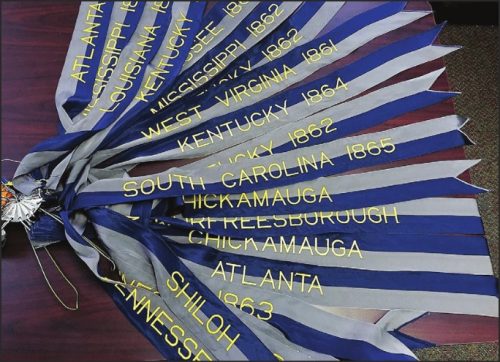
If you look at U.S. Army unit colors, you will see multi-colored streamers hanging from them. These are “battle streamers” or “campaign streamers.” They symbolize past battles or campaigns where members of the units fought or performed honorably.
For decades, the U.S. Army allowed Army National Guard units that were descended from former Confederate units to display battle streamers the unit won while in Confederate service. At about the same time, the Army began naming its helicopters for Native American tribes who, in the past, had fought United States troops. The Comanche, the Sioux, the Mohawk, and the Kiowa all used to be Army aircraft. (The Apache and the Blackhawk still are.)
No one with a lick of common sense thinks that the United States Army allowed Confederate battle streamers on unit colors because it condoned slavery, or that it named helicopters after Native American tribes because it approved of those tribes killing settlers (white, black and Hispanic), taking women and children captive and torturing captives to death. The Army recognized that its modern-day legacy stems from the heritage of men and women who fought both for and against the Stars and Stripes. The descendants of British Loyalist colonials, Confederate soldiers and Native American warriors have all helped make the modern American military what it is today. For example, the grandsons of Navajo warriors who fought the U.S. cavalry became the Navajo Code Talkers who helped the Marines achieve victory in the Pacific in World War II. E plurubus Unum. Out of many, one.
The Naming Commission members apparently didn’t agree. They recommended — in big capital letters! — that Confederate battle streamers be removed. The streamers were removed in September of 2023. Twelve Virginia Army National Guard units lost a total of 135 battle streamers. That is a lot of valor by past Virginians to simply toss into a storage closet.
The early 2020s were a time of national turmoil. COVID, the George Floyd tragedy, etc… That turmoil has passed. Congress now has a chance to review the actions it took during that turmoil and remedy those actions that deserve to be remedied. This is one of those actions.
Restoring the Confederate battle streamers is one of the easiest things Congress can do to address what many Americans see as a gross overreach by Congress, and its careless, even reckless handling of American heritage. Glenn Reynolds, the popular “Instapundit” blogger, was so disturbed by the removal of the Reconciliation Memorial from Arlington National Cemetery, that he asked aloud if Congress had chosen to play “Civilizational Jenga.” “Bit by bit,” Reynolds wrote, “our ruling class is eliminating our societal safety margins.”
It would cost virtually nothing. Simply mail the streamers back to the unit headquarters. (I will personally pay reasonable postage fees, if need be). The Confederate streamers will blend in with all the other streamers Army units have won in other American wars. People who are triggered by the sight of Confederate streamers would either have to go to the unit headquarters to see them or use binoculars to look for them as a unit’s colors pass by during a parade.
Congress should remedy its error. The Naming Commission is ultimately not to blame. It only made recommendations. It was Congress who allowed those recommendations to be turned into actions. Hence, it created this problem. Now it has the opportunity and duty to fix it — or give a compelling explanation why it cannot, or will not, fix it. Thousands of United States military veterans who are descended from former Confederates, and their families and communities, have earned, and deserve, a full explanation and justification from their elected representatives for what Congress allowed the Naming Commission to do.
This tradition goes back to the founding of our country. In the Declaration of Independence, the Founders detailed the grievances that King George and the British Empire had inflicted on the colonies, grievances that impelled the colonies to seek independence. Shivering Continental infantrymen at Valley Forge didn’t just take orders from Baron Von Steuben because he was a Prussian general. They demanded to know the reasons behind his orders. Congress must respect this tradition. It needs to fix the problems it created with the Naming Commission or explain to us why it won’t fix them—and own that explanation.
Donald Smith was raised in Richmond. His mother was born in a house not far from VMI, and family members still live there.
Leave a Reply
You must be logged in to post a comment.