• A Purge Victim Speaks

    by James A. Bacon

    Stanley Goldfarb

    One victim of the Democrats’ winnowing of Governor Glenn Youngkin’s appointments to state boards and commissions this year was Stanley Goldfarb. The General Assembly nixed 13 appointees in all — an unprecedented number in modern Virginia history, I believe. Most, like Goldfarb, were outspoken conservatives who had demonstrated a willingness to speak out against the “progressive” project in Virginia higher-ed.

    Youngkin’s other appointees have kept a low profile for fear of triggering retaliation of exactly the sort that occurred this year. But not Goldfarb. He paid the price for his views. But he was not silenced. He let it all hang out in a column published this morning in the Wall Street Journal.

    Youngkin appointed Goldfarb, the founder of the Do No Harm medical organization that combats wokery in the medical field, to the Board of Visitors of Old Dominion University in June. A former associate dean of curriculum of the University of Pennsylvania School of Medicine, he brought impressive credentials to the task. He took his job as board member seriously. And he ran into a brick wall.

    The story he tells is shocking. Having observed similar treatment of activist board members at the University of Virginia, though, I don’t find it surprising. When it comes to conservative reformers, ODU’s leadership, like those of many other public Virginia universities, adheres to the mushroom school of management: Keep ’em in the dark, and feed ’em… you know what.

    Goldfarb was naive enough to think that he might have something to offer ODU, which had recently absorbed the Eastern Virginia School of Medicine (EVMS) and had no institutional experience managing a medical school. He was particularly interested in understanding how the Diversity, Equity & Inclusion ideology had permeated the institution.

    He never got the chance.

    (more…)


  • CVOW One of Four Wind Projects Not Frozen By Trump. Yet.

    by Steve Haner

    Dominion Energy Virginiaโ€™s current offshore wind construction project is one of only four still in the process of building towers and turbines in the wake of an executive order from President Donald Trump.ย  It is also the largest of the survivors, with more planned power output than the other three combined.

    Coastal Virginia Offshore Wind (CVOW) will include 176 turbines and several offshore substations, with a nameplate value of 2,600 megawatts. The other projects still underway at this time are Vineyard Wind 1 off Massachusetts (806 MW), Revolution Wind serving Rhode Island and Connecticut (704 MW) and Sunrise Wind, a New York project with 924 MW.

    Vineyard Windโ€™s construction was interrupted last summer by a defective 351-foot turbine blade that shattered and scattered debris far and wide. Now it is dealing with the revelation that more than 60 additional blades from supplier GE Vernova have a similar flaw and will need to be replaced.ย 

    Dominion continues to report a smooth construction process but has announced a cost overrun of $900 million in recent days. Perhaps the thing to note is that Dominionโ€™s project is the only survivor under construction that has among its backers a sitting Republican governor. The other three are in deep blue states. It is also the only one to be owned directly by the utility (now with a non-controlling partner) and thus guaranteed by its captive ratepayers.

    (more…)


  • The Provost Search Is On

    by James A. Bacon

    Now comes the battle to replace the University of VIrginia’s provost Ian Baucom. The University has assembled a 14-person group to launch a national search, according to an announcement in the UVA house organ UVA Today.

    Ian Baucom

    The announcement attributed the appointments vaguely to “the University of Virginia,” without identifying specifically who made the selection. An educated guess is that President Jim Ryan picked the members of the search committee, perhaps in consultation with Rector Robert Hardie, his close ally on the Board of Visitors. But that is only an inference.

    The announcement gave no clue what criteria “the university” would use in seeking a successor. Baucom was Ryan’s right-hand man who executed his “great and good” agenda to transform UVA in line with social-justice and equity principles. It would surprise no one if Ryan wanted a chief academic officer who would sustain that legacy.

    The selection of the second most powerful administrator at UVA could be contentious, however. It is not in the least melodramatic to suggest that the future of UVA’ hangs in the balance.

    (more…)

  • A Tired Ryan Contemplates a Difficult Future

    UVA President Jim Ryan. Image credit WVIR-TV.

    by James A. Bacon

    When University of Virginia President Jim Ryan appeared in a WVIR-TV interview in late January, he seemed fatigued. His brow was deeply furrowed and his face, already lean from marathon training, wore an expression of perpetual worry.

    The last few months have been the most trying time in Ryan’s six-and-a-half-year tenure. After enjoying tremendous initial success in implementing his priorities at UVA, he is now mired in endless controversies which threaten to unravel his legacy.

    In his early years under Democratic governors and a friendly Board of Visitors, Ryan advanced a sweeping “great and good” overhaul of the University based on the principles of social justice and equity: publication of the Racial Equity Task Force report, renaming of the Alderman Library, removal of the George Rogers Clarke statue, erection of a monument to enslaved laborers, expansion of a Diversity, Equity & Inclusion bureaucracy, imposition of DEI statements, steering tens of millions of dollars toward the recruitment of minority students, grad students and faculty, the stacking of faculty with far-left professors, and much more.

    It all came easily. Ryan was popular with students and faculty, the Board was cooperative, alumni were somnambulent, and after the 2020 George Floyd protests, he was in sync with the national vibe.

    But the vibe has changed, and the past few months have been a strain.

    (more…)


  • A $29 Billion Virginia Battery Bonanza, Unanimous in VA Senate

    By Steve Haner

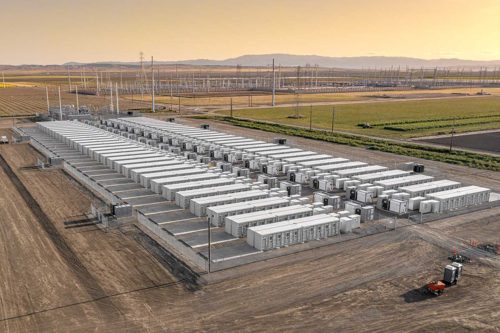
    A 137 megawatt battery storage facility in California. The pending legislation would mandate about 30 such plants in Virginia.

    Based on current pricing for the present-day energy storage projects, legislation pending at the Virginia General Assembly could cost ratepayers of the two largest electric utilities between $18 billion and $29 billion over the next 20 years.  

    That capital cost, based on the current $300,000 to $500,000 price per megawatt hour for the massive utility scale battery projects, may not include the financing costs that always accompany such large construction projects.  Both utilities would expect their standard annual profit margin on the investments, as well.  What regulators call the revenue requirement will dwarf the numbers mentioned above.  It is the revenue requirement that drives the cost on customer bills.

    And for all that money the utilities would not create a single electron of additional electricity.  The batteries envisioned simply store energy created by a real generation plant, releasing it to the grid when needed (such as when the sun is not producing solar electricity, or the wind has deserted the ocean turbines.)  The cost of producing the electricity they store is on top of the cost of the batteries themselves.

    The Senate version (Senate Bill 1394) of the legislation passed unanimously, but neither it nor the House version (House Bill 2537) are fully through the Assembly process.  There is time to face the reality of what this would cost.  No official fiscal impact statement of any kind has been produced by the State Corporation Commission or the Commission on Electric Utility Regulation.  That is because not one of 140 legislators has even asked. 

    In an earlier article discussing the battery storage mandates, the figure of $500,000 per megawatt hour (MWh) in capital costs was used and was promptly challenged by an anonymous renewable energy fan in the comment string.  That person is probably not aware of the cost of some smaller battery projects already approved by the Virginia State Corporation Commission, which make $500,000 per MWh look cheap.

    (more…)

  • Passing the Baton

    Image credit: Chat GPT

    by James A. Bacon

    I’m old enough to remember — waaaay back in the early 1980s — when Richmond was the dominant business center in Virginia. But as editor of the start-up Virginia Business magazine in 1986, it quickly became apparent that the mega-trend business story of the era was the extraordinary economic and demographic growth of metropolitan Washington. I recall publishing a magazine running a cover story describing Northern Virginia as “The Suburb that Ate Virginia.” By the late 1980s, it wasn’t even a contest. Northern Virginia had become the commonwealth’s growth driver.

    And so it has been ever since. Fortune 500 companies began moving to NoVa. The tech sector boomed. The population swelled. Household incomes soared. Northern Virginia, which once was thought to extend from Washington to the Occoquan, now in the public imagination reaches to the Rappahannock. Somehow, NoVa’s economic dynamism persisted despite the challenges of soaring housing prices, strained infrastructure, and arguably the worst traffic congestion in the country.

    For four decades, Virginia’s state capital was left eating NoVA’s dust.

    Then, suddenly, around the time of the Covid pandemic, something changed. Northern Virginia, once a massive magnet for domestic in-migration, became an exporter. The population continued to grow thanks to a steady influx of foreigners, but more “domestic” migrants (people moving within the country) were leaving the region than arriving. Meanwhile, more domestic migrants were moving to the Richmond metropolitan area than ever.

    Citing the work of Hamilton Lombard, who runs the demographic research group at the University of Virginia’s Weldon Cooper Center, I’ve noted the sea change on this blog. Now the Richmond Times-Dispatch has taken belated notice that the baton of population and business growth has passed back to its hometown.

    In the past four years, Central Virginia has added more residents than any comparable period since the first census taken in 1790.

    (more…)

  • Interest-Rate Cap on Loans: Beware the Unintended Consequences

    Image credit: Chat GPT

    by James A. Bacon

    A bill capping financial loans to a maximum of 12% interest passed the state Senate Monday. If enacted into law, Virginia would go from having one of the most permissive caps among the 50 states to perhaps the most stringent. The measure could have a debilitating effect on lending to people with low credit ratings, effectively shutting them out of legal lending markets.

    The most astonishing thing about SB 1252, sponsored by Senator Lamont Bagby, D-Richmond, is that it passed with significant Republican support. Only six Republicans voted against it; the rest voted for it, along with all the Democrats. If the measure passes the House as well, I hope that Governor Glenn Youngkin, who as a successful businessman has a basic grasp of economics, will veto it.

    The usual justification for capping interest rates is that high rates on credit cards, consumer loans, consolidation loans and payday loans can trap people on a treadmill of indebtedness, with interest charges piling up faster than borrowers can pay them off. To be sure, this is a real problem, and I don’t pretend it isn’t. The question is whether the cure is worse than the illness.

    (more…)

  • Take That, TurboTax

    by Dick Hall-Sizemore

    Each year when I finish using TurboTax to prepare my tax returns, I file my federal tax return electronically. However, in order to file my state tax return electronically, I have to pay extra. I refuse on principle. I print off the completed state return, sign it, put it in an envelope, and mail it to the Virginia Dept. of Taxation.

    I do this because I am still peeved about the state capitulating to the private tax preparation industry 15 years ago.

    For several years, the Commonwealth had a perfectly good system that enabled most residents to prepare and electronically submit their state tax returns. That changed with the passage of HB 1349 in 2010. The effect of that bill was to prohibit the Dept. of Taxation from operating a free preparation and filing system, available to all residents, and instead operate the Virginia Free File program. The legislation directs the state to โ€œenter into a non-monetary agreement with companies in the electronic tax preparation and filing industry (the “Consortium for Virginia”) to work together to offer free, online tax return preparation and filing services to 70 percent of Virginia taxpayers with the lowest incomes.โ€ For anyone interested, the Tax Department has provided an excellent, detailed history of this legislation and its aftermath in its fiscal impact statement for HB 2264.

    (more…)

  • More Pathetic Excuses

    AI-generated image of an MS-13 gang member. Needs mommy and daddy to help answer question about immigration status. Welcoming communities should embrace his humanity. And he commits crimes at lower rates than the rest of society.

    by James A. Bacon

    Democrats in the General Assembly are killing Republican bills right and left. In one incident that drew my jaundiced attention this morning, the Senate Courts of Justice Committee voted yesterday to spike a Republican-sponsored bill that would make it easier to deport convicted violent felons. I almost feel guilty writing about this. Mocking the people speaking against the proposal is easier than losing socks in the laundry.

    State law requires law enforcement authorities to check the immigration status of adults convicted of violent crimes. But the law does not require the same for juveniles, creating a loophole for youthful lawbreakers who enter correctional facilities as juveniles but are not released until after they have aged into adulthood. Senator Tara Durant, R-Fredericksburg, submitted SB 1268 to require authorities to check the immigration status of juveniles as well, and to forward that information to U.S. Immigration Customs and Enforcement (ICE).

    Sophia Gregg with the American Civil Liberties Union of Virginia countered that juveniles should not be questioned about their immigration status without a guardian present. “There is no reason that we should treat children the same way we treat adults,โ€ย The Virginia Mercury reports her as saying.

    Sheila Herlihy of the Virginia Interfaith Center said the interrogation of immigrants conflicted, in the Mercury’s words, with the values of welcoming communities.

    Senator Jennifer Carroll Foy, D-Prince William, called the legislation โ€œunnecessary, duplicative, and a messaging bill,โ€ and said that it unfairly vilified immigrant communities.ย โ€œAt the end of the day, the studies and statistics show that immigrants who do commit crimes commit them at a lower rate than the people who are actually here lawfully.โ€

    I am not making this up.

    (Bacon rubs his hands gleefully.) OK, let’s get to work.

    (more…)

  • Dominion’s Wind Farm Price Jumps $900M

    Dominion’s offshore wind project.

    Dominion Energy Virginia has announced a $900 million increase in the capital costs of its Coastal Virginia Offshore Wind project, bringing the new projected total to $10.7 billion. The additional expense will be incurred on transmission interconnections needed to allow the power to move within the PJM regional electricity market.ย 

    The news came in a company press release Monday. The construction of the 176 turbines and related substations off Virginia Beach is still on budget, the company reported. The project is still set to be completed and operational in late 2026. From the release:

    New electric generation resources constructed within PJM, like CVOW, are assigned costs by PJM that are deemed necessary to effectively integrate these resources and ensure the reliability and stability of the electric grid. Higher network upgrade cost estimates by PJM reflect the significant increase in demand growth that require incremental generation and transmission resources across the system.ย 

    Because of an agreement made at the time of the State Corporation Commission approval of the application in late 2022, Dominion and its capital partner Stonepeak will absorb some of the additional cost and not charge it all to ratepayers. But ratepayers will see a slight increase in monthly bills at some point as a result of the additional PJM charges.

    The project remains one of the few that seems to be surviving the turmoil in the wind industry caused by an executive order from President Donald Trump. Its final federal permits were issued under his predecessor and the project was well underway before the order. Dominionโ€™s permits remain under attack for various claimed deficiencies, but there is no indication the federal government will pause the project. The potential cost impact of a cancellation on ratepayers was discussed earlier.

    On the same day as the Dominion announcement about the cost increase, New Jersey officials cancelled an ongoing solicitation for a wind project there:

    The New Jersey Board of Public Utilities (BPU) has canceled its fourth offshore wind solicitation amid significant market challenges and Shellโ€™s withdrawal from the Atlantic Shores projectโ€ฆThe solicitation, which initially targeted between 1,200 MW and 4,000 MW of capacity, faced setbacks when two of three bidders withdrew, leaving Atlantic Shores as the sole remaining participant.

    — SDH


  • Virginia to Stop Mutilating Children

    by Kerry Dougherty

    Jason Miyares

    Health centers at the University of Virginia and Virginia Commonwealth University have stopped mutilating children!

    Not that the doctors are eager to stop. These patients-for-life are big moneymakers. Theyโ€™re being forced to leave the kids alone.

    It took an executive order from President Donald Trump plus a stern warning letter from Virginia Attorney General Jason Miyares for these Mengele-style experiments to end.

    No worries, their lawyers are looking for loopholes as you read this.

    The president signed an amazingly comprehensive executive order โ€œPROTECTING CHILDREN FROM CHEMICAL AND SURGICAL MUTILATIONโ€ on January 28.

    Two days later, on January 30, Miyares fired off a letter of his own warning that noncompliance with the Executive Order poses a major legal and financial risk for these state agencies.

    Miyaresโ€™ letter reads in part:

    As the Executive Order takes effect immediately, I write to provide this prompt legal advice to enable the Commonwealth – including its agencies – to protect itself from significant legal risk and substantial financial exposure. Given the plain terms of the Executive Order, the chemical and surgical mutilation of children must end immediately. Any institution that continues to engage in such mutilation unacceptably and unjustifiably endangers not only itself and the commonwealth, but also the vulnerable children of the commonwealth.

    Continue reading.


  • Virginia Students Missing Even Low Expectations

    By Hannah Schmid

    Virginia students continued to struggle to meet national proficiency standards based on results in the recently released 2024 data from the National Assessment of Educational Progress (NAEP). Reading scores remained stagnant among Virginiaโ€™s fourth graders while math scores slightly increased. Among Virginiaโ€™s eighth graders, scores in both reading and math declined.

    Every two years, NAEP tracks the nationโ€™s fourth and eighth gradersโ€™ proficiency in reading and math in the largest nationally representative assessment of student progress.

    Only 31% of Virginiaโ€™s fourth graders were proficient in reading and 40% in math on the national assessment in 2024. For eighth graders, only 29% were proficient in both reading and math.

    Parents, most of whom only read reports from the stateโ€™s Standards of Learning (SOL) assessment, will be shocked by this data showing such low rates of reading and math proficiency in Virginia. On the 2024 SOL, 73% of Virginiaโ€™s fourth graders were proficient in reading and 72% of eighth graders. In math, the 2024 SOL showed 71% of fourth graders were proficient and 63% of eighth graders.

    How does such a discrepancy exist?

    (more…)

  • A Rosetta Stone for Nursing Facility Articles

    A Rosetta Stone for Nursing Facility Articles

    by James C. Sherlock

    I will continue to pursue the public health crisis that is Virginiaโ€™s worst nursing homes. ย 

    I am quite aware that my articles on that subject are sometimes difficult to follow because I provide so much detail and data.ย  I am attempting to make a case to Virginia officials to act on this information. Such an effort is ineffective without such detail because much of the data are from federal databases perhaps unfamiliar to many. ย 

    I often refer to the federal Social Security Act Sec. 1819 because it directs all states what their nursing facility laws and regulations must at a minimum specify.

    But for casual readers, I offer a Rosetta stone. Virginiaโ€™s Regulations for the Licensure of Nursing Facilities has a decent glossary of terms as well as offering what the title promises. ย 

    In general, Virginia nursing home regulations expand little on what the federal law requires. The definitions of terms comes first. I have added a table of contents with links to find whatever else readers may find helpful. ย 


  • How NOT to Reverse DEI

    by James A. Bacon

    Here in Virginia, conservatives are making principled arguments against Diversity, Equity & Inclusion (DEI) initiatives in K-12 schools, higher education, and government.

    DEI bureaucracies cost millions of dollars and crowd out spending for other priorities. DEI compels speech in some instances (pronouns and diversity statements) and suppresses it in others (through fear of microaggressions). DEI labels some groups as victims and others as oppressors, feeding a sense of grievance, victimhood and division. Far from fostering a sense of “belonging,” DEI feeds alienation. And far from creating broad-based opportunity, it undermines the principle of meritocracy.

    But DEI is not the cause of everything that goes wrong. Given the polarization of our society today, it is vital for critics to be careful when indicting the ideology. Blaming it for tragedies, mishaps and abuses for which it bears no fault provides ammunition to its defenders, who don’t hesitate to label the entire anti-DEI project as racist, misogynist, transphobic, or whatever.

    Unfortunately, that’s what happened last week when a helicopter collided with an American Airlines jet in Arlington, causing the deaths of 69 passengers and crew. President Trump pinned some of the blame for the tragedy on DEI in the Federal Aviation Administration.

    (more…)

  • Eat More Bacon!

    by James A. Bacon

    Step aside, Artificial Intelligence, it’s time for a business story that really matters to every American household. Smithfield Foods, the Chinese-owned, Virginia-based pork producer, has gone public in an Initial Public Offering (IPO). The company’s big challenge, according to CEO Shane Smith, is persuading Americans to eat more pork. That shouldn’t be too hard, given the fact that bacon is the most delicious food in the history of mankind!

    “In a more than $50 billion pork industry that produces far more bacon, chops and hams than Americans will eat in a year,” reports the Wall Street Journal, “Smithfield needs to push U.S. buyers to fill up their bellies with pork.”

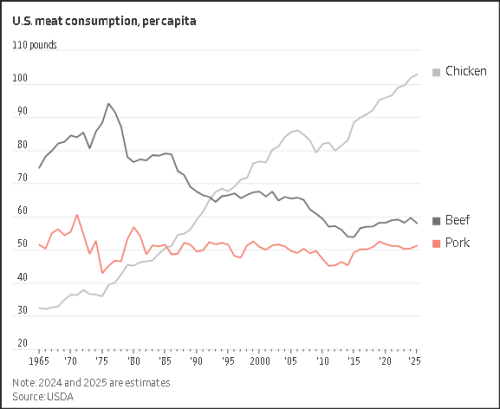
    While Americans’ per capita chicken consumption has tripled and beef consumption has declined since 1965, consumption of pork products has barely held its own — a sad commentary on American cultural norms.

    It seems that young people prefer chicken sandwiches, reports the Journal.

    Chicken? Really? Can you get any wimpier? I suppose there’s always tofu.

    (more…)