
By Steve Haner
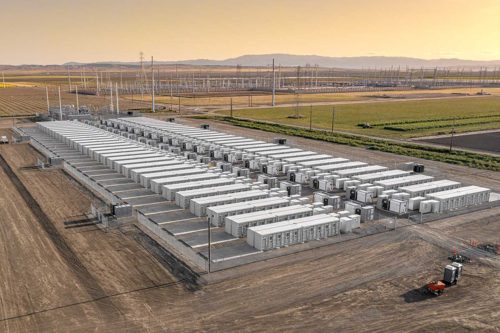
Based on current pricing for the present-day energy storage projects, legislation pending at the Virginia General Assembly could cost ratepayers of the two largest electric utilities between $18 billion and $29 billion over the next 20 years.
That capital cost, based on the current $300,000 to $500,000 price per megawatt hour for the massive utility scale battery projects, may not include the financing costs that always accompany such large construction projects. Both utilities would expect their standard annual profit margin on the investments, as well. What regulators call the revenue requirement will dwarf the numbers mentioned above. It is the revenue requirement that drives the cost on customer bills.
And for all that money the utilities would not create a single electron of additional electricity. The batteries envisioned simply store energy created by a real generation plant, releasing it to the grid when needed (such as when the sun is not producing solar electricity, or the wind has deserted the ocean turbines.) The cost of producing the electricity they store is on top of the cost of the batteries themselves.
The Senate version (Senate Bill 1394) of the legislation passed unanimously, but neither it nor the House version (House Bill 2537) are fully through the Assembly process. There is time to face the reality of what this would cost. No official fiscal impact statement of any kind has been produced by the State Corporation Commission or the Commission on Electric Utility Regulation. That is because not one of 140 legislators has even asked.
In an earlier article discussing the battery storage mandates, the figure of $500,000 per megawatt hour (MWh) in capital costs was used and was promptly challenged by an anonymous renewable energy fan in the comment string. That person is probably not aware of the cost of some smaller battery projects already approved by the Virginia State Corporation Commission, which make $500,000 per MWh look cheap.
In the most recent approved application for a battery project for Appalachian Power Company, it asked to build a 7.5 megawatt facility able to produce 4 hours of backup power, or 30 megawatt hours of electricity. The all-in cost was $57.3 million, or just under $2 million per megawatt hour. Just the batteries alone were to cost $34.5 million, more than $1 million per megawatt hour.
In Dominion Energy Virginia’s most recent approved application, several projects were included, with one of them proposing a facility that would run for 10 hours. But it was only a 1.5 megawatt facility and thus would produce only 15 megawatt hours. The cost of that was just under $1 million per megawatt hour. A four-hour battery in the same application was to cost close to $2 million per megawatt hour.
Those were tiny projects compared to what is envisioned in the pending legislation, and some economies of scale are likely. After examining them, an estimate that the upcoming cost could still be in the $300,000 to $500,000 per MWh range looks quite fair.
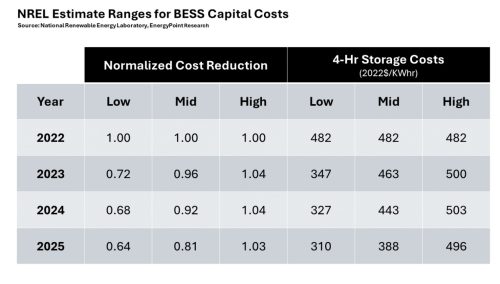
Here is some additional support for that estimate. An online search produced a table from the federal National Renewable Energy Laboratory (above) that projected a 2025 price of $310,000 to $496,000 per megawatt hour for four-hour batteries. It lists the cost in dollars per kilowatt hour, so you need just multiply by 1,000 to get dollars per megawatt hour. The cost per MWh for even longer duration (10 plus hours) rises substantially, as explained by this.
One good provision in the bill is the insistence that the Department of Fire Programs be involved in the planning. If the current facilities catch fire, they apparently cannot be extinguished. The largest such U.S. facility just burned. Local opposition to hosting one of these battery plants is rapidly exceeding the local opposition to massive solar fields.
The authors of the Virginia legislation, probably the battery manufacturing firms themselves, purport to know what amount of storage is justified for the two utilities with three target dates of 2035, 2040, and 2045. It is arrogant beyond imagination to think that anybody knows what the best storage technologies will be then, things are evolving so rapidly. But far too many voting legislators just took it in stride.
There is an off ramp in the enactment clauses at the end of the bill to amend those targets if the SCC finds they are not technically viable or achievable. But the language does not, repeat not, require the SCC to determine if they are just, reasonable, prudent or necessary. Those are the power words in energy regulation — just, reasonable, prudent and necessary.
In the House, 44 of the Republican members voted no and one didn’t vote. But in the Senate, all 19 Republicans voted aye. If that vote is repeated on the House version, it becomes that much harder for Governor Glenn Youngkin (R) to consider a veto.
The bill breaks down the demanded future facilities into short (4 hour) and long (10-24 hour) duration batteries. Ignoring the 24-hour option and just assuming all the long duration batteries are for ten hours, Appalachian will need to install 8,320 megawatt hours of storage by 2045 and Dominion 50,800 MWh. Half of the long duration storage must be built by 2035 (260 MWh and 17,400 MWh). If some 24-hour batteries are used, the total megawatt hours and the cost will grow substantially.
This is just one more illustration of how unrealistic it is for Virginia’s legislators to seek to micromanage the electricity provided by the state’s multiple providers, down to the percentage of power that must come from solar, from offshore wind and from batteries, for 20 or 25 years into the future. The Virginia Clean Economy Act needs to be repealed, not made even more fantastic.
Leave a Reply
You must be logged in to post a comment.