• Fred and Phoebe Discuss Economic Policy


    Alert! Alert! Danger! Danger! Bacon is playing with fire!

    Once again, I am experimenting with new media forms– this time making a brief animated “movie” based on topics debated on this blog, vivid proof that I have too much time on my hands. All my prejudices are on display. I make no effort to be fair and balanced. I don’t bother to fact check. But I do throw in a few yucks. Enjoy.

    (If you can come up with better one-liners, I will plug them into the script and re-publish the movie.)


  • Why Southern History Can Be So Dodgy

    Popular histories about the Confederate States of America can be dodgy, as a recent controversy over a school textbook approved for Virginia fourth-graders shows.

    In her book “Our Virginia: Past and Present,” author Joy Masoff claims that thousands of Southern blacks fought fo the Confederacy, including two entirely black battalions under the command of the famous Virginia Gen. Thomas “Stonewall” Jackson.

    Masoff, who is not a trained historian, says she got the infromation from a Web site. It can be traced to the Sons of Confederate Veterans, a Tennessee-based group open exclusively to males who can show that their ancestors fought for the Confederacy.

    Disputes like this used to be fairly common some years ago, and it is surprising that they continue to crop up. Many serious historians note that very few African-Americans fought for the Confederacy, although some slaves were used as forced labor to build fortifications or as valets for Southern officers.

    Critics say that assertions such as Masoff’s ought to be strongly opposed because they are designed to give the Southern cause — maintaining slavery — credibility. Groups that tend to romanticize the traditional white Southerners’ view of the conflict counter that a lot of honest history gets lost in politically correct versions that have been taught in schools for decades.

    I am not a Southern by background but have lived a good part of my life in the South. One still cannot escape what some whites wish could have been.

    I now live near Richmond, whose beautiful Monument Avenue is marked by traffic circles guarded by giant statues of Jackson, Robert. E. Lee and J.E.B. Stuart. Some 100,000 Confederate veterans attended the unveiling of Lee’s statue on May 29, 1890. Granted the real history of these men can be a bit grey (no pun intended). Jackson, for instance, broke state law by teaching black children to read and write at Sunday school.classes when he was at the Virginia Military Institute before the war, according to a biography by noted historian James. I. Robertson Jr.

    My first newspaper job was at a small daily in eastern North Carolina where my family lived. I worked there summers when I was in college. It was a pleasant little town with the usual characters waxing eloquent about moonlight and magnolia.

    I had a month off one college winter and needed a study project for school. So I went to the newspaper and proposed a Civil War history of the town based on a diary of a Union Navy officer I had found in the local library.

    In 1862, Lincoln sent Union gunboats to a number of small river ports in the Carolinas to keep Southerners from getting war materials. This was the case in my little town. But when I read the diary, my eyes opened wide.

    According to the author’s account, the town’s elders paddled out in a rowboat to greet their Northern captors with open arms. They were merchants who found that the Southern cause was bad for business, and they were treated to an elegant dinner with wine aboard one of the Yankee gunboats.

    Naturally, when my series was printed, it was not well received. One of my critics was a self-styled historian who would fit right in with the Sons of Confederate Veterans. I’m not saying my history was spot on –I was 20 years old at the time — but the experience taught me that anything written about so painful a period has to be undertaken with great care.

    You would think that anyone with a hand in the contents of a grade-school textbook would understand that. Cribbing material off a Web site posted by a member of the Sons of Confederate Veterans is suspect at best.

    Peter Galuszka

    (First posted on TheWashington.Post.com)

  • The Once and Future Kingdom of Austerity

    American liberals are big fans of the European welfare state. They point to European models of national health care, rich pensions and generous unemployment benefits as worthy of emulation in the United States. Europeans may not make as much money as Americans, the liberals say, but they have created a more humane way of life.

    What you don’t hear from the American left these days is much acknowledgment that the Europeans are backpedaling as fast as they can. There is a reason that transportation and oil-refinery unions have been striking in France and government workers are rioting again in Greece. When Greece nearly defaulted on its national debt last year, governments got a glimpse of what would happen when the money ran out, and they began enacting some of the toughest austerity measures of the post-World War II era.

    While France and Greece have grabbed the headlines – protesters setting things on fire makes a visual the media can’t resist – the most important case study in austerity economics may be the United Kingdom. Taking out the carving knife, the newly elected Conservative Party government is dissecting government with a vigor not seen since Margaret Thatcher’s heyday.

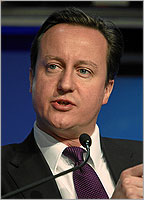
    The secret to restoring the United Kingdom’s economic vitality, says Prime Minister David Cameron, is to slash public spending and reinvigorate the private sector. The Conservative Party plan calls for a combination of spending cuts, tax increases and targeted tax cuts for business that would reduce Britain’s borrowing by $180 billion a year by 2015 – a fiscal consolidation equivalent to 6.2 percent- of that year’s expected gross domestic product (GDP).

    The draconian measures defy the Keynesian doctrine that the best way to jump-start the economy during an economic downturn is to increase deficit spending. While deficit spending may give the economy a short-term jolt, evidence is accumulating that large ongoing deficits cause serious long-term damage, especially when the national debt is already high. Carmen M. Reinhart and Kenneth S. Rogoff have argued famously that when the national debt of advanced nations exceeds 90 percent of GDP, economic growth tends to slow considerably. A more recent study published by the World Bank identified a tipping point at a 77 percent debt-to-GDP ratio.

    With a 2010 debt-GDP ratio of 72.7 percent, the United Kingdom is near that tipping point. (The United States is well past it.) Preaching that the nation faces an “age of austerity,” Mr. Cameron has called upon Britons to show restraint (no riots, please) and adopt the spirit of self-sacrifice their forebears displayed during the two world wars. Expecting to sack more than 600,000 government jobs, Conservatives are gambling that whacking state spending in a weak economy will restore market confidence and encourage private businesses to step up their investment and hiring.

    Because government spending accounts for such a large share of the economy in some depressed regions of the United Kingdom, Conservatives hope to prime the pump of private investment by pumping funds into regional industry clusters. The track record of such industrial policy is not encouraging, but politically, it may be necessary to prop up the economy beyond the confines of the prosperous London metropolitan area. With the exception of the regional stimulus spending, however, the United Kingdom is hewing to a budget discipline that U.S. conservatives can only dream about.

    No political figure of Mr. Cameron’s stature has spoken as honestly to Americans, nor has anyone prominent – outside of Wisconsin’s Republican Rep. Paul Ryan – offered a cost-cutting program as far-reaching. The House Republicans’ Pledge to America would roll back spending by roughly $100 billion a year, to pre-stimulus, pre-TARP levels. But to achieve budget balance over the course of an economic cycle would require spending cuts on the order of $1 trillion yearly. Meanwhile, the U.S. political class and its intellectual enablers remain in steadfast denial. Progressives such as Robert Reich and Paul Krugman argue that the United States needs more government spending, not less.

    Americans should watch the outcome of the English experiment closely. Republicans likely will spend the next two years crossing swords with President Obama, a dogged defender of the leviathan state. The key electoral test will come in the presidential election of 2012. By then, the results of the English experiment should be in. Either it will be a model worth emulating or it will prove to be an economic and political failure. I’m betting austerity will pay off for the United Kingdom. I can only pray that the United States can embrace serious cost-cutting before the gravitational tug of our massive debt pulls the economy into oblivion.

    (This column was published originally in the Washington Times.)


  • Obama’s Stealth Tax Cut

    There’s been a torrent of misinformation on this blog ever since the mid-term elections edged their head ever so slightly on the horizon. We’ve seen a wave of deficit hysteria, bashing Obama for just about everything from TARP to the Lindberg kidnapping and the specter of rising regulations and taxes.

    That’s why the front page of today’s New York Times is so startling. They take us to Huntersville, N.C., a small community near the Charlotte metropolis to a country club rally organized by a Republican women’s club.

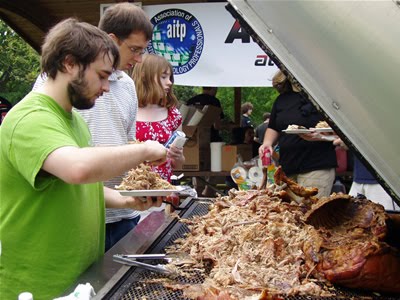
    Amidst the vinergary barbecued pork and the hush puppies, a Times reporter asks a number of those in attendance if they have seen their taxes go up. The answer is resoundingly “yes.”

    Then, we learn that federal income taxes have been down $400 for individuals and $800 for married couples for the past two years as part of the stimulus program. A Times/CBS poll showed that only 10 percent of those surveyed knew that their taxes had actually gone down.

    How come no one knows? The Times speculates it is the way Obama did it. He wanted to encourage spending to get the economy moving again. That sounds logical enough. Plus, he did not want to hand out tax rebates a la George W. Bush because people tend to park those in the bank and not spend.

    Problem was states, notably in North Carolina, simultaneously raised their taxes as the feds cut theirs, so not many people noticed. In North Carolina, the fed tax cuts put $1.7 billion back in the pocket of the typical Tar Heel. But it just didn’t seem that way.

    The problem seems to be separating Obama’s actual actions from what the yahoos, as Larry Gross calls them, accuse him of doing. Tax cuts are one of them. Another is immigration. The Tea Party types love to whine about illegal immigrants but, in fact, the number has dropped from 12 million to 11 million during the Obama years and Obama has actually toughened enforcement and has forced more deportations than Bush. To be sure, some illegals are going home because of the bad economy, but the results speak for themselves.

    When you take the trend farther, you begin to wonder about the deficit. How big will it really be? Jim Bacon tries to supply an answer but his rush-job book unfortunately is tainted by partisan, libertarian-conservative political concerns. Read the cover jacket. It has Jim “demolishing the arguments of liberals and progressives..”

    But the tax cuts are real and Jim Bacon cannot demolish them. The Boomergeddonites try to deflect that by complaining about cutting tax hikes for the very rich, say those with incomes above $250,000. They claim that ending the tax bennies for the country club types will hurt small business and nip innovation in the bud. Mercedes sales, maybe, but the argument is a stretch.

    As this highly polarized election approaches, it is critical to separate the wheat from the rest.

    Peter Galuszka

  • The Dangers of Japan’s “New Fru”

    As mid-term elections approach, the Conventional Wisdom has it that the U.S., thanks to President Barack Obama’s excessive spending on stimulus measures and other things, is presenting the U.S. with up to $2 trillion extra in long term debt. Thus, we are being set up for a big financial mess later on.

    There’s also a school of thought that, on the contrary, the U.S. has not spent enough to get itself out of recession and on the road to recovery where rising revenues will help erase the deficit spending so far.

    The big example that many are pointing to is Japan, which was on top of the global economic world back in the 1980s but then collapsed into the “lost decade” of deflation. The Convention Wisdom had held that Japan could not respond to recovery panaceas of a monetary policy nature because the keiretsu of interlocking banks, companies and government agencies made it too ossified to do so.

    But today there’s a new realization that this view may not have been correct since much of the inflexibility of the Japanese structure had been evident a decade or two before. The leading proponent of the Japanese deflationary re-think is Richard Koo, head economist for Nomura Securities.

    Koo says that Japan got trapped in what is called a classic “Balance Sheet” recession which is said to have been coined by Edward Frydl of the New York Fed. In it, companies react to recession by amassing cash which they use to pay down debt on their balance sheets. Paying back loans becomes an obsession so pervasive that the companies stop using the cash for expansion or investment. Borrowing flows to next to nothing, despite near-zero interest rates. Asset prices fall further, leading to more corporate bankruptcies and so on. Unemployment, already high, goes up even more with no end in sight.

    This, Koo says, is what really went wrong with Japan. The mess would have collapsed into depression, Koo has said. “Had there been no fiscal stimulus, the Japanese economy today would have contracted by 40-50 percent, if the U.S. experience during the 1930s is any guide<' he said.

    The U.S. seems to present similarities. Despite some stimulus spending (although much of it has remained unused), unemployment is still near 10 percent and won’t go down. Interest rates are near zero. Big corporations are hording more than $1 trillion in cash while small businesses, accounting for about two thirds of jobs, can’t get loans.

    The panacea, presented by conservatives, such as James A. Bacon, and some moderates, is to slam the brakes on government spending because of some far-off looming catastrophe that they envision.

    Koo has a different view: “Since the government cannot tell the private sector NOT to repair its balance sheets, the only thing the government can do to keep the economy going is for the government to borrow and spend the unborrowed savings in the private sector and put them back into the economy’s income stream. Moreover the stimulus must be maintained until private sector deleveraging is over.”

    A big problem, Koo acknowledges, is that it is really tough to maintain stimulus spending in a democracy. But failing to spend is equally dangerous. “Not realizing the critical danger posed by private sector deleveraging at zero interest rates, those who push for fiscal consolidation argue that a big government is a bad government and that the wasteful deficit is jeopardisding the future of our children and grandchildren.”

    Sound familiar? It shouldn’t be. That’s the anti-Obama and anti-stimulus argument of just about every conservative these days from pistol-toting “patriots” at Tea Party conventions or Jim Bacon, who paints an excessively and inaccurately gloomy picture of government spending in his book “Boomergeddon.”

    If you want to envision a deflationary future for the U.S., take a look at a front page article in Sunday’s New York Times. It describes the fall of Japan from the hey day years of the 1980s to today’s disillusionment. The “New Fru” that slick marketers such as those at Richmond’s Boomer Project project takes hideous new turns. Young Japanese are forced to live in tiny, three story homes with the dimensions of a sport utility vehicle and kitchen “that probably belongs on a submarine.”

    This is not to say that any new government spending should be random or careless. There is, right now, a huge new for new infrastructure projects in the U.S. Other countries such as China, and even Russia, are spending more on new roads, dams, airports and railroad trains than the U.S. is. Such spending would be useful here.

    ome Nov. 2, a Republican sweep is likely. What isn’t known is how big it will be or what type of Republicans will prevail. If they are the tea baggers or Boomergeddonites, there will be a great feeling of “New Fru” rollicking through the land. But if you give these people the keys, we could all end up living in little huts in a few years with no Ginza to take our mind of our troubles.

    Peter Galuszka

  • Feast to Famine

    When Meredith Whitney speaks, Wall Street listens. Whitney is the financial analyst who first warned that the real estate crash spelled disaster for the U.S. banking system. In a new, 600-page report, โ€œThe Tragedy of the Commons,โ€ she sounds the alarm for a second-wave financial crisis afflicting state and local government.

    Whitney sees scary parallels between the fiscal condition of states/municipalities and the banks, including excess leverage, off balance-sheet financing, and a lack of transparency. As falling real estate values continue to undermine property tax revenues, and as federal stimulus funds dribble to a halt, she says, heavily indebted municipal governments will find themselves in deep trouble.

    Two of the 15 states studied โ€” Texas and Virginia โ€” get positive ratings under Whitneyโ€™s rating system. That is reason for Virginians to take some grim satisfaction but no excuse to get complacent. We have issues galore to deal with, including rising Medicaid costs, schools that donโ€™t teach, $620 million owed to the state retirement system, and a transportation-funding mechanism in worse repair than Interstate 95โ€ฒs creaky bridges. Unlike previous economic recoveries, in which gushing revenues replenished state treasuries, Virginia will enjoy little respite from fiscal stress in the decade ahead.

    The years of plenty have passed. The years of hardship are upon us. We can no longer afford government-as-usual. We cannot tinker on the budgetary margins with incremental process reforms and tweaks to line items. We must thoroughly rethink how we deliver government services. If we fail to do so, circumstances will force the harsh decisions upon us.

    Even as Virginiaโ€™s lawmakers grapple with short-term challenges, they should not overlook a formidable long-term threat to the stateโ€™s fiscal well-being: a federal government hurtling toward its own ignoble demise. As I argue in my book Boomergeddon, by the mid-2020s, the federal government itself will be so deeply indebted that it is highly likely to go into default. Uncle Sam then will face a budget gap equal to some 40 percent of the budget, which it will try to close through some combination of cutting spending, raising taxes, repudiating the debt, or cranking up the printing presses. The result will be economic chaos, if not another Great Depression-style meltdown.

    To some, the idea that the federal government faces default within 15 years smacks of โ€œdeficit hysteria.โ€ But look at the facts. Even the Obama administrationโ€™s own 10-year budget forecast projects that annual deficits will never shrink below $700 billion, and that the national debt will increase by $8 trillion โ€” to $21 trillion โ€” by 2020. The International Monetary Fund declares that the ratio of U.S. debt to the size of its economy will reach 110 percent by 2015, about the same as Greeceโ€™s when its debt woes sparked Europeโ€™s sovereign debt crisis.

    Moreover, President Obamaโ€™s forecast is based upon a number of optimistic assumptions, not the least of which is that Congress will stop spending money like a Valley Girl with daddyโ€™s credit card. Making a different set of likely tax and spending assumptions, the non-partisan Concord Coalition sees total debt exceeding $28 trillion by 2020.

    Obamaโ€™s economic growth forecasts are shaky, too. His 10-year projection assumes economic growth averaging 3.4 percent annually, with no recession โ€” an economic performance comparable to the Internet-fueled boom of the Clinton years. But there is no sign of a boom in the making. Indeed, the U.S. will be fortunate to avoid a double-dip recession. Plugging different growth assumptions into the Obama model โ€” 1 percentage point slower economic growth through the decade, plus a mild recession toward the end โ€” yields a national debt of $29 trillion by 2020.

    Likewise, the Obama budget model is highly sensitive to changes in interest rates. The presidentโ€™s number crunchers assumed that interest rates on 10-year Treasuries will never climb higher than 5.3 percent during the 2010s. But if 10-year bonds returned to the rate of the early 1990s, around 10 percent, the national debt could exceed $36 trillion! If the federal government somehow survives the gantlet of the 2010s, it then faces the wave of 78 million retiring boomers as well as the drawdown of Social Securityโ€™s (anticipated) $4.3 trillion trust fund, forcing the Treasury to borrow trillions more.

    Per capita federal spending in Virginia is seventh highest in the nation. When Uncle Sam defaults, Virginia will feel the anguish more than most. The commonwealth must begin now preparing for that day. Gov. Bob McDonnellโ€™s Commission on Government Reform and Restructuring is a good place to start. But it will take a lot more than privatizing ABC stores to diversify the economy and bullet-proof the commonwealthโ€™s finances.

    (This column was first published in the Richmond Times-Dispatch.)


  • I Always Wondered about those Signs Myself

    From a Wall Street Journal article on government austerity and economic development in the United Kingdom, making the point that efforts to rejuvenate regional economies have a mixed track record in the UK and elsewhere:

    Stuart S. Rosenthal, an economics professor at Syracuse University, remembers driving through Virginia in 1997 and seeing a sign saying, “You are entering southwest Virginia’s high tech corner” [sic — the sign said “corridor].

    “And all I could see was cows and farms,” he said. Recent employment data shows that aside from one pocket, little has changed.

    Ouch!

    Are those signs still up? If so, someone please take them down.


  • It’s My Way or No Highway

    Virginia has long been in the forefront of using privatization as a way to finance public projects without draining public budgets. It has been touted as a way to have your cake and eat it, too, by both Democrats and Republicans.

    But there have been big problems with the concept. Most recently, offers to buy out management of the Virginia Port Authority’s massive container shipping facility in Hampton Roads were rejected because private companies such as CenterPoint and Carlyle offered absurdly low ball figures. The Pocahontas Parkway near Richmond didn’t live up to its traffic volume expectations and its financial and managerial structure had to be quickly redone to preserve the state’s AAA credit rating status.

    Now comes the latest twist. According to a Wall Street Journal story this morning, private companies are no longer waiting for states or localities to pitch public works projects, and are coming up with their own ideas and pushing them.

    Just about the time earlier this month that the state dumped selling off VPA because of the lowball prices offered, Skanska Infrastructure Development and Kiewit Infrastructure among other firms pitched expanding the existing Hampton Roads Bridge Tunnel from two lanes to four at a cost of up to $4.5 billion.

    The bridge tunnel, as anyone who has ever traveled to Tidewater knows, is a horrible bottleneck that can result in long delays early on weekday mornings as commuters flock to jobs at the huge Naval bases nearby or on weekends when vacationers head to the beaches.

    The two-lane tunnel has been around since 1957 and the bonds paid for by tolls were settled in 1976. The tolls were lifted long ago.

    The problem is that many in the local community, including Norfolk Mayor Paul Fraim are angry with the unsolicited private proposal because it would involve uprooting hundreds of homes and stick motorists with tolls of up to $6 one way. Thus, a commuter working at the Norfolk Naval Base who lives in Hampton would have to shell out an extra $240 a month just to commute to his or her job.

    That’s a lot of dough just so some huge private firms can get their investment back. There have been proposals for third crossings not involving expanding the existing HRBT but funding has been scarce.

    The Journal notes that events such as this are being repeated in other states and are taking the privatization concept to a new level.

    It is a troubling development. Despite what the privatization fans think, the concept puts private business in the driver’s seat. They should not be making decisions about whose house gets to be condemned to make way for their project. And they should not be allowed to set toll rates without public input.

    We’re not talking “magic of the market” nonsense here. Let’s say Skanska and friends get their way. If you are a commuter you do have a choice not to pay the toll, but it presents a ridiculous inconvenience. You would have to drive all the way to Newport News and take another bridge tunnel and then crawl to Norfolk from Portsmouth, adding maybe an hour one way to your commute. Or you could swim.

    At last weekend’s celebrated Tea Party convention, the “patriots” had booths pushing information about eminent domain issues in which the state misused its power to force people from their homes a la the Kelo case in Connecticut.

    I tend to be with the patriots on this one. But the bigger question is, if the bad guy is private business and not public government, will they have the nerve to fight that too.? What gives large corporations the right to shove people from their homes and set usury tolls?

    Peter Galuszka


  • Enough Already with the Secret Tax and Fee Hikes

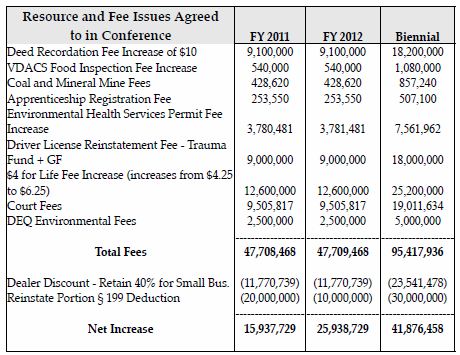
    Gov. Bob McDonnell has repeatedly asserted that the government of Virginia managed to close a $1.8 billion shortfall in the Fiscal 2010 budget “without a tax increase.” (See his column in the Wall Street Journal.) That may be true from a technical viewpoint but it leaves a few things unsaid. I won’t even get into the complex deal by which the commonwealth effectively borrows money from the Virginia Retirement System and repays the sum as part of a larger pension overhaul. More to the point is the matter of some $95 million in higher “fees” in the biennial budget, plus multimillion-dollar reductions in targeted tax breaks that bring the total to $137 million.

    The accompanying chart from the House Appropriations Committee shows the grab bag of additional fees inserted by the General Assembly into the budget legislation during the last day of the 2010 session. There are two issues here.

    First, when is a “fee” not a fee but a tax increase? I would argue that a fee becomes a tax when the revenue generated by the fee exceeds the level needed to provide the related government service. By that definition, how many of the above are fees and how many are taxes? I don’t know. But an honest rendering of accounts probably would suggest that the General Assembly did increase some taxes.

    The second issue is the manner in which these fee increases and tax break deductions were enacted. According to Del. Robert G. Marshall, R-Manassas, they were jammed into a much larger bill at the last minute. Legislators never had an opportunity to vote them up or down on their individual merits. In other words, there was minimal transparency. It makes me sour and argumentative to see fees and taxes increased in this manner.

    Marshall has a solution. He proposes an amendment to the state constitution as follows:

    Any law that appropriates funds shall not contain any provision that imposes, continues, increases or revives any tax, fee, or fine, nor shall any such law contain any provision that reduces or eliminates any credit, deduction, or exemption associated with any tax, fee or fine.

    Personally, I happen to dislike tax credits and exemptions as a tool of public policy and think many if not all of them should be eliminated on the grounds that they provide preferences not available to the general public and that they reduce the tax base. On the other hand, I also believe in transparent government. If anyone has an argument in opposition to Marshall’s amendment, I would like to hear it.

    (Marshall provides a bit more information about his proposal here.)


  • The Thoughts of the Chief Rabbi

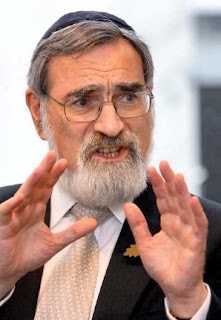
    This Tuesday, the Lawn at the University of Virginia was a portrait of early fall beauty. Inside the equally-magnificent Rotunda, Chief Rabbi Lord Jonathan Sacks spoke on “Difference and Democracy in the Post-Secular World.”

    Somehow I got on the mailing list of U.Va.’s Institute for Advanced Studies in Culture. I don’t know why but suspect it was because I exchanged business cards with a young woman from the institute at a meeting on Kazakhstan in New York City in June.

    Lord Jonathan Sacks in the Chief Rabbi of the United Hebrew Congregations of British Commonwealth countries. He’s studied at Cambridge and Oxford and written 18 books, mostly on theology and political theory, plus pens a Sunday column for a London newspaper. He was knighted by the Queen in 2005.

    His talk was fileld with insights especially pertinent during these days of Tea Parties and shock political radio heads like Limbaugh and Beck, constant misinformation about Barack Obama’s religion and heritage, a weak recovery, loss of faith and political blame.

    Rabbi Sacks noted that about 1831, two young men started out on separate journeys and came up with crucial observations.

    Charles Darwin set out on the HMS Beagle and came up with the survival of the fittest theory. But he noticed something else. If the theory was carried to its logical conclusion, then all the weaklings would be destroyed. Instead, in many natural species, there is a sense of altruism in which some members of a breed sacrifice themselves for the good of the group. Such groups emerge as the strongest and most sustainable, Darwin decided.

    The other young man was Frenchman Alex de Tocqueville who went on an exploration of the young United States. Among his observations was that Americans were highly religious. Yet the U.S. was one country in the world of the time where religion and politics were kept separate. The greater the separation, the strong the religiousity. Curious.

    Rabbi Sacks went on discussing how social institutions such as family and marriage have come under great assault in the last half century or so. The reason, he believes, is that too much of the concepts of state power and the (free) market have infiltrated marriage. Politics involves coercion or coopting to force a point of view. The market means that one is constantly on the lookout for something better.

    Neither aspect works well for an institution that is supposed to be caring, loving and giving as is marriage. Since their infiltration, marriage has suffered from widespread divorce. That’s one reason why birth rates are so low in Europe, forcing coming demographic wars as immigrants become the only breeders, he says.

    His last point had to do with the univesity. “If you politcize the university, you destroy the university,” Sacks said. The point of the institution is to have a place where one can have a robust debate about what is true, not propaganda. Keeping bias aside and giving all a respectful hearing are essential to create a “civil space” to exchange ideas. “The guardians of knowledge must defend and protect that civil space,” he said.

    As I listened to the rabbi, I couldn’t help reflect on the irony of the venue. Here we were at U.Va. which is in the forefront of one of the most shameful, politicized attacks on university freedom in the U.S. today — Va. Atty. Gen. Kenneth Cuccinelli’s stubborn demands to probe the emails, articles, letters and reports of a legitimate former U.Va. global warming professor and his associates. A hard-right activist, Cuccinelli fits right in the radical conservative movement pushed by think tanks such as the Cato and American Enterprise Institutes to negate the human causes of climate change at all cost.

    And when I thought about altruism, I remember all those Ayn Rand fanatics at Richmond’s Tea Party convention last weekend. I am not a Rand fan and the thought of reading 900 plus pages of her blather in “Atlas Shrugged” turns my stomach. A true hard ass, Rand believes that altruism is nonsense. Society functions best when people pursue strictly only their own self interest. So, bring on the free market!

    Lastly, I thought about the religion separation argument and how many in the conservative movement wrap themself up in flag and cross, claiming that the U.S. was intended as a “Christian” nation. Inaccurate nonsense.

    In any event, listening to Chief Rabbi Lord Jonathan Sacks was a geat way to spend a fall afternoon.

    Peter Galuszka


  • Foreclosure Fiascos

    A common refrain on this blog that gains more currency as frustration with the anemic economic recovery grows is that regulation of business is somehow to blame.

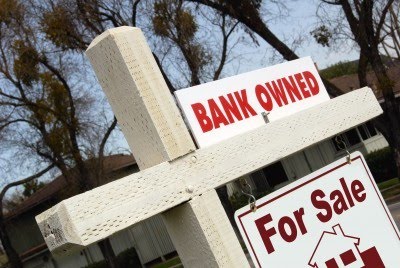
    That might suit the right-wingers but it is a fallacy. And just as the big financial institutions were allowed to run amok by federal and state regulators during the go-go mortgage years, a brand new financial problem has arisen: phony foreclosures.

    As banks loaned mortgage money like crazy during the last decade, they quickly securitized those loans, meaning they packaged them into parts and sold them off to new owners. Traditionally, if you buy a house, there is a deed of sale and trust or whatever in your local courthouse that states who holds the loan, for how much, and so on. If the house is sold or foreclosed upon, this tried and true system keeps track of ownership and the loaned money.

    Well, not no more it don’t. Federal regulators and Congress are finding that many banks, especially the big mortgage enchilada, Bank of America, apparently sold off mortgages without bothering to take the time to record the sales properly.

    They often used ill-trained and sometimes semi-literate robo-signers who would sign hundreds of foreclosure papers every day without even examining them.

    So, you have banks foreclosing on the homes of people even though they don’t own the loan.

    This is insane. But it has happened on such a large scale that it might dip us into another financial crisis.

    The reason for this is simple: greed. Banks could give a damn about people or propriety. They made big bucks granting questionable loans. And they made even more bucks securitizing loans and selling them off without messing with the paperwork.

    And where were the regulators? Who knows? Probably the same place when banks were greatly leveraging their lending to equity ratios and making loans to people without incomes.

    But if you pay attention to the Republicans and some of the people who write for this blog, it’s not the banks’ fault, it’s the fault of “regulation” that is hampering our “free market” system.

    Guess what? How can there be a “free market” when someone is seizing your property and selling it off because you haven’t paid a loan that really is no longer due to that person or bank? What’s to keep some free market maven, such as Jim Bacon or Groveton, from showing up at my front door and ordering me out so they can resell my house?

    I don’t owe Jim Bacon or Groveton any money.

    Peter Galuszka


  • Google Blows Away McDonnell’s Plans

    The timing couldn’t be more revealing.

    Just as Gov. Robert F. McDonnell, pushing his goal of making Virginia “the Energy Capital of the East Coast,” was set to open a hydrocarbon-heavy lineup at a two-day energy conference in Richmond, Google struck.

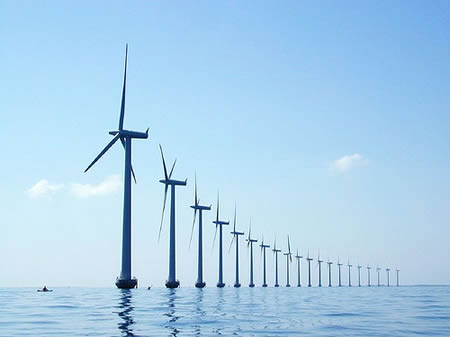
    The Internet giant and Good Energies, a New York investment firm, announced a $5 billion project to build an underwater transmission backbone for a farm of wind turbines up to 20 miles off the East Coast from Virginia to New Jersey. The project would take a decade to complete and eventually generate up to 6,000 megawatts of electricity, or about as much as four large nuclear power stations. Analysts say Google needs great gobs of energy for its operations, which include a large server farm in Northern Virginia.

    The news came just as McDonnell was to open the energy conference. He envisions wind and solar among his preferred mix, but his plan is heavily dependent on hydrocarbons such as coal and petroleum as well as nuclear.

    Virginia has reserves of high-quality coal in its southwestern mountains, but the seams have been increasingly mined out, and large-scale production likely would involve mountaintop removal, a highly controversial practice that involves lopping off huge swaths of earth.

    McDonnell has also pushed offshore oil drilling, but his plans hit a snag in April when BP’s Deepwater Horizon rig exploded in the Gulf of Mexico, resulting in the largest environmental disaster in the nation’s history.

    Undaunted, McDonnell is still pushing offshore drilling, and tonight’s keynote dinner speaker will be Texas oilman T. Boone Pickens, who likes what McDonnell is trying to do. But the Virginia Sierra Club trashed McDonnell’s plans, saying they rely too much on oil and coal, and pay only lip service to renewable energy sources like wind and that the states wastes too much energy as it is.

    Therein lies the rub. Google, which will fund the huge offshore wind project, is a 21st century company. T. Boone Pickens seems an icon from another era, and so does McDonnell as a result of all this. A more modern governor might have had the Google announcement taking place at his conference. Instead, attendees will get the usual Texas oilmen.

    To be sure, there may be some problems with a wind project of the size envisioned. The area is a busy fishing ground, and tall windmills might interfere with that. It is also a major maneuver area for the Air Force and Navy, which opposed McDonnell’s offshore oil plans because they could interfere with military exercises.

    But at the end of the day, one simple fact keeps coming up: No one knows for sure if there are big oil deposits off the Virginia coast. There may be natural gas. But there’s no doubt how much wind is out there.

    Peter Galuszka

  • “Well Within Reach”

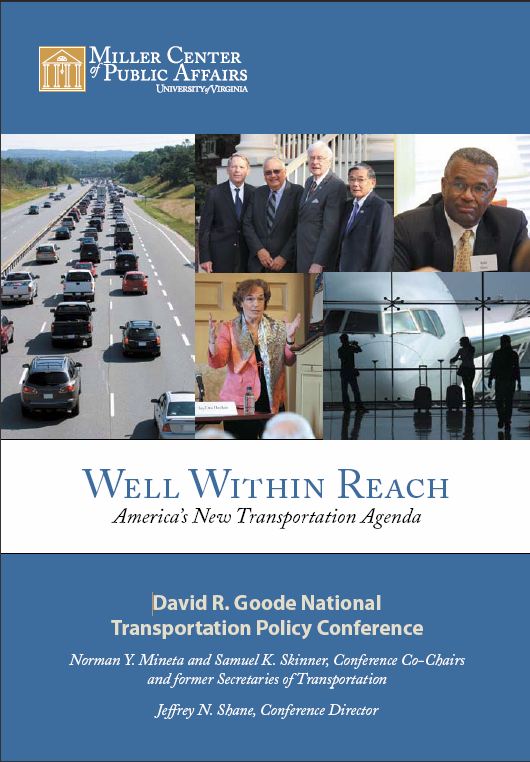
    The Miller Center of Public Affairs at the University of Virginia has issued an important new report on transportation, “Well Within Reach: Americaโ€™s New Transportation Agenda.” The report is the brainchild of former Gov. Gerald Baliles, the last governor of Virgina to think seriously about transportation.

    I haven’t had time to read it closely enough yet to provide any thoughtful comments, but a quick glance suggests that the report does incorporate some new thinking, as evidenced from this quote in the executive summary: “Funding for the Highway System was intended to come from drivers, but the current fuel tax no longer creates a direct link between charges and use. We must return to a ‘pay as you go’ system.”

    Emphasis on “user pays” — good.

    Ignoring the relationship between transportation and land use — bad.

  • Krugman Unhinged

    Paul Krugman advanced the argument in a recent NYTimes column — I kid you not — that there has not been a big expansion of government spending under the Obama administration. America needs more spending and bigger deficits in order to gin up some real stimulus!

    I know, I know, Krugman is an easy target โ€” like shooting fish in a barrel. But he won a Nobel Prize, forcrissake, and heโ€™s a columnist in the New York Times, a newspaper that some people take seriously. Whatโ€™s more, heโ€™s so insufferably smug and contemptuous, he needs to be knocked down a peg or two. So, I do my best in the video above.

    (Show mercy on me for the technical quality of the video. YouTube and video-making is a brand-new thing for me. But go ahead and thrash away at the facts and logic expressed therein.)


  • Cuccinelli: The Scary Winner at the Tea Party


    One fact coming out of the Tea Party convention hasn’t really come out on these blog postings, but it is probably the most important one: Kenneth Cuccinelli is the big beneficiary.

    Any political ambitions that the highly ambitious attorney general might have had got a huge boost when the Cooch got a standing ovation at the Greater Richmond Convention Center. Everywhere, along with “Guns Save Lives” paste-on paper slogans, there were Cuccinelli stick-ons. Cars in the parking lot across the street were slathered in pro-Cooch propaganda.
    It may not be so hard to understand why the Tea Partiers like him. Fairly affluent with incomes of from $50,000 to $100,000, white, and middle aged the Tea Partiers project the resentment of outsiders not unlike the 1960s’ “Silent Majority” angry with civil rights, the sex revolution and underclass “welfare” that Richard M. Nixon so skillfully tapped.

    Cooch is perfect for them. He’s a loose cannon, bows to no larger power and is unabashedly hard right whether he’s taking on imagined fraud in global warming research, peddling questionable legal opinions on police power on stopping suspected immigrants or making certain that gays and lesbians have no legal right to protection against discrimination on public college campuses.

    Given the groundswell of support for him by the masses at the convention center, it is clear where they are really coming from. Fellow bloggers may try to paint the event as a truly diverse, sincere and sympathetic gathering (one blogger even said he has decided to “endorse” the movement and is now a “patriot” as if we couldn’t wait for his decision). But the fact is that what you are really seeing is a big move to the far right among the conservative movement.

    This is what is frightening. More traditional Republicans such as George Allen, Bob McDonnell and Bill Bolling all hustled to get a place at the Tea Party table. House Minority Whip Eric Cantor wisely didn’t show up. Say what you want about these politicians, but they aren’t imbued with a kind of self-righteous fanaticism. With the exception of Cantor, they seem willing to compromise and at least consider, to varying degrees, the views of others.
    Not so the Cooch. He sees himself as stubbornly correct in his convictions. When an Albemarle County judge kissed off his “civil investigative demands” against the University of Virginia and a former professor who is an expert on global warming, Cuccinelli charged back with a scaled down attack. This one involves a state global warming research grant whose state funding totaled less than the $350,000 or so that U.Va.’s alumni and other community members have coughed up to fight off Cuccinelli’s first attacks.
    Its this kind of single mindedness that would make Cuccinelli downright dangerous if he were to attain higher office such as governor or in Congress. There would be no room to consider the views others. Whatever the “Cooch” thinks is morally correct. It is a quality of certainty that could date back to the Jesuits which ran a private high school in Washington that Cuccinelli attended. I attended another such high school in the D.C. area and I while I have great respect for the Society of Jesus, I can sniff out a certain strain of righteousness that should give one pause.
    The Tea Partiers running around with their funny tri-cornered hats, anti-Obama stickers, and 9 mm. automatic pistols in slick Velcro holsters may not realize what they are getting into by giving Cuccinelli a jet-assisted political boost. Lots of politicians have cleverly exploited the politics of resentment even though it didn’t seem to me that the Tea Partiers were particularly down and out. Well-fed and well-dressed, they seemed just as interested in taking the U.S. back five or six decades to some wonderful and imaginary White Toast era than in affecting decent change.
    The most important single political statement they came was backing some kind of constitutional amendment letting states shun federal laws they don’t like. It is the same logic used by the Southern racists to shun integration back in the 1950s and 1960s. Imagine if we had someone in office as self-assured and single-minded as Cuccinelli to oversee such as states’ rights campaign.
    If that were to happen, the Tea Partiers would see violations of civil rights beyond their wildest dreams.
    Peter Galuszka