• Suck It Up Exxon, Your Profits Are Pitiful Compared to Higher Ed Profits

    Higher education is a highly profitable business. That applies not only to “for-profit” colleges like the University of Phoenix, which reported a 30% operating profit margin in the first quarter of 2011, but the so-called “nonprofits.”

    How can a nonprofit have a profit? Economically speaking, as Vance H. Fried with the Cato Institute argues in a new policy analysis, “Federal Higher Education Policy and the Profitable Nonprofits,” when a nonprofit’s revenue exceeds the cost of providing a service, in this case undergraduate education, it’s a profit.That profit does not show up in the financial report of your alma mater because profits are recorded as expenses. “Nonprofit schools,” he writes, “take their profits from undergraduate education … in the form of spending on some combination of research, graduate education, low-demand majors, low faculty teaching loads, excess compensation, and featherbedding.”

    Fried sees two types of profit. The first consists of payments to college insiders that do not increase college outputs: excess compensation and featherbedding primarily. The second is subsidies for missions unrelated to undergraduate education, such as graduate education and research.

    How, then, does one gauge the profitability of a nonprofit university? One is the “build up” method, which starts with a blank piece of paper and creates a detailed pro forma statement of operating costs for a hypothetical institution. In one exercise, creating the fictional 3,200-student College of Entrepreneurship and Leadership in Society entailed operating costs of $6,705 per pupil.

    A second approach utilizes real data reported by colleges in several states. Actual costs for an undergraduate education range from $7,080 in Florida and $7,980 in Illinois to $11,040 in Ohio. If we assume costs averaging $8,000 per student, says Fried, tuition revenues alone imply a profit of $5,500 per student at undergraduate institutions. When donations and endowment income are added, profits jump to $12,800 per student. As Fried wryly notes, “That’s more than a 60 percent profit margin per student — double the margin of for-profit Phoenix.” (By point of comparison, oil giant Exxon Mobil’s profit margin was 9.6% in the most recent quarter.)

    While public institutions charge lower tuition than private colleges, they also enjoy substantial state support. Here’s a question for Virginia policy makers. What is the purpose of public support? Presumably, it’s to make an undergraduate education more affordable for Virginia residents. The objective is not supporting graduate programs or even subsidizing university R&D, as desirable as those things may be.

    If Fried’s analysis is correct, and if we use $8,000 as a benchmark cost of providing an undergraduate education, then undergraduate students in public Virginia universities are a ginormous profit center. According to the State Council of Higher Education in Virginia, tuition and mandatory fees in 2010-2011 for undergraduate student amounted to $8,830 at senior institutions (and considerably less in community colleges) on average. That doesn’t include state support, which covers 55% of what universities say it costs to educate an undergrad. These rough numbers suggest that undergraduate tuition and state assistance are subsidizing salaries, administrative bloat, low faculty teaching ratios, graduate education, R&D, economic development and other extraneous missions to the tune of $9,000 a year.

    Maybe Fried’s assumptions aren’t quite accurate — maybe the subsidy is less than $9,000 a year. Maybe it’s mission critical for Virginia universities to support national-caliber graduate schools and research programs. Maybe the state would support those endeavors if called upon to do so. The problem is a lack of transparency. Citizens and policy makers don’t know how much it costs to educate an undergraduate student, and we don’t know how much money is being captured for the benefit of other campus interests.

    It’s time we find out. It’s time we find out how badly the sheeple are getting sheared.


  • The Wonk Salon, June 16, 2011

    How Uncle Sam Can Drive Education Reform at the Local Level
    Center for American Progress
    Congress should reauthorize the Elementary and Secondary Education Act to make the federal government a stronger catalyst for reform of local school systems.

    Save Southern Forests by Taxing on Basis of Current Use, not Market Value
    World Resources Institute
    Rising property taxes resulting from encroaching development push private owners of forest land into selling property to pay their tax bills. Taxing on the basis of current use, not market value, would ease the pressure.

    Fighting Organized Retail Crime
    Government Accountability Office
    Retail chains are collaborating with online marketplaces like e-Bay and law enforcement authorities to combat organized shoplifting and fencing.

    Doing More with Less in Special Education

    American Enterprise Institute
    Special education spending has risen to an unsustainable 21% of total education spending. Educators need to re-think they way the approach special ed, especially labor-intensive but ineffectual teaching models.


  • The Invisible Parking Glut

    There is one very important benefit to building roads and parking spaces: They facilitate travel by automobile. Cars are a wonderful convenience. The personal mobility afforded by automobiles ranks so high in the list of fundamental human desires that people in developing countries around the world purchase cars as soon as they can afford them. Automobility is one of the great blessings of contemporary civilization.

    But there are hidden costs to building all that impervious surface, and Todd Litman with the Victoria Transport Policy Institute has cataloged most of them. Roads and parking add to the cost of land, public facilities and private housing stock. They create “suburban sprawl,” or disaggregated, low-density development, which leads to excessive gasoline consumption and carbon emissions. They increase waste water run off, add to water pollution, reduce open space and create urban heat-island effects. And the list goes on.

    What especially gripes Litman in an article published in Environmental Practice, “Why and How to Reduce the Amount of Land Paved for Roads and Parking Facilities,” is that the excess supply of paved surface is the result of conscious government policy.

    The optimal amount of roads and parking is the amount, Litman argues, that “could be financed if travelers had reasonable transport options … and paid all direct and indirect roadway costs [and parking costs] through user fees.” Mandating parking spaces reduces the incentive for employers to explore alternative solutions — arranging to use a nearby church’s parking lot during weekdays, for instance, or encouraging employees to ride share.

    Most current planning policies are predicated upon the axiom that it is desirable to maximize road and parking supply. “Most communities have zoning codes that require generous minimum parking and roadway supply,” Litman writes. As a result of over supply, “many parking facilities are frequently under-used.”

    Litman enumerates several strategies that would enable communities to reduce the acreage of impervious surface. He covers the gamut from better streetscaping to setting prices for paid parking, from parking taxes to improved facility design. They are all ideas worthy of consideration.

    What Litman inexplicably does not list is a recommendation for getting local governments out of the business of mandating parking requirements in the first place. Wal-Mart executives know how many parking spaces to place around their stores — they don’t need local zoning boards telling them their business. Let office-park tenants trade off the cost of “free” parking (which isn’t free, but bundled into the price of their rent) with the cost of implementing a Transportation Demand Management Plan. Let market prices allocate scarce parking and transport assets. Unleash human creativity.

    Litman contends that the space set aside for impervious space can be reduced by 20% to 40% by applying cost-effective transport and parking-management strategies. In turn, shrinking asphalt acreage by that amount would allow offices, stores and houses to be located closer together, making more destinations accessible by foot, bike or mass transit. Always remember: “Sprawl” is not the result of untrammeled markets and insufficient planning. It is the result of too much and the wrong kind of planning.


  • The Wonk Salon, June 15, 2011

    Proposed EPA Clean-Air Rules Expensive, but Worth It
    Bipartisan Policy Center
    A slew of regulations under consideration by the Environmental Protection Agency will require significant investments in the electric power system but the benefits to the environment and public health exceed the compliance costs.

    The Role of Research Universities and Labs in Manufacturing Competitiveness
    Council on Competitiveness
    To stay competitive, U.S. industries need to increase their innovative edge by building economic ecosystems that include universities and research labs in the process of researching and commercializing new technologies and products.

    Beware Medical Studies that Focus on Race
    Center for American Progress
    Considerable medical research uses race as a criteria for studying disparities in medical outcomes. But “race” is a social construct, not a scientific one. The research preoccupation with race can perpetuate harmful assumptions about racial groups.


  • Who Will Watch the Watchers?

    This column published in the Washington Times this morning is a Virginia story even though the Upper Big Branch mine is located in West Virginia: Massey Energy and Alpha Natural Resources are both Virginia-based companies.

    Later this month, the Mine Safety and Health Administration (MSHA) is expected to release the findings of its investigation into the deadly explosion at the Upper Big Branch coal mine in West Virginia. But who, if anyone, will investigate the way the MSHA conducted that investigation?

    Twenty-nine coal miners died April 5, 2010, when a powerful explosion ripped through Upper Big Branch, which was owned by the former Massey Energy Co. Less than a week after the explosion – before the formal investigation began – the MSHA declared the tragedy to be โ€œa failure first and foremost of Massey Energy Co. management,โ€ and then set out to prove its point. In a Massey-funded probe into the causes of the disaster, a team of experts not only disputed the MSHAโ€™s anticipated conclusions, but accused the regulatory agency of conducting a โ€œdeeply flawedโ€ accident investigation. The fix was in from the beginning, contends the Massey report.

    In its biased investigation, the agency โ€œlured witnesses, sometimes under false pretensesโ€ and without an attorney, to interviews where it โ€œframed questions to induce testimony that only supported the MSHAโ€™s conclusions.โ€ Moreover, the agency interfered with Masseyโ€™s investigation, prohibiting its experts from utilizing essential tools such as photography, modern mine mapping and independent coal-dust sampling. The agency coerced Massey into applying rock dust and water to areas still under investigation, thus destroying evidence, and it ordered the withdrawal of the companyโ€™s scientific experts from the mine on the basis of concocted safety concerns. Most explosively, the company charged the MSHAโ€™s chief investigator with attempting to intimidate its experts with โ€œretaliatory actionโ€ in order to influence their conclusions.

    The companyโ€™s new owner, Alpha Natural Resources, stated that the Massey report was โ€œunauthorized,โ€ and declared it would conduct its own inquiry. But former Massey chairman Bobby R. Inman, who is no longer with the company, released it in early June, two days after the acquisition was completed, out of โ€œa strong sense of responsibility for all those who mined coal.โ€

    In his cover letter, Mr. Inman urged Congress to pass legislation to create an independent agency to investigate mine accidents, rather than letting the MSHA โ€œpolice itself.โ€ An independent West Virginia investigation found that the agencyโ€™s lax enforcement of safety rules made it partly to blame. Whether the MSHA will accept a share of the culpability in its own report is an open question. As judge and jury in the case, the agency can easily cover its own tracks. Mr. Inman cited the National Transportation Safety Board, which investigates airline crashes, as an alternative model.

    I have no way of knowing whether to believe Masseyโ€™s experts, who blamed an unforeseeable upwelling of natural gas for the explosion, or the findings of the West Virginia inquiry, which concluded that the disaster was a result of the companyโ€™s violations of multiple safety standards made possible by insufficient regulatory oversight. The West Virginia panel was arguably more independent than the Massey-hired experts, but it wasnโ€™t necessarily any less biased. It drew heavily from the tainted MSHA-directed witness interviews, and it did not have access to forensic evidence collected by the Massey team.

    Unfortunately, there is no way to keep politics out of the investigation. Before its acquisition by Alpha, Massey was the largest non-union coal mining company in the country. As such, it became Public Enemy No. 1 for the United Mine Workers of America (UMWA), as well as environmental groups and other allies in the progressive movement. Moreover, the companyโ€™s CEO, Don Blankenship, was a combative and polarizing figure in West Virginia. Mr. Blankenshipโ€™s friendship with a state Supreme Court judge who ruled on a major Massey-related lawsuit was especially scandalous.

    Less remarked upon is the pervasive influence of the miners union in West Virginia politics, the employment of former UMWA miners as MSHA inspectors or the role of West Virginiaโ€™s congressional delegation in advancing the unionโ€™s interests in Washington. The UMWA used the Upper Big Branch disaster to put unremitting heat on Massey, depicting the company as a renegade on safety and environmental issues. The publicity from the mine disaster was so negative and all-pervasive that Masseyโ€™s board agreed to sell the highly profitable company. The new owner, Alpha, has ample incentive to make peace with the union and the MSHA, blame former management for the catastrophe and move on.

    There is no one left to defend the reputation of the old Massey Energy organization and that of the executives and managers who worked there – no one except Bobby Inman, the 80-year-old former director of the Central Intelligence Agency, who now is a professor at the University of Texas. Mr. Inman is armed with nothing more than an orphaned report, which, regardless of the merits of its contents, will predictably be dismissed as a whitewash.

    Still, the issue Mr. Inman raises will not go away. There will be other mine disasters. The politics and prejudices of Central Appalachiaโ€™s ongoing class war will intrude into the investigations, and justice could be derailed as a result. The MSHAโ€™s behavior would be a worthy subject of a congressional hearing, and Mr. Inmanโ€™s idea for an independent investigative agency is one that should be pursued.

    (Image credit: Washington Times)


  • Don’t Get Used to the New Look and Feel — It Won’t Last

    I am nearly ready to pull the trigger on a major re-design and re-launch of the Bacon’s Rebellion blog and website. But the new design you see on this page isn’t it. Blogger has just introduced some new templates, which I’m taking advantage of because the result is so much better than the old Blogger template. Enjoy! Just don’t get too attached. This won’t last.


  • The Brutal Facts Facing Southside and Southwest Virginia

    The Tobacco Indemnification and Community Revitalization Commission (TICR) has spent 12 years and $756 million on the goal of revitalizing the tobacco- and manufacturing-dependent economy of Southside and Southwest Virginia. What do the residents of those regions have to show for all that money?

    That’s the question I would like to have seen answered in a draft report by the Joint Legislative Audit and Review Commission (JLARC). JLARC didn’t go that route, although its report does take as a starting point that the hoped-for economic transformation has yet to occur. Unfortunately, TICR has only $606 million left to spend, which, at its current annual “burn rate” of 15% of its endowment, will reduce annual spending to less than 10% of the current level within 14 years.

    JLARC offers some reasonable recommendations: (1) slow the draw down of funds to extend the life of the endowment; (2) consider more “strategic” objectives in the region’s workforce; (3) alter the project evaluation process to screen out weak proposals; and (4) do a better job of monitoring projects for performance.

    These would all be helpful, but it is hard to imagine them making much difference to the big picture. The mill-town economy of these regions is not adapted to the increasingly knowledge-intensive nature of work or the globalized nature of the world trading system. A majority of funds have not gone to transforming the region — pole vaulting from a light-manufacturing economy to a knowledge economy, as, say, Ireland or Bavaria have (See “Job Creation in the Countryside“) — but to prop up an antiquated and uncompetitive base of economic activity, mainly light manufacturing and call centers.

    Yes, there have been investments in broadband and Danville’s showcase R&D center, but 12 years of effort leave the two regions essentially unchanged.

    The problems of Virginia’s tobacco regions are hardly unique to Virginia. Mill-town economies across the country that relied upon cheap land, low taxes and cheap labor have been devastated in a world where China, India and other developing countries have even cheaper land, lower taxes and lower-paid labor. Adding to their regions’ woes, the two regions never developed a culture that valued education — a precondition for transitioning to a knowledge economy.

    The sad reality is that Southside and Southwest Virginia are largely doomed to decline as population growth and capital investment continue to gravitate to America’s largest metropolitan regions. Smearing small investments across a swath of small towns doesn’t come close to creating the economic conditions required for success in today’s economy. That’s not what the politicians and civic leaders of the tobacco communities want to hear but it’s the truth.

    The only hope I can see — and this is a long shot — would be to concentrate the remaining $600 million in a handful of places that have a prayer of gaining the critical mass needed to compete for financial and human capital. That would include the region’s two small metropolitan areas, Danville and Bristol-Abingdon, and possibly Farmville, which is home to Longwood University and Hampton-Sydney. Conceivably, these three centers could function as magnets for economic refugees from more remote communities who would find the prospect of living only an hour from home in a second-tier city preferable to moving to a big, scary place like Northern Virginia.

    Otherwise, the most useful way to spend the TICR money would be to assist those who want to better themselves by picking up the tab for their U-Haul rentals when they move to Washington, Charlotte, Houston or anywhere else that offers solid job prospects.

    (Click on map for more legible image.)


  • The Wonk Salon, June 14, 2011

    Benchmarking Virginia
    Joint Legislative Audit and Review Commission
    JLARC compares Virginia to the other states on 34 measures of demographic, economic and fiscal performance. Lots of raw material for public policy junkies.

    VCU Meets Performance Standards
    Joint Legislative Audit and Review Commission
    Virginia Commonwealth University met all but one of 17 performance standards in its most recent review. The university fell short on “affordability.”

    Want to Do Business with the State? You’ll Have to E-Verify
    Joint Legislative Audit and Review Commission
    State agencies don’t do much to ensure that contractors hire only employees authorized to work in the United States. But they soon will be required to use the federal E-Verify system.


  • Solid, Prescient, Calm and Alarming…

    Barnie Day has reviewed “Boomergeddon” over on Bob Holsworth’s “Virginia Tomorrow” blog. Barnie doesn’t like the cover… make that, he hates the cover… but he praises what’s inside. Here’s the juiciest nugget:

    The cover not withstanding, Boomergeddon should be required reading. Period.

    This is not some policy Pooh-Bahโ€™s slanted screed, although Bacon can hold his own on policy eight days a week, but rather a non-partisan, numbers-driven analysis of the goddamn mess weโ€™re in, written in easy, rhythmic, anecdotal, pedestrian language that Jenks, my yellow lab, could follow.

    The case Bacon makes is solid, prescient, and simultaneously calm, reserved, and alarming; weโ€™re doing ourselves in.

    Thanks, Barnie.

    By the way, Barnie’s new e-book, “The Last Pahvant,” is for sale on Amazon.com. I haven’t read it yet… but I will.


  • Hooray! Virginia Marginally Less Debt-Ridden than Other States

    Virginia state and local governments increased their indebtedness by almost $400 per capita — up 6% –in FY 2008 compared to the year before. But the commonwealth’s ranking among the 50 states slipped only one notch, to 28th most debt-ridden state in the union, because state and local governments nationally borrowed more as well, piling on 5.8% more debt.

    According to data collected by the Joint Legislative Audit and Review Commission and published in its annual “Virginia Compared to the Other States,” per capita indebtedness breaks down like this:

    State….. $2,806
    Local….. $4,211
    Total….. $7,017

    A morcel of consolation: Because Virginia had the 7th highest per capita personal income in the country in 2009, the state would compare much more favorably in a ranking of per capita debt as a percentage of income. In other words, although we carry a moderately high level of debt, the debt burden is somewhat less onerous because we have higher incomes with which to pay our obligations. But JLARC did not calculate those numbers so I can’t show them to you.

    For purposes of comparison, state/local indebtedness pales in comparison to that of the federal government, which amounts to $46,000 for every man, woman and child in the country and is increasing at an annual rate of about 10%.

    (Click on map for more legible image.)


  • Virginia Legislators Are Better Educated? Really?


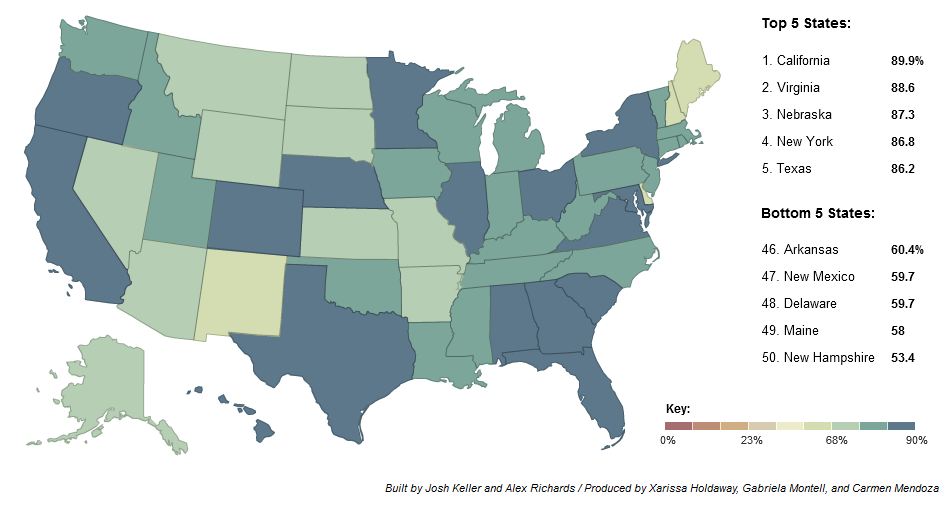
    It’s often tempting to refer to Virginia’s state legislature as an ignorant rabble, but that caricature is difficult to maintain in light of a Chronicle of Higher Education research report showing that 88.6% of the 140 members of the General Assembly have college degrees — the second highest level in the country. Only California ranks higher.

    Of course, California is vivid proof that there is not necessarily any connection between the educational attainment of legislators and the quality of their governance. Indeed, there may be an inverse relation between education and competence. The more degrees politicians have under their belts, the more likely they are to believe they know what’s best for lesser mortals — and the more tempted they are to meddle in things they know nothing about! Ninety-four percent of the members of Congress have a college degree or higher. Need I say more?

    Virginia legislators rank 3rd in the nation (after New York and New Jersey) for the percentage of lawmakers possessing an M.A. degree or more.

    And they rank 6th in the nation (following Delaware, Oregon, Georgia, Utah and North Carolina) for lawmakers possessing doctorates.

    College officials often complain that state lawmakers don’t understand the challenges of public universities because they either didn’t earn a degree or they earned one from a private institution. But the Chronicle‘s findings didn’t support those beliefs in Virginia, where 53% of lawmakers went to college in the state and most of those attended public schools.

    The schools with the highest representation of alumni serving in the General Assembly:

    University of Virginia… 24
    University of Richmond… 16
    Virginia Teach… 14
    Virginia Commonwealth University… 12
    College of William and Mary… 9
    Old Dominion University… 9
    Virginia State University… 5
    Virginia Union University… 5
    James Madison University… 5

    (Click on map for more legible image.)


  • The Wonk Salon: June 13, 2011

    Summer Learning, Summer Fun
    Rand Corporation
    Summer learning loss is a problem for all kids, lower-income ones especially. Developing summer learning programs in the current fiscal environment is challenging but feasible.

    * * *

    Find more than 240 studies and reports on public policy issues affecting states, metropolitan regions and communities. Peruse the latest research by topic category. Visit the Wonk Salon.


  • Chart of the Day: Where Does Virginia’s Air Pollution Come From?

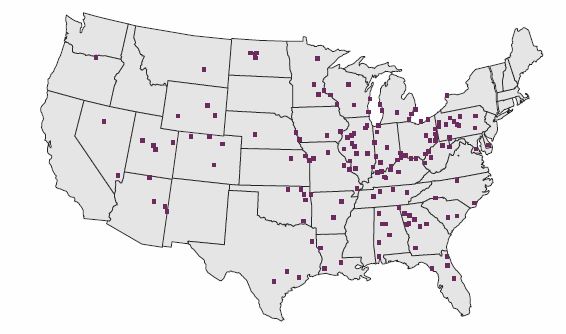
    A new Government Accounting Office report has mapped the locations of some 284 tall smokestacks, 500 feet or higher, around the country. The purpose of tall stacks, located primarily at coal-fired power plants, is to lift sulfur dioxide, nitrogen oxide, mercury and other pollutants high enough into the air that they can avoid concentrated pollution in the immediate area. But the pollutants are carried downwind and eventually settle in diluted form.

    And guess who’s in the path of all that pollution? Primarily the Mid-Atlantic states, Virginia in particular. I just report the facts. You can draw your own conclusions. (Click on map for more legible image.)


  • The Wonk Salon, June 12, 2011

    Cutting Higher Ed Spending: The Oklahoma Experience
    Oklahoma Council of Public Affairs
    Despite recent cuts in state subsidies, higher ed spending in Oklahoma universities is still higher than five years ago, adjusted for inflation and enrollments. Meanwhile, many students learn little, and many never graduate.


  • ENOUGH? and FUNDAMENTAL TRANSFORMATION

    Do you wonder why:

    โ— The US and about half the planets population is stalled in a Jobless โ€˜recoveryโ€™?

    โ— There is no sign of an end of decline in the price of dwellings and land held for speculatively Urban development?

    โ— Most citizens do not believe The Great Recession is โ€˜overโ€™ and most do not believe Bernanke when he says the โ€˜setbacksโ€™ are temporary?

    โ— The Wealth Gap has become the Wealth Gulf and grew WIDER during The Great Recession to date?

    โ— The Great Gambling Venue for the rich โ€“ and the lottery for the rest โ€“ (aka, the stock market) is continuing to re-decline?

    โ— There is growing hysteria among what Mr. Bacon calls โ€˜the political classโ€™ to find โ€˜solutionsโ€™ that will put off the need to face reality?

    โ— Among those who seek to carry Elephant Clan banner, candidate after candidate is failing to get traction and new candidate after new candidate is jumping into the fray?

    EMR suspects that all these things are indicators that there is a growing feeling that following the onset of The Great Recession, NOTHING WILL BE THE SAME.

    While most do not see The New Reality, a growing number can feel it.

    In a new Perspective titled โ€œENOUGH?โ€, SYNERGY explores the reasons behind why NOTHING will be the same โ€“ ever again.

    See the Executive Summary and Overview of ENOUGH? on the PERSPECTIVES page at www.emrisse.com