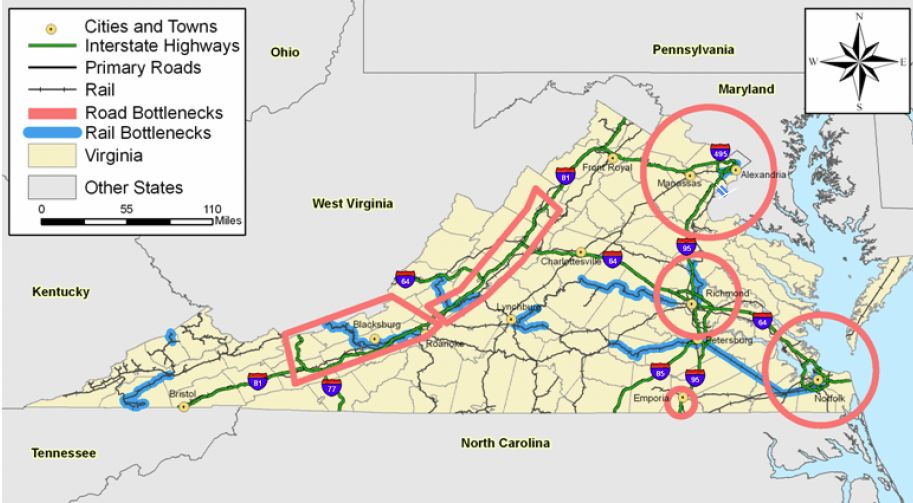
Click on map for more legible image of freight bottlenecks in Virginia.
by James A. Bacon
If Virginia finishes funding a slate of highway, railroad and port mega-projects designed to eliminate transportation bottlenecks and shift freight from highways to rail, some of which are already completed and all of which are underway, the state could reduce truck Vehicle Miles Traveled in congested conditions by 30%, creating more than $20 billion direct and indirect savings to the economy through 2035. So says Cambridge Systematics in a report presented to the Commonwealth Transportation Board (CBT) Wednesday.
The report identifies the following benefits:
Avoidance of potential future transportation and environmental impacts: pavement damage, safety, emissions ($4.7 billion)
Travel time savings due to reduced highway congestion ($6.6 billion)
Direct shipper cost savings from reduced highway congestion and increased use of lower-cost transportation modes ($6.4 billion in direct savings, $5.4 billion in indirect and induced savings, accruing inside and outside VA)
Unfortunately, the report does not list the cost of the improvements, much less a Return on Investment. Until the commonwealth begins ranking transportation projects by ROI — and makes transparent the method for calculating ROI — there is no way to rationally allocate public transportation funds.
I did have a chance to speak briefly to David Tyeryar, deputy secretary of transportation, who told the CTB that the Office of Intermodal Planning and Investment does perform ROI calculations on proposed projects. While OIPI can rank ROI for projects within each transportation mode — roads, ports, aviation, rail, mass transit, etc. — it does not maintain a master list ranking all projects.
Finally some encouraging news from Norfolk’s scandal-plagued light rail project, The Tide. Philip A. Shucet, the former VDOT commissioner who was drafted to bring order to the mismanaged project, gave a project overview yesterday to the Commonwealth Transportation Board. The good news: The 7.4-mile rail line is in the final phases of testing and is scheduled to open August 19.
The bad news — and this was news that Shucet revealed only in response to a question — is that the project will continue to be a drain on taxpayers. Based on current ridership projects, fare box revenues will recover only 8% of operating costs. Not only will taxpayers never get a dime back from the $338 million they paid in up-front capital, Norfolk citizens will be on the hook for millions of dollars yearly… basically for ever.
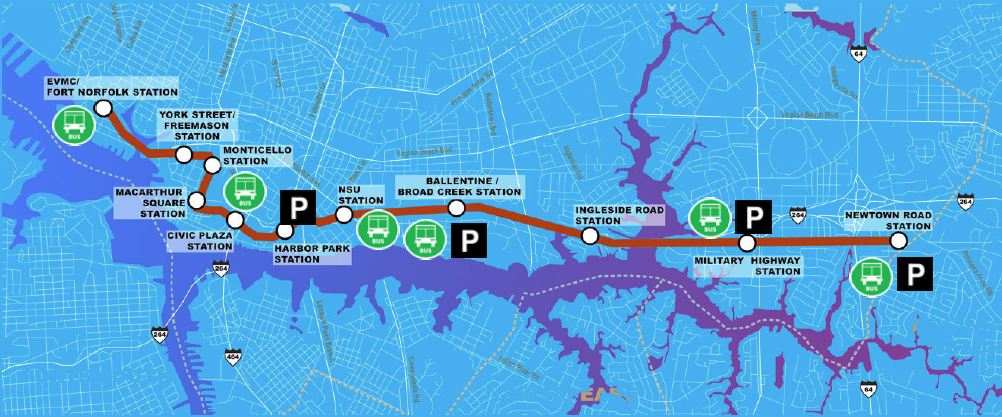
But, hey, the project is a cool one. The rail line begins near the Sentara hospital complex, runs through downtown and terminates at Newtown Road. The trains, powered by overhead electric lines, will traverse the distance in 24 minutes, stoppling at 11 stations along the way. (Click on map for more legible image.)
According to traffic estimates, there will be 2,900 weekday passenger boardings initially, and the number should grow to 7,000 by 2030. Shucet dangled the possibility, based on the experience of some other light rail systems, that those estimates could be low. Presumably, rail ridership will relieve some congestion on Norfolk’s streets and will spur transit-oriented development around the rail stations, which could further reduce automobile dependency in the years and decades ahead. Whether the project will generate a positive Return on Investment, even including the social and environmental benefits, is an open question.
Shucet said the City of Norfolk’s final tab for the project, which has been subject to some $50 million in cost overruns, is $66 million. The feds are chipping in $201 million, and the state $71 million. None of the CTB members asked the logical follow-up question to Shucet’s revelation that fares would cover less than one-tenth of operating costs: What will operating losses amount to? How much will Norfolk taxpayers be asked to cover on an ongoing basis? Inquiring minds would like to know.
Succumbing to public pressure, the Metropolitan Washington Airports Authority (MWAA) has back-peddled on its plan to build an underground rail station as part of the Rail-to-Dulles Metro rail extension. That will chop about $300 million off the $3.8 million price tag for Phase 2 of the project. But negotiations continue between federal, state and local authorities on what still needs cutting and how to pay for what remains. (See the WaPo account here.)
The MWAA board endorsed the framework of a deal brokered by U.S. Transportation Secretary Ray LaHood. It’s not clear from any of the reporting that I’ve seen whether that includes pushing for maximum competition in the construction bids by eliminating the requirement for a union-shop Project Labor Agreement. That move could potentially save another $300 million.
Maine Leads the Way in Market-Driven Health Care Heritage Foundation
Maine tried Obama-styled health insurance reforms and found they didn’t work. Now the Pine Tree State is trying market-based reforms.
Time for Progressives to Think Natural Gas Progressive Policy Institute
Want to get a fast, cheap, 10-20% reduction in U.S. greenhouse gas emissions? Back out oil- and coal-fueled electricity by fully utilizing existing natural gas power plants with excess capacity.
Public Sector Unions Influence Wages More than Pensions Center for Retirement Research
Pension benefits are legislated, not bargained, putting a premium on lobbying influence, not union membership numbers. But union clout does seem to influence bargaining outcomes for wages.
The McDonnell administration has pushed through $200 million in funding for the Charlottesville Bypass over strenuous local opposition. The big question: Will the bypass need a bypass five years from now?
by James A. Bacon
The Commonwealth Transportation Board (CTB) voted today to provide $197 million in funding to build the 6-mile Charlottesville Bypass and another $33 million to widen a 1.6-mile stretch of U.S. 29. The controversial bypass project is almost certain to receive final approval in August by the Charlottesville-Albemarle Metropolitan Planning Organization.
The vote represents a significant victory for the McDonnell administration, which lobbied Republican board members on the Albemarle County Board of Supervisors earlier this month to reverse its previous opposition to the project, thus creating an opening for the CTB deliberation. After years of transportation funding cutbacks across Virginia, the Charlottesville Bypass is likely just the first in a series of mega-projects likely to receive funding as the administration dispenses the proceeds from $3 billion in transportation bond issues leveraged, in many instances, by public-private partnerships.
Ironically, the project received its strongest backing from CTB board members from outside the Charlottesville area, while James Rich, representing the Culpeper transportation district of which Albemarle County is a part, spoke passionately against it. Business and civic leaders in Lynchburg and Danville deem U.S. 29 to be an economic lifeline for the region’s manufacturing sector, and they regard the severe congestion north of Charlottesville as a hindrance to their economic development.
Opponents accused the administration of moving too fast, with too little transparency, in doling out the money. The Charlottesville Bypass will be funded at the expense of other more pressing projects. “Virginia has many transportation needs competing for limited money, and shifting these funds will shortchange other projects statewide,” said Trip Pollard with the Southern Environmental Law Center. “That’s not sound planning, especially when there are far more effective and less costly alternatives to reduce congestion.”
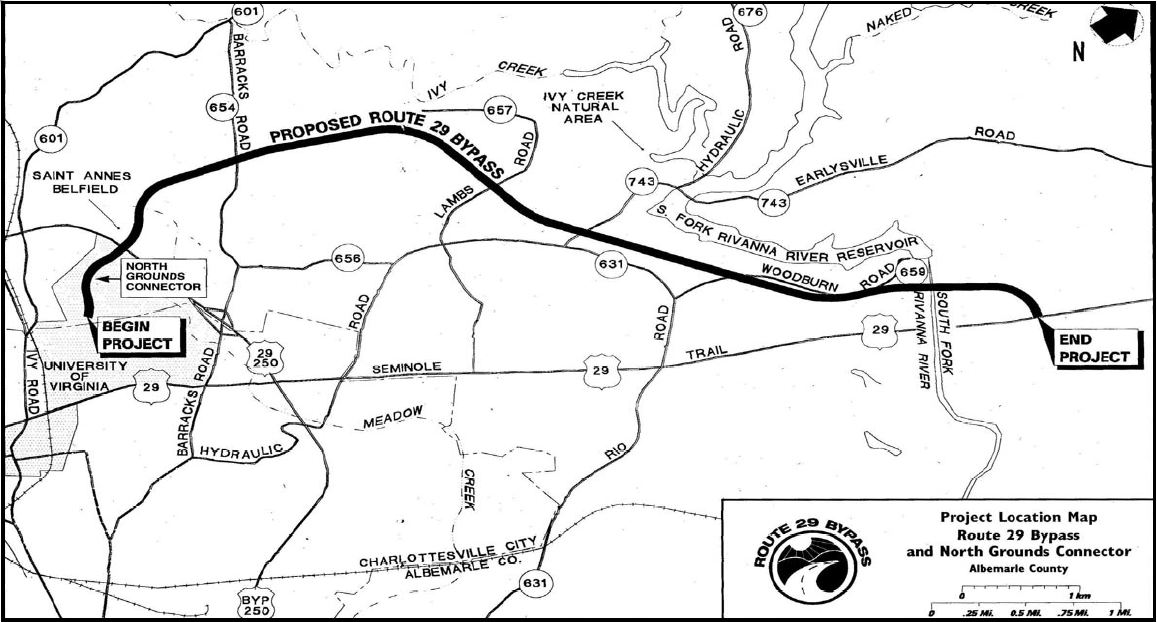
(Click on map for more legible image.)
The controversy highlighted an irreconcilable contradiction that plagues many of Virginia’s transportation corridors. On the one hand, U.S. 29 is a classified as a “corridor of statewide significance,” meaning that it plays a role in providing connectivity between urban centers. It is also a U.S. highway stretching from Pensacola, Fla., to Baltimore, Md. One stretch between Danville and Greensboro, N.C., is touted as “future Interstate 785.” On the other hand, the highway doubles as the primary development corridor in Charlottesville-Albemarle County. It is the location of 20,000 jobs, most of the region’s retail business and its largest residential real estate developments, accounting for 40% of the region’s tax base. Peak traffic reaches roughly 50,000 cars per day.
The lack of access controls along the U.S. 29 corridor means that anyone can build a strip mall, subdivision, office park or even a single-family home and connect directly to the highway. That practice, combined with Albemarle County’s decades-long policy of making it the count’s major growth corridor, has created nightmarish congestion. As one of the Albemarle dissenters summed up the dilemma in the public hearing, “It is not possible for a road to function as a highway and a commercial main street.”
In voting to fund the Charlottesville Bypass, the CTB board made clear its policy preference for maintaining the system integrity of the state’s corridors of statewide significance. “No one project is the solution,” said Doug Koelemay, representative of the Northern Virginia transportation district. “We need to look at all projects as a whole. We’re trying to make a system work.”
“This has gone on too long,” said Lynchburg district representative Mark Peake, alluding to the on-again, off-again history of the Bypass. “This is a United States highway, not the City of Charlottesville’s main street. … We’ve studied this for 20 years. We have the money now. Let’s do it!”
Because U.S. 29 is classified as a U.S. highway, it must be approved by the Charlottesville-Albemarle Metropolitan Planning Organization, but that should prove to be a formality. Two of the five MPO board members are Albemarle County supervisors who voted to rescind the county’s previous objection to the Bypass. A third is a VDOT official who answers ultimately to the Secretary of Transportation.
The 6-mile Bypass will run from Rt. 250 in the south to just north of the Rivanna River, bypassing about a 3 ½-mile stretch of U.S. 29 with 14 traffic lights. In a 1997 study, traffic was forecast to reach 24,400 vehicles per day by 2022, said James Utterback, Culpeper district administrator for the Virginia Department of Transportation. Utterback offered no estimate of how much travel time the Bypass would save.
Although there is a broad consensus that the $33 million allocated to widening a section of U.S. 29 is worthwhile, foes predicted that the $197 million spent on the Bypass will be largely wasted. The “bypass” is not even a bypass, they argued. It’s better labeled a “connector,” for it circumvents only half of the congested area. The “bypass” will dump travelers onto U.S. 29 just past the Rivanna River, where they will encounter many more miles of stop-and-go traffic. In the years ahead, congestion will only worsen as development continues to crowd the highway as far north as Ruckersville in Greene County. “In another five years, we’ll need to build another road to bypass the bypass,” predicted Albemarle resident Denny King during the public hearing.
Moody’s Rating Service is about to pull the rug from under U.S. Rep. Eric Cantor and Gov. Bob McDonnell. It’s about time they had a reality check but too bad it will be so expensive.
Moody’s says that Virginia is one of five states whose credit it might downgrade if the federal government misses its deadline to raise the debt ceiling and go into default. A primary reason is that Virginia depends very much on federal jobs given its proximity to Washington and its many military bases.
This may be news to Eric Cantor, the House Majority Leader, who is pushing a childish campaign to demolish any negotiated deal for raising the debt ceiling while addressing federal spending.
After voting for just about every budget hike George W. Bush presented, Eric the Boor, is now playing Tea Party by insisting on huge federal cuts while playing chicken with our future.
He seems to think that it is good politics to run head of the Tea Party parade while also servicing his biggest campaign donors, namely Goldman Sachs, Bank of America, Capital One Financial, and others. They all stand to pay more if some of Grand Bargains go through. Managers of billion dollar and largely unregulated hedge funds might have to (sniff, sniff) pay 15 percent extra in fees. The ultra-rich might have to pay more taxes. Imagine!
Bob McDonnell is trying hard to be our Jobs Governor. He says he’s created thousands of private sector jobs while balancing the budget.
He seems to forget just how dependent Virginia is on the evil federal government which might not be able to write checks after Aug. 3.
Both Cantor and McDonnell have made careers playing the anti-tax, anti-spending, anti-Washington game. It is make believe given the reality of the state’s true employment picture and who pays the bills.
Want to see how it affects you and me? If Moody’s takes us down a peg, then we’ll all be paying more for Transportation Secretary Sean Connaughton’s billions in bonds for questionable roads. Virginia’s years-old reputation will be squandered.
And who will have done it? The very people who claim to be the most fiscally responsible.
As I noted several weeks ago, if the federal government’s AAA rating is cut owing to skittishness over the debt ceiling, Virginia’s AAA rating could suffer as well. And now, Moody’s has made the possibility of such a downgrade quite clear:
— Moody’s Investors Service has placed on review for possible downgrade the Aaa ratings of the states of Maryland, New Mexico, South Carolina, Tennessee, and the Commonwealth of Virginia. In connection with Moody’s July 13 action placing the Aaa government bond rating of the United States on review for downgrade, Moody’s announced that it would assess the ratings of Aaa-rated states to gauge their sensitivity to sovereign risk. The review actions affect a combined $24 billion of general obligations and related debt.
Other states Moody’s rates as AAA aren’t on the list. So why Virginia, but not, say Alaska or North Carolina? I’ll let the bullet points do the talking:
• Sensitivity to national economic trends compared to other Aaa-rated states based on Moody’s Economy.com measure of employment volatility due to U.S. fluctuations: Above average
• Federal employees as a percentage of the state’s total employment: Above average
• Capital markets risk: Low due to a small amount of puttable variable rate debt outstanding
• Federal procurement contracts as a percentage of state gross domestic product: Above average
• Medicaid as a percentage of total expenditures: Below average
• Available fund balance as a percentage of operating revenue: Below average
While the ratings agency makes it clear that any downgrade of state debt like Virginia’s would be on a case-by-case basis, the points above still ought to be quite sobering for those who believe that Virginia — business friendly, well-managed commonwealth that it may be — controls its own fate. It does not.
Ultimately, it’s the fate of our impoverished Uncle on the Potomac that decides. Remember that as the resident political class beats its breast over its already spent budget surplus.
This is the stereotype of poverty in America. It’s also statistically rare and does not reflect a failure of the social safety net.
by James A. Bacon
Americans equate poverty with deprivation. Families wearing rags, living in tarpaper shacks, going hungry and lacking the basic tools to participate in mainstream American life — basically, the whole Great Depression “Grapes of Wrath” thing. A vast poverty industry perpetuates the notion that extreme hardship is not only common but spreading across the land and the progressive worldview of America as a fundamentally unjust society draws succor from it, so it is rarely challenged.
But “poverty” as usually discussed in the United States does not describe peoples’ actual living conditions, it describes their taxable income. People below a certain “poverty threshhold” are declared to be poor. But that definition is meaningless as a characterization of how people actually live because it excludes massive transfer payments and social services programs designed to cushion “the poor” from deprivation. Thus, Medicaid will spend $276 billion in federal dollars this year to provide health care services to the poor. Other mandatory programs (not including Social Security and Medicare), most of which are means tested, are budgeted for $713 billion. Transfer payments to the poor amount to $1 trillion in a $15.2 trillion economy. (Please note: Those numbers do not include Social Security, Medicare, discretionary federal funding for the poor, state Medicaid matching funds, state funding for the poor, or private charity.)
So, how do “poor” people live? What is their material standard of living? It varies, of course. Some truly are destitute, though that condition is usually the result of temporary misfortune, thus transitory, or the consequence of substance abuse. For the most part, the poor enjoy many of the same material amenities that middle-class Americans enjoyed a generation or two ago. That’s the message of a new Heritage Foundation report, “Air Conditioning, Cable TV, and an Xbox: What is Poverty in the United States Today?” Write Robert Rector and Rachel Sheffield:
In 2005, the typical household defined as poor by the government had a car and air conditioning. For entertainment, the household had two color televisions, cable or satellite TV, a DVD player, and a VCR. If there were children, especially boys, in the home, the family had a game system, such as an Xbox or a PlayStation. In the kitchen, the household had a refrigerator, an oven and stove, and a microwave. Other household conveniences included a clothes washer, clothes dryer, ceiling fans, a cordless phone, and a coffee maker.
The home of the typical poor family was not overcrowded and was in good repair. In fact, the typical poor American had more living space than the average European. The typical poor American family was also able to obtain medical care when needed. By its own report, the typical family was not hungry and had sufficient funds during the past year to meet all essential needs.
Poor families certainly struggle to make ends meet, but in most cases, they are struggling to pay for air conditioning and the cable TV bill as well as to put food on the table. Their living standards are far different from the images of dire deprivation promoted by activists and the mainstream media.
Destitution does exist. But it’s usually the result of substance abuse. I’ve visited the houses of poor people that are spare but livable. And I’ve seen crack houses where every stick of furniture, indeed every belonging but a mattress, has been hawked or pawned for cash. The latter is a tragedy for those involved, especially innocent children, but it does not represent a failure of American society, nor should it justify increased entitlements during a period of fiscal austerity.
More common, I would wager, are instances in which people game the system. They get themselves declared disabled, then earn cash on the side as carpenters, hair dressers, landscapers or whatever — never reporting their income. But the poverty lobby isn’t the slightest bit interested in these cases. For those who make a living in the compassion industry, the more poor people the better.
In the 1980s, two University of Pennsylvania criminologists published a research study on the impact of mandatory arrests in cases of domestic violence in Minneapolis, Minn. They found that the arrests led to lower rates of domestic violence. Based on that one study, police departments across the country began instituting mandatory arrests. But experiments conducted in other cities found mixed results. In Omaha and Charlotte, violence increased.
Therein lies a cautionary tale. The logic is slowly sinking in among legislators that it’s a good idea to base public policy on the evidence. It’s good to ask the question, “Does this policy do what it’s supposed to do?” But not all systems for measuring results are created equal.
A new paper by David D. Muhlhausen with the Heritage Foundation argues that Congress should invest a bit more not only to measure results of its programs but to measure them according to the precepts of methodologically sound social science. His logic applies equally to the General Assembly.
Mulhausen advocates the “gold standard” of evaluation designs: Setting up control groups, randomizing the assignation of individuals to those groups, and conducting experiments in multiple locations. To do otherwise, is to risk reporting ambiguous results and nullify the whole purpose of conducting the experiment. He recommends the following: (1) New or reauthorized programs should specifically mandate experimental evaluation of the program; (2) the experimental evaluations should be large-scale, multi-site studies; (3) legislators should specify the types of outcome measures to be used to assess effectiveness.
To do otherwise is to base public policy on anecdotal evidence — typically in a political context in which self-interested parties are usually the ones generating the anecdotes. Testimony orchestrated by special interests simply cannot be trusted to provide an accurate depiction of reality.
A less well-known ratings agency, Egan-Jones, has downgraded the federal government’s debt from AAA to AA+. The report explaining why can be found here. If you’re not a client, Zero Hedge has the press release, complete with charts, which gives you a solid understanding of the report’s contents:
We are taking a negative action not based on the delay in raising the debt ceiling but rather our concern about the high level of debt to GDP in excess of 100% compared to Canada’s 35%. Nonetheless, since the US’s debt is denominated in dollars, a hard default is unlikely.
So the mummery behind the debt ceiling talks has little to do with the government’s fundamentals, which are only getting worse. This additional item is worth remembering as doomsday (or at least doomsday as it is preached in the press) approaches:
Egan-Jones does not view a country’s ability to print its own currency as a guarantee against default. Additionally, Egan-Jones generally views cases of excessive currency devaluation as a de facto default.
Based upon that last bit, one could argue that the Federal Reserve’s mass printing of money over the last several years has effectively rendered the United States a larger version of Zimbabwe.
File this under the heading of Fundamental Governance Reform. In a recent edition of the “Utne Reader,” Kirkpatrick Sales makes the case that the optimal size of a successful independent state is somewhere between 3 million and 5 million. By his logic, the United States is massively dysfunctional. Even Virginia is too big for its own good. (Maybe we’d all be better off in Northern Virginia did secede from the commonwealth!)
Were it not for the problem of national defense, I’d be all in favor of breaking up the country into smaller pieces. Fifty independent states would not do a very good job of keeping world sea lanes open for global trade. Otherwise, Sales’ argument reminds me of one that the urbanist Jane Jacobs once made (as I best recollect it), that maintaining a unitary currency, fiscal policy and monetary policy for a nation as diverse as the United States cannot possibly benefit all regions equally. Each region would be better off, she contended, it if could optimize its own mix of economic policies. Inspired by fiscal crises in the PIIGS countries, much the same debate is taking place in Europe today.
(Hat tip to EMR, who is too engaged in his “Enough?” project to do much blogging himself.)
Polish workers in London waiting on street corner for casual work
by James A. Bacon
I have long maintained that the flood of unskilled immigrants (whether documented or not) into the United States has had the effect of depressing the wage rates for unskilled American workers. It’s a matter of simple supply and demand: More competition for the same number of jobs drives down the compensation that unskilled laborers can demand.
But a new study of European labor markets suggests the analysis should be more nuanced, especially when viewed over a decade-long time horizon. I hate as much as the next guy to admit that I might be wrong, but I also try to remain open to new evidence and new logic. This study, “Immigration, Jobs and Employment Protection: Evidence from Europe,” compels me to question my earlier position.
By way of background, Western Europe saw a surge of immigration in the decade preceding the Global Financial Crisis that pushed the foreign-born population from 8% to 12% — very comparable to the impact of immigration in the U.S., where the percentage rose from 10.6% to 13.6% over the same period.
The authors, Francesco D’Amuri and Giovanni Peri, scrutinized the employment data to see whether the inflow of immigrants to 14 Western European countries decreased employment rates and/or if it altered the occupational distribution of natives with similar education and age. They found no impact upon native employment rates but significant evidence of a shift in occupations. Immigrants took “simple” (manual-routine) occupations and natives moved toward more “complex” (abstract-communication) jobs. Overall, the authors write, “immigration stimulated job creation, and the complexity of jobs offered to new native hires was higher relative to the complexity of destructed native jobs.”
They added one important addendum: The reallocation of natives to new, more complex occupations was significantly larger in countries with
more flexible labor laws. The tendency was particularly pronounced among less educated workers.
The question then arises: Could the same trend have held true in the United States? Did the flood of immigrants into unskilled and semi-skilled jobs act as an impetus for native-born Americans to raise their levels of educational achievement, engage in more training, and/or move up the occupational ladder? If the European pattern prevailed here, then immigration could have goaded native-born Americans to improve themselves. From a metaphysical standpoint, the implication is even more startling: It could mean that I was… wrong.
In support of the idea that immigration had the a similar impact here as in Europe, the U.S. has very flexible labor markets, making easier here than in some European countries for workers to move from one job sector to another. On the other hand, there are important unknowns. Does the uneven quality of the U.S. education system mean that some Americans are equipped to make the occupational transition while other Americans, the product of under-performing schools, lack the requisite skills to migrate to more “complex” jobs?
For the moment, we have to leave the question unanswered. The study did not analyze the U.S. data. So, I am not yet prepared to concede that my previous analysis was wrong. However, I must confess, D’Amuri and Peri identified a critical variable that I had overlooked.
The New York City school system performed a fascinating experiment over the past three years. The goal: to see if paying bonuses to school teachers and staff might spur educators to change how they teach enough to improve students’ educational achievement. There are some object lessons for Virginia, where legislators bandy about the idea of performance bonuses as an option for school reform.
The city set aside a $50 million pot of money to be distributed over three years to 200 or so schools (the precise number varied from year to year). The goal was to test the proposition that an incentive pay system would motivate educators to change their practices to ones more likely to improve student achievement, explains the Rand Corporation in a report, “A Big Apple for Educators,” summarizing the program.
Three years and $50 million years later, the measured effect on student achievement was indiscernible. But that doesn’t mean the experiment was a failure — it yielded knowledge on how not to structure a performance plan.
Given the egalitarian ethos of educators in New York City schools, roughly two-thirds of the schools chose to divvy up their bonus, if they won it, between all teachers and staff, regardless of individual performance. Thus, the bonus amounted to roughly $3,000 per person. Even schools that differentiated between individuals on the basis of absences or unsatisfactory staff ratings “generally remained cautious about deviating from egalitarian awards,” Rand reports, and slated 74% of the staff for the modal award amount. In other words, nearly all the bonus money was paid for collective performance.
Here’s the real kicker: While teachers and staff expressed a strong desire to win bonuses, “many winners reported that, after taxes, the bonus seemed insignificant. In fact, almost one-half of the teachers … indicated that the bonus was not large enough to motivate extra effort.” Consequently, Rand reports, the bonuses had no effect on teacher-reported attitudes, perceptions and behaviors, and they had no effect on student standardized test scores.
Bacon’s bottom line: If you want to improve performance by motivating teacher to intensify their individual effort, you need to make the bonuses big enough to matter. Spreading around the bonuses to everyone in the school is plain idiocy if you don’t have a clear alternative model you’re coaxing them to buy into. Just handing out money and hoping for the best doesn’t work.
How Disadvantaged Schools Use Title I Funds Government Accountability Office
School districts mainly use their federal Title I funds for improving student-teacher ratios, extending instructional time, professional development and the purchase of technology.
Putting Washington Money to Work for Washington Demos
Parking state tax revenues in a Washington Investment Trust, not the big money center banks, will underwrite the expansion of business in the state of Washington.
I’m normally not one for sermonizing. Hellfire-and-damnation preachers have been lamenting the moral decline of America for the past, oh, 300 years, and yet we survive. But sometimes I wonder. Could our country be experiencing a moral decline? It certainly feels so.
Let me make one point really clear. I don’t equate “moral” decline with a decline in god-fearing religion. I am, after all, an atheistic-leaning agnostic. But one can be an atheist-agnostic and still lament the disparagement of the old bourgeois virtues as enshrined in the University of Virginia’s honor code — you shall not lie, cheat or steal — and find despair in the normalization of depraved behavior. Let me offer four data points from the headlines of today and yesterday that inspired this jeremiad.
Teachers in Atlanta, Baltimore, Philadelphia and Houston stand accused of boosting standardized test scores by such means as correcting student papers and even helping students cheat themselves. As scary as the cheating itself is the excuse-making that followed. Said one Robert Schaeffer, public education director of the National Center for Fair and Open Testing, as quoted in the Washington Times: “The teachers and principals who changed test scores did something unethical and probably illegal, [but they were] caught between a rock and a hard place. We’ve created a climate that corrupted the educational process. The sole goal of education … became boosting scores by any mean necessary.”
That’s right — the cheaters are really victims of society’s unreasonable expectations. It comes as little surprise, then, that the American Association of School Administrators decided not to retract the “Superintendent of the Year” award given to Atlanta school superintendent, Beverly Hall, in 2009. “No charges have been brought,” said an AASA official. “There’s no conclusive evidence that she’s been found guilty of any kind of unethical behavior.”
A related phenomenon is the spread of plagiarism, which happens to be the topic of an essay by Thomas Bertonneau, a professor of comparative literature:
Plagiarism is one more index of the long- heralded Decline of the West. More and more students go to college; fewer and fewer of them are actually capable of rising to the higher learning. Colleges and universities, operating by the enrollment economy, actively seek students and bend or ignore admissions criteria to recruit them in numbers. Aggressively cynical and uncivilized, the popular culture promotes crass self-interest and narcissism.
The sitting vice president of the U.S.A. once, when a senator, plagiarized a campaign speech from his British member-of-Parliament counterpart, but he is the sitting vice president of the U.S.A. … Rampant plagiarism is an alarming moral problem. The destruction of shame makes theft and fraud thinkable options for an increasing number of students.
Ah, the destruction of shame. I think Bertonneau is on to something. The trait of being “non-judgmental” is widely deemed a prime virtue today. But when no one judges another’s behavior, shame disappears. When shame disappears, society loses its main sanction against all manner of vice.
Now, let’s move on to the normalization of depravity. The Huffington Post‘s “weird news” carries a story about the arrest of three brothers in a small Minnesota community for allegedly murdering their mother. States the account: “Jacob Cobb, 17, allegedly strangled mom Tamara Lee Mason on the living room floor when she suggested that her sons play the board game [Yahtzee] … last Christmas.” The boys hid their mother’s remains in a garbage can in a shed until the frozen ground softened enough to bury her in the backyard.
“It is very strange,” said Stevens County Sheriff Randy Willis. “She wanted to play Yahtzee and they didn’t. That seemed to be, in their minds, what expedited her sudden demise.”
Weird? Strange? It strikes me that we have raised a generation of sociopaths. These weren’t urban youth raised in a single-family household with a crack whore for a mother, whose despicable behavior would inspire all manner of excuse-making and cries for forgiveness. They were (to all appearances) small-town, middle class kids.
One final story, this one also from the HuffPo: A Southern California woman was arrested for cutting off the penis of her estranged husband. Catherine Kieu Becker allegedly prepared dinner for her husband and drugged him to make him drowsy. While he slept, she tied him to the bed. When he awakened, she cut his penis off with a knife — and here’s the piece de resistance — “threw it into the garbage disposal, turning it on as she did so.”
It has been nearly 20 years since the infamous Lorena Bobbitt chopped off her husband’s penis in a fit of spontaneous rage. A jury found her not guilty due to insanity arising from sexual, physical and emotional abuse. Her husband, Wayne Bobbitt, had his penis surgically reattached and proceeded to take a feature role in two porn movies. His brief porn career lead to a stint on World Wrestling Federation’s Monday Night Raw television program in the company of another porn star who had almost had his penis dismembered.
The Bobbitts gave us a two-fer — (1) a jury could not hold Lorena responsible for her action on the grounds of temporary insanity, and (2) the absence of shame in our culture enabled her violent, philandering husband to trade on his notoriety. After two decades of therapeutic blame avoidance, Ms. Becker’s case has not inspired anywhere near the shock and controversy that the Bobbitts’ did. Indeed, where Lorena threw her husband’s penis out the car window, she at least felt remorseful enough to later retrieve it. By contrast, Ms. Becker, tossed the offending organ in the garbage disposal, flipped the switch and then, when the police arrived, told them that her husband “deserved it.”
In mining the rich vein of dishonesty and corruption, I would be remiss not to mention Wall Street, a moral cesspool if ever there was one. The new ethic in America’s financial sector today: “If it’s not illegal, it’s OK.” Even if it is illegal, serve your time in jail, give a portion of your ill-gotten gains to charity and hire a publicist to get you on television. We are, after all, a country without shame. We will eagerly rehabilitate anyone’s reputation (unless the offender is a politician of the opposing party, in which case the old rules still apply).
What, then, becomes of a country in which educators set the most reprehensible example for our youth, in which the most successful know no bounds in their quest for the accumulation of wealth? What becomes of a society in which no one can be trusted and, therefore, no one trusts one another? What becomes of a country that has not only defined deviance down, but has all but abandoned the idea that deviance even exists? Is there any hope for us?
The year: 2075. The American colonies on the Moon are getting restless under Washington’s tyrannical rule….
This second edition of “Dust Mites” has a snazzy new cover, includes helpful lunar maps, and is 5,000 words tighter than the original. The sequel, “Trogs,” is scheduled for publication this summer.
Advertisement
Advertisement
Advertisement
Advertisement
About
Bacon’s Rebellion is Virginia’s leading politically non-aligned portal for news, opinions and analysis about state, regional and local public policy. Read more about us here.
Fund the Rebellion
Shake up the status quo! Your contributions will be used to pay for faster download speeds and grow readership. Make a one-time donation by credit card or contribute a small sum monthly.
Can’t wait until tomorrow
For your Bacon’s Rebellion fix?
Enter your email address to receive immediate notifications of new posts by email.
SUBSCRIBE
Search Bacon’s Rebellion
Categories
Archives
The Jefferson Council
Protecting Thomas Jefferson’s Legacy at the University of Virginia
Forgot Your Password?
Shoot me an email and I’ll generate a new password for you.