The Laughable Fiction of Travel-Demand Forecasts

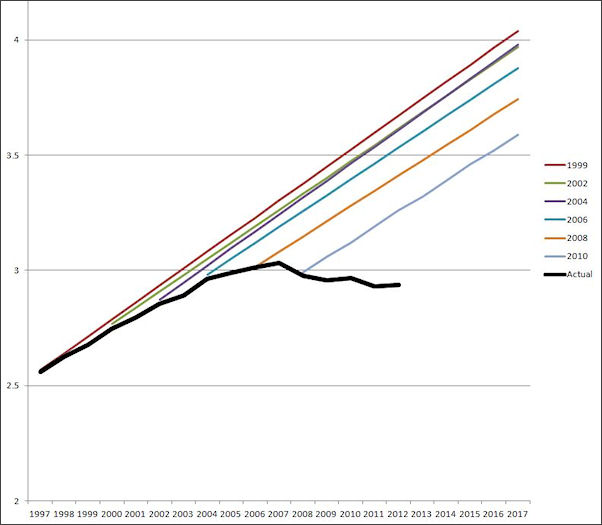
U.S. VMT (in trillions) as tracked by FHWA’s Travel Volume Trends (“Actual”) and as projected by U.S. DOT’s C&P reports (by year reports are dated). Source: State Smart Transportation Initiative.

by James A. Bacon

The Virginia Department of Transportation and regional transportation planning organizations periodically make traffic forecasts for planning purposes. The idea makes sense in the abstract — estimating future volumes of traffic is needed to determine how much, and where, we should invest in new transportation infrastructure. Unfortunately, the process is flawed. Estimates have consistently overshot the mark in recent years, feeding the sense of transportation “crisis,” justifying the construction of uneconomical projects and feeding the clamor for higher taxes.

The problem is hardly unique to Virginia. The U.S. Department of Transportation has been consistently overestimating traffic volumes for years, though rarely so egregiously as in the past  year. In its 2012 Conditions and Performance Report to Congress issued December 2012, USDOT projected that Vehicle Miles Traveled in the U.S. would reach 3.3 billion. Turns out the estimate was about 11% too high. Think about that: Eleven percent off in just one year!

The Frontier Group decided to compare past USDOT projections with real-world performance. The result was the graph shown above. Writes Eric Sunquist with the State Smart Transportation Initiative: “The rolled-up trend estimates show essentially the same slope year after year, indicating that agencies providing [Highway Performance Monitoring System] data generally have not updated their models and assumptions to account for current conditions, as if they expect the year to be 1980 forever.”

Projecting long-term traffic forecasts is bad enough. Acting upon those forecasts is foolhardy. There are just too many unknowns to take the forecasts seriously. Will the price of gasoline go up or down? Will Millennials continue to reside in urban centers, sticking to their buses and bicycles as they get older, or will they move to the ‘burbs and embrace the auto-centric lifestyle? What impact will smart-cities technology have on relieving traffic congestion? Which transportation mode will innovate faster and gain more transportation market share — cars, bicycles or mass transit? How will economic restructuring affect the distribution of jobs? Will new technologies enable more people to work at home? Will driverless cars make long-distance commuting less onerous and more popular? Will developers continue building green-field projects on the metropolitan periphery or will they shift to infill and re-development? We can guess the answers but we cannot know them. And we don’t have a clue how the trends might interact in unexpected ways.

There’s one other reason to regard predictions of infinite increases in traffic and congestion with suspicion. In personal correspondence, Barry Klein, president of the Houston Property Rights Association, invokes the work of transportation theorist Yacov Zahavi to suggest why the traffic modeling systems used in Houston are thoroughly inadequate: When congestion intensifies, people change their behavior. “Travel models,” Klein writes, “historically have not included a ‘feedback loop’ so the reactions by road users when confronted with congestion was not reflected.”

Congestion is a subjective experience and people have different levels of tolerance for it. … When individuals perceive themselves to have an intolerable congestion problem they usually find a way to resolve their problem. This phenomenon is unacknowledged by transportation planners. …

Here are three examples of how individuals in different social roles adapt their use of the road network and allow the commute time to stay under half an hour. Workers often-times relocate (not hard for renters), adjust their work hours and even change employers when traffic becomes irritating. Employers will relocate to parts of the region that are less congested or that put them close to the workforce that they desire. Retailers play a role, because of their habit of looking for under-served pockets of consumers and then set up stores in their proximity, which incidentally reduces congestion by giving consumers shorter shopping trips. 

All these factors combine to disperse traffic over the road network. They each play a role in the on-going, unplanned but never ceasing trends that mitigate congestion. 

People adapt in other ways. As traffic congestion increases, people are more likely to avail themselves of alternatives to the automobile: walking, biking, riding mass transit or working at home. Developers respond to the increased demand for convenience by building housing where more transportation options are available. Employers implement Transportation Demand Management strategies. The list goes on.

Bottom line: Long-term traffic forecasts are a fiction. Rather than spending billions of dollars expanding the transportation network in anticipation of travel demand that may or may not materialize, we should focus short-term on addressing demand that demonstrably exists right now and longer-term on achieving a better balance of land uses that generates fewer and shorter trips.


ADVERTISEMENT

(comments below)


Comments


Comments

19 responses to “The Laughable Fiction of Travel-Demand Forecasts”

  1. DJRippert Avatar

    There is no fiction to the fact that vehicle miles traveled increased 500 billion miles per year between 1997 and 2007 – as your chart clearly documents.

    During that period, Virginia was in year 11 – 21 of its frozen gas tax.

    It really wouldn’t matter if VMT “flatlined” in Virginia for the next 10 years. We are so far behind in transportation funding we’d need that much time and money just to catch up.

  2. DJRippert Avatar

    “When individuals perceive themselves to have an intolerable congestion problem they usually find a way to resolve their problem.”

    If that were true, congestion would solve itself. It does not.

    1. Tysons Engineer Avatar
      Tysons Engineer

      Except it does via land use changes. Eventually outer zones stop allowing so many rezonings because the marketability of the outer zone even initially shows that it is inhabitable.

      In other words, the development patterns of suburbia for too long have been pulling the wool over the eyes of new home buyers. They show up to the new utopian outerland, and see, oh, this price is 100k less and only 3 minutes further than the one right down the road closer to my job where all that real traffic is.

      Then comes 3 years later, where that outerland is actually now smack in the middle of the traffic mess and that 3 minute addition is now another 15 to 20 minutes on top of their old commute and people realize that this wasn’t what they signed up for. So they demand and cry for more transportation and wider highways (unknowingly destroying the community fabric they lived in by adding onramps and uncrossable road sections where just a few years earlier their children may have walked to school).

      That of course works for a year, until the developers at the hinter can restart the process by promoting how simple and easy it is to get to point A, and simply live 3 minutes further out.

      Rinse, lather, repeat -> economic destruction of all things non-strip mall

      Take out that cycle, and you find the places that have good commutes often slowed that cycle by absorbing population increases with more infill and redevelopment projects. More people living closer in means more of a focus on local first solutions.

      1. DJRippert Avatar

        Hmmm….

        “Suburban” Fairfax County is 7 times bigger than the “city” of Richmond but has more than twice the average population density.

        Which one is really the suburb?

        Congestion at the Woodrow Wilson Bridge did not end through land use changes or by waiting for VMT to decline. It ended once billions of dollars were spent to re-engineer the roads around that bridge.

        The only city in Virginia is Arlington / Alexandria – and I had to concatenate two jurisdiction (one county and one independent city) to get that one city.

        “Take out that cycle, and you find the places that have good commutes often slowed that cycle by absorbing population increases with more infill and redevelopment projects.”.

        Where do you believe this has been achieved?

      2. re: ” Then comes 3 years later, where that outerland is actually now smack in the middle of the traffic mess and that 3 minute addition is now another 15 to 20 minutes on top of their old commute and people realize that this wasn’t what they signed up for. So they demand and cry for more transportation and wider highways (unknowingly destroying the community fabric they lived in by adding onramps and uncrossable road sections where just a few years earlier their children may have walked to school).”

        100% correct. The folks down Fredericksburg way who commute to NoVa bitterly complain no only that too many “come here’s” are “ruining” the “rural character” of our area but that ‘something has to be done” about their commute because it’s gotten terrible.

        Mind you the biggest complainers say they had “no choice” but to move to the exurbs and they also have “no choice” but to commute solo every day from the same origin to the same destination”.

        they are similarly outraged that the HOT lanes will be tolled instead of getting rid of HOV and just adding more “free” lanes .. to ‘spread out” the flow.

        People make choices where they live relative to where they work but it does have consequences in places that are growing – more people more cars, more congestion.

        but it is the house that brings them to the exurbs… and the “expense” of the commute is not really recognized until after they get the house and settle in to the commute which as TE says – get worse, not better.

  3. I mostly agree with Jim and his sources on this although anyone who thinks congestion does not exist or will “fix” itself needs to visit NoVa, their beltway and I-95 through the DC/Va/Md region extending to the exurbs.

    but I’m skeptical of attempts to develop prioritization schemes because there are so many moving parts … transportation is not a road – it’s a network.

    You can “relive” congestion on one road or segment but not on the network because the congestion just gets “pushed” to the next chokepoint.

    I-95 between DC and Fredericksburg at about 6:30am on a weekday is a monster but there is so much volume that to really add benefit you’d have to add 2 or 3 new lanes the whole distance and think about what that would mean. Every bridge, every interchange, everywhere some company had built next to I-95 would have to be addressed. The public has not accepted the reality but Va/VDOT did some time ago and that’s why they decided on a congestion management concept – HOT lanes rather than try to significant new free lanes…

  4. If you only look at limited sample set then yes, using a short term data set to point to a long term trend will seem ridiculos. But might I suggest a longer term data set for a long term forecast. Your chart only shows data from 1997 to present. The Great Recession is clearly visible. Here is a VMT dataset that goes back to 1970. I challenge you to create the same chart with this data – http://www.fhwa.dot.gov/policyinformation/travel_monitoring/historicvmt.cfm

    I think it will paint quite a different picture. Bottom line, the current economic slump will not last forever. Now that does not mean people travel behaviors are not changing. But to conclude that we have somehow hit a ceiling on travel demand based on 15 years of data – 5 years years of which is the largest economic slump since Great Depression is flawed. My $.02.

    1. BOTB, I am not arguing that “we have hit a ceiling on travel demand.” Far from it. Certainly not in a fast-growth region like metropolitan Washington. What I am arguing is that the traffic projections used to justify mega-billion dollar transportation projects severely exaggerate the problem.

      Will travel demand pick up as the economy regains momentum? Undoubtedly. Will it resume growing at the same rate as in the 1990s and early 2000s? I’m dubious. But, as I argue in the post above, so many things are changing — demographic shifts, cultural preferences, economic trends, new technologies — that we don’t have a clue. The official travel forecasts are a not-so-scientific wild-assed guess.

      There is one thing we do know with fair certainty — the level of traffic congestion that we experience right now. My argument is that we should direct resources to fixing here-and-now congestion rather than congestion that may or may not materialize 20 years from now.

  5. I’m persuaded by this argument. The recovery, as they say, has been “weak” and not robust and probably is tracking the lower VMT.

    and I’d also step a little further and somewhat challenge the idea that “congestion” necessarily harms the economy. Congestion is a “cost” just like gasoline is a cost and when mobility costs “more”, people and businesses tend to compensate by getting more efficient.

    for instance, people buy more fuel efficient cars – and take other actions to reduce the impact of congestion – like taking mass transit or altering work hours, etc.

    But here’s a question for those that are familiar with VMT – how does VMT measure conversion from solo to mass transit? The VMT of a 4 person carpool is 1/4 the VMT of 4 solo-driven cars. even more dramatic with a van pool or bus or commuter rail.

    and again, please note how Va and VDOT chose to respond to congestion on I-95 – instead of building more free lanes – they chose to manage congestion with HOT Lanes. How does that factor into year-to-year measurement of VMT?

  6. Two examples affecting Loudoun County of misleading, potentially costly transportation projections of VDOT:
    — its projections for traffic on Route 15 at the Point of Rocks (Potomac River) bridge, which contrast with Maryland’s own lower projections;
    — its projections of future north-south traffic from Prince William County into Loudoun that VDOT believes require the Bi-County Parkway, in contrast to transportation expenditures to reduce the known and vexing east-west congestion in Loudoun.

    The development community, heavy donors to Loudoun’s Board of Supervisors, bets on and endorses the VDOT projections.

  7. but people… if you believe the libertarian types say that people make rational choices …..

    but as pointed out up thread – people knowingly move to an exurb based apparently on an expectation that the commute time when they looked at their planned house purchase was not going to change/get worse.

    How reasonable is that expectation?

    but we seem to orient our transportation planning policies to respond to that behavior – sometimes.

    I have yet to understand how or why VDOT goes about determining if a prospective road should be planned as a free road or a toll road.

    Why the HOT Lanes, the Pocahontas Parkway and Hampton Tunnels but not the Bi-county parkway?

    why not compare two versions of the road for traffic modelling? One as a free road and one as a toll road (with various static and dynamic tolls)?

    why not plan all new roads to be dynamically tolled roads (that allows near free passage at uncongested periods)?

    VDOT’s approach to this is uniformly not discussed..as far as I can tell.
    The public has no clue about how this is decided.

  8. Don questions Barry Klein’s statement that when confronted with congestion, people usually find a way to resolve their problem. “If that were true,” Don says, “congestion would solve itself. It does not.”

    I agree and disagree with Don’s response. He is correct to say that congestion does not “solve itself.” Congestion remains. It does not magically go away.

    The larger point that Don is missing is this: When congestion occurs, enough people change their behavior that traffic does not continue increasing in a straight-line progression — which was the point that I was making in the post.

  9. Here’s an interesting perspective on road funding and congestion:

    “Road pricing and asset publicization: A new approach to revitalizing US infrastructure”

    the long and short of it – is to lease out existing non-tolled roads and turn them into tolled roads with concessionaires doing the tolling and the state getting
    a cut of the revenues – that they will then use to build more roads.

    so on a given road – you’d eventually reach a kind of equilibrium between traffic demand and what people are willing to pay so the revenues would “top out” and you’d then have a fairly predictable and steady source of revenue to supplement existing gas taxes – to add capacity to congested roads.

    In other words, congestion would start to pay for itself.

    see the article at:

    http://www.aei.org/papers/economics/road-pricing-and-asset-publicization-a-new-approach-to-revitalizing-us-infrastructure/

    I’m quite sure neither the Smart Growth nor the anti-toll folks will find this appealing but it does seem to have a symmetrical way of reflecting congestion and providing funding to deal with it.

    I’m sure the cynics won’t agree…

  10. FYI: Although Mr. Bacon does not allow blogs which don’t immediately relate to Virginia, there are many aspects of this discussion which have been tried and adapted or discarded in other countries and states For example, the United Kingdom tested a per-mile tax years ago and felt it was unworkable in practice and one of their transport economists, Stephen Leake, suggested that vehicles be taxed by efficiency so that, for example, walking is 100 percent efficient and a 8,000 pound Hummer with an 80 pound driver is one percent efficient. Both methods, it is easy to see, create more effigy than our per-gallon tax (which the Brits also have), but neither proved workable and enforceable in practice.

    Any kind of reasonable analysis would conclude that DOT’s will tend to overestimate future travel demand simply because increased future demand is the best “hedge” to protect DOT jobs today. Any awareness of transportation research would also indicate that American DOT’s — and their consultants — will come up with incredibly specific, yet almost entirely useless, data. “Stated preference” data, for example, constantly tells planners that people say they’ll use transit IF this or that expensive upgrade is added but new ridership usually fails to appear once that expensive infrastructure is built. It’s to the point that jurisdictions say in their RFP that the MPO (or city or county) knows that stated preference data is useless but then demands stated preference data. Other countries, realizing this issue, work to make driving more difficult in concert with improving, and researching, alternative transportation. Here, — as is happening this week — we increase the federal subsidy for parking and decrease it for transit while complaining loudly that more people should use transit. We, as in Uncle Sam, provides three in four dollars for local road construction but force local transit companies to match public money dollar for dollar in any capital improvement projects while refusing to allow federal funds to be used for any transit operating expenses.

    DOT evaluators, of course, knowing all these kinds of things, predict a consistent increase and, as the graph illustrates, a straight line increase in VMT.

  11. well Jim himself has blogged numerous times on mileage tolling.. with the toll rate itself keyed to the efficiency of the vehicle but the idea of having (much lower) tolls for people who walk or bike… and tolls for vehicles much higher.. is interesting.

    there is a fine line between a legitimate user fee and trying to use taxes to reward or penalize behaviors – or having them perceived as being used that way.

    Most folks are now going to go along with a mileage metering device in their car that the government “checks” .. que the NSA et al and most people are going to rebel against the idea that they would be penalized for driving “too much”… by the govt.

    the problem with transit funding is that most folks see road funding as coming from a user fee that directly connected to the mode of travel and cars pays gas taxes and transit riders do not pay an equivalent tax to fund transit.

    even as I admit that govt is already involved in rewarding or penalizing mobility behaviors with things like dynamic tolling and parking rules, ticketing, I think getting to a more granular level and then taxing modes is a step too far..

    and I will readily admit this also. The DOT will gladly spend whatever money is made available to them for whatever purpose they like and can convince supporters to support – regardless where there is any real “ROI” but perhaps this goes back to your point about what is “efficient” or not and it flew right over my head.

  12. A few years ago, 2006, I believe, Milton Couplos, a conservative pro-defense thinker, calculated about two-thirds the externalities of driving and concluded that Americans should be paying an additional $10.06 per gallon in federal gasoline tax. In 2011, the Victoria Transportation Policy Institute did perhaps the best study of driving externalities and concluded that it costs American society 54 cents for every mile that we drive (a car’s CAFE rating made very little difference to the average). Other analyses put the per-mile externality costs as low as 29 cents.

    Those numbers will likely have changed since the boom of fracking of course but will still be well-above what any driver considers “reasonable” — if he/she was expected to pay his/her own way. Mr. Bacon consistent advocacy for “user fees” is to be encouraged especially now that we’ve built toll roads almost everywhere and are discovering that drivers don’t use them nearly as much as the planners — the same folks who gave us the “laughable fiction of travel demand forecasts” — had suggested.

    I don’t advocate for Leake’s approach because, again, the UK decided it was unworkable in practice and if they, with their much smaller country (both population and landmass) decide it’s difficult, we, well…

    Nor do I advocate for a “per mile” charge but not just for the privacy aspects which you’ve noted. Also because enforcement will become a massive issue whih would require a new bureaucracy. We already have a working system for collecting gasoline taxes and we already know that the aggregate population responds to price. A couple years ago, the D.C. area put on five “congestion forums,” laying out three new ways to address traffic (removing gas tax and adding per mile tax; tolling more roads; putting on congestion charge zones — like London) and the people at the forums, having been taught the realities of congestion during the forums, decided that the best approach was to raise the gasoline tax.

    Since these forums illustrate that Americans (of all stripes as the people were selected demographically based on the area of that forum) are capable of learning and willing to charge themselves more for the greater good, what is missing is political leadership.

    Please remember that during the last gasoline spike, 2008, presidential candidates John McCain and Hilary Clinton called for a suspension of the meager 18.4 cents federal tax and the winning candidate “stimulated” the economy by pouring an extra $28 billion into roads but could only find $8 billion for transit and $400 million for bike-ped in his first year. Certainly, the one thing we have enough of in this country are highways encouraging us to drive more without ever thinking that each time we drive we are ensuring that we must stay diplomatically and militarily active in the Middle East; without ever realizing that we cannot decrease greenhouse emissions substantially without addressing transportation; without imagining that our metal “exoskeletons” keep us from connecting with each other; without realizing that our driving creates the need for the ineffectual “buy local” campaigns; without our amazing inability to see ourselves as the creators of the congestion we so hate.

    Our “love affair with the automobile” — even ITS automobiles, even electric automobiles, even hybrids — needs to be examined but in a popular media desperate for automobile advertising and a political world desperate to appease voters, there is little chance.

    How can we know this? Read Al Gore’s Noble acceptance speech for “An Inconvenient Truth.” He does not mention automobiles as if he didn’t know that almost one-third of American emissions come from transportation and that transportation was (it’s changed) the fastest growing emitter of greenhouse gases at the time.

    1. re” the costs and externalities

      most people don’t know them or are pretty skeptic about them but perhaps
      if we list them out here again with the cost of each and show how that cost is borne by everyone and not just users of roads. With our own increased production of oil combined with the realization that our boots-on-the-ground strategy is a failure in the middle east and we are getting out.. might also change the “externality” argument.

      Right now we spend about twice as much on the Fed side as the gas tax produces and there is sentiment in Congress – not to increase the tax but not spend more than the 18 cent tax produces and cut transit spending which is perceived to be subsidized by gas taxes.

      on political leadership – the GOP in Va has consistently and successfully run against the Dems by tarring them with the “they’ll raise gas taxes” argument.

      That was an argument that McDonnell used on Deeds. It’s not leadership.. it’s political suicide… The folks on the right now disown McDonnell for his role in the increased gas tax.

      but more than anything else, raising the gas tax does not increase revenues, it accelerates the purchase of more fuel efficient cars. The gas tax is dead or dying as a source of revenues. In Va, even with the higher tax, it provides about 16 % of our transportation revenues – not even enough to pay for maintenance and operations – which is why we are seeing more toll road proposals.. which I view as having a much tighter nexus to driving and drivers than the gas tax because the gas tax provides people with an “all-you-can-eat” attitude… i.e. “I pay my taxes, where are my roads” whereas the toll reminds them every time that roads are never paid for and there is a real cost to using them – and that cause is proportional to use. Toll roads also have a built-in ROI. you know fairly easily if a road is “paying for itself” or being “subsidized”.

      but I think the idea that users of the automobile are going to pay for bike, ped, transit infrastructure is not an easy sell. There is a sense of penalizing some people for their choice of mode and at the same time making them pay for things they don’t use. not saying it can’t be done but am saying it ain’t going to be done by a politician telling constituents that he/she has decided to be a “leader” and support something his/her constituents stridently oppose… out she/she will go as soon as the election is held.

  13. Yes, Larry, again you’ve hit the proverbial nail on the head. With American political leadership best defined as ‘finding out which direction the parade is going and getting in front,” we can’t expect any political leader to do anything seemingly contrary to what the vast majority of voters seem to support and, since almost all of we voters are also drivers…

    And you’re right, too, that one of the main effects of higher gasoline taxes is higher mileage cars. A U of Michigan transportation economist wrote in 1999, for example, that Italy with the world’s highest gas taxes also had the highest fleet fuel economy and the reason that hybrids developed first in Japan is that high gasoline taxes turned the entire nation of 123 million people into a massive test market for fuel efficiency. Both Japan and Europe are today using gasoline tax income to develop bike-ped and transit and other alternatives, and that idea probably wasn’t an “easy sell” in the 1970s when these nations taxed gasoline heavily instead of, like we did, came up with the Corporate Average Fuel Economy standards after the Arab oil embargoes. Once we started down the wrong (obviously my opinion) path, we can’t get off of it even when we know it’s ineffective because we, the people don’t want to understand the complexity. You, for example, may have heard of the Smart Car, a French-built product, which at about $12,000 isn’t selling very well. Here’s, most likely, what you didn’t know. Mercedez owns and imports the SmartCars. Why? Because, at least partially, it decreases the massive fines Mercedez (and all American manufacturers) pay for not meeting CAFE. Overnight, Mercedez annual fine went from $29 million to $3 million in the first year they introduced the SmartCars (selling very few of them). Again, while all of the American manufacturers pay big CAFE fines, none of the Japanese importers have ever paid because to support their primary market — Japanese consumers battling a high gasoline tax — they’ve got to supply energy efficiency. CAFE, in short, has successfully given foreign car manufacturers a government subsidy over American manufacturers.

    The real issue, I submit, is that we don’t have true in-depth reporting over transportation in America because we — yep, me too — are all drivers and we reporters — yep, me too — love — yep, me too — our cars for the ease and convenience they provide while our media are tied heavily to automobile advertising. When we spend six months with the daily above-the-fold, front-page headline in both the NY Times and Washington Post, our two newspapers of record, being about a horrible oil spill destroying the Gulf of Mexico without ever — go back and check! — mentioning that the oil had been destined to support our driving 2.9 trillion miles annually, we should recognize that we have a national state of denial.

    We believe our own “big lie” and to get out of continuing to do ourselves harm we’ve got to begin talking in public about the costs of our driving for every transportation need or desire. Something like 40 percent of America’s car trips are less than two miles — I’m not going to look it up right now. Some of us, some of the time, would, at the very least, trip chain some of those drives if our mainstream media ever pointed out that we taxpayers spend on the order of $30 million a day, yep a day, to keep naval vessels in the Persian Gulf in case the Iranians ever threaten to close the Strait of Hormuz where 40 percent of the world’s oil flows — most of it to China which pays zero dollars protecting that oil supply all the while it’s kicking our economic a.. and undercutting the few remaining American manufacturers.

    I’m a backer of the first President Bush who truly was a great environmental president — stomping by any objective measure everyone who followed him. One of his “best” programs was Transportation Enhancement Act funding which “demanded” (in quotes because no state ever actually used the full 10 percent) that 10 percent of all federal gas tax revenue returned to the states be spent on “non-motorized transportation” as a step in weaning us from foreign oil. ISTEA, TEA-21, etc. have been reauthorized three or four times since but I’m willing to bet, Larry, that if you check on the projects getting TEA funding in your area today you’ll find that almost all of them are something to drive to. The vast majority of TEA money over the years have gone — and still go — to tourism centers which look like old rail stations, or bike-ped tracks which are only used for recreation, with virtually no transportation benefits, under the cover of “enhancing the visitor’s experience.” Governor McDonnell uses Virginia’s TEA money to keep the interstate rest areas open, a far cry from trying to wean us from oil, as President Bush and his Democratic congress thought, when they passed TEA in the wake of the first Gulf War. The next time you’re in Tennessee, Larry, stop by Chattanooga and check out “The National Tow Truck and Recovery Museum” paid for with your TEA dollars!

    All I, the American driver, cares about, however, is getting the other damn drivers out of my way and no politician, no reporter, no thinker ever dare disturb my serenity.

    So it goes in the car culture. We continue on our merry way, never challenging the auto status quo and forgetting that we bear some responsibility to hand some semblance of our nation down to our children and grandchildren.

  14. I can sense the frustration! and I’m sharing it although probably not as acutely.

    we’ve become a seriously divided company and virtually every issue of import has become a de-facto litmus test of which side you are on.

    I don’t like it .. I think it’s terrible for the country.. but I have to recognize it as the environment… because only the pragmatic can figure out a path forward.. the dreamers are too busy dreaming or being frustrated.

    we started this “just wait until my guy gets in office” mindset a couple of decades ago and it’s corrosive.. to our politics…

    more and more folks are downright surly… about things like bike/ped.

    In my county – an innovative trail plan – using utility right-of-way corridors went down to defeat when the “anti” types showed up in droves at the hearings opposing trails near their homes even if on county utility rights-of-ways….

    people show up in opposition to requiring developers to put in sidewalks if there are not already sidewalks to connect to… and you can see how that vicious cycle works – in reverse…

    we’re at a low period on this.. it will turn around at some point when enough people in the middle start to realize how vacant the right is on these positions.

    Right now, down my way.. folks are ready to hang the Gov and VDOT over putting HOT lanes on I-95 and we just had 3/4 of a BOS thrown out of office for supporting a toll road and eminent domain to get right of way for another road….

    it’s bad.. I do not deny it… but the transit/ped/bike people simply do not have the numbers to prevail…at least right now.

Leave a Reply


ADVERTISEMENT