A Virginia corporation is one of a handful of companies involved in developing an energy alternative that, if successful, will render the debates over solar, wind, and fossil fuels moot. The alternative is miniaturized nuclear power.
Not to be confused with the small modular reactors (SMRs) being explored by Dominion Energy, these reactors, as described by the Washington Post, would be “small enough to be packed in a shipping container and loaded on a truck.” The fuel for these microreactors would be uranium sealed in poppyseed-sized pellets coated with layers of heatproof material. The U.S. Dept. of Energy describes them as “meltdown-proof.” Instead of using water as a coolant, these reactors would use helium gas, molten salt, or air-cooled alkali. They can be designed to generate as little as a single megawatt of power—enough for a single manufacturing plant. One of these reactors next to every data center built in Virginia would go a long way toward resolving the Commonwealth’s future power needs.
With statewide elections coming up this fall, all candidates have an opportunity, indeed an obligation, to state clearly their position on a fundamentally flawed piece of legislation passed during the Northam administration: the net-zero greenhouse gas emission goals contained in the Virginia Clean Economy Act (VCEA).
The VCEA mandates Virginia reductions in the emission of carbon dioxide and other so-called greenhouse gasses such as nitrous oxide to the point where Virginia greenhouse gas emissions are completely offset by the amount of such gases removed from the atmosphere in Virginia. The VCEA sets goals to achieve net-zero emissions for electric generation by 2045 and for the entire Virginia economy by 2050.
These utopian milestones cannot be achieved. Enormous economic and social damage will be done in the futile attempt to do so. The Electric Power Research Institute, the respected research arm of the American utility industry, published a detailed study showing that no combination of existing or feasible technologies -– wind, solar, hydro, nuclear, battery storage, energy efficiency, atmospheric carbon dioxide removal –- can get our country to net-zero by 2050. The study estimates that attempts to achieve the impossible goal will cost hundreds of billions of dollars.
Even if these milestones were achievable and achieved at enormous cost to the lives and livelihoods of Virginians, the result would do absolutely nothing to reduce the global emissions of the greenhouse gasses said by environmentalists to be the primary cause of global warming.
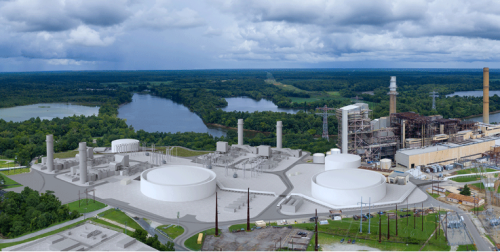
Rendering of Chesterfield project from Dominion’s public website.
By Steve Haner
The State Corporation Commission’s (SCC) decision on whether Dominion Energy can build a new natural gas-fired power plant will depend on which expert or set of experts it believes, and which of the many computer models that dominate the testimony it judges best predict Virginia’s energy future.
Dominion has filed testimony to the SCC from its outside expert backed by computer modeling that concludes there is a risk to the reliability of our electric grid unless additional “dispatchable” generation resources are built. “Dispatchable” means that they are under operator control, can be turned on or off as needed, and are not dependent on the weather.
The wind, solar and battery resources that are demanded under the Virginia Clean Economy Act are not considered “dispatchable,” at least not as dispatchable as a natural gas plant that starts on ten minutes notice. But opponents of the gas plant application have hired several experts of their own, armed with their own models, who assure the SCC those generation assets coupled with heightened efforts to limit demand will be adequate to keep the lights on in the next decade and beyond.
On behalf of Attorney General Jason Miyares, who participates in utility regulation as the state’s consumer counsel, an expert witness that office often uses endorsed the Dominion application. Scott Norwood did not dive into the reliability debate, however, and noted Dominion only expects the plant to run about 16% of the time. It is designed to be a “peaker” plant, running only at times of constrained electricity supply.
The Republican National Committee (RNC) and Winsome Earle-Sears have attacked Abigail Spanberger for receiving a $50,000 campaign donation from an individual whom they claim is a member of the Chinese Communist Party.
There is one little detail that the Republicans fail to mention. The individual, Pin Ni, has also donated to a long list of Republicans, including the RNC and the National Republican Campaign Committee.
Ni is the president of Wanxiang America Corporation, a Chinese-owned auto parts company based in Chicago.
Republicans claim Spanberger broke the law by accepting donations from a foreign national. However, according to the Virginia Political Newsletter, Ni has had a Social Security number since 1992. That would mean that he is at least a green card holder, making political contributions legal. Even if that were not true, then Sen. Steve Daines (R-Montana), the RNC, and other Republicans are also guilty.
The University of Virginia, it announced on Monday, has an interim president. His name is Paul G. Mahoney and he’s been around for a while – living and working within the body of the beast – and that’s promising. He has friends; he knows the culture. He might do some good while the 28-member search committee looks about for a permanent person.
Mahoney is a former dean of the UVA Law School, a product of MIT and Yale Law School, a corporate law scholar -– securities regulation, financial derivatives, contracts, stuff like that — and a former clerk to U.S. Supreme Court Justice Thurgood Marshall.
Interesting, huh? Interesting is good. Interesting may help get people to listen.
Mahoney can’t just occupy space, breathing. Not while matters continue to throb and roll. He should wield complete leadership, even if over a limited tenure. Between the existing UVA faculty, the existing governor, the existing state legislature and all the rest of the things that exist -– the students start returning soon -– calm seas hardly beckon.
We know about the Department of Justice, of course. It seeks to enforce the Supreme Court’s 2023 Harvard ruling which bars racial discrimination as a categorical factor in the admissions process. Logic leads to an obvious conclusion: collegiate race-based administrative dictums are kaput.
A recent headline indicated that Abigail Spanberger, Democratic nominee for Governor of Virginia, had “embraced” natural gas in an interview. A reading of the text left a very different conclusion, as in reality what she embraced was the anti-natural gas Virginia Clean Economy Act.
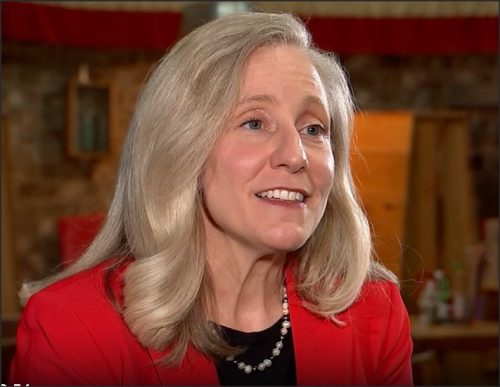
Abigail Spanberger
Spanberger did tell Inside Climate News that natural gas will be “part of the energy mix into the future,” which is a statement of the obvious. The reporter noted her support was “for now.” But then the reporter quoted her saying:
“However, I think when it comes to new natural gas infrastructure, that’s where we really need to be focused and sort of thinking carefully about the lifespan of those projects and whether indeed they are the most cost-effective solution.”
Let’s break the code on that one. Dominion Energy has an application pending to build a new, 944-megawatt natural gas plant in Chesterfield County. The plant would open in 2029 and under the Virginia Clean Economy Act, it would have to close by 2045. One major argument the opponents are raising is that it would become a stranded asset, far too expensive to build with the assumption of a mere 15-year life span.
The Sierra Club and others fighting the plant read that line and knew they have an ally in Spanberger, as if they didn’t already know. The fight over that application at the State Corporation Commission is the ultimate test case on natural gas’s future in Virginia, although the law only prohibits utility-owned generation, not merchant generators.
Winsome Earle-Sears
A few days before the Inside Climate News report, Republican nominee Winsome Earle-Sears provided a guest editorial column to the Washington Examiner. She was quite clear in her endorsement of Dominion’s application for the Chesterfield County plant. “The Spanberger-Hashmi-Jones ticket will kill this project, and consumers will suffer. It’s not just expensive, it’s offensive,” she wrote.
The Earle-Sears column was the longest exposition on energy she or her campaign has produced, but apparently it was only distributed on social media, and that by the Examiner itself, not her campaign. It was not picked up and shared in the daily news feed of the Virginia Public Access Project, which reaches thousands of key inboxes. In fairness, VPAP might not have seen it.
I’ve been publishing Bacon’s Rebellion since 2002 (with one short interlude). My goal has been to create a platform for quality conservative journalism and commentary on Virginia-specific issues that allowed for civil dialogue and contradicting views. It’s been a good run. The blog has been a huge part of my life, and I have made many wonderful friends both in person and through correspondence. For entirely personal reasons, I have decided it is time to step aside. It’s not a decision I make lightly, but it is one that I must make.
I want to thank the many people who supported me along the way — readers, donors, and collaborators. Your encouragement is what kept me going these many years.
The blog isn’t going away (not yet anyway). Just me. I will continue to maintain Bacon’s Rebellion as long as there is interest in it. You’ll still be able to read Steve Haner, Dick Hall-Sizemore and regular outside contributors.
But I will say this: If anyone is interested in acquiring and investing in the blog with the aim of nurturing the spark of independent reporting and commentary on state and local issues in the great commonwealth of Virginia, please contact me at [email protected].
To borrow the great Douglas Adams line that conveys parting in a spirit of gratitude and a light heart, let my final words be, “So long, and thanks for all the fish.”
On Friday some happy-but-not-unexpected news broke: The Corporation for Public Broadcasting is about to go kaput.
It’s on life support for two more months.
That’s because Congress defunded the body that awards public funds to National Public Radio and the Pubic Broadcasting Service. The left-wing non-profit expected to be showered with $1.1 billion in tax dollars, but the Big Beautiful Bill passed by Congress last month zeroed it out.
Unsurprisingly, PBS itself misreported the news.
The Corporation for Public Broadcasting, which has distributed federal funds to both PBS and NPR for decades, announced Friday that it's shutting down.
The news comes after President Donald Trump recently clawed back more than a billion dollars of funding for public… pic.twitter.com/KyrWrRpBXm
The State Corporation Commission Friday approved two separate increases in Dominion Energy Virginia’s rates; one caused by the Virginia Clean Economy Act (VCEA) and the other related to regional transmission services. Combined they add more than $5 to a 1,000-kilowatt hour residential bill effective September 1.
The VCEA driven increase is an additional $2.99 on what is called Rider RPS, for “renewable portfolio standard.” The case ended with Dominion approved to collect the $609 million over one year that was pending earlier this year. The money is not for electricity or power lines or operating cost, but for intangible “renewable energy certificates” Dominion must buy because it missed the VCEA’s goals for its own renewable production.
The transmission increase is another $2.10 which is passed through to pay the regional PJM Interconnection energy marketplace, in this case for transmission and for the demand reduction programs it operates. The SCC doesn’t set transmission rates but accepts those imposed by the Federal Energy Regulatory Commission (FERC.) That is imposed on bills through Rider T1. (You can find a list of all Dominion riders, costs in addition to base rates, here.)
The two rider increases come in addition to an increase in the portion of the monthly bill dedicated to collecting fuel costs, which is Rider A. Effective July 1, the basic fuel charge for Dominion customers – in this case all types of customers pay the same per kWh – rose from $20.74 to $29.68 per 1,000 kWh, a healthy 43% jump. That should just be hitting bills now.
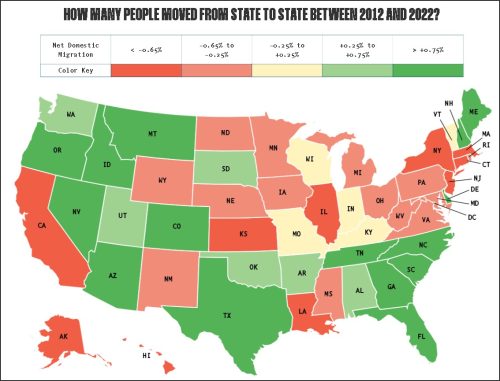
Virginia lost a net of 120,000 residents through domestic migration (excluding foreign immigration and emigration) over the decade between tax years 2011-12 and 2021-22, according to the Unleash Prosperity “Vote with your feet” database. That was the 9th worst performance among the 50 states.
That out-migration translated into a loss of $14 billion in adjusted gross income, or an average of $117,000 per person — not per household, but per person. On average, the households leaving Virginia were affluent. The loss of prime taxpayers translates into roughly $800 million in lost state income-tax revenue.
No surprise to anyone paying attention: Florida, Texas and North Carolina were the big winners. New York, California and Illinois were the big losers. Sadly, Virginia was the only loser on the South Atlantic Coast, one of the fastest growing regions of the country.
“The single most important thing that is going on in this country, economically and demographically, is the massive shift in migration that’s happened over the last 10 to 20 years, and it is accelerating,” economist Steve Moore told attendees at the launch of the Unleash Prosperity website.
Interestingly, Gov. Glenn Youngkin took time out of his schedule to speak at the unveiling. According to The Daily Signal, he attributed the population shift to what the news outlet described as “a virtuous cycle in red states of cutting or eliminating state income taxes, which led to a greater influx of people and jobs, which created a larger tax base and more revenue for state budgets.”
Twenty-five years of student housing generating students
by Joe Fitzgerald
History, arithmetic, evidence. Those are just some of the things that suggest a student housing glut is a major factor driving enrollment growth in Harrisonburg City Public Schools. They’re also some of the things City Council members can legally and politically ignore in making decisions about the city’s future.
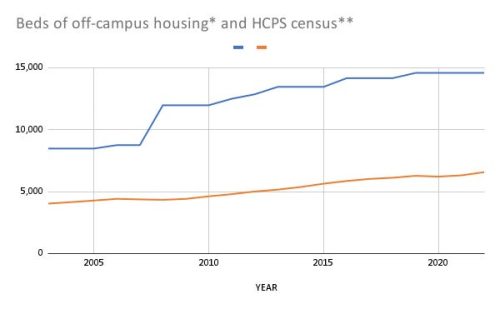
Since Sunchase opened in 1999, every three bedrooms of housing targeting JMU students has generated one new K-12 HCPS student.
But JMU student housing doesn’t have people in that age range, and some of that housing is in the county, you say. Bear with me.
Start with this graph.
*Source: HRHA housing studies, news sources **Source: Harrisonburg City Public Schools
New off-campus JMU housing and growth in K-12 are roughly parallel except for the one blip. That blip came when a previous City Council changed zoning rules to make it harder to build new apartment complexes. But the change didn’t kick in for three years, and developers built while the building was good, adding more than 3,000 beds of student housing.
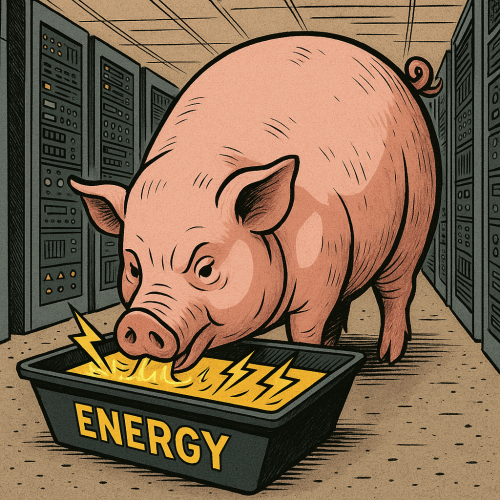
(Haha! Not so crazy. For those who missed it, check out my post from earlier this year, “Attack of the Killer Swine.”)
Wait, there’s more news about pigs and bacon! The Wall Street Journal profiled Virginia’s very own Smithfield Foods, which has genetically engineered a super pig that produces more bacon!
Against the backdrop of hysterical warnings that the George Mason University Board of Visitors might fire President Gregory Washington, GMU’s first Black president, at its meeting today, the Board gave him a raise. It wasn’t exactly a ringing endorsement — only 1.5 percent — but it was a raise. Apparently, that means he still has a job.
Gregory Washington
Let’s review the tape of what the media were saying about the GMU president, who has been on the defensive as the Department of Justice, the Youngkin administration, and the Board of Visitors pushes back against anti-Semitism and racial preferences at the Northern Virginia university.
Faculty members said they were concerned that a pileup of investigations would be used to justify toppling him, as happened with Dr. Ryan. [at the University of Virginia].
“We’re worried it’s going to be high noon on Friday,” said Tim Gibson, an associate professor at George Mason and the president of the Virginia state conference of the American Association of University Professors, a faculty rights group.
A growing number of George Mason University faculty are concerned about the fate of President Gregory Washington, whose annual performance review is set for the upcoming Board of Visitors meeting Friday morning — amid an onslaught of federal investigations.
The year: 2075. The American colonies on the Moon are getting restless under Washington’s tyrannical rule….
This second edition of “Dust Mites” has a snazzy new cover, includes helpful lunar maps, and is 5,000 words tighter than the original. The sequel, “Trogs,” is scheduled for publication this summer.
Advertisement
Advertisement
Advertisement
Advertisement
About
Bacon’s Rebellion is Virginia’s leading politically non-aligned portal for news, opinions and analysis about state, regional and local public policy. Read more about us here.
Fund the Rebellion
Shake up the status quo! Your contributions will be used to pay for faster download speeds and grow readership. Make a one-time donation by credit card or contribute a small sum monthly.
Can’t wait until tomorrow
For your Bacon’s Rebellion fix?
Enter your email address to receive immediate notifications of new posts by email.
SUBSCRIBE
Search Bacon’s Rebellion
Categories
Archives
The Jefferson Council
Protecting Thomas Jefferson’s Legacy at the University of Virginia
Forgot Your Password?
Shoot me an email and I’ll generate a new password for you.