
Twenty-five years of student housing generating students
by Joe Fitzgerald
History, arithmetic, evidence. Those are just some of the things that suggest a student housing glut is a major factor driving enrollment growth in Harrisonburg City Public Schools. They’re also some of the things City Council members can legally and politically ignore in making decisions about the city’s future.
Since Sunchase opened in 1999, every three bedrooms of housing targeting JMU students has generated one new K-12 HCPS student.
But JMU student housing doesn’t have people in that age range, and some of that housing is in the county, you say. Bear with me.
Start with this graph.
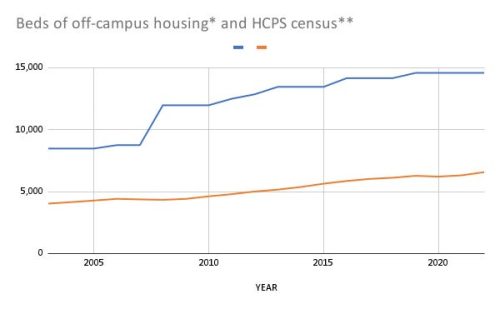
**Source: Harrisonburg City Public Schools
New off-campus JMU housing and growth in K-12 are roughly parallel except for the one blip. That blip came when a previous City Council changed zoning rules to make it harder to build new apartment complexes. But the change didn’t kick in for three years, and developers built while the building was good, adding more than 3,000 beds of student housing.
The sons and daughters of NOVA and New Jersey moved into the newer apartments built then and in the years since. Young families moved into the older housing, but not right away. The window for JMU housing to become family housing seems to be about four years.
For math nerds, the correlation between JMU housing growth and HCPS is a positive .88. For non-math people, that number doesn’t go any higher than 1. Think of it as two numbers that line up 88 percent of the time. And if you shift the two columns in the spreadsheet to allow for a four-year lag, the correlation is .97. That’s 97 out of 100.
Skeptics will tell you that correlation isn’t causation. That generally means that two numbers grow together or at the same rate because of some third factor. If anyone tells you, in this context, that correlation isn’t causation, ask them what that third factor is. I’ll wait.
One of those factors might be what other housing is built in town at the same time. Checking that number might tell you what percentage of new housing in Harrisonburg since the Great Recession is student housing. I haven’t computed that. Someone should.
Harrisonburg’s City Council in July approved a new student housing complex, The Vista, on Port Road, with a projected 119 apartments. If four bedrooms each, 476 rooms, that’s 158 new K-12 students if the trend continues. If City Council at its August 12 meeting approves the proposed Link complex downtown, anywhere from 424 to 750 new bedrooms of student housing will be added. That’s anywhere from 141 to 250 new K-12 students. The Vista and the Link add, low estimate, 299 to K-12, or, high estimate, 408. A little less than half of those students would be in the city’s elementary schools, already 200 students over capacity.
City Council and the city’s Planning and Community Development Department have not taken this into account in approving student housing. Instead they depend on a recent Weldon Cooper Center so deeply flawed as to be a C+, at best, in a first-year statistics class. Not saying I’m smarter than Weldon Cooper’s statisticians, but I know Harrisonburg better than they do. Their study of housing and student generation said the impact of people moving into older housing was “important to consider” but then they didn’t consider it.
The WC study further missed the point by noting that most of the new students in the city in the past 15 years or so didn’t live in the newer housing. They ignored, missed, dismissed, or didn’t understand that new housing generates students in the older housing. The attorney/salesman for The Link says it should be compared to Urban Exchange for the number of K-12 students living there. He’s wrong. It should be compared to Copper Beech for how many more K-12 students there are four years later.
The 3-to-1 ratio of bedrooms to K-12 is very rough. The actual number, based on my own spreadsheets, is 2.88-to-1. But that second number is a reminder not to try being too precise with a rough estimate. If you factor in other new housing, or other demographic factors, the number might be 2.5 or 4. Those two lines on the graph will still line up. History, arithmetic, and evidence say they will. Weldon Cooper and Community Development not acknowledging it won’t change that conclusion. Off-campus housing for JMU students generates new K-12 students in HCPS, and somebody has to pay for that. We’re 10-15 years from having to build a new elementary school. We should put that off as long as we can.
Joe Fitzgerald is a former mayor of Harrisonburg. This post is republished with permission from his blog Still not sleeping.
Leave a Reply
You must be logged in to post a comment.