• Is the Big Problem at Richmond Schools Decrepit Buildings or Teacher Turnover?

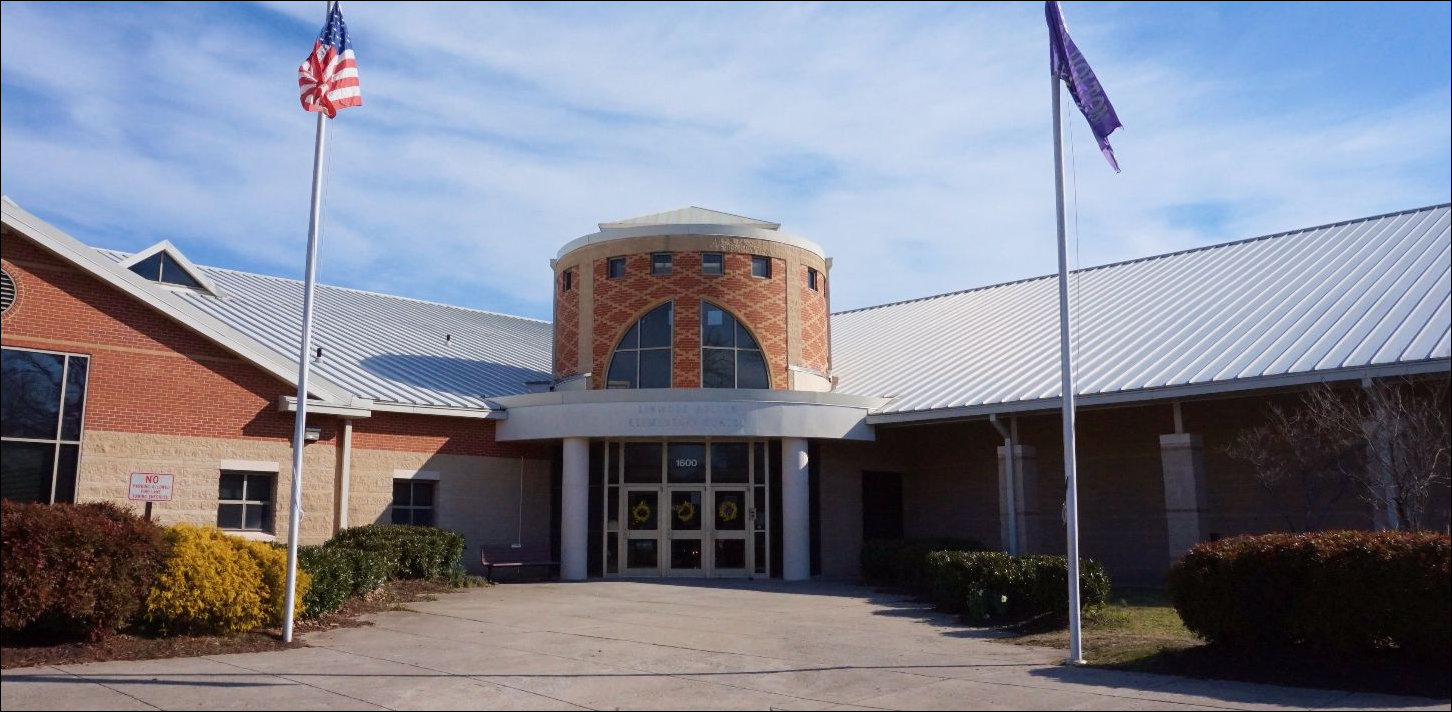
    Linwood Holton Elementary School in Richmond. Richmond has several beautiful new schools. What difference have they made?

    The City of Richmond is debating proposals to spend $740 million to $800 million to modernize the city’s school buildings after years of neglect. The latest new wrinkle reported by the Richmond Timesย Dispatch is that the Richmond School Board has delayed a vote on the grounds that it needed more time to ponder the plan. The main concern expressed so far — where on earth would the money come from? — is valid. But there is an even more fundamental question: Will modernizing school buildings do anything to reverse the school system’s atrocious under-performance?

    No question, many school buildings are aging and sub-standard, with crumbling tiles, broken toilets, wheezing HVAC systems, and leaking roofs. They are an embarrassment and a disgrace, and they need to be fixed. But that should cost a fraction of the sums being discussed.

    Based on the conviction that creating a better physical environment can improve academic performance, Richmond has built several expensive new school buildings in recent years. As part of their deliberations, School Board members should examine whether those buildings have made any difference in educational achievement of the children who passed through their doors.

    Here’s what I hear. While new buildings provide a better physical environment, poor children from broken homes in inner city neighborhoods bring the same emotional and disciplinary issues to school. Young, inexperienced teachers are shocked and dismayed by the environment, they get burned out and they leave. The Richmond school system has such a horrendous reputation among teachers in the metropolitan area that it couldn’t hire enough to fill its classrooms this fall, meaning it has had to rely more heavily than ever upon substitute teachers, some of whom probably shouldn’t be teaching at all. Prediction: Richmond’s teacher shortage will get even worse in January when burned-out teachers decide after Christmas Break they don’t want to return.

    Once basic health and safety standards are resolved, Richmond schools have more urgent priorities than building fancy new school buildings. Above all, the system needs to address the problem of school discipline and teacher churn.


  • More Miscellaneous Morsels…

    Corporate Research Center, CRC, aerials, Phase 2, Dairy Farm

    Luxury apartments for research park. The Virginia Tech Corporate Research Center, which has more than one million square feet of office space, is joining forces with a local real estate developer to add luxury apartments to the mix, reports the Roanoke Times. The company had previously added amenities to play soccer, lacrosse, volleyball, basketball, and disc golf to its work-live-play options.

    โ€œWhat weโ€™re trying to do is create a self-contained community that has all the amenities at your fingertips,โ€ said CRC President Joe Meredith. โ€œThe last amenity that we donโ€™t have is housing.โ€

    The Corporate Research Center, in my recollection from visits a decade ago, was a classic suburban office park, the main selling point of which was its proximity to the Virginia Tech campus. It was a pretty sterile place. Integrating apartments into the mix sounds like a good move — indicative of a larger trend in which suburban office parks are busily reinventing themselves as islands of walkable urbanism capable of attracting Millennials and the businesses that want to hire them.

    Longwood revising bias reporting protocols. Longwood University has temporarily shut down its bias incident reporting system, reports Campus Reform, and is rewriting protocols to protect freedom of speech. The Foundation for Individual Rights in Education (FIRE) had criticized Longwood for its particularly broad definition of what constituted a “bias” incident.

    Director of Citizen Leadership and Social Justice Education Jonathan Page conceded that some of the definitions the school had used were problematic, telling the Rotunda that Virginia Assistant Attorney General Cameron O’Brion advised the university to remove the former protocol and provided recommendations for revision in response to [a] studentโ€™s complaint.

    “A lot [of Oโ€™Brionโ€™s recommendations] were based in how we were not only defining bias and hate crimes, they really didn’t fall in line with how the FBI defined hate crimes, that a lot of the things we defined as bias incidents were really freedom of speech issues,” Page explained. “Some of the language that we modeled came from some private institutions and so as a public institution we can’t have the same stance that privates do.”


  • Albemarle County’s Unfortunate Distinction

    Image credit: Wall Street Journal

    So much to blog about. I don’t know if I can get to it all this morning. Let’s start with this…

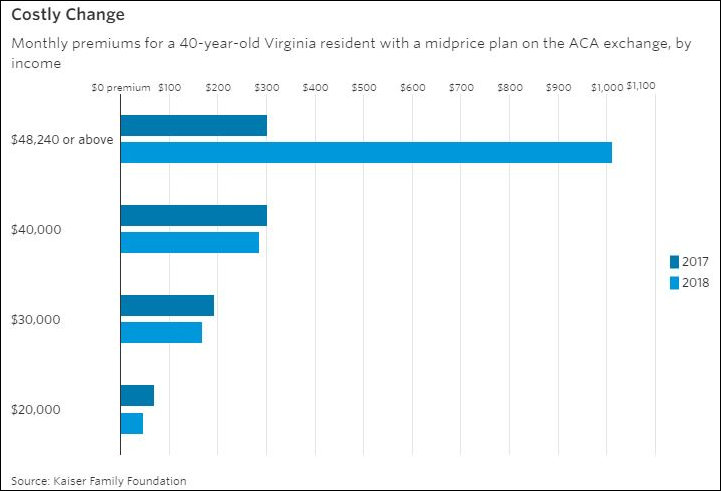
    Albemarle County will have the distinction of having the highest cost in the nation in 2018 for people on the Affordable Care Act exchange. The Wall Street Journal cites the plight of Ian Dixon, as 38-year-old app developer, whose premiums for a family of four will jump from $988 a month to $3,158 a month. The article did not mention the size of the policy’s deductible, but in my observation of other health plans, it could be significant.

    Insane. Just insane.

    As the WSJ notes, other health plans have fled the ACA market in Charlottesville and Albemarle. The sole remaining provider, Optima Health, wanted out as well, but decided to stay in the market rather than leave citizens with zero alternatives.

    Bacon’s bottom line: The company says the uncertainty created by the GOP push to repeal Obamacare and a Trump administration decision to end subsidies to insurers contributed to the rise in premiums.ย That uncertainty undoubtedly has accelerated the ACA market meltdown, but the health exchanges were in a downward spiral before Trump took office. The system is collapsing next year instead of two or three years from now.

    This is what happens when a country is locked in 50-50 gridlock, neither has the political power to fully implement its healthcare vision. We get total dysfunction, and people like Ian Dixon are paying the price. Adding insult to injury, unless Congress repeals the mandate requiring people to purchase health insurance, Dixon will be dunned a tax (really a penalty, but the Supreme Court called it a tax) if he refuses to sign up for a plan that could soak up 100% of an average person’s income.


  • Thanking Those Who Make EnergyShare Work

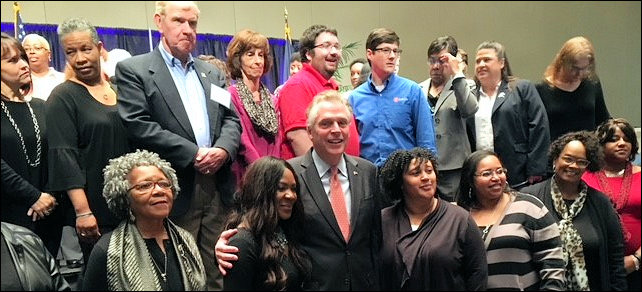
    Governor Terry McAuliffe in group photo with Virginia EnergyShare case workers and other partners

    Since expanding its EnergyShare program in 2015, Dominion Energy Virginia has helped 35,000 people pay their heating and electric bills and has weatherized 18,800 homes. In addition, the utility has hosted 700 outreach events to share practical, energy-saving tips that enabled participants to reduce energy usage by 7.5% on average.

    Those were some of the figures batted around today in an event Dominion hosted to thank its EnergyShare partners, including the United Way of Greater Richmond and Petersburg, the Salvation Army, and nearly 100 social services departments across Virginia.

    As part of a legislative deal that froze utilities’ electric rates and declared an increase in solar energy to be in the public interest, Dominion committed an additional $42 million over five years — the money comes from shareholders, employees, and individual donors — to expand the program that had been in existence since 1982.

    Energy Share is “one of those things that our state offers that other states don’t offer,” bragged an enthusiastic Governor Terry McAuliffe, who has participated in two previous annual Energy Share events. And that’s not just McAuliffe hyperbole. While other states do run energy assistance programs, none is as comprehensive as Virginia’s, which couples weatherization with emergency aid as well as initiatives targeting homeless veterans and the disabled.

    The Commonwealth of Virginia provides a means-tested energy assistance program for low-income residents. But that doesn’t cover everyone in need, Boxley Kortni, a Hanover County social services case worker, explained to Bacon’s Rebellion. Hardly a day passes without someone approaching social services for assistance. They’re typically poor or working poor, and they’ve had an emergency — big medical bills, or they were ill and couldn’t work, or their car broke down and they couldn’t get to work.

    Kortni cited the recent case of a woman who stayed in the hospital while her young son recovered from surgery. Her job offered no vacation or time off, so she didn’t get paid. Many people live paycheck to paycheck, and this woman was no exception, and she failed to pay her electric bill. And because she worked, she made too much money to qualify for state assistance.

    EnergyShare assistance is not limited to covering electric bills. It can be given to anyone who heats a home with fuel oil, kerosene or wood. Dominion provides the money, budgeting $8.8 million this year. In Central Virginia, United Way strokes the checks, and local social services case workers identify the recipients.

    The private program is more flexible than the state program, and case workers have some latitude in how it is administered. Donna Latta, who works for King & Queen County, says she looks at the client’s case history to be sure they are experiencing a genuine emergency and aren’t routinely skipping payments. Say a client owes $500, she says. EnergyShare can pay up to $600, but she likes to see the client chip in a little of his or her own money. She also is wary of clients who come back over and over, which indicates that they aren’t dealing with an emergency but a chronic problem. “People have to take responsibility,” she says.


  • Broadband Boondoggles in Southwest Virginia

    Throughout the Central Appalachian region — Virginia, West Virginia and Kentucky — community leaders have a keen understanding that they must find new industries to replace coal. And there is a near universal conviction that any hope to diversify local economies requires high-bandwidth connections to the outside world. This conviction has led to a series of initiatives, some misguided and some on target, to bring broadband to this isolated region.

    Ronald Bailey with Reason Magazine has visited Central Appalachia to examine these efforts and concludes pessimistically, that they’re not accomplishing much. The article’s headline says it all: “The Noble, Misguided Plan to Turn Coal Miners into Coders: Expensive high-speed internet and job training will not transform Appalachia into ‘Silicon Holler.’”

    The story begins in 1999 with the decision of Bristol Virginia Utilities (BVU) to build a fiber-optic network connecting its eight electric substations and all of the city’s public facilities. In 2002 BVU OptiNet began deploying a fiber-to-the-home network with the help of state and federal grants, tobacco settlement money, and revenue bonds — $132 million all told for 13,000 customers. (That’s a capital investment of about $10,000 per customer.) The end result:

    Cash inflows from successive government grants enabled OptiNet to function like a Ponzi scheme, masking the fiscal rot at the heart of the enterprise. Eventually in 2013, an audit found extensive misuse of fundsโ€”personal trips, bribes, and kickbacksโ€”by board members, officers, and contractors. In 2016, nine people associated with the BVU Authority, including its CEO, chief financial officer, and board chairman, were sent to prison for conspiracy and fraud. The state government’s 2016 final report noted that the OptiNet division was operating at a net loss, that this was expected to continue, and that therefore it was unlikely to generate enough cash to pay both the principal and interest owed on $45.5 million in bonds it issued in 2010.

    The audit also found that the BVU Authority used an improper methodology to account for and cancel debt when it became an independent entity, and as a consequence it now owes the Bristol city utility division nearly $14 million. The auditors’ blunt assessment: “These conditions raise substantial doubt about OptiNet’s ability to continue as a going concern.”

    Now a Southwest Virginia entity, Sunset Digital, has negotiated a deal to acquire OptiNet’s assets for $50 million. As the author Bailey notes, that’s a “smart move” for Sunset Digital and its owner Paul Elswick, who are backed by a Miami, Fla., based private equity firm.

    Meanwhile, in nearby Dickenson County, the county also has been investing in building a fiber-optic cable network. In 2004 the board of supervisors created theย Dickenson County Wireless Integrated Network (DCWIN). Next yearย  DCWIN issued $1.5 million in bonds to build 10 cell towers. To pay off the bonds, the network had to sign up 1,500 customers. Never happened. Five years later, the county board dissolved the authority, assumed its debts, and sold the wireless network to a local company for $277,000.

    Those are relatively small potatoes compared to the shenanigans in eastern Kentucky, which Bailey describes in considerable detail. The author came away impressed by some of the entrepreneurs who want to bring broadband to the region, but not so impressed by the efforts of local government officials, who don’t know what they’re doing. He calls into question the entire premise of trying to rejuvenate the economy by pumping money into highways, broadband, and other infrastructure.

    It is hard to see the seeds that are supposed to someday sprout and grow into a nascent Silicon Holler.

    It’s difficult to tell how many employers, if any, have decided to relocate to Southwestern Virginia due to better access to high speed data networks. As with the highway construction project before it, the internet infrastructure push has not created a detectable boom. Population in the counties covered by various government-subsidized broadband networks continues to fall, dropping from 334,000 in 2000 to 324,000 now. Between 1980 and 2000, by contrastโ€”without any high-speed internet to speak of and with the highways uncompletedโ€”the area’s population dropped by a smaller amount, from 336,000 to 334,000.

    For more than 50 years, the feds have poured billions in job training and infrastructure funds into central Appalachia with the goal of spurring economic growth and reducing endemic poverty. There is very little to show for all that effort.

    Bacon’s bottom line: I kinda sorta agree with Bailey. But not entirely.ย I share Bailey’s skepticism about how local governments have tried to jump-start broadband connectivity. Clearly, Bristol and Dickenson County lost a lot of money they could ill afford to lose. If local governments are going to get into the broadband business, they need to be better stewards of scarce public dollars..

    Butย I sympathize with the desire of Southwest Virginians to salvage their economy, and I agree that having broadband connectivity is a necessary condition to achieving that revitalization. In other words, without broadband, there will never be an economic revival. Unfortunately, investing in broadband is no guarantee that new jobs and opportunities will come. It’s the ticket the region must buy to get into the game.

    Hat tip: Jack Lucas


  • Follow the Dark Money

    Yes, it’s a legitimate story when Dominion spend big bucks supporting grassroots groups that favor the Atlantic Coast Pipeline. Why isn’t it also a story when out-of-state billionaires underwrite pipeline foes?

    We learn from the Washington Post today how Dominion Energy, its partners in the Atlantic Coast Pipeline, and the American Gas Association poured resources into groups called EnergySure and Your Energy Virginia to “whip up” a grassroots campaign in support of the project.

    Quoting from a presentation made by Dominion executive Bruce McKay to an industry conference in Arizona last month, the Post described the scope of the effort:

    As of early October, Dominion had compiled a โ€œsupporter databaseโ€ of more than 23,000 names, generated 150 letters to the editor, sent more than 9,000 cards and letters to federal regulators and local elected officials, and directed more than 11,000 calls to outgoing Gov. Terry McAuliffe and Virginiaโ€™s U.S. senators.

    Pipeline foes criticize Dominion for its outsized influence in Virginia state politics, characterizing the pipeline conflict as a David vs. Goliath contest. “Dominion is by far more well-resourced,” the Post quotes Denise Robbins of the Chesapeake Climate Action Network as saying. “What we have is public support and the will of the people who don’t want these pipelines in their communities.” Continues the article:

    The protesters also have criticized Northam for failing to disclose that several members of his 85-person transition advisory team have ties to Dominion – a company that has given extensively to Virginia politicians of both parties, and in which Northam owns stock. Dominion and its executives gave Northamโ€™s campaign more than $87,000 this year, according to the nonpartisan Virginia Public Access Project.

    Bacon’s bottom line: The Post article highlights a legitimate story. Dominion is a dominant player in Virginia’s political process, and the public has a right to know how it conducts business. If Dominion, a regulated utility whose fortunes depend upon achieving favorable political outcomes, pours money into campaign contributions, lobbying and grassroots activities, that’s a fair topic of inquiry by the press.

    What bothers me is that the Washington Post and other media show no comparable curiosity about Dominion’s opponents. What do we know about the groups contesting the Atlantic Coast and Mountain Valley pipelines? What do we know about the resources poured into the campaign to halt the pipelines? Where do these groups raise money for economic studies, cable television ads, and the organizing of protest marches?

    To take a concrete example, what do we know about the Chesapeake Climate Action Network (CCAN), the environmental justice-oriented group quoted by the Post, which has organized many of the anti-pipeline protests in Richmond?

    Well, we know that the group is based in Takoma, Md., and maintains offices in Richmond and Norfolk. In fiscal 2015 it listed 22 employees. According to itsย latest 990 form and a 2016 audited reportย posted on its website, theย group raised $263,000 in 2016 through contributions, another $1,043,000 through grants (including the release of previously restricted grants), and a nominal sum from other sources. While we know how much money it brought in, we don’t know where that money came from. Nowhere on its website, in its audited report, or its 990 form does CCAN reveal how many donors contributed, or who they were. Restricted grants (presumably from foundations) account for 80% of its revenue. Who is CCAN beholden to? The public doesn’t know. The Washington Postย is happy to quote CCAN in its article but displays no curiosity about whose interests it serves.

    Contrast CCAN to a true grassroots environmental organization like the Piedmont Environmental Council. The 2016 PEC annual report lists every donor — literally hundreds of them — who contributed $100 or more. The PEC makes no secret of the fact that its biggest backers of $100,000 or more include the Aqua Fund, the William M. Backer Foundation, the Loudoun Soil and Conservation District, Jacqueline B. Mars, Jean Perin, the Prince Charitable Trusts, and the Wrinkle in Time Foundation. It’s all there for the public to see and evaluate.

    A look at the CCAN’s board of directors suggests that the group’s support comes mainly from Maryland and Washington, D.C., not Virginia. Only two of the 13 board members have identifiable Virginia connections: April Moore, vice-president of Friends of the North Fork of the Shenandoah River, and Tony Noerpel, founder of Sustainable Loudoun. Another board member has West Virginia ties, and the rest hail from the Baltimore-Washington area. CCAN lays claim to “public support and the will of the people who don’t want these pipelines” in Virginia. But how do we know that it reflects the will of “the people” any more than does Dominion, which cites the support of construction unions, chambers of commerce, and economic developers?

    We know where Dominion’s money comes from — from Dominion rate payers and shareholders. It’s pretty straightforward. We don’t know where CCAN’s money comes from. Could some or most of it come from out-of-state millionaires and billionaires who could care a fig about Virginia’s economic development?

    A 2014 minority staff report of the U.S. Senate Committee on Environmental and Public Works, “The Chain of Environmental Command: How a Club of Billionaires and Their Foundations Control the Environmental Movement and Obama’s EPA,” reached the following conclusions:

    • The “Billionaire’s Club,” an exclusive group of wealthy individuals, directs the far-left environmental movement. The members of this elite liberal club funnel their fortunes through private foundations to execute their personal political agenda, which is centered around restricting the use of fossil fuels in the United States.
    • Public charity activist groups propagate the false notion that they are independent, citizen-funded groups working altruistically. In reality, they work in tandem with wealthy donors to maximize the value of the donors’ tax deductible donations and leverage their combined resources to influence elections and policy outcomes.
    • Far-left environmental activists, while benefiting from nonprofit status, essentially sell a product to wealthy foundations who are seeking to drive policy and political outcomes.
    • The Billionaire’s Club knowingly collaborates with questionable offshore funders to maximize support for the far-left environmental movement.

    The “offshore funders” are associated with Russian energy interests who share the environmentalists’ goal of curtailing U.S. fracking of natural gas.

    In their coverage of President Trump, Post reporters frequently allude to findings of the U.S. Intelligence community, in particular the report, “Assessing Russian Activities and Intentions in Recent US Elections,” which argued that Vladimir Putin-directed initiatives aimed at discrediting Hillary Clinton and helping Donald Trump win the 2016 presidential election. But I have yet to see the Post cite the passage that says RT (formerly Russia Today) ran anti-fracking programming highlighting environmental issues and the impact on public health. The anti-fracking stance, states the report, “is likely reflective of the Russian Government’s concern about the impact of fracking and US natural gas production on the global energy market and the potential challenges to Gazprom’s profitability.”

    Ken Stiles, a Virginia Tech geography instructor who used to work for the Central Intelligence Agency, has traced the flow of dollars from Russian energy interests through the Bermuda-based Klein Fund to the California-based Sea Change Foundation, and then from Sea Change to the Charlottesville-based social/environmental activist group Virginia Organizing. Virginia Organizing provides administrative support for anti-pipeline groups such asย Preserve Montgomery County and the Friends of Nelson County.ย (Thisย articleย in theย Daily Signalย provides the details.)

    Virginia Organizing, which describes itself as “a statewide grassroots organization dedicated to challenging injustice by empowering people in local communities,” had a 2015 budget of $4.5 million. The group did not acknowledge the fact that it was a recipient of Sea Change Foundation money in either its website or its 990 form.

    Stiles approached Bacon’s Rebellion before he contacted the Daily Signal. While I was intrigued by his findings, I thought it was a stretch to link Russian anti-fracking money with what appeared to me to be genuine, NIMBY-inspired grassroots groups likeย Preserve Montgomery County and the Friends of Nelson County. There was no way to know where the Russian money went once it reached the Sea Change Foundation. In all likelihood, I felt, the Russian money was so co-mingled with the contributions of rich American donors that it was meaningless to trace a trail from Russian oligarchs to an organization like Virginia Organizing, much less to groups one step removed from Virginia Organizing. I think Stiles got impatient with my journalistic standards of proof, so he went to the conservativeย Daily Signal instead.

    Still, I believe that Stiles raised an important point.ย Much of the anti-pipeline money in Virginia comes from wealthy out-of-state environmentalists (with a few rubles mixed in). These big donors have funded an archipelago of grassroots groups dedicated to fighting fracking and natural gas pipelines across the country.

    When Dominion spends money supporting grassroots movements to influence public policy, yes, that is a news story. When out-of-state billionaires spend money, an unknown fraction of which came from Russian energy interests, to support grassroots movements to shut down fracking and pipelines, that is a news story, too — just not one that the Washington Post is interested in telling.

    Virginians have a right to know who is influencing the public policy process in their state, and how much these shadowy interests are spending. It’s easy to follow the dollars going to campaign finances because campaigns are obligated by law to report them. Thus, we know thatย California billionaire and global warming activist Tom Steyer funneled almost $1 million through his organization NextGen Climate Action into Governor-elect Ralph Northam’s gubernatorial campaign this year, and $1.6 million into Governor Terry McAuliffe’s campaign four years before that. But there are millions of dollars of dark money sloshing around Virginia through social-justice and environmental foundations and activist groups which go mostly unreported. The public has a right to know where all the money is coming from and which groups are beholden to that money.

  • The Political Revolt against Higher Ed Builds Steam

    Frank Antenori

    I’ve been exploring the idea on this blog recently that the evolution of a mono-culture of left-of-center thinking on American college campuses is alienating a large swath of the electorate. On the one hand, public colleges and universities lobby for more public dollars; on the other, their actions vitiate the values of much of the tax-paying public. No wonder political support for public higher education is waning.

    In an article entitled, “Elitists, crybabies, and junk degrees,” the Washington Post highlights the views of Frank Antenori, a former Green Beret who serves in the Arizona state legislature — a legislature that has cut state support for higher education by 54% since 2008. Writes the Post:

    There is a growing partisan divide over how much to spend on higher education. Education advocates worry that conservative disdain threatens to undermine universities. …

    In July, a Pew Research Center studyย found that 58ย percent of Republicans and GOP-leaning independents think that colleges and universities have a negative effect โ€œon the way things are going in the country,โ€ up from 37ย percent two years ago. Among Democrats, by contrast, 72ย percent said they have a positive impact.

    A Gallup pollย in August found that only about a third of Republicans had confidence in universities, which they viewed as too liberal or political. Other studies show that overwhelming numbers of white working-class men do not believe a college degree is worth the cost.

    Antenori, who got most of his higher education by working through night school, thinks universities are becoming increasingly elitist and politically correct, that more kids should pursue vocational educations, and that taxpayers shouldn’t pay students to pursue “junky” degrees in “diversity studies and culture studies.”

    Bacon’s bottom line: The backlash against higher education is just beginning. In a world in which every aspect of society and culture is becoming politicized — with the most heated rhetoric emanating from leftist echo chambers of the academy — don’t be surprised if taxpayers and tuition-paying parents begin evaluating higher-ed institutions through a politically polarized lens. If presidents of public universities in Virginia want to blunt that backlash — which seems to be gaining momentum — they might consider devoting at least a fraction of their efforts to attaining political/philosophical diversity as they do to racial and socio-economic diversity.


  • Spike the State-Local Tax Deduction

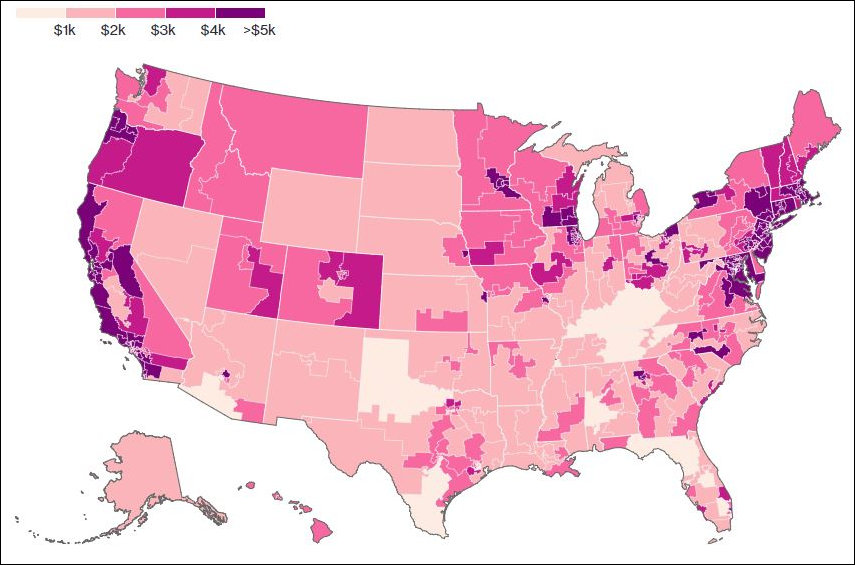
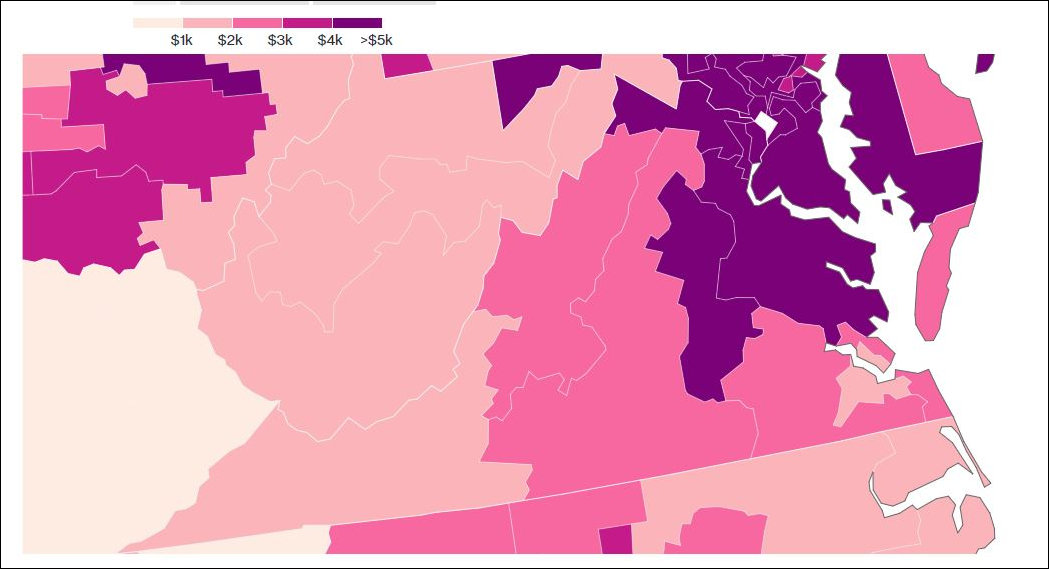
    Average state and local tax deduction by congressional district. Source: Bloomberg

    A provision in the proposed tax reform package working through Congress would eliminate the deduction for state and local taxes, hitting high-income earners in high-tax states most of all. According to the calculations of Bloomberg Politics (as seen in the maps above and below) residents of congressional districts in Central and Northern Virginia would be among those most impacted.

    It amuses me to see how foes of tax reform highlight this negative impact without looking at the larger context. The tax reform package that hurts higher-income households by eliminating the state-local tax deduction more than offsets that loss by lowering tax rates for higher-income households. Unfortunately, Bloomberg doesn’t publish a map showing how it all nets out.

    The architects of tax reform maintain logical consistency. They favor measures that reduce loopholes, broaden the tax base, and lower tax rates for everyone. The critics’ arguments are incoherent. They favorย preserving the state-local tax deduction, which favors the rich, and oppose the lower tax rates, which favor the rich. They don’t reveal the real reason for their opposition, that the state-local tax deduction will hurt high-tax states and localities.

    The state-local tax loophole is worth about $1.3 trillion over 10 years, according to Bloomberg. That’s a massive subsidy for high-tax states and the Blue State tax-and-spend governance model, and it insulates those states from the consequences of their policies. Eliminating the subsidy will accelerate the flight of high-income households from high-tax states (mostly blue states) to low-tax states (mostly red states), thereby undermining blue-state tax bases and accelerating their rush to fiscal ruin.

    Insofar as Virginia is a purple state trending blue, eliminating the loophole will impact our state more than most. On the other hand, if Virginians had to absorb the full cost of our tax-and-spend habits, we might be more parsimonious with our public dollars. And that is a thing that many devoutly wish for.


  • Still a Few Slots Open for the Big Bacon Fry

    The political discourse in the United States just gets nastier. People in the other political tribe aren’t just misguided or informed by different values, they’re ignorant, stupid, lying, evil people out to ruin the country. If you’re a Bacon’s Rebellion reader, you’re probably just as tired of the hyperbolic rhetoric and personal vilification as I am. Fortunately, there’s an antidote — the Big Bacon Fry, the first-ever gathering of Bacon’s Rebellion readers and supporters. Our mission: to get Americans talking civilly to one another again.

    Please join me in brainstorming ways to improve the quality of dialogue and debate. We’ll put a couple of concrete ideas on the table: (1) pulling friends together in monthly groups like Richmond’s own West End Eating, Drinking and Bloviating Club to discuss topics of mutual interest, and (2) forming stakeholder groups to tackle tough public policy issues of community and statewide import. But we’re open to ideas of all kinds, and we want to hear them.

    The program starts 11:30 a.m., this upcoming Saturday (Dec. 2) at the Westin Hotel in Henrico County, just off Interstate 64. We’ll open with a mix-and-mingle just to get to know one another, and then we’ll get down to business. The meeting ends at 2:30, and you can be on your way. Or you can join me afterwards at the hotel bar!

    We stillย  have a few slots open. If you can make it, please let me know — [email protected] — so I can notify the caterer.


  • The Energy-Efficiency Option

    When Virginians contemplate their energy future, they have two broad options for accommodating a growing population and economy: generate more electricity (increase supply) and conserve electricity (reduce demand). The debate over the supply side of the equation gets most of the attention — what’s the best mix of nuclear, gas, coal and renewable energy sources? Energy efficiency gets less ink. Butย  investments in energy efficiency, say environmentalists, can not only reduce the pollution and carbon-dioxide emissions associated with electricity generation, they can effectively pay for themselves by obviating the need to build expensive power plants in the future.
    That’s a great theory. How’s it working out?

    From a public policy perspective, Virginia has lots of leeway to become more energy efficient. The American Council for an Energy-Efficient Economy ranks Virginia only 29th nationally in an energy policy scorecard that takes into account utility programs and policies, transportation policies, building energy codes, Combined Heat and Power (CHP) policies, state-led energy-efficiency initiatives, and appliance and equipment standards. (Virginia did move up three notches in 2017, however, by adopting the 2015 IECC building energy code and partnering in an initiative to conduct a residential energy code field study.)

    The McAuliffe administration has set a goal of reducing electricity consumption by 10% by 2020, according to the Richmond Times-Dispatch. The main tools for achieving that reduction are programs managed by Dominion Energy and Appalachian Power to foster conservation by businesses and homeowners. Trouble is, those programs don’t always pass muster with the State Corporation Commission.

    โ€œUtility programs make up about 90 percent of the progress toward our 10 percent reduction,โ€ says Chelsea Harnish, executive director of the Virginia Energy Efficiency Council.

    Here’s the hitch. When Dominion subsidizes, say, weatherization of a poor person’s house or a homeowner’s purchase of a new, energy-efficient heat pump, all Dominion payers chip in for a program that benefits only those customers who get the new heat pumps or the insulation in their attics. โ€œA lot of utility programs are not passing, not able to get approval from the State Corporation Commission, says Harnish. The SCC, she explains, is “concerned about nonparticipant costs.”

    Writes the Times-Dispatch:

    In an order this year that rejected Dominion home-energy assessment and residential heat-pump upgrade programs, the commissioners said they could not find that the so-called demand-side management programs were in the public interest.

    โ€œWe are sensitive to the impact of the proposed DSM (demand-side management) programs on customersโ€™ bills, particularly the bills of customers not participating in the programs,โ€ they wrote.

    Part of the problem, Harnish said, is the challenge of calculating the value of such programs.

    โ€œWhat we hear from the SCC time and time again is theyโ€™re skeptical of deemed savings,โ€ said Harnish, referring to industry-standard formulas that predict a certain benefit, such as the amount of energy use cut by installing LED light bulbs, for example. The SCC is currently receiving input on uniform standards for what the energy-efficiency industry calls evaluation, measurement and verification should look like, she said.

    Another barrier to energy conservation is a price of electricity in Virginia that is below the national average. Explains Dominion spokesman David Botkins: “The costs of energy avoided for a given program is less than would be avoided in some other parts of the country, due to the higher cost of electricity elsewhere. This causes the economic value and cost-effectiveness of energy-efficiency programs in Virginia to be lower than in some other regions.”

    By most peoples’ standards, lower electric rates are a good thing. Likewise, many electricity customers undoubtedly are pleased that the SCC is protecting their interests as rate payers from programs generating an uncertain payback. But there may be ways to promote energy efficiency that don’t go through the SCC.ย The Virginia Energy Efficiency Council is pushing stricter building codesย  and performance-based contracting for state-owned buildings.ย Under performance-based contracting, government agencies repay energy service companies out of the savings generated through lower utility bills.

    Bacon’s bottom line: In my observation, the biggest obstacle to energy-efficiency is that the state and local government budgets have time horizons too short to allow investing in conservation. A high-return energy-efficiency project might pay itself back in three to four years — a handsome return. But the Commonwealth operates on two-year budgets, while most local governments go year-to-year. If a project doesn’t recover its costs within the current fiscal year, it can’t be justified. That’s just crazy. Surely there is a work-around.


  • Eco-Districts as Competitive Advantage for Edge Cities

    Speaking at a TedxTysons conference, my friend Dan Slone describes his vision for eco-districts in edge cities. Eco-districts integrate urban farming, renewable energy, microgrids, water recycling and even wildlife habitat with a walkable, mixed-use built environment to create resiliency and business continuity in the face of natural disasters and social upheaval.


  • NoVa HOT Lane System Nearing Completion. Now What?

    Pierce Homer, former Secretary of Transportation

    Several years ago I found myself sitting in the office of Pierce Homer, who served as Virginia’s Secretary of Transportation between 2005 and 2010 during the Warner and Kaine administrations. He pointed to a large map in his office showing the multiple spines of the Northern Virginia transportation system — the Interstate 95/395 corridor, the Interstate 66 corridor, the Dulles Toll Road corridor, and the Interstate 495 Capital Beltway. He envisioned a day when there would be tolled HOT lanes on three of the four corridors (with the Metro Silver Line running down the Dulles Toll Road corridor).

    Homer’s vision struck me as audacious at the time. No one, to my knowledge, had ever articulated such a goal. The vision was not part of the public discourse about transportation policy at the time. Neither Governor Tim Kaine nor any of his successors ever put forth the scheme to the citizens of Northern Virginia as part of coherent, unified vision of the region’s transportation future.

    But within a few years, Homer’s vision will come to fruition. Construction is about to commence on an eight-mile stretch of Interstate 395 to convert high-occupancy vehicle (HOV) lanes into high-occupancy toll (HOT) lanes. As the Washington Post reports, the $480 million project will “deliver the next major milestone in the state’s vision to create a network of more than 90 miles of HOT lanes in Northern Virginia by 2022.”

    About 45 miles of HOT lanes are operating on I-495 and I-95 already. Another 10 miles are scheduled to open on I-66 next month. I-395 will complete the HOT lane-ification of Northern Virginia.

    Homer’s vision has been implemented piece by piece throughout three successive gubernatorial administration, two Democratic and one Republican. While individual projects have seen controversy over the details, no one has raised serious objections to the larger architecture. No politician has made it a signature issue to halt the HOT lanes. Given how agitated people get over traffic in Northern Virginia, that’s a remarkable thing.

    The HOT lane formula prevailed because Northern Virginia’s transportation options are so constrained. Over the years the region’s highways became so boxed in through sprawling suburban development that the acquisition of right of way to expand the width of the highway corridors became prohibitively expensive. Except in the Dulles corridor, commuter rail wasn’t a serious alternative. Despite carpoolers’ ability to access lightly traveled HOV lanes, shared ridership has been declining. (The jury is out whether Uber can revitalized ride sharing.) But HOT lanes raised toll revenue that could be used to add new lanes in between existing lanes, make interchange improvements, and even subsidize the cost of commuter bus routes. Also, HOT lanes gave time-sensitive motorists the option of buying their way out of traffic gridlock, which took a few cars off the other lanes and rendered them marginally less congested.

    Adding HOT lanes was a necessary evolution to the road system that has made driving inย Northern Virginia temporarily more tolerable than it would have been without them. As one who makes periodic forays into Northern Virginia, I have used the HOT lanes on occasion. But congestion is a still deterrent to Richmonders venturing to Northern Virginia and Washington, D.C. Indeed, I would say based upon my personal experience that driving on I-95 is more gridlock-prone and unpredictable than ever.ย 

    I regard HOT lanes as a palliative that purchased the region a few years’ reprieve from traffic hell but does not address the region’s imbalance in the location of jobs and housing that forces people to commute long distances. As former Bacon’s Rebellion contributor E M Risse used to remind us repeatedly, there is no transportation solution for poor land use policy. Northern Virginia cannot build enough highways, commuter rail, HOV lanes or HOT lanes to fix what ails it. The only long-term solution is to build communities with a better balance of jobs, housing, shopping, public services, and other amenities at the neighborhood and sub-regional scale, and to design communities with sufficient density that people can reach many of their destinations by foot.

    If only we had a Pierce Homer of land use policy with a vision of Northern Virginia’s land use future….


  • What’s Driving up the Cost of Attendance at Virginia Colleges?

    Source: 2017 State of the Commonwealth Report

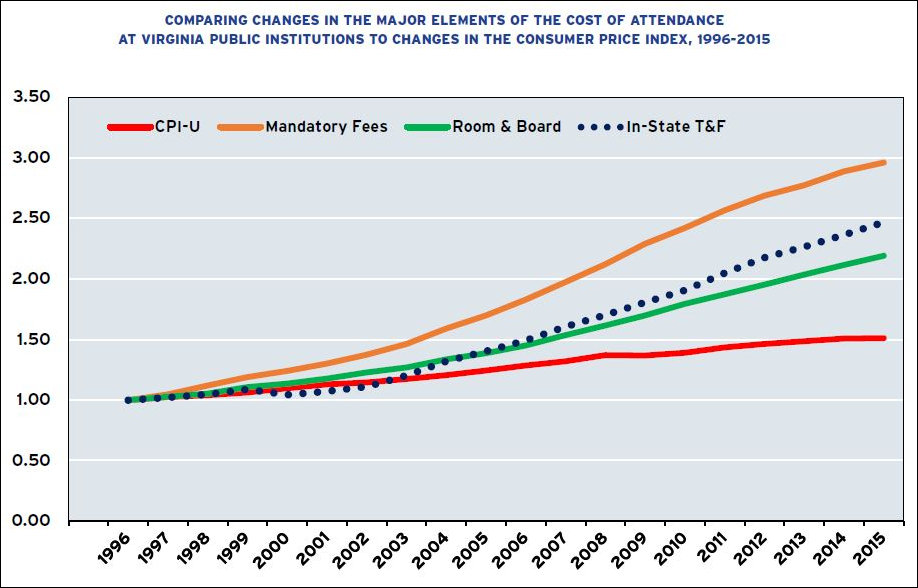
    In the 2017 State of the Commonwealth Report, authors Robert M. McNabb and James V. Koch address the perennial question of why the price of higher education is increasing so much faster than everything else. While acknowledging that stagnant state financial support for the higher-ed system has played a contributing role, they insist that’s only part of the story.

    As evidence, they proffer the graph seen above. The red line tracks the increase in the Consumer Price Index (CPI). The green line shows the cost of room & board, which relies on charges to students, with no contribution from the state at all. That cost has risen consistently over twenty years at about twice the rate as the CPI. The orange line shows mandatory student fees, which also receives no state funding. That cost has risen about three times the increase in the CPI. Together, the two categories account for roughly half the expense of attending college.

    Tuition, the blue dotted line, rises at a rate somewhat faster than room and board. That’s the only piece influenced by the level of state aid. What factors other than state support might influence the cost of tuition? McNabb and Koch offer several in this list of factors driving up the overall cost of attendance (including tuition, fees, room and board), which I replicate here almostย verbatim:

    • Institutional concern with national rankings is epitomized by U.S. News & World-Report rankings. Fixation on rankings can lead to decisions divorced from the needs of taxpayers, students and families.
    • Amenities competition stimulates institutions to offer such things as recreational spas and climbing walls as well as upscale (and expensive) food services.
    • Institutions often construct new, spacious buildings even though it is costly to maintain this space, and utilization of existing space is surprisingly low. A 2014 study by the State Council of Higher Education for Virginia (SCHEV) disclosed that no residential four-year campus in the Commonwealth of Virginia utilized its classrooms more than 76 percent of reasonably available hours, and three campuses ranged below 60 percent usage. Parenthetically, it is not clear that adding significant new space is an intelligent public policy when internet-based instruction is expanding and head count enrollments are declining. Modernization and rehabilitation of existing space may make more sense and be less expensive.
    • Institutions increasingly assess mandatory fees to support items ranging from student centers to athletic teams. In 2016-17, eight Virginia four-year public institutions charged their full-time undergraduate students athletic fees of $1,538 or more. Consider Christopher Newport’s $1,886 annual fee. This corresponds to a charge of $188.60 per three-hour undergraduate course. Doubtless, CNU’s Captains are well regarded, but they also are expensive, and students bear a substantial portion of that cost.
    • The growth of institutional room and board charges at most Virginia institutions easily has exceeded the growth of the consumer price index. First-rate residence halls and excellent food are pleasing, but costly.
    • Administrative proliferation (as measured by the number of administrators per faculty member or student) exists on most campuses. Further, these administrators tend to be paid well.
    • Institutions have reduced the proportion of their budgets they spend on instruction.
    • Disproportionate growth in spending on employee fringe benefits (which sometimes have substituted for pay raises during difficult years) has pushed tuition and fees upward.
    • Federal government financial aid policies are based upon institutional costs. Hence, when institutional costs increase, the “feds” supply more money.
    • Institutions are reluctant to take advantage of new teaching and learning technologies, flipped classrooms and other innovations that have the potential to scale higher education.
    • Institutions are disinclined to share resources with other institutions, even in low-enrollment areas such as foreign languages and literatures.
    • Institutions are averse to pricing the resources they use internally, such as space, and this leads to suboptimal behavior and hoarding.
    • Institutional mission creep has propelled many institutions into offering new, low-enrollment programs, often at the graduates level.
    • Faculty productivity, as measured by faculty credit hours generated, has declined on most campuses.
    • Subsidies from undergraduate students often are required to support faculty research activity and this is true even in cases where the research also is supported by outside grants.

    While the influence of these factors varies widely from institution to institution in Virginia, the authors acknowledge, “collectively, these are among the primary reasons why tuition and fee increases at Virginia’s public colleges and universities not only have vastly exceeded the growth in the consumer price index and median household income, but also why they have been substantially higher than the national average.”

    Bacon’s bottom line:ย While I agree with the thrust of the McNabb-Koch analysis, I would be more circumspect in concluding that the factors listed above are “the primary reasons” for tuition and fee increases. In many cases, we just don’t have the data to say one way or the other. Despite that reservation, I think the list provides several fruitful lines of inquiry, and I suspect that the data would prove the authors correct in many instances.

    Space utilization. To what extent, for example, is space underutilized on Virginia campuses? Every institution provides a different story. When Norfolk State University saw its enrollment plummet several years ago, for example, its space utilization went down as well. Utilization should improve as enrollment rebounds. Elsewhere, research universities cite the need for new buildings outfitted with specialized laboratories or other features to pursue advanced scientific and engineering disciplines, even if it means leaving former space underutilized. Thus, there may be legitimate explanations for temporarily low space utilization.ย However, I would agree that every college or university president should include in his or her dashboard of institutional performance a metric showing the utilization rate for individual buildings and campus-wide.

    Low-enrollment programs. How many universities maintain low-enrollment programs? Which departments are fully enrolled? Which are under-enrolled? If I were a university board member, I would like to see a faculty-to-enrollee ratio for every department. If a department had persistently low enrollment, perhaps it should receive fewer resources — or perhaps it could compensate by pursuing more online enrollment. Do university presidents even collect that data?

    Faculty productivity. My sense is that faculty productivity has declined over time, especially for tenure-track faculty members who are subject to the publish-or-perish dictum. What is the relative teaching load for full professors, associate professors, assistant professors, instructors, and graduate institutions? How many courses do they teach — and how many students are enrolled in those courses? This data should be readily available, and there is no excuse for institutions not compiling and publishing it.

    McNabb and Koch are both industry insiders — Koch is former president of Old Dominion University. As long-time participants in the academic enterprise, they know how higher-ed works. They have tremendous credibility. Let’s hope that Virginia’s political class is paying attention.


  • Virginia: 31st in Tax Climate

    Source: The Tax Foundation

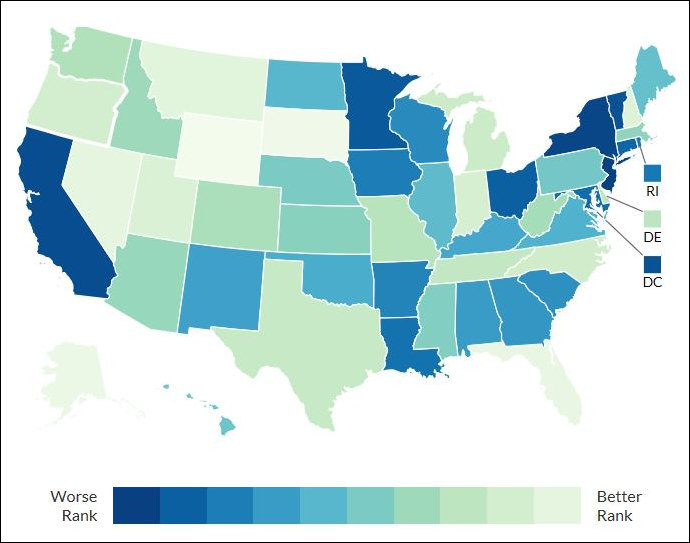
    Just a reminder: Virginia is not a low-tax state. According to the Tax Foundation’s 2018 ranking of state business tax climate, Virginia scored 31st. While the Old Dominion scores pretty well for corporate taxes and sales taxes, it flunks the grade for individual taxes and unemployment insurance taxes.

    Here are the category rankings:

    Overall rank: 31
    Corporate taxes: 6
    Individual taxes: 40
    Sales taxes: 10
    Property taxes: 31
    Unemployment insurance taxes: 41

    If you are taxaphobic, the best states in the country are Wyoming, South Dakota, Alaska, and Florida. The worst: New Jersey, New York, California, Vermont, and Minnesota.

    On the positive side, higher taxes pay for higher levels of services and amenities such as schools, higher-ed, public safety, roads, mass transit, Medicaid, and social services. On the negative side, you don’t always get what you pay for. In many states, public employee unions have captured a big share of tax revenue, and lots of the money has been spent to little effect. Tax-paying citizens continue to vote with their feet, leaving high-tax states and seeking opportunity in lower-tax states.

    Update: “The Tax Foundationโ€™s State Business Tax Climate Index (SBTCI) that you cited actually is not primarily intended to be reflective of business tax burdens in states,” notes Stephen Moret, president of the Virginia Economic Development Partnership (VEDP). “It is more of a ranking of tax complexity or tax structure than it is a ranking of state/local tax burdens.” See his full observation highlighted in the comments section.


  • The High Cost and Social Inequality of Higher Ed in Virginia

    Source: 2017 State of the Commonwealth Report

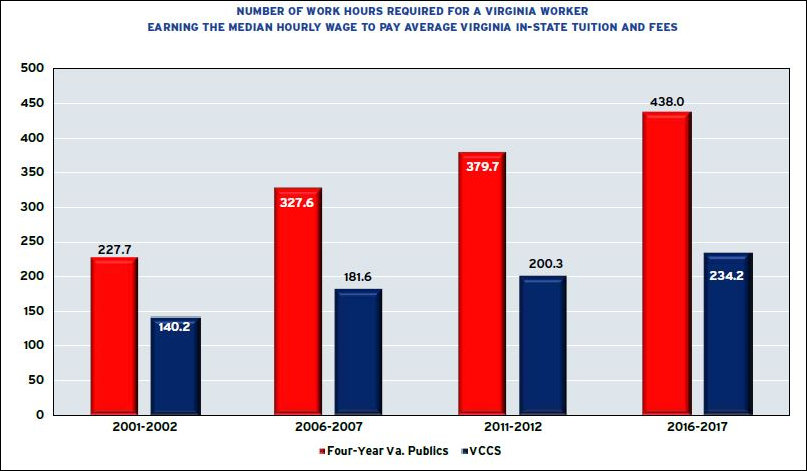
    Everyone knows that the cost of attending college in Virginia has soared in recent years, even as family incomes have stagnated. A good way to visualize the divergence between cost and affordability is to calculate the number of hours it takes for a family earning the Virginia median hourly wage to pay for a year of average tuition & fees. That’s exactly what Paul M. McNabb and James V. Koch have done in their 2017 State of the Commonwealth Report. The results can be seen in the chart above. The number of working hours required to attend a four-year college has increased 82% since the 2001-02 academic year, while the number for a two-year college has increased 67%. (These numbers don’t include room, board, textbooks and other miscellaneous costs.)

    Higher education is the most inflationary sector of the U.S. economy, with cost increases outpacing that of the inflation-prone housing and healthcare sectors. In their analysis of Virginia’s higher-education system McNabb and Koch explain the causes of runaway tuition increases and explore the impact on Virginians. (Note: Koch, a former president of Old Dominion University, serves on the board of Partners 4 Affordable Excellence @ EDU, a sponsor of this blog.)

    The question naturally arises whether Virginia’s colleges and universities are pricing state residents out of higher education. Pointing to the declining head count in the state’s public institutions — nearly 6% between the 2011-12 school year and the 2016-17 year — the authors say yes. “Simply put, increasing numbers of students have decided that our public colleges have become too expensive compared to the benefits they generate in return.”

    The sticker price of college tuition & fees is not the same as the actual price that many students pay. The federal government dispenses Pell grants to low-income students, the state operates its own financial-aid program, and higher-ed institutions themselves extend financial aid. Consequently, theย net price paid by students often is considerably lower than the advertised price.

    Colleges and universities raise much of the money for financial aid by raising the sticker price that students from affluent families pay. In effect, the authors write,ย “the pricing policies of most colleges and universities today … administer a collegiate version of a steeply progressive income tax, taking from the more wealthy and giving to the less wealthy by means of the net prices each group pays.”

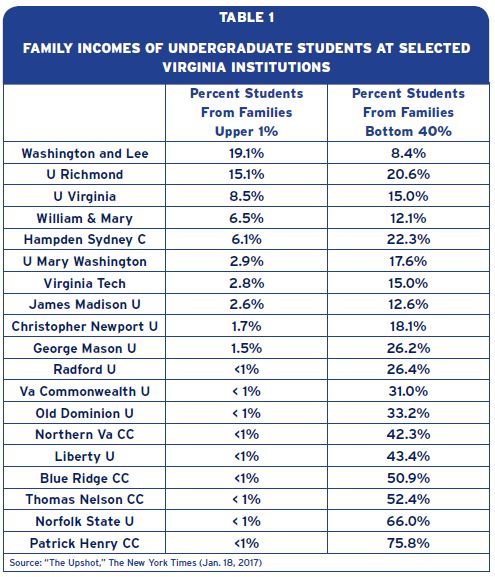
    Despite their redistributionist tuition policies, universities remain economically and socially stratified. While some of Virginia’s elite public universities do offer steep discounts to low-income students, high admission standards mean that, as a practical matter, only a small number make it in.

    If the denizens of the bottom 60 percent of the income distribution can be fashioned as “common people,” then one might say that at least five Virginia public institutions (University of Virginia, William & Mary, Virginia Tech, University of Mary Washington, and Christopher Newport University) have relatively few common people in their undergraduate student bodies.

    Source: 2017 State of the Commonwealth Report

    McNabb and Koch raise the question of whether the General Assembly should financially support colleges and universities whose pricing policies imitate that of private universities.

    Is it appropriate for the citizenry to subsidize institutions that increase social and economic inequality rather than provide the traditional ladders of opportunity that diminish differences?

    Tough question. Virginia’s elite universities are unlikely to change their policies. Programs designed to increase the presence of lower-income students at the elite institutions might endanger their coveted Top 25 rankings if they eroded SAT score, ACT scores and on-time graduation rates.

    Rare is the president of a top-ranked institution who wants to preside over a noticeable decline in his or her institution’s rankings. What member of an institution’s board of visitors will brag about the lower national ranking that came about because more Pell Grant recipients were admitted?

    The authors point to the University of California system as an alternative model that Virginia might emulate. At the University of California at Berkeley, for example, 30% of undergraduates were Pell Grant recipients in 2015-16, while at UCLA the number was 35%.

    But Virginia institutions are moving the opposite direction. At least a half-dozen Virginia public four-year institutions appear to have pursued policies that had the effect of restricting access of lower-income Virginians, say McNabb and Koch. “Is this a trend that the citizenry should support? We do not have the answer to this question, but it is easy to observe that what is perceived to be good for an individual institution’s national rankings may not be synonymous with what is good for Virginians.”

    Bacon’s bottom line: That’s where the authors leave it. They don’t carry their thinking to its logical conclusion: that Virginia should cut off state funding and turn its elite public universities loose, letting them be free to be what they want to be — like, say, Duke or Dartmouth — and then redistribute state funds to institutions that appeal to a broader cross-section of the population.

    I’m not sure how I stand on the issue, but I do see the logic.