• Let’s Hope This Act Never Grows Old

    I’d never heard of the Church Sisters — Savannah and Sarah Church — until this week, when I read they were coming to play in Richmond. These young ladies who were raised in the heart of the Virginia coalfields, Dickenson County, and in Danville, meld Bluegrass and Gospel. The melody in this video, “Where We’ll Never Grow Old,” has a slow tempo but the twin sisters’ harmonies are lovely. (Skip through the first 30 seconds of the video to get straight to their performance.)

    Southwest Virginia may be down and out economically, but the cultural traditions of Central Appalachia are as vibrant as ever. The twins have signed a record contract with Taylor Swift’s label, which could well push them into the big time.


  • More Tuition Increases Recommended at UVa

    From the Daily Progress:

    Applicants for the University of Virginiaโ€™s Class of 2023 may face sticker shock when applying to their programs. The universityโ€™s Board of Visitors Finance Committee approved tuition increases on Friday between 2.5 and 17.5 percent for incoming undergraduates.

    Itโ€™s the third year in a row that increases for returning undergraduates remained below inflation, but administrators say increases are needed in some academic colleges to pay for high costs of instruction.

    Annual increases in the schools of architecture, nursing, engineering and applied sciences, public policy and commerce range from $1,436 to $2,962.

    The article did not provide an average tuition increase for the university as a whole.

    Bacon’s bottom line: It makes sense to charge different tuition & fees for different schools and programs. After all, the educational products are very different. Costs vary widely from school to school, and so does competition, demand, and value provided. At the same time, this approach obscures the overall thrust of tuition policy. Is UVa moderating its tuition hikes, or is it delivering another round of overall increases. Did the UVa administration fail to provide an overall figure, or did the Daily Progress reporter fail to report it?

    Update: A UVa Today article answers the main question I was asking: “Overall, the proposed weighted average tuition increase for all in-state UVA students is 3.3 percent, and the proposed weighted average for non-Virginians is 3.9 percent.”


  • Actually, Travel Times Are Faster on I-66, VDOT Says

    Image credit: Virginia Department of Transportation

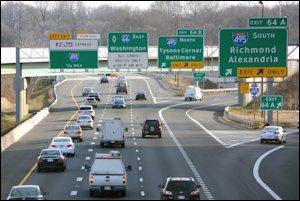
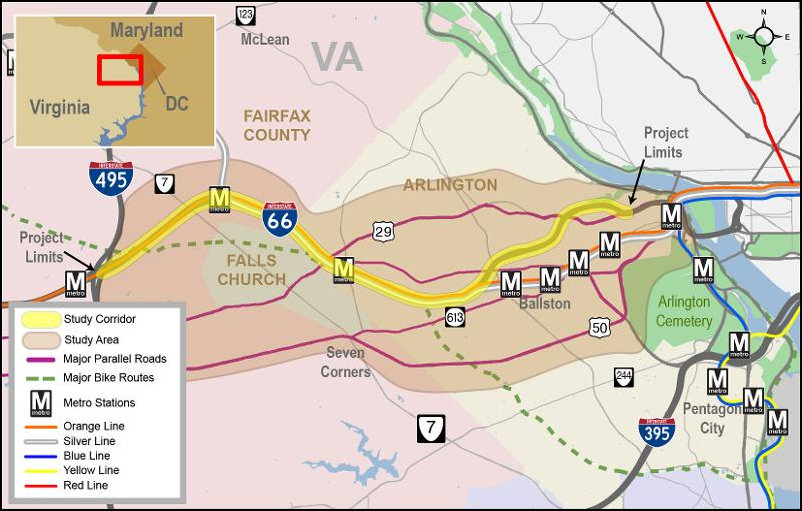
    Many Northern Virginia motorists and politicians seem to be having mental breakdowns over the opening of HOT lanes on Interstate 66 inside the Beltway. Most notably, they point to the first-day, one-way $34.50 peak toll as an outrage against the driving public. Ironically, though, morning and afternoon commutes were faster during the first four days of HOT lane operation than the same period last year, asserts the Virginia Department of Transportation.

    The averageย toll price during morning rush hour was $10.70 and during evening rush hour $3.80, stated VDOT in a press release issued yesterday evening. Only 39 vehicles paid the posted highest toll of $34.50. A third paid less than $10. And average travel times for the 10-mile route were 10 to 12 minutes compared to 15 to 30 minutes last December.

    VDOT analysis also showed that of the 13,307 vehicles that used I-66 Inside the Beltway between 5:30 a.m. and 9:30 a.m. Monday, 5,082 were carpoolers who traveled free. Traffic was heavier but travel times were comparable during the evening commute the other direction.

    “Contrary to the continued political rhetoric of critics, I-66 Inside the Beltway Express Lanes tolls have been based on sound planning and with the ultimate goal of improving travel for everyone,” said Secretary of Transportation Aubrey Layne. “We want to move more people, improve connectivity and provide additional travel choices. This is about unlocking gridlock on I-66 as Governor McAuliffe pledged.”

    VDOT also noted that,ย except for an incident that closed two or three lanes of traffic on Route 50 Monday evening, travel on parallel roads such as Route 50, Route 29, and Route 7 were “either similar or improved compared with last December.”

    The VDOT statement did not address observations that serious delays occurred at points accessing I-66 inside the Beltway.

    Bacon’s bottom line: Assuming VDOT is not cherry picking its data, it appears that the HOT lanes are working as advertised, and that the people who are most upset by the HOT lanes are those who were prepared to be upset by HOT lanes to begin with. However, any conclusion is preliminary until the public has had a chance to review and critique the travel data.


  • More People Still Leaving Virginia than Moving In

    Source: StatChat blog

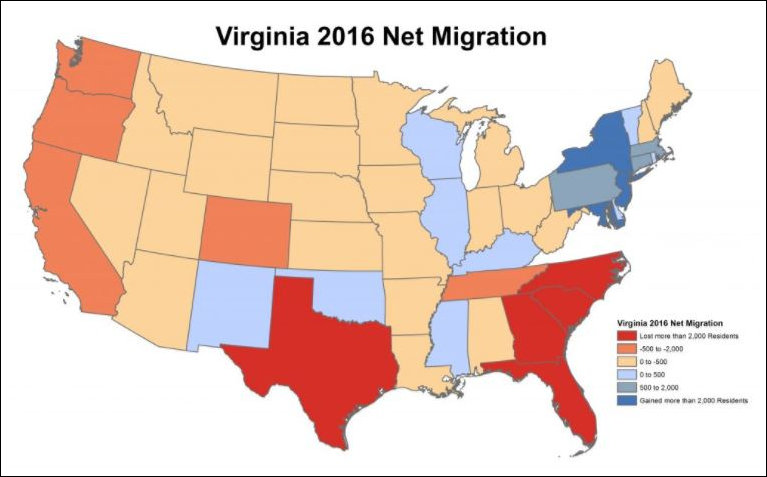
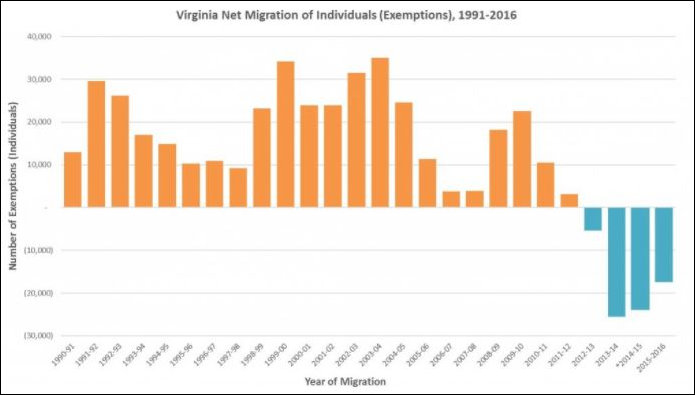
    Virginia has experienced its fourth consecutive year of domestic out-migration, reports Hamilton Lombard with the University of Virginia’s demographic research group in its StatChat blog. Prior to 2013, Virginia had never experienced a year of out-migration since the Internal Revenue Service began collecting data in 1978. (The data is based on address changes for households filing income taxes.)ย Virginia’s population is still growing thanks to a surplus of births over deaths, but the growth rate has slowed from 80,000 a year in the 2000s to 50,000 for the past four years.

    Lombard attributes the out-migration largely to the impact of sequestration-related cutbacks to defense spending on the economy in Northern Virginia and Hampton Roads.ย He also suggests that the high cost of Northern Virginia housing may play a factor in the exodus.

    While Virginia still experiences net in-migration from traditional feeder states in the Northeast, it is exporting population to fast-growth Sunbelt cities. The largest cohort of immigrants is in the 26- to 35-year-old age range, although Lombard expects to see a growing number of retirees leaving the state for lower-tax climes.


  • Adjunct Faculty: Higher Ed’s Lumpenproletariat

    Heide Trepanier at her studio. Photo credit: Style Weekly. Her artwork hangs in the Virginia Museum of Fine Arts but as a VCU adjunct faculty member, she would get paid only $3,000 for teaching an art course next spring.

    I have a pet theory. One of the reasons that employees of colleges and universities are so politically liberal and obsessed with inequality and privilege is that colleges and universities themselves are such unequal and hierarchical places. Those on the lower rungs feel oppressed. Those on the upper rungs feel guilty.

    A case in point: A group of adjunct art faculty members at Virginia Commonwealth University has circulated a petition calling for a pay increase. The part-time instructors, who are hired on a contractual basis and are not on the tenure track, currently are paid $800 per credit, a sum that is scheduled to rise to $1,000 per credit this spring. But adjunct faculty members are calling for pay of $2,000 per credit.

    โ€œA lot of people feel exploited,โ€ artist Heide Trepanier, who has worked as an adjunct at VCU, told Style Weekly. โ€œThings like the School of the Arts donโ€™t pull in big funding,โ€ she says, โ€œso their big way of [making] money is pulling in more students and cutting costs. You have these upper-level administrators earning hundreds of thousands of dollars and most of the people there teaching, who are in direct contact with the students, [have no chance] for full tenure track positions.โ€

    Adjuncts receive no benefits or no free parking, the cost of which Trepanier says translates to teaching one day a week free. “Adjuncts don’t have any say in the process. VCU is using a successful business model that is not working in higher education. Now theyโ€™ve got a problem because the majority is starting to organize.โ€

    The inequality is national in scope, not limited to VCU. There are wide disparities in universities between similarly educated and qualified individuals and the pay and privileges (like paid sabbaticals) they enjoy. Adjunct faculty are the lumpenproletariat of the academic world. Above them, the petite bourgeoisie, are “instructors” who, though they may not be on a tenure track, do enjoy the benefits of full-time employment. Then come the gentry and aristocracy: the assistant professors, associate professors, and full professors. Within the ranks of full professors, there are innumerable gradations of pay and status. The elite occupy endowed chairs, with endowment-funded supplements to their salaries, and are assigned a complement of graduate students. And, unless they violate the code of politically incorrect behavior and discourse, they enjoy virtually life-time job security.

    Granted, not all adjuncts, instructors, and professors are equally accomplished. Some contribute more intellectually to their fields — through research and writing — than others. The irony for institutions whose primary mission is to educate people is that the most accomplished professors — those who have reached tenure — do the least teaching. They get the lightest teaching loads so they can devote more time to pursue research and writing. The system is captive to the publish-or-perish phenomenon in which those who create knowledge (much of it of dubious value) are valued far more highly that those who disseminate it.

    I have two close friends who are, or have been, adjunct faculty members of Richmond-area universities. One has a law degree, the other has a Ph.D. in psychology — the same educational credentials as those who occupy much loftier positions in the academic hierarchy. Both have intense and/or engaging personalities and both, I would wager (although I have not seen them in a classroom setting) are engaging teachers. As it happens, both are women, which may or may not be typical of adjunct faculty generally. And both either are, or have been, frustrated or embittered by their treatment.

    Universities respond that they would love to increase pay for adjunct faculty but they just can’t. Cutbacks in state support for higher education, you know.

    Here’s how Shawn Brixey, dean of VCU’s School of the Arts, justifies the pay disparities, as summarized by Style:

    He notes the fiscal reality that budget cuts occurred last year, which leaves little discretion โ€œbeyond meeting unavoidable costs.โ€ Throughout the years, tuition increases have, for the most part, replaced state funding cuts. He adds that the universityโ€™s administrative costs are โ€œvery low compared to like institutionsโ€ and that heโ€™s working on generating new revenue streams to ease the tuition burden.

    โ€œWe know that faculty compensation at VCU of all types โ€“ including for our teaching and research faculty and administrative and professional faculty – is below the average of that of our peers and fellow state tier 3 institutions,โ€ Brixey explains via email. โ€œThe administration is working to improve that. They have made adjunct faculty compensation a top priority for the FY19 budget.โ€

    Brixey has a point… assuming you accept the hierarchical nature of the faculty as an immutable feature of higher education at VCU and nearly every other nonprofit college and university in the country.


  • Documenting Cville’s Left-Wing Radicalism

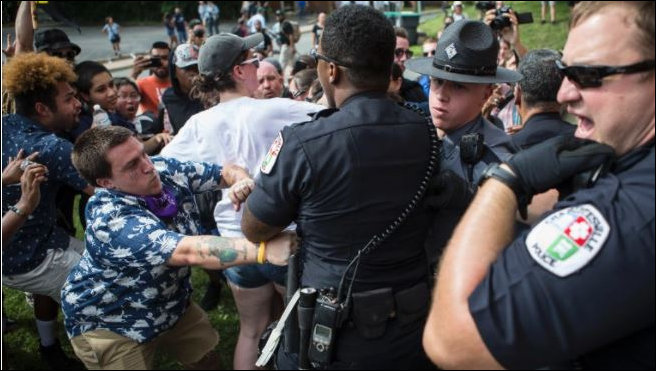
    Counter protesters tussle with Charlottesville police in July 2017 Klan rally, a run-up to the tragic August United-the-Right protest. Photo credit: CNN

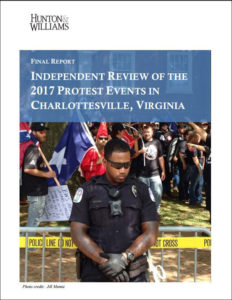
    The primary purpose of the Heaphy report on the Aug. 11-12 United the Right rally was to evaluate the actions of Charlottesville city officials and whether the violence could have been prevented. But the document provides a treasure trove of raw material to help pundits and commentators understand the larger context of the confrontation between far-right and far-left forces and the events that led up to it.ย While those offended by the report have subjected it to nitpicking criticisms and minor errors of fact, the findings have held up remarkably well since its release.

    Material in the report lends itself to at least two useful lines of inquiry that have gone largely unexplored: (1) to illuminate the size and scope of the left-wing radical community in Charlottesville, and (2) to show how the anti-Trump narrative of the national media, which gave the incident inordinate attention, skewed perceptions of what happened.

    Before I delve into the data, let me make a disclaimer so my intentions are not misconstrued, as they inevitably will be. I am not defending the statements of President Trump regarding the rally, such as the proposition that there were “good people” on both sides, nor am I drawing a “moral equivalence” between Nazis, Klansmen and white supremacists on the one side and radical leftist anarchists on the other. My purpose is to correct a misperception perpetuated by the national media in its zeal to condemn Trump by downplaying the contribution of left-wing anarchists to the violence of that day. While there has been a growing recognition by some left-of-center observers (mostly moderate liberals) that Antifa and other radical leftists are prone to violence, the mainstream broadcast media continues to soft-peddle that reality.

    Conservatives don’t refer to Charlottesville as the People’s Republic of Charlottesville without reason. The city has emerged as Virginia’s center of radical left-wing activity. Other parts of Virginia are just as “blue,” as in Democratic leaning. The vote totals in Arlington and Alexandria, for example are just as lopsided as they are in Charlottsville, but voters there are more “establishment” liberals dedicated to maintaining the power and authority of the federal government, not overthrowing it. Many Charlottesville radicals are dedicated to the proposition that all government is illegitimate.

    Back in April, I observed that Democratic gubernatorial hopeful Tom Perriello was Virginia’s “radical chic” candidate. Perriello’s campaign was funded by liberal billionaire George Soros, global activist organization Avaaz, and a coterie of wealthy Albemarle County gentry such as author John Grisham, musician Dave Mathews, yoga instructor Lilly Bechtel, and reproductive-rights advocateย Sonjia Smith.

    “Never in all my years as an observer of Virginia politics have I seen such large contributions bubble forth from the Peopleโ€™s Republic,” I observed at the time. “Whether this gusher of campaign contributions portends an inflection point in Virginia politics, I donโ€™t know. But it is remarkable.”

    While the Albemarle gentry funds left-wing candidates and causes, Charlottesville provides numerous foot soldiers of the Left. The Heaphy report provides a window into activist groups that burbled up from the grassroots during the controversy over the removal of Charlottesville’s Robert E. Lee statue in a series of confrontations with local white-rights provocateur Jason Kessler.ย A faith-based organization called Congregate Charlottesville organized training sessions on nonviolent civil disobedience. Other anti-racist groups, writes Heaphy, “prepared to disrupt [a May 14 event] and hinder law enforcement response to specific threats.” Among the radical anti-racist groups active at the time were Antifa, Solidarity Charlottesville, Black Lives Matter, and SURJ (Showing up for Racial Justice) .

    As Kessler organized a series of rallies highlighting his white-rights issues, Leftist groups mobilized to push back against his white-nationalist agenda. May rallies and counter rallies elevated the Lee statue controversy from a local issue to part of an ongoing national debate over Confederate statues. Against this backdrop, a KKK group from North Carolina organized a rally in defense of the Lee statue on July 8.

    Charlottesville police intelligence indicated that numerous radical groups were organizing a counter-protest and engaged in extensive planning to handle the event.ย On the day of the July 8 rally, it was clear that the counter-protesters were well organized.

    Lieutenant Oโ€™Donnell characterized Antifa as โ€œvery organizedโ€ and โ€œtotally coordinated.โ€ย He spoke with a โ€œstreet medicโ€ who revealed that she had protested at Standing Rock,ย South Dakota for eight months before arriving in Charlottesville. At 2:15 p.m., Antifa wasย spotted wearing gas masks, padded clothing, and body armor. Captain Shifflett recalledย being surprised at the planning by some counter-protesters who brought organized medics,ย used walkie-talkies to share information, and wore helmets, full body pads, gas masks, andย shields. CPD Lieutenant Dwayne Jones observed counter-protesters actively monitoringย scanners and other devices to track the movements and communications of the police.

    The Charlottesville police created a corridor for the estimated 40 to 60 Klansmen to walk to the protest zone at Justice Park and managed to keep the them separated from the counter-protesters. The Klansmen gave a few speeches as an estimated 1,500 to 2,000 counter protesters tried to drown them out with noise and pelted them withย apples,ย tomatoes, oranges, and water bottles. Around 4:30, the Klansmen left the park and headed back to their cars parked in the JDR Court garage.

    At this point the counter-protesters grew more threatening. Asย the Klan entered the parking garage, the CPD Command Center issued an orderย to hold the Klan inside because counter-protesters were blocking the door. Police instructed theย Klan to stay in their vehicles. Amanda Barker, a participant in the Klan rally, described the situation as โ€œterrifyingโ€ because the Klan wereย โ€œtrapped inside the garageโ€ and could hear the counter-protesters outside.

    Police instructedย the Klan to line up their cars and prepare to quickly exit the garage. With an increasing number of counter-protesters gathering outside of the garage door andย blocking the Klanโ€™s exit, Lieutenant Joe Hatter told the Command Center โ€œthis is seriousโ€ andย requested permission to declare an unlawful assembly. Police Chief Al Thomas acceded to the request.ย Hatter organized Charlottesville, Albemarle and Virginia State police into a line in front of the parking garage and used a bullhorn toย announce that the gathering had been declared an unlawful assembly.

    With police clearing a path and a police car leading the caravan, the Klan exited the parking garage. Counter-protesters confronted the cars and hit them with weapons. When the Klansmen reached the U.S. 250 Bypass, they immediately left the city. States the Heaphy report: (more…)


  • Acronyms that Will Change our Communities: MaaS and LML

    Source: Navigant Research

    You know something is destined to become the Next Big Thing when a business research firm like Navigant Research starts charging $1,800 for special reports on the subject. I can’t afford to pay that kind of money, but I do subscribe to Navigant’s alerts to keep tabs on the hottest, most hyped trends in the business world.

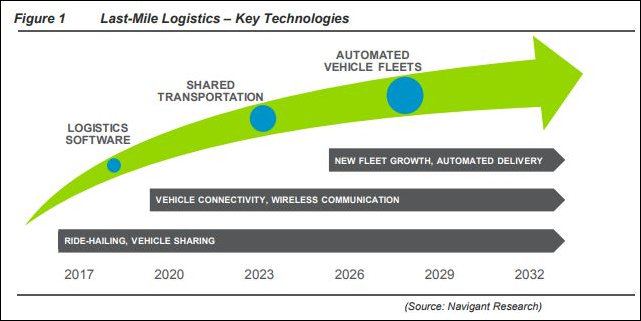
    Let me introduce two acronyms: MaaS (Mobility as a Service) and LML (Last Mile Logistics). I have discussed mobility as a service several times on this blog — the idea of subscribing to mobility services, such as access to cars, taxi rides, buses, mass transit and even bicycles — rather than owning the transportation assets outright. LML, a new acronym to me, refers to the local delivery of food, small packages and even consumer appliances directly to the home.

    The Navigant report, “The Future of Last-Mile Logistics,” explores the intersection of the two. States the executive summary (which is all I have access to):

    The biggest challenge today for LML is congestion and parking in large cities. The development of MaaSย applications offers a potential solution. In the near future, a MaaS service for a city or local region is likelyย to deploy a fleet of automated vehicles (ranging from single-person vehicles to minibuses) designed toย move large numbers of people to work during rush hour and deliver on-demand transport during off peakย hours. This type of fleet would have excess capacity available outside peak hours to perform functionsย like small parcel and takeout food delivery and would be able to take waste away in bags for recycling orย disposal. If the fleet resource is shared effectively, operating single-purpose vehicles for delivery will noย longer be necessary for many businesses.

    Integrated, shared fleets for MaaS offer the potential for new LML options and delivery cost savingsย for businesses. Automated driving vehicles are critical for the success of these service models in theย long term, while drones have the potential to become a cost-effective solution for deliveries toย remote locations.

    Got that? Mobility-service companies, be they tech companies like Google and Uber or traditional automobile companies like Ford, General Motors and Mercedes Benz, are preparing for the day when companies operate fleets of driverless cars, vans and buses that operate 24/7. Peak demand for these vehicles will occur during traditional rush hours when people travel between home and work. As demand drops off during the mid-day, cars can be kept busy — and assets continually utilized — by converting them into delivery vehicles.

    The potential ramifications are mind-boggling:

    • Car ownership. Many people will find it cheaper and preferable to buy the ride rather than own the car. Demand for garages will plummet. (Expect millions of garages to be converted to man caves.)
    • Parking. Demand for parking will crater, freeing up tremendous urban and suburban space for conversion to different uses. Walkability will improve in areas with urban density, and low-value parking lots and parking decks will be converted to high-value offices, apartments and condos. urban uses. That’s good for the urban tax base. Suburban localities, with their vast tracts of acreage dedicated to parking, will be most severely impacted, especially if they maintain mandated parking ratios and prevent the land from being recycled.
    • Fewer errands. As retailers become more proficient at delivering packages, people will conduct more business online and rely upon home delivery. Insofar as improved home delivery improves the competitive advantage of online retailers, expect further decline of traditional stores and an eventual crisis in retail-oriented real estate development. Dwellings may have to be reconfigured to accept delivery of these items, especially groceries that require refrigeration. Great for renovations contractors and Home Depot!
    • Longer commutes. Driverless cars may make long commutes less onerous by allowing “drivers” to surf the web, read email and do work while commuting. Longer commutes could encourage more leapfrog development — to some degree offsetting the competitive advantage to urban areas of less parking.
    • Demise of mass transit. Driverless vans and buses will gain market share from mass transit companies with high costs and rigid schedules. Poor people will benefit from the wider range of choices. Mass transit companies will fight for their existence. Urban jurisdictions will face the question: to subsidize or let fail.

    These bullet points are all speculative. For all practical purposes, it is impossible to anticipate how the MaaS and LML revolution will pan out. The interactions are too complex for mere mortals to anticipate all possible outcomes.

    What we can say for sure is that the transportation future will be very different in 10 to 15 years than it is now. Transportation is a major driving force behind land use, and we can say with equal certainty that land use patterns will be very different as well — although change will come much more slowly.

    Here in Virginia, cities and counties that put a premium on flexibility and adaptability will thrive. Those that rigidly adhere to outdated zoning and comprehensive plans will lose.


  • Hey, I-66 Whiners: Join a Friggin’ Carpool!

    Interstate 66 east at the Capital Beltway in Virginia. Jan. 2016. (WTOP/Dave Dildine)

    The Interstate 66 toll lanes opened yesterday in Northern Virginia, and dynamically priced tolls during the morning commute hit $34.50 for the 10-mile stretch from the Beltway to Washington, D.C., reports the Washington Post.

    The high price for the tolls — among the highest that drivers have paid for the privilege of traveling on a state-owned highway in the United States, the Post observes — induced the usual hand wringing. Reports the Post:

    โ€œI drove onto I-66 around 8:10 this morning to Washington and my one-way toll was $17.25 โ€” which I at first thought Iโ€™d misread,โ€ Justin Cole said. โ€œWith tolls reportedly climbing to around a daily one-way peak of $34.50, that is going to introduce a real hardship for people on low wages or working in the nonprofit or public sector.โ€

    Others took to social media to express their outrage, with the hashtags #I66tolls and #highwayrobbery trending.

    โ€œThis is like a bad telethon, watching the number go higher and higher all morning,โ€ tweeted commuter Cameron Gray.

    โ€œThe tolls on I-66 are being increased so only the 1% can afford to use it. Time to get that private jet,โ€ said another.

    โ€œItโ€™s price gouging,โ€ said Virginia Del.-elect Danica Roem (D), who won office last month on a platform that focused on traffic in her suburban Prince William County district. She said she will push to cap tolls in the coming General Assembly session.

    โ€œWe are talking about $34.50 for a few miles inside the Beltway. Thatโ€™s clearly price gouging,โ€ Roem said. โ€œWhere else in the country do you pay a $34.50 toll to go somewhere?โ€

    I have to say, a $34 toll for a 10-mile trip is extravagantly high. I would never pay it. Here’s a tip to the whiners: Don’t have to pay it either! Just drive on I-66 like you always have! There are no fewer lanes than there were before. Was traffic on I-66 this morning any worse than it was last week? No? Then get over it!

    As long as you’re not the person paying them, high toll fares are good news. When the state covers its cost of setting up the HOT lane infrastructure, it will devote surplus revenue to multimodal improvements — buses, Metrorail, bicycle, pedestrian facilities — that take commuters off I-66 and make the highway a little less congested for everyone else.

    As for the proposal by Del.-elect Danica Boem, D-Manassas, to cap the tolls, it’s time for an economics lesson. The tolls are driven by demand. If the toll reaches $34, that’s because people are willing to pay that much for a quicker trip. If you cap the toll at, say, $10, too many people will crowd the HOT lanes, and average driving speed could well drop below the guaranteed 45 miles per hour. That would kill the reward for ride sharing, and fewer ride shares would mean more cars on the road.

    Carpools, vans and buses get to use the HOT lanes for free.ย If you really, really, really want to use the HOT lanes, then stop your bellyaching, relinquish your privilege as driver of a single-occupancy vehicle, and join a friggin’ carpool!


  • Dominion Open to Ending Rate Freeze

    Mark O. Webb

    Take surplus revenue and invest it in modernizing the electric grid, the Richmond utility proposes.

    Dominion Virginia Energy has proposed ending a controversial freeze in base electric rates and plow surplus revenues owed to rate payers into modernizing the electric grid.

    “We believe it is time to transition away from the rate freeze as the outlines of state carbon regulation have become more clear and the need and the opportunity to reinvest in grid transformation becomes more pressing,” saidย Mark Webb, senior vice president for corporate affairs, in remarks made during a hearing of theย Commission on Electric Utility Regulation.

    None of the commission members seemed surprised by Dominion’s dramatic shift, which it aired publicly for the first time, nor did they have any questions. Dominion’s presentations were orchestrated with comments made by Technology Secretary Karen Jackson, who emphasized the need to bolster the grid against cyber-security attacks, and a representative of the Edison Electric Institute, who discussed how grid modernization sped the restoration of electric surface this year after Hurricanes Harvey and Irma.

    In a separate presentation, Kimberly B. Pate, director of the division of utility accounting at the State Corporation Commission, noted that a reduction in the corporate tax rate from 35% to 20% embedded in Congressional tax legislation would reduce the tax liability of Dominion by $165 million and Appalachian Power Co. by $80 million. If the freeze in electric rates were still in effect, she said, the tax savings would flow straight to shareholders rather than rate payers.

    Dominion pushed for the rate freeze in 2015 after the Obama administration had proposed its Clean Power Plan designed to electric utilities’ reduce carbon-dioxide emissions as part of the U.S. commitment to combat global warming. No one at the time knew what impact the regulations would have, but the SCC warned that the regulations potentially could cost Virginia rate payers billions of dollars. Since the Trump administration declared its intention to scrap the Clean Power Plan, critics have charged that the freeze would allow Dominion to keep potentially hundreds of millions of dollars of excess earnings instead of rebating them to rate holders, as it would without the freeze. Dominion officials have conceded that the company has generated excess revenue but contended that it faced other potential liabilities, such as storm damages and coal-ash disposal costs, and that the excess revenue could easily turn to a shortfall.

    In endorsing an end to the freeze, Dominion positioned the rollback as a way to finance modernization of the electric grid.

    “As you have heard today, there are new challenges to our ability to keep the lights on in the form of cyber threats, physical security threats, and super storms,” Webb said. “We need to modernize and transform the grid to know immediately when your power is out or even about to go out, and where to deploy our crews to restore power. We can, with the right investments, come ever closer to our goal of power that is always on.”

    He continued:

    Under any regulatory construct there will be years with excess earnings due to favorable weather, the absence of severe storms, economic growth, and business efficiencies. In this respect, forecasts of utility earnings are similar to forecasts of the state budget. Some years, forecasts may prove too optimistic, in others too pessimistic. The General Assembly may wish to consider a reinvestment model, where in years when there are such excess earnings, they are reinvested in modernizing and transforming the electricity grid, similar to how the Commonwealth sets guidelines for use of a budget surplus.

    While the excess revenues would not be returned directly to rate payers under the proposal, Webb told Bacon’s Rebellion, rate payers would benefit indirectly: Dominion would not need to recoup the investment through a Rate Adjustment Clause, the usual mechanism for passing on the cost of capital investments to rate payers.

    In addition to better managing power outages, Webb said that a modernized grid would facilitate the two-way flow of electricity in the distribution system that would make it easier to integrate increased production from solar energy.

    Chris Eisenbrey, senior director of business continuity for the Edison Electric Institute, described the benefits of grid modernization for Florida Power & Light and CenterPoint Energy in Houston. Since 20016 FP&L has invested $3 billion in a stronger, smarter more resilient grid, he said. The utility estimates that the ability to identify problems, turn devices on and off remotely, and efficiently allocate its linemen and other resources saved its customers 40 million outage minutes.

    Jackson, Virginia’s secretary of technology, said that the threat of cyber sabotage has evolved from teenager hackers in their basements to state actors with vast resources. She quoted an estimate that China had 100,000 people employed in its cyber-espionage division. Russia, Iran, and North Korea have thousands more. If a foreign power wants to launch a cyber-attack on the United States, the electric grid is a primary target. “Electric power companies are in an unenviable position,” she said.

    “Our goal is to come ever closer to always keeping the lights on, and to dramatically reduce the time required to restore power outages,” Webb said. “Through investments in new technology, careful planning, and grid modernization we can keep the lights on to a degree unimaginable even a decade ago.”

    No one responded to the Dominion proposal at the hearing. “It’s hard to react to something that is just a shadow of a hint with zero details,” said Stephen Haner, a lobbyist representing the Virginia Poverty Law Center (and a contributor to this blog). “Are they talking $1 billion or $5 billion? Paid for over three years or ten years or twenty years? What [Return on Investment] are they looking for?ย  What will be the long term impact on operating costs? Details matter a lot.”

    Speaking generally, he favors the idea of modernizing the electric grid that saves money and manpower, Haner said. “I think the ratepayers and the SCC will be very supportive of moving in that direction.”

    But he has reservations. “At one point I think Mark Web said they have to end the freeze in order to undertake the grid modernization and that is just laughable,” Haner said. “They only have to end the freeze if they are going to try to charge us more … in base rates, or they want to eliminate the legal authority of the SCC to order refunds or reduce rates. I doubt I will like their first draft.”

    When asked to explain the change in policy regarding the rate freeze, Katherine Bond, senior policy adviser for dominion, acknowledged that Dominion has been heavily criticized for the freeze. “We’re active listeners,” she said.

    Update: Senate Majority Leader Thomas K. Norment, Jr., R-James City, said he was “a little perplexed” by Dominion’s proposal, reports the Richmond Times-Dispatch. “I don’t think we’re going to be moving in that direction at a rapid pace,” said Norment, who chairs the utility restructuring commission. The T-D article provides other useful background not found in my blog post.


  • “A significant failure that has diminished the City’s faith in its elected leaders”

    I haven’t had time to do anything more than scan Timothy Heaphy’s report on the tragic events in Charlottesville on Aug. 11-12, but I’ve seen enough to know that itย provides a sober, just-the-facts-ma’am narrative of events leading up to the Unite the Right rally, a blow-by-blow account of the rally itself, and critical context to evaluate the performance of both politicians and police. A formidable research effort, the 207-page report represents a ddraws upon interviews with hundreds of participants, hundreds of thousands of documents, thousands of photographs and many hours of video.

    I extract some of Heaphy’s key conclusions about what went right and what went wrong at the United the Right rally. (Most of what follows is quoted verbatim, although I have made occasional modifications for purposes of readability.)

    What Went Right

    Despite the presence of firearms and angry confrontations between protesters and counter-protesters, no person was shot and no significant property damage occurred.

    The Charlottesville Fire Department and UVA Health System had effective operations plans that allowed rescue personnel to extract and treat a large number of injured persons within minutes of a violent attack.

    Law enforcement planning and response was informed by thorough, accurate intelligence before and after the event.

    What Went Wrong

    The Charlottesville Police Department (CPD) did not seek input from law enforcement personnel experienced in handling similar events, and the CPD did not provide adequate training or information to officers in advance of the event.

    The City of Charlottesville waited too long to request the specialized assistance of the Virginia Department of Emergency Management.

    The Charlottesville City Council unduly interfered with operational planning by directing that the event be moved to McIntire Park just days in advance.

    Rather than micromanage professional staff and second-guess their decisions, Council should have helped the community understand the rules that govern these events. Rather than overruling law enforcement and forcing them to prepare for a more complex event, Council should have helped the community understand the public safety challenge and anticipate the law enforcement response to the event. Instead of working as a team, City staff and City Council worked at cross purposes and stoked public uncertainty about the event. This was a significant failure that has diminished the City’s faith in its elected leaders.

    The timing of the decision to move the rally to McIntire Park was initiated much too late. The City of Charlottesville did not provide adequate information to the public about plans for the event. City planners mistakenly believed that they could not limit the possession of certain items used as weapons at the Unite the Right event.

    The owners of private property adjacent to Emancipation Park — the Central Branch of the Jefferson-Madison Regional Library and Christ Episcopal Church — refused police access to their facilities, which hampered law enforcement response.

    The University of Virginia Police Department refused multiple offers of mutual aid assistance from the Charlottesville Policy Department, resulting in violent encounters that emboldened protesters at the Unite the Right rally.

    The Charlottesville Police Department implemented a flawed operational plan that failed to protect public safety on August. 12. Specifically, it failed to ensure separation between Alt-Right protesters and organized counter-protesters. The CPD was insufficiently equipped to respond to mass unrest, and it failed to intervene in violent disorders and did not respond to requests for assistance.

    The Virginia State Police directed its personnel to remain behind barriers within Emancipation Park.

    It is remarkable that VSP officials attended weeks of planning sessions with CPD and weighed in on CPD’s operational plans without ever specifying in writing or verbally that VSP did not expect its officers to police serious incidents of lawbreaking by participants. Their inaction in the face of violence left CPD unprepared.

    Upon declaration of an unlawful assembly, protesters were pushed directly toward counter-protesters without separation. (more…)


  • The Looming Mass Transit Apocalypse

    Outside of a handful of the nation’s largest, densest cities, public transit in the United States is doomed, contends Randal O’Toole, a Cato Institute scholar, in a new analysis, “The Coming Transit Apocalypse.”

    Nationally, commuter rail and buses already commandeer $50 billion a year in public subsidies to cover operating expenses, O’Toole says. The cost to the public will only grow as the industry grapples with billions of dollars in maintenance backlogs and unfunded pension and retirement healthcare liabilities. The coup de grace will come within five to ten years as driverless ride-hailing services provide greater convenience — door-to-door service — at roughly the same cost per mile as mass transit.

    The industry response to these pressures, says O’Toole says, has been to seek ever bigger subsidies. Rather than throw good money after bad, he advises, municipal governments should plan for an “orderly phase-out” of publicly funded transit services.

    O’Toole’s critique of the industry is especially timely for Virginians to ponder as the Commonwealth, along with Maryland, Washington, D.C., and the federal government patch together a rescue package for the fiscally ailing Washington Metro service. Do Virginia taxpayers want to saddle themselves with huge new obligations for a commuter rail and bus system that might not survive the driverless car revolution?

    Transit is the most expensive and heavily subsidized form of travel in the United States, O’Toole says. In 2015 transit agencies nationally spent an average of $1.14 per passenger mile (only a quarter of which was passed on to passengers in the form of fares). That compares to 60 cents per passenger mile for Amtrak, 26 cents for driving, and 16 cents for flying. While massive subsidies have helped expand total transit ridership as the population has grown, urbanites are taking fewer transit trips per person than in the past.

    Metro is an essential piece of transportation infrastructure in the Washington region, but nowhere near dominant. While Metro accounts for only 3.8% of overall metropolitan travel, according to O’Toole, 17.6% of commuters use it. The percentage rise to 28.1% in the central city.

    Mass transit is a marginal contributor in Virginia’s smaller metros. In Richmond, buses accounts of 0.3% of all trips, 1.9% of commuting, and 5.5% of commuting in the central city.ย The numbers are comparable in Hampton Roads. Light rail and buses account for 0.4% of all travel, 2.0% for commuters, and 5.5% for central city commuters.

    The declining price of gasoline in recent years has contributed to a fall-off of mass transit after it peaked briefly in the mid-2000s, says O’Toole. Lower-income people are especially sensitive to the price of gasoline, and when gas prices fall, many switch to automobiles. The fracking revolution has kept U.S. gasoline prices relatively stable in recent years, and O’Toole does not expect that to change any time soon.

    Meanwhile, despite massive subsidies, mass transit agencies have racked up a maintenance backlog that federal officials estimated to be $87 billion nationally (in current dollars) in 2010 and $95 billion (in current dollars) in 2015. To eliminate the backlog within 20 years, 100% of funds now spent on improvements would have to be shifted to maintenance, O’Toole says. That shift is unlikely to ever take place, he adds, because politicians show a pronounced bias in favor of “ribbons over brooms” — headline-generating new projects over nitty gritty maintenance work.

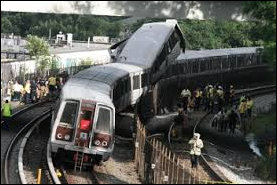
    Rail infrastructure has an estimated life of 30 years, after which time it needs to be thoroughly rebuilt or rehabilitated to avoid the risks of delays and accidents. Those are precisely the problems that have dogged the Washington Metropolitan Area Transit Authority (WMATA) as it allowed its maintenance backlog to grow, leaving it with $17.4 billion in unfunded capital needs over the next 10 years. As service and safety have deteriorated, the commuter rail system has been experiencing a steady erosion of riders and fares that has intensified the fiscal crunch.

    WMATA is facing another disastrous predicament that has garnered relatively little attention: The agency has accumulated $1.027 billion in unfunded pension obligations and $1.767 billion in unfunded health care obligations. Those massive liabilities are over and above the authority’s unfunded maintenance needs.

    When driverless cars become a reality, the cost of operating a ride-hailing service will be decline to the cost of operating the car, says O’Toole — about 40 cents per vehicle mile. “Door-to-door driverless service will also be far more convenient than transit, thus making transit inferior to shared driverless cars in every way.”

    As riders shift to driverless ride-hailing services, the economics of mass transit will deteriorate even more rapidly: fare revenues will decline, maintenance backlogs will grow, and there will be more schedule delays, more safety incidents, more poorly maintained facilities, and more disillusioned riders.

    How can municipal authorities respond to this ticking fiscal time bomb? First, says O’Toole, they can stop building fiscally unsustainable new projects. Second, as rail lines wear out, transit agencies should replace them with cheaper-to-operate buses. Third, plan express buses and bus rapid transit services that share lanes with other traffic rather than rely upon dedicated lanes. Fourth, make a priority of paying down debts and unfunded liabilities. And fifth, instead of subsidizing all passengers, convert subsidies into vouchers for lower-income riders.

    Bacon’s bottom line:ย Predictably, transit agencies will do none of these things. Instead, they will lobby for bigger subsidies. The big question is how much tolerance taxpayers will have for pumping new money into a failed business model. My guess is that taxpayers will continue to be cajoled into paying continued subsidies until such time as driverless cars and jitneys take so much market share from commuter rail and buses that the impending collapse of public transit is obvious to all. Of course, by then, it will be too late to salvage much from the situation.

    The only thing that can possibly save mass transit is a rapid evolution toward denser, mixed-use land use s along transportation corridors that would enable rail and bus to serve more riders and generate more fare revenue. That evolution is happening along Washington’s Metro system, but it is a slow, herky-jerky process that speeds up and slows down with business cycles and metropolitan booms and busts. Even then, I am highly skeptical that mass transit could ever pay for itself. If rail loses money in New York, it will lose money everywhere in the U.S. (Yes, yes, I know that roads and highways are subsidized, too, but the subsidies are much smaller per passenger mile. In any case, the road network should move to a pay-as-you-go system just as mass transit should.)

    What seems absolutely foolhardy, given what we know now, is to double down on our commitment to new money-losing mass transit projects. State and local governments can sustain the fiscal drain for only so long. When they inevitably have to cut back — read my posts about Boomergeddon — the retrenchment will be all the more painful for riders, transit agencies and taxpayers alike.

  • The Ascendancy of Gas and Wind

    A front-page article in the Wall Street Journal today highlights how the rapid rise of wind and natural gas is forcing electric utilities to close older coal- and nuclear-powered generating units. Last year natural gas surpassed coal as the leading source of electricity, and wind provides energy at the lowest price of any source.

    Last year the wholesale price of electric power averaged less than $25 per megawatt hour in Texas, which has the most deregulated electricity market in the country. The wholesale price has fallen as low as $29 in the PJM Interconnection grid (of which Virginia is a part), which arguably operates the most sophisticated interstate grid in the country. PJM benefits from the construction of gas-fired plants tapping cheap Marcellus shale gas and extensive wind farms in the Midwest.

    Citing a study by investment bank Lazard, the WSJ gave the following average unsubsidized cost of generating power from different electricity sources:

    • Natural gas — $60
    • Coal — $102
    • Nuclear — $150
    • Solar — $49.50
    • Wind — $45

    But the WSJ provides one very big caveat: Those numbers don’t factor in the intermittent production of wind and solar. A megawatt of electricity that is “dispatchable” — that is, it can be produced when called upon to meet demand — has greater economic value than a megawatt of electricity from a source that produces output when the sun is out and the wind is blowing.

    I’m still trying to figure out the economics of this. As I understand it, the marginal cost of operating a wind or solar facility is essentially zero. The energy source is free, and the manpower requirements are negligible. Thus, wind and solar producers dump all of their production into wholesale markets, undercutting coal, gas and nuclear generating units that actually have operating costs. As a consequence, coal and nuclear are losing market share and, increasingly, many units are unable to operate profitably. Even less efficient gas-fired units may be in trouble.

    Question: If the wholesale price for electricity is below the unsubsidized cost of generating electricity in the PJM system, how can anyone justify building new capacity of any kind?

    Another question: What happens if dozens of coal and nuclear plants in the PJM system shut down? Will there be sufficient capacity to meet base-load demands for electricity, especially at night when solar isn’t producing? There is plenty of wind power at night, but not in Virginia. There is only so much power the electric grid can transmit from Midwestern wind farms to Virginia.

    I have seen no indication that PJM’s experts are worried about these problems, so maybe I’m raising a non-issue. All I can say is that the electrical industry works according to laws of economics like no other.


  • Is the Big Problem at Richmond Schools Decrepit Buildings or Teacher Turnover?

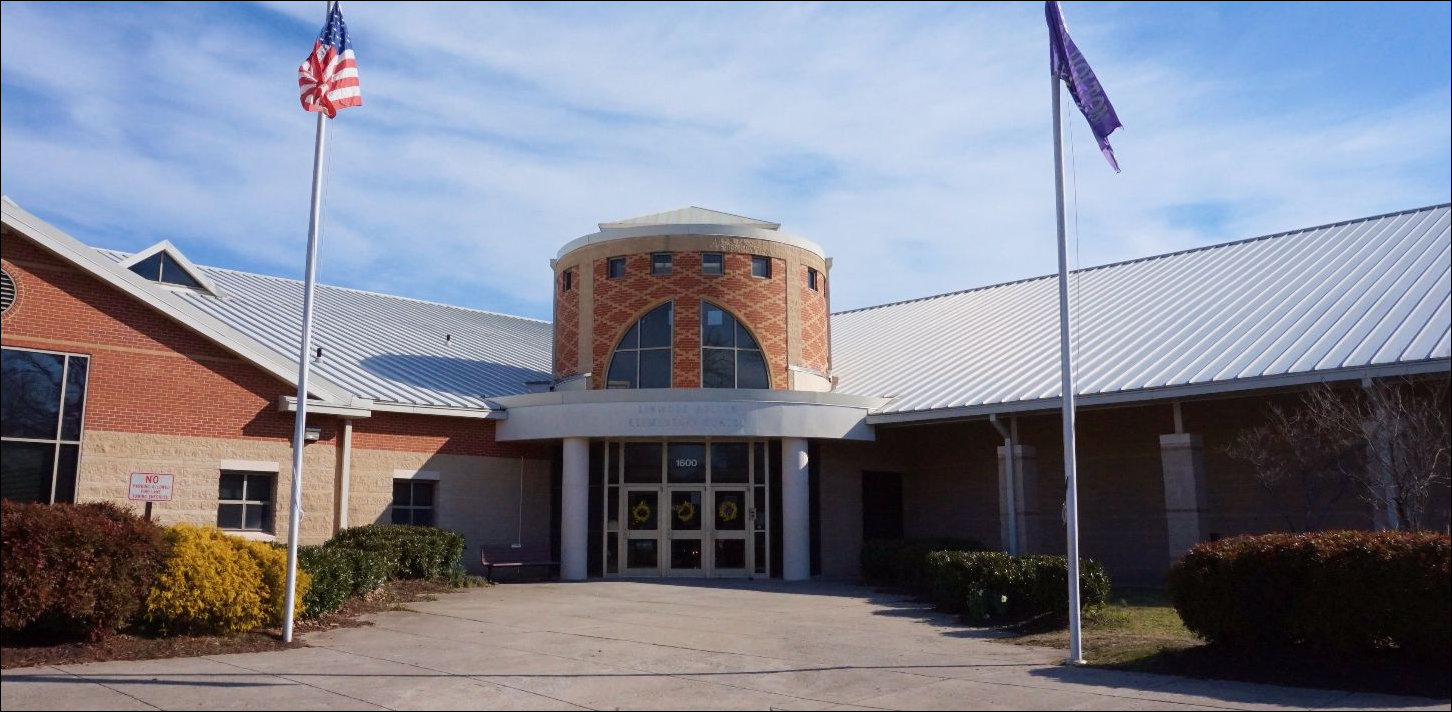
    Linwood Holton Elementary School in Richmond. Richmond has several beautiful new schools. What difference have they made?

    The City of Richmond is debating proposals to spend $740 million to $800 million to modernize the city’s school buildings after years of neglect. The latest new wrinkle reported by the Richmond Timesย Dispatch is that the Richmond School Board has delayed a vote on the grounds that it needed more time to ponder the plan. The main concern expressed so far — where on earth would the money come from? — is valid. But there is an even more fundamental question: Will modernizing school buildings do anything to reverse the school system’s atrocious under-performance?

    No question, many school buildings are aging and sub-standard, with crumbling tiles, broken toilets, wheezing HVAC systems, and leaking roofs. They are an embarrassment and a disgrace, and they need to be fixed. But that should cost a fraction of the sums being discussed.

    Based on the conviction that creating a better physical environment can improve academic performance, Richmond has built several expensive new school buildings in recent years. As part of their deliberations, School Board members should examine whether those buildings have made any difference in educational achievement of the children who passed through their doors.

    Here’s what I hear. While new buildings provide a better physical environment, poor children from broken homes in inner city neighborhoods bring the same emotional and disciplinary issues to school. Young, inexperienced teachers are shocked and dismayed by the environment, they get burned out and they leave. The Richmond school system has such a horrendous reputation among teachers in the metropolitan area that it couldn’t hire enough to fill its classrooms this fall, meaning it has had to rely more heavily than ever upon substitute teachers, some of whom probably shouldn’t be teaching at all. Prediction: Richmond’s teacher shortage will get even worse in January when burned-out teachers decide after Christmas Break they don’t want to return.

    Once basic health and safety standards are resolved, Richmond schools have more urgent priorities than building fancy new school buildings. Above all, the system needs to address the problem of school discipline and teacher churn.


  • More Miscellaneous Morsels…

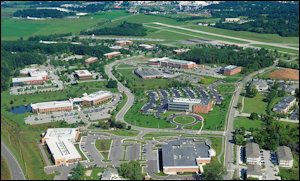
    Corporate Research Center, CRC, aerials, Phase 2, Dairy Farm

    Luxury apartments for research park. The Virginia Tech Corporate Research Center, which has more than one million square feet of office space, is joining forces with a local real estate developer to add luxury apartments to the mix, reports the Roanoke Times. The company had previously added amenities to play soccer, lacrosse, volleyball, basketball, and disc golf to its work-live-play options.

    โ€œWhat weโ€™re trying to do is create a self-contained community that has all the amenities at your fingertips,โ€ said CRC President Joe Meredith. โ€œThe last amenity that we donโ€™t have is housing.โ€

    The Corporate Research Center, in my recollection from visits a decade ago, was a classic suburban office park, the main selling point of which was its proximity to the Virginia Tech campus. It was a pretty sterile place. Integrating apartments into the mix sounds like a good move — indicative of a larger trend in which suburban office parks are busily reinventing themselves as islands of walkable urbanism capable of attracting Millennials and the businesses that want to hire them.

    Longwood revising bias reporting protocols. Longwood University has temporarily shut down its bias incident reporting system, reports Campus Reform, and is rewriting protocols to protect freedom of speech. The Foundation for Individual Rights in Education (FIRE) had criticized Longwood for its particularly broad definition of what constituted a “bias” incident.

    Director of Citizen Leadership and Social Justice Education Jonathan Page conceded that some of the definitions the school had used were problematic, telling the Rotunda that Virginia Assistant Attorney General Cameron O’Brion advised the university to remove the former protocol and provided recommendations for revision in response to [a] studentโ€™s complaint.

    “A lot [of Oโ€™Brionโ€™s recommendations] were based in how we were not only defining bias and hate crimes, they really didn’t fall in line with how the FBI defined hate crimes, that a lot of the things we defined as bias incidents were really freedom of speech issues,” Page explained. “Some of the language that we modeled came from some private institutions and so as a public institution we can’t have the same stance that privates do.”


  • Albemarle County’s Unfortunate Distinction

    Image credit: Wall Street Journal

    So much to blog about. I don’t know if I can get to it all this morning. Let’s start with this…

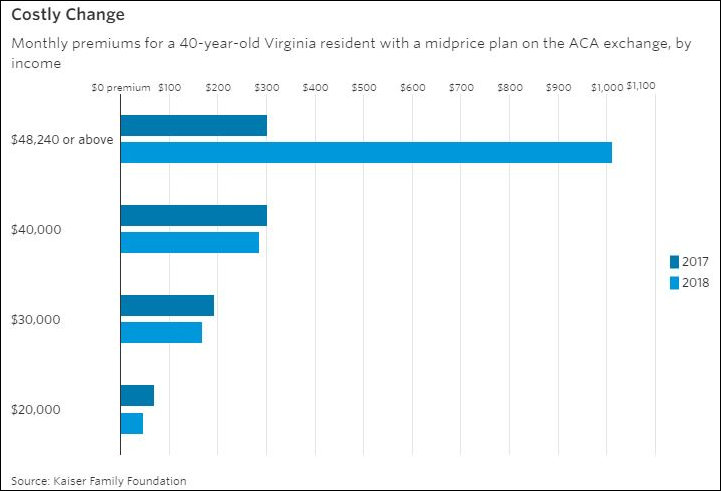
    Albemarle County will have the distinction of having the highest cost in the nation in 2018 for people on the Affordable Care Act exchange. The Wall Street Journal cites the plight of Ian Dixon, as 38-year-old app developer, whose premiums for a family of four will jump from $988 a month to $3,158 a month. The article did not mention the size of the policy’s deductible, but in my observation of other health plans, it could be significant.

    Insane. Just insane.

    As the WSJ notes, other health plans have fled the ACA market in Charlottesville and Albemarle. The sole remaining provider, Optima Health, wanted out as well, but decided to stay in the market rather than leave citizens with zero alternatives.

    Bacon’s bottom line: The company says the uncertainty created by the GOP push to repeal Obamacare and a Trump administration decision to end subsidies to insurers contributed to the rise in premiums.ย That uncertainty undoubtedly has accelerated the ACA market meltdown, but the health exchanges were in a downward spiral before Trump took office. The system is collapsing next year instead of two or three years from now.

    This is what happens when a country is locked in 50-50 gridlock, neither has the political power to fully implement its healthcare vision. We get total dysfunction, and people like Ian Dixon are paying the price. Adding insult to injury, unless Congress repeals the mandate requiring people to purchase health insurance, Dixon will be dunned a tax (really a penalty, but the Supreme Court called it a tax) if he refuses to sign up for a plan that could soak up 100% of an average person’s income.