• COVID-19: Milder than We Thought

    The latest numbers from the state and hospital-association COVID-19 dashboards suggest that the coronavirus in Virginia still is retreating. The seven-day moving average of test-positive cases for COVID-19 tests continues to fall, hitting a new low of 5.8%.

    Meanwhile, two measures of intensive hospital utilization have hit new lows. The number of COVID-19 patients in Intensive Care Units fell t0 219 yesterday, down from a high of 469 in early April, while the number on ventilators declined to 99, from a high of 302 in mid-April.

    New research from the federal Centers for Disease Control suggest that only one in ten COVID-19 cases have been identified through testing, so the number of confirmed cases, which stands at 60,570, is likely the tip of the proverbial iceberg. If the national rate holds true here, more than 600,000 Virginians have contracted the virus. In other words, about 7% of the population has been infected. The bad news is that the virus still has a long way to run.

    Here’s the good news: If that 600,000 figure holds up, and if the Virginia Department of Health’s 6,071 figure for the number of hospitalizations is reasonably accurate, it means that only 1% of the population that gets the disease ends up hospitalized for it. Given the 1,700 Virginia deaths so far, it also means that only three out of 1,000 who get the disease die from it. (more…)


  • Richmond’s “Numbnuts” Cripple Busch Gardens

    by Kerry Dougherty

    Five more days until Virginia finally enters Phase 3 of the slo-mo reopening of the commonwealth.

    But if you were planning to take the kids to Busch Gardens or Kings Dominion to celebrate, forget it.

    Thanks to ridiculously small crowd limits, both sprawling theme parks said they canโ€™t comply with Virginiaโ€™s rules. The management of the parks want to know why they are lumped in the same category as bowling alleys and skating rinks.
    Under the governorโ€™s rules โ€œentertainment venuesโ€ can open at 50% capacity, but with no more than 1,000 visitors.

    On a good summer day Busch Gardens draws upwards of 24,000 guests. Holding the 383-acre park to 1,000 visitors would be economic suicide for one of the biggest tourist attractions in Virginia.

    So Busch Gardens will remain shuttered. And the economy of the so-called Historic Triangle of Williamsburg, Yorktown and Jamestown will continue to circle the drain.

    โ€œOur parks are largely outdoor facilities spread across hundreds of acres but we continue to be lumped in with unrelated models like bowling alleys and skating rinks,โ€ said Kevin Lembke, president of Busch Gardens. (more…)


  • “Bring That Sucker Down Without Anyone Getting Hurt”

    Confederate statue in North Carolina

    By Peter Galuszka

    In a striking sign of the times, Popular Mechanics magazine has published a how-to article regarding removing statues on your own.

    The article is titled: โ€œHow to Topple a Statue Using Science: Bring that sucker down without anyone getting hurtโ€ by James Stout.

    The force need to bring down a controversial statue is not all that great, Stout writes. Most statues are bronze, with an alloy of 90% copper and 10 percent tin with a maximum thickness of 3/16 of an inch. Most people statues weigh 3,500 pounds. One that includes a horse is maybe 7,000 pounds.

    For a pure muscle job, youโ€™d need about 70 people and several high-endurance recovery straps. One should be placed across the head. Once in place, youโ€™ll need to break the statue from its base. This can be done by two teams on either side of the statue working a back and forth motion.

    As for safety, this isnโ€™t that big a deal as long as you have done the proper geometry.

    If you donโ€™t have many protestors, you can do the job using a high temperature approach with home-made thermite. Propane torches are also good. (more…)


  • Beyond COVID-19: New Opportunities in Land Use

    Vacant storefronts — a challenge and an opportunity

    by James A. Bacon

    The stay-at-home orders prompted by the COVID-19 epidemic accelerated a trend that was already reshaping the American economy: the shift of commerce from bricks-and-mortar retail to online delivery. Traditional retailers are retrenching; malls and shopping centers are hollowing out. If current trends continue, we’ll be seeing a lot more UPS and Amazon trucks cruising through our neighborhoods… and a lot of vacant retail space.

    This seemingly irreversible trend will create dramatic challenges and opportunities for Virginia communities. Local governments rely upon the property taxes generated by malls and shopping centers. As those properties empty out and lose value, local governments will see an important revenue source erode. That is a problem, to be sure. But the decline of bricks-and-mortar also presents Virginia localities with once-in-a-generation opportunities. The potential exists to address two of Virginia’s chronic issues: affordable housing and traffic gridlock.

    The scarcity of affordable housing in Virginia, especially in high-growth counties, has become increasingly acute in recent years. Construction of new dwelling units has not kept pace with household formation, and housing shortages have pushed up rents and sales prices faster than incomes have risen. Home builders would be more than happy to build more houses, if only they could find the land and gain zoning approvals from local governments to do so. Meanwhile, congestion is reasserting itself on Virginia’s Interstates, highways and arterials. There is not enough money to build our way out of gridlock.

    While no solution is perfect, the least imperfect is to recycle old retail districts into “walkable urbanism” resembling pedestrian-friendly places such as Arlington, Reston, or downtown Richmond and Norfolk. (more…)


  • COVID Workplace Rules Endorsed, But Not Final

    The Northam Administrationโ€™sย Safety and Health Codes Board agreed yesterday that COVID-19 in the stateโ€™s workplaces demands an emergency state response, but the nature and exact wording of that regulation remains undecided.ย  If adopted, formal regulations come with the potential for heavy penalties for employers cited for failures.

    Earlier versions of the key documents have already been revised by state staff, so should be reviewed again by concerned parties. The draft rules (here) and a related 200-page briefing package (here) were first made available June 12 and then revised June 23, right before Wednesdayโ€™s meeting. Further changes are likely.

    A window for on-line written comments closed June 22, but more than three thousand were received, with the business community reaction overwhelmingly negative. To review the written comments already filed visit the meeting information page (here) and scroll down to a long list of documents. The massive set of online comments are on this related pageย on Virginiaโ€™s Regulatory Town Hall website.

    The vote to proceed with something came after a contentious virtual emergency meeting where only members of the board and staff were able to speak. Three of the boardโ€™s members opposed the emergency declaration and three abstained, perhaps reflecting the broad and strong opposition the draft proposal generated from Virginiaโ€™s busines community. It will meet again to dive into the actual text soon.ย  (more…)


  • How Greeniacs Destroy the Environment

    by Paul Driessen

    The US Supreme Court recently ruled 7-2 to reverse a lower court ruling invalidating a permit for theย Atlantic Coast Pipeline, which will bring West Virginia natural gas to Virginia and North Carolina, for home heating, factory power, electricity generation and manufacturing petrochemical feedstocks.

    Environmentalists had claimed the U.S. Forest Service had no authority to issue the permit, because a 0.1-mile (530-foot) segment would cross 600 feet below the 2,200-mile-long Appalachian Trail, which is administered by the National Park Service. Justice Thomasโ€™s majority opinion scuttled that assertion.

    Pipeline project developers Dominion Resources and Duke Energy should receive the USFS and other permits relatively soon โ€“ and have the pipeline in operation by early 2022 โ€“ unless a Biden administration takes over in 2021 (with AOC as woke climate and energy advisor to Biden and Democrats) and imposes Green New Deal bans on drilling, fracking, pipelines, and eventually any use of natural gas, oil and coal.

    Meanwhile, environmentalist groups plan more lawsuits. They insist the pipeline would put rivers and streams at risk of increased sedimentation, scar pristine landscapes, and harm sensitive species.

    These plans and assertions underscore how inflexible they have become in opposing any US fossil fuel use. How incapable of recognizing or rationally discussing the far greater human and ecological impacts from energy systems they favor. How reliant on blatant double standards and mob rule, instead of on rational, cohesive, persuasive discussion. (more…)


  • Up Next: School Bus Crisis

    by Kerry Dougherty

    Last week we marveled at Gov. Ralph Northamโ€™sย unworkable guidelinesย to reopen Virginia schools this fall.

    Richmondโ€™s bizarre restrictions on social distancing and class size make it impossible for kids to be in their classrooms five days a week.

    Instead, most school districts seem to cooking up schemes to divide student bodies in half with 50% of children in school two days a week, the other half in school for two other days a week, and the fifth day given over for teacher planning.

    In other words, weโ€™re looking at a two-day-a-week school year.

    Sure, school officials insist that students will also have three days of virtual learning, but itโ€™s no secret that distance learning was a colossal disaster this spring.

    I read a Washington Post piece on distance learning this week and spied this comment from a teacher who wants to go back to the classroom five days a week even if it puts her and her family in peril for Covid-19:

    (more…)


  • Another Use and Abuse of Statistics…

    Sources: Fairfax County Police Department, U.S. Census Bureau

    by James A. Bacon

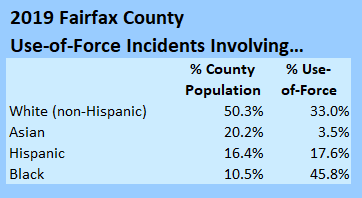
    The Fairfax County Police Department publishes a statistical report every year on the police use of force in the county. There were 594 use-of-force incidents reported in 2019, up from 510 the previous year. The publication provides data with minimal commentary.

    This is the headline from the Reston Now article summarizing the report: “Fairfax County Police Disproportionately Use Force on Black Individuals.” The headline was backed up by this paragraph:

    Black residents were involved in roughly 31 percent of use-of-force incidents, even though they make up a little over 8 percent of the total population. Roughly 48 percent of all use-of-force incidents involved whites, who make up 67 percent of the total population.

    By placing the data in the context of the national uproar over the George Floyd killing and calls for police reform, as the story did, Reston Now feeds the standard media Oppression Narrative. But the story left a lot out, which seems to be the usual operating procedure. Cherry pick the facts that support the media narrative, and omit anything that might call it into question. (more…)


  • Stop the Problem Before It Starts

    by Chris Braunlich

    With the General Assembly taking up policing reform in this summer’s special session, there should be at least one bill stopping a problem before it begins.

    Most big problems are created by a small number of people. The same is true of police officer transgressions. Most police officers are good police officers, but Derek Chauvin was a bad cop with 18 prior complaints in 19 years at the time he killed George Floyd. His partner, Tou Thao, has six complaints, including an open one at the point he was fired. The head of their police union, Lt. Bob Kroll, is the subject of at least 29 complaints.

    Their continued presence was an insult to the more than 680,000 good law enforcement officers who are guardians of our safety, who took the job to serve the public and who put their lives on the line.

    Yet, instead of eliminating a narrow source of major abuse, they were allowed to continue their abuse of Minneapolis citizenry. Why?

    Increasingly, we can point to provisions commonly found in Collective Bargaining Agreements (CBAs) negotiated between governments and the police union as part of the contract process. The issue has never arisen in Virginia before, because collective bargaining was prohibited. But Governor Ralph Northam has signed into law legislation that could mean local governments and their police unions next year will negotiate the conditions of the disciplinary process against misbehavior by individual police officers. (more…)


  • Northam Gets a Couple of Things Right

    by James A. Bacon

    I do have my issues with Wise King Ralph, but I have to give credit where credit is due. He has done two things right in the past few days. He has given the OK to move to Phase 3 of the COVID-19 lockdown on July 1, and he has refused to buckle under to violent protests in Richmond. Virginia’s capital city will not turn into Portland or Seattle East.

    It was not a foregone conclusion that the Governor would accede to a further relaxation of the emergency restrictions promulgated to fight the spread of the COVID-19 virus. While Virginia metrics were all heading in the right direction, the national media were in full-blown hysteria mode over a rise in infection rates in other states that had moved to reopen their economies. Even local media, which reported on beach vacationers bringing the coronavirus with them back to the Roanoke region, were sounding the alarm. Indeed, Northam said explicitly that he was paying attention to what was happening in other states.

    But in the end, Wise King Ralph did the right thing. Phase 3 represents a big step forward in getting back to normal. The measures it continues to maintain — restrictions on mass gatherings with the potential to turn into super-spreader events — are defensible.

    Meanwhile, the Governor, while not exactly posing as Mr. Law and Order, defended city and state police officers who earlier yesterday used tear gas and rubber bullets to clear a sit-in outside of Richmond City Hall that was blocking traffic. As The Virginia Mercury put it, Northam expressed “befuddlement” at the ongoing protests against police brutality even though he had promised “future action on police reform and other important equity issues.” (more…)


  • It’s About Time: Phase 3

    by Kerry Dougherty

    Finally.

    After weeks of plummeting death rates, dwindling hospitalizations and a sharp drop in positive test results for COVID-19, slow-walking Gov. Ralph Northam announced that theย  commonwealth can enter Phase Three.

    But not until next week, on July 1.

    Northam made the announcement at yesterdayโ€™s press conference.

    For months, Northamโ€™s pressers have been characterized by gloom and arbitrary rules that confounded the public.

    From the governorโ€™s nonsensical โ€œweโ€™re a commonwealth and weโ€™re going to act like a commonwealthโ€ to his ridiculous no-sitting-or-loud-music-on-the-beach edicts, these bi-weekly broadcasts have been a source of dread for many of us.

    Phase Three should have happened weeks ago. Nevertheless, sometimes we must simply be grateful for the crumbs the governor sprinkles in our direction. (more…)


  • BR’s COVID-19 Parallel Universe

    By Peter Galuszka

    Almost every morning, I wake up a little before dawn, make coffee, let the dog out and feed her and start reading the news.

    I take The Washington Post in print along with The New York Times, Richmond Times-Dispatch, The Virginian-Pilot, NBC News, various television stations and, of course, Baconโ€™s Rebellion online.

    Later in the morning, I check out Blue Virginia, Virginia Mercury and RVA.

    When it comes to the COVID-19 pandemic, every morning I step into two different universes.

    One gives me the global and national view that jumps right in and explains where we are with the virus and who and what are at risk.

    The other view, that of Baconโ€™s Rebellion, mostly paints a very different picture. This view insists that the pandemic is exaggerated and overrated, needless regulations are being enacted by a dictatorial governor, our school system and housing trends are at risk and we should open everything up right now. (more…)


  • Where Are the Other 52 Nursing Homes with Outbreaks?

    by Carol J. Bova

    The governorโ€™s Long Term Care Facility Task Force list shows 179 nursing home and assisted living facilities with outbreaks of COVID-19. There are 52 more, according to the Virginia Department of Health (VDH) Outbreaks tab on the daily COVID-19 data, but no explanation why theyโ€™re missing from the Task Force list.

    It took a little digging to narrow down where those facilities are located. The Task Force list canโ€™t be downloaded or copied or sorted. But by adding its info to the CMS nursing home COVID-19 dataset and tagging each entry with the locality the Task Force used, I could compare the faciliity locations to the VDH Outbreaks Data Downloads and compile a list breaking down the number of missing outbreaks by Health District.

    Alexandria โ€“ 4
    Arlington โ€“ 3
    Central Shenandoah โ€“ 3
    Chesapeake โ€“ 1
    Chesterfield โ€“ 2
    Chickahominy โ€“ 2
    Crater โ€“ 2
    Eastern Shore โ€“ 2
    Fairfax โ€“ 14 (more…)


  • Open the Schools

    By James C. Sherlock

    I have written here multiple times about the terrible and disproportionate effects that school shutdowns are having on poor children in Virginia.

    The public school is an enterprise that has no admission standards. We do it that way on purpose, to try to give every American child as much opportunity to learn and develop into a successful citizen as we can. Public schools represent a core value of the American way of life and provide foundational support to our republic.

    Virginia Guidelines vs. CDC Guidelines

    On June 9, 2020 Governor Ralph Northam announced guidance for a phased approach that allows Virginia schools to slowly resume in-person classes for the coming academic year.ย There were two sources for the Governorโ€™s guidance, the Virginia Department of Health (VDH) and the Virginia Department of Education (VDOE). Both dropped the ball.

    VDH summarized and truncated the published CDC school considerations to slow the spread of COVID-19 to the point that they are at best unhelpful. It is difficult to imagine why they did not just publish the CDC guidelines, but they did not.

    That flawed guidance was absorbed into the VDOE reopening guidelines.

    One of the core recommendations that originated in VDOE — remote learning for large classes of K-12 studentsโ€” has been shown in every study to have been ineffective in April and May. An alternative schedule will prove in practice unexecutable. (more…)


  • Nursing Homes Most at Risk from Virus are Bigger, Urban

    Die, virus, die!

    Three out of five of the 1,645 Virginians who have died from COVID-19 have been residents of long-term care facilities — one of the highest percentages of any state in the United States. There has been considerable speculation why. Vincent Mor, a research scientist with the Brown School of Public Health, has found that nursing-home staffing levels aren’t the issue. Neither is the source of funding, whether Medicaid or private insurance.

    Mor argues that the size and location of long-term care facilities are the most decisive factors. Facilities most likely to have COVID-19 cases tend to be (1) located in larger urban areas with large populations of Hispanics and African-Americans, who are disproportionately likely to have the virus, and (2) the size of the facility, or, more specifically, the greater the number of employees coming and going.

    “It’s all about the traffic,” he says in this PowerPoint presentation summarizing his research. “The bigger the building, the more people enter. … So, it’s NOT about the facility but the virus.”

    I had never made these connections, and I think they are worth exploring here in Virginia. If the same pattern holds, it may influence how public health authorities prioritize the allocation of resources in the battle against the virus. (more…)