• Wait Til the Midnight Hour

    by Kerry Dougherty

    Sitting down, Virginia?

    Big news! Especially for night owls.

    Beginning Monday, we will be allowed to stay out past midnight, thanks to the benevolence of our beloved Governor, Ralph Northam.

    His Excellency announced yesterday that he has decided to lift our 12 to 5 a.m. curfew, the one based on the Northam family credo that โ€œnothing good happens after midnight.โ€

    Thank you, dear leader.

    Best of all, he is magnanimously allowing us to consume alcohol AFTER 10 PM! Yes, you read that correctly. No longer will waiters be prying drinks from our greedy hands on the stroke of 10. We now have Northamโ€™s permission to drink until midnight! This, despite data that once showed the Covid-19 virus could tell time and was prone to attack at 10:01. Apparently that virus has mutated into a form that infects only people imbibing after midnight. Lucky us! (more…)


  • WaPo Nabs Polk Award, Is Pulitzer Next?

    Ian Shapira

    By Peter Galuszka

    How ironical.

    Our esteemed Jim Bacon has been on a tear in recent months writing about media coverage of the problem of systemic racism at the Virginia Military Institute.

    Of special interest to Jim is the reporting of Ian Shapira, a Washington Post reporter who has been digging into the VMI. After his stories were published, the superintendent of VMI retired and an inquiry was launched.

    Jim doesnโ€™t like what the Post and Shapira have done. Some of Jimโ€™s headlines go right to the jugular including โ€œVMI Update: The WaPo Makes Another Sleazy Insinuationโ€ and ย โ€œWaPo Ratchets Up Assault on VMI.โ€

    At one point, Jim made this observation: โ€œPolish up that Pulitzer. It looks likeย The Washington Postย is vying again for the big prize in journalismโ€

    Well, guess what happened? Shapira and the Post have won a George Polk award for their VMI coverage. The citation reads thusly: (more…)


  • Equity in Virginia School Funding

    by Matt Hurt

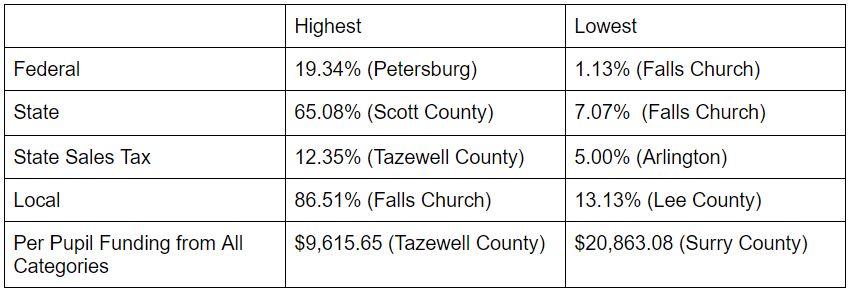
    Virginia Public School Region VII has demonstrated that large per-student budgets are not a prerequisite to ensure success on Virginiaโ€™s Standards of Learning assessments. High pass rates indicate that the schools and divisions in the Southwest are meeting the needs of their students for basic skill attainment. However, to achieve Virginiaโ€™s 5 Cโ€™s — Critical Thinking Skills, Collaboration Skills, Communication Skills, Creative Thinking Skills, and Citizenship Skills — students need access to more educational opportunities than the current state funding formula provides. Affluent localities have provided these opportunities for their students, whereas others have not found the means.

    School funding is very complicated as there are so many variables at play. Public school budgets can be broken into four funding sources — federal, state, state sales tax, and local dollars. There are differing criteria for each, which impact the overall budget for a given school division. The degree to which school division budgets vary by funding source can be seen in the table below, drawn from the 2019 Superintendent’s Annual Report. Also included is the range of per pupil funding that year.

    (more…)


  • AP Scores Tell a Familiar Tale

    Credit: Virginia Department of Education

    by James A. Bacon

    There is happy news from the release of the latest College Board scores. Nearly three out of 10 of Virginia’s 2020 public high school graduates demonstrated college-level achievement on at least one AP exam, reports the Virginia Department of Education in a press release today. The percentage was down — from 28.8% last year to 28.6% this year — but only slightly. Additionally,ย the percentage of Virginia students earning a score of 3 or higher in the AP’s 5-point scale was 10th best in the nation, and significantly higher than the national average of 28.6%.

    On the other hand, wide disparities persisted between the at which Asians (52%), whites (28.1%), Hispanics (24.3%) and blacks (9.1%) made the grade. The Northam administration has made “equity” the top educational priority of his administration, but Superintendent of Public Education James Lane acknowledged, “There are still wide disparities in participation in outcomes when we compare data for different student groups.” (more…)


  • Certificate of Public Needโ€™s Hall of Mirrors

    by James C. Sherlock

    Versailles Hall of Mirrors

    In Versailles’ Hall of Mirrors, everything is reflected hundreds of times.

    The mirrors were also a commercial. They represented an effort of Louis XIV to establish for France monopolies on the production of luxury goods.

    Virginiaโ€™s Certificate of Public Need (COPN) law and regulations represent a similar structure.

    Everything in the process reflects back on itself. Those reflections both reinforce the structure and cement monopolies. Though it represents the intrigue of Versailles, COPN lacks beauty and grace. But, in another similarity, neither Louis nor Virginiaโ€™s General Assembly tried to represent the interests of the people in these enterprises.

    This essay will help explain how COPN works. It would be shorter if theย tentacles of COPN were not so completely enveloping and self-reinforcing. This is in its entirety both legal and a scandal, as with much else in Virginia politics.

    Two recent COPN decisions affect my home area of South Hampton Roads.ย Those cases pointed to the systemic roadblocks to successfully challenging Sentara Healthcareโ€™s dominance here which will never be surmounted while COPN stands as is. (more…)


  • The Future is Now

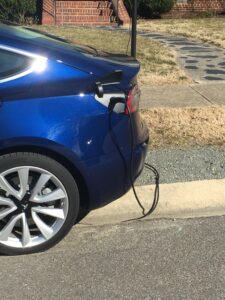
    Seen in my neighborhood on my morning walk.


  • Work at Home and the Transportation Revolution

    Long-Term Trend in Working at Home. Credit: Alan Pisarski

    by James A. Bacon

    It may be time for a major re-think of transportation policy. Alan Pisarski, a Northern Virginia transportation consultant, argues that the states should refrain for now from expanding the transportation system and dedicate funds to properly maintaining the transportation assets they have.

    New technologies and business models, some accelerated by the COVID-19 epidemic, could radically change decades-old travel patterns. In a Reason Foundation presentation made last year, Pisarski said the level of uncertainty is “immense.”

    Virginia legislators would do well to review Pisarski’s presentation as they tinker on the 2022-23 budget bills advancing through the General Assembly. Absent major changes, the commonwealth will allocate $8 billion roads and highways, almost $1 billion to rail and mass transit in fiscal 2022, and even more the following year. That includes $3.6 billion for new highway construction and $700 million for mass transit (mostly to support the Washington Metro). Spending is up dramatically from the $7.2 billion allocated to transportation in fiscal 2020. Fixated on social justice issues, legislators have been content to let the system run on auto-pilot, with funds allocated between maintenance, road construction, and transit investments according to complicated formulas. The larger issue of how much money Virginia really needs has gone unaddressed. (more…)


  • Chinese-American Parents Condemn Critical Race Theory

    CACAGNY celebrating Chinese New Year in a Flushing, N.Y., parade in 2018.

    by Asra Q. Nomani

    This past weekend, I spoke at an online conference of CAPA-Fairfax County, a local chapter of Chinese-American parent groups mobilizing to defend merit-based education in the United States.

    As some participants spoke in Chinese, I could make out some key phrases: โ€œโ€˜moral courage,โ€ โ€œpublic service,โ€ and โ€œCultural Revolution.โ€

    When it came my turn to speak, I told the Chinese-American parents: They can save America. After surviving the Cultural Revolution, they uniquely recognize the dangers to an ideology like critical race theory, the race-based philosophy that dismantles core principles in our society, such as the idea of the American Dream, replacing the idea of equality with the disingenuous notion of โ€œequity,โ€ and punishing Asian-American children for their advanced academics.

    They cheered their potential role in the country that they love.

    And now we see just that kind of moral leadership by another association, CACAGNY (โ€‹็ด็ด„ๅŒๆบๆœƒ), the Chinese American Citizens Alliance Greater, based in New York, which published a letter yesterday denouncing critical race theory as โ€œa hateful, divisive, manipulative fraud.โ€ A member @queens_parents published the letter on Twitter, and it can be found here online at their website www.cacagny.org. (more…)


  • Newspapers: No Laughing Matter

    by Kerry Dougherty

    Almost any time I do any public speaking – not often since the pandemic began – a member of the audience will ask something like this:

    โ€œWhat advice would you give to a young person who wants to work in newspapers?โ€

    After I stop laughing, I ask if the young person has a trust fund. If the answer is no – and itโ€™s always no – I say there is no money and no future in newspapers. The young person should learn to code or do something useful, like dog grooming.

    That usually gets a laugh. But Iโ€™m not joking.

    Newspapers large and small are circling the drain. Itโ€™s a national tragedy. Here in Tidewater we just found out that both The Virginian-Pilot, where I spent 33 years, and The Daily Press, are now owned by a hedge fund. (more…)


  • Did UVa Stack the Deck in Its Lawn Selection Process?

    by James A. Bacon

    It is deemed a great honor to be one of the 47 fourth-year students at the University of Virginia awarded a residence on the Lawn, Thomas Jefferson’s architectural masterpiece and World Heritage site. A committee of 60 students selects the residents from a pool of applicants, in theory based on their record of “unselfish service and achievement in their respective fields of activity and academics.”

    But when the Cavalier Daily published an article yesterday providing the racial/ethnic background of the individuals who were offered a spot on the Lawn next year, it didn’t emphasize their accomplishments. Rather, drawing from data provided by Dean of Students Allen Groves, the article focused on the increased demographic “diversity” of the Lawn residents.

    “Students of Color” received nearly 60% of the offers this year, compared to only 30% last year, reported the student-run newspaper.

    The dramatic one-year shift in the racial/ethnic composition of Lawn residents raises the question of whether race and ethnicity has become an explicit but not-stated-publicly criteria for selection. (more…)


  • How Electricity “Capacity” Markets Work

    There has been a lively discussion in the comments threads of recent Bacon’s Rebellion posts about what lessons Virginia can learn from the near-collapse of Texas’ electric grid. A key difference between the two states is that Texas maintains its own reliability council, ERCOT, while Virginia belongs to an interstate compact, PJM. Both organizations administer auctions to sell electricity in near-real time. Unlike Texas, PJM maintains a market for future electricity “capacity.” The role of capacity markets is hard for most people (including me) to wrap their heads around. But reader Allen Barringer (Acbar), a retired utility regulatory lawyer, gives it a shot. — JAB

    The concept of reliability in electricity grids is probabilistic. There is no such thing as absolute certainty of reliability. In general, the acceptable risk of an outage is defined by the North American Electric Reliability Corporation (NERC), a standards-setting organization regulated by the Federal Energy Regulatory Commission (FERC), which sits atop around a dozen regional reliability councils whose members are the utilities and Independent System Operators (ISOs) that run the electric grid. The reliability criterion is that consumers should not lose electric service as the result of problems on the โ€œbulk powerโ€ electric grid more often than one day in 10 years.

    State regulatory authorities such as Virginia’s State Corporation Commission (SCC) donโ€™t regulate the bulk power grid; they focus on local reliability issues like distribution line outages. But the states also regulate retail electric rates and, in Virginia, the SCC reviews the โ€œintegrated resource plansโ€ (IRPs) of the retail electric companies.ย ย  (more…)


  • Good Neighbors

    Shu-Jin Wu

    by Kerry Dougherty

    In these hyper-partisan pandemic times it often seems we will never come together as a country.

    We are too far apart politically. We spend too much time insulting each other. We canโ€™t agree on the simplest things. Weโ€™re sick of the pandemic, divided about restrictions and gloomy about the future.

    Even the vaccine isnโ€™t bringing us the joy it should because know-it-all doctors on TV warn that nothing must change — masks, distancing, gatherings — once weโ€™re fully vaccinated.

    Some of us thought the point of a vaccine was a return to normalcy.

    Sigh.

    But then Saturday happened and once again, I was buoyed by the basic kindness and generosity of Americans. Especially my neighbors in Virginia Beach. (more…)


  • Virginia Pandemic Emergency Plan Was Never Exercised


    by James C. Sherlock

    As we suspected, Virginia did not exercise its Pandemic Emergency Plan from the time it was published in 2012 until COVID-19 struck.

    I received the following response today to a FOIA request I sent to the Commonwealth of Virginiaย Department of Emergency Management:

    The Virginia Department of Emergency Management (VDEM) received your February 13, 2021, email regarding aย document request. In that request, you seek:

    “Existing VDEM records of Virginia state, regional, and local participation in the National Exercise Program since 2012 at every level of training and exercises that addressedย Infectious Disease and Biological Incidents.”

    VDEM does not have any documentation that meets the requirements of your request. As a result, pursuant to Va.ย Code ยง 2.2-3704.B.3, VDEM notes that no records or data exists in response to your request.

    Is โ€œoops” a good enough response for the Governor? It appears so.


  • Sentara and the Judge

    by James C. Sherlock

    Updated Feb. 23 at 2:15 pm

    In an ongoing series of reports, Ray Locker,ย enterprise and investigative editor of the Checks and Balances Project, has exposed a story with far-reaching implications.

    Norfolk Circuit Court Chief Judge Mary Jane Hall sat in judgment on a case,ย Chesapeake Hosp. Auth. v. State Health Commโ€™r,ย  in which Sentara was an included defendant. ย 

    It appears from that reporting that she could have recused herself for two reasons:

    • prior to her appointment to the bench Judge Hall not only had represented Sentara for years in another COPN case; but also
    • the judge’sย co-attorney on that previous COPN case, Jamie B. Martin of Williams Mullin,ย was Sentaraโ€™s attorney in Chesapeake Hosp. Auth. v. State Health Commโ€™r.

    From Mr. Lockerโ€™s first article:

    The Virginia Canons of Judicial Conduct says this about judicial impartiality:

    โ€œ(1) A judge shall disqualify himself or herself in a proceeding in which the judgeโ€™s impartiality might reasonably be questionedโ€

    Further under Canon 2,

    “The test for appearance of impropriety is whether the conduct would create in reasonable minds a perception that the judge’s ability to carry out judicial responsibilities with integrity and impartiality is impaired.”

    My own additionalย researchย into published Norfolk Circuit Court opinions shows thatย Judge Hall sat in judgment on cases in that court involving Sentara as well as onย Chesapeake Hosp. Auth. v. State Health Commโ€™r. ย This case was filed in Chesapeake Circuit Court.

    The Chief Justice of the Virginia Supreme Court, who is charged with overseeing judicial conduct, assigned the case to Judge Hall

    Chief Justice Lemons of the Virginia Supreme Court asked Judge Hall to sit by designation in Chesapeake in place of the judges of the First Judicial Circuit (Chesapeake) and hear the case. She accepted. He made the appointment on July 31, 2018.

    There would be three possible reasons to import a judge:

    1. Chief Justice Lemons assessed that there were no judges on the Chesapeake Circuit with the experience to hear a COPN case; or
    2. he assessed that the Chesapeake Circuit judges were conflicted or could have been considered so; or
    3. The Chesapeake Circuit had more cases than judges at that point.

    There is no indication in the record of why Judge Hall was imported in this case.

    (more…)


  • Help for Small Businesses–One State Use of CARES Funding

    By Dick Hall-Sizemore

    I owe the Dept. of Small Business and Supply Diversity (DSBSD) an apology. In an earlier post, I questioned whether the agency would be able to quickly distribute $120 million in grant funds. It turns out that its first checks went out in mid-August and it had to stop accepting applications on Dec. 9 because the amount of money designated for the program had been exhausted.

    The program is called Rebuild VA. Approved applicants received awards of three times their average monthly recurring eligible operating expenses plus COVID-related expenses, up to a maximum grant of $100,000. To be eligible for an award, an applicant could be a corporation, pass-through entity, nonprofit organization, recognized tribe, sole proprietor, or individual contractor who met the following criteria:

    • Principal place of business in Virginia
    • 250 or fewer full-time employees
    • Operating prior to 3/12/2020
    • Currently in good standing with State Corporation Commission (if applicable), and
    • Engaged in legal activity.

    (more…)