• Be Warned: The Death Cult Is Coming

    A man wearing sunglasses and a hoodie with a shark design, smiling broadly.

    by Kerry Dougherty

    This is a cautionary tale. So when the ghoulishness of Canada spreads to Virginia you canโ€˜t say you werenโ€™t warned.

    Hereโ€™s how it starts:

    In 2016 Canada passed the so-called MAID law, legalizing medical assistance in dying.

    It was presented as a compassionate measure. One that would allow suffering patients, whose deaths were imminent, to get help from their doctors in ending their lives.

    However, it wasnโ€™t long before so-called medical doctors were actively killing patients who were not near death but whose conditions were uncomfortable. A decade later, theyโ€™re starting to execute the mentally ill. (Killing the mentally ill was approved in Canada last year but implementation was supposedly delayed until March 2026. The case cited below shows itโ€™s already in effect.)

    Between 2016 and 2023 60,000 Canadians were killed by these executioners with medical degrees. In 2023 alone 15,000 Canadians were murdered by medical providers.

    MAID now accounts for 4.7% of all deaths in Canada. Continue reading.


  • RECs are Costly Pretend Renewable Power the VCEA Makes Us Buy

    by Steve Haner

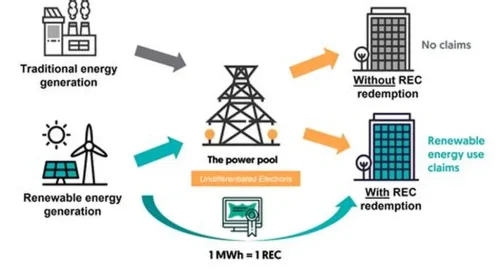
    All electrons are agnostic until buying a REC makes you green!

    A key, but poorly understood, provision of the Virginia Clean Economy Act (VCEA) is a requirement that Virginiaโ€™s two largest electric utilities must either generate or purchase a growing number of renewable energy certificates (RECs). Eventually their RECs must equal 100% of their non-nuclear generation. What are RECs and why do they matter to you? ย 

    Put simply, aย RECย is an electronic record that provesย aย generatorย producedย one megawatt hour ofย electricity fromย an approved โ€œrenewableโ€ source, usuallyย solar orย wind.ย It can be a utility, an independent energy generator, a business with solar on its roof or even a shared community solar systemย thatย isย granted a REC.ย A smallย portionย of RECs are awarded for hydro or geothermal generation.ย ย ย 

    The certificate is issued and tracked by a third party, and โ€“ here is the point โ€“ can be sold. Recording and tracking RECs is one of the jobs done by the PJM Interconnection regional grid operator. There are several marketplaces compiling and transferring them.ย ย ย 

    The buyer then โ€œretiresโ€ the REC, in effect cashing in the environmental virtue of that โ€œgreenโ€ energy. It can be retired only once. The entity that earns the REC can also be the one to retire it, but usually they are traded.ย ย  ย 

    Oneย website that reports on the REC industry put the total world REC market at more than $20 billion in 2024, predicting it will exceed $40 billion by 2030. The annual compound growth rate is higher than 10%. The same website was quite open about what is going on:ย ย ย 

    โ€œBy buying RECs, companies can effectively offset their carbon emissions and achieve 100% renewable energy consumption without significant investment in renewable energy infrastructure.โ€ย ย ย 

    (more…)


  • Jeanine’s Memes

    A propaganda poster depicting historical figures associated with collectivism, featuring a bold statement about the deaths of over 100 million people in the 20th century, with imagery of skulls and corpses in a dramatic red and black color scheme.

    View more memes at The Bull Elephant.


  • Quote of the Day: Helen Andrews

    Women can sue their bosses for running a workplace that feels like a fraternity house, but men canโ€™t sue when their workplace feels like a Montessori kindergarten.

    — Helen Andrews, “The Great Feminization


  • Ouch. It Hurts, But It’s True


  • If Personnel Is Policy, Watch Out!

    A large, cartoonish figure wearing a suit is shown in a chaotic cityscape, shouting and holding a stack of files. Surrounding him are crumbling buildings and helicopters in the sky, creating a dramatic and surreal atmosphere.

    The incoming Spanberger administration, writes Victoria Cobb, president of the Family Foundation, “is structured to consolidate power in Richmond, expand bureaucratic reach, and normalize government intrusion into family life, healthcare, education, and the economy.”

    From a Thursday Family Foundation Action Letter:

    Governor-elect, Abigail Spanberger, is quickly making her selections for cabinet and senior staff appointments. But these are not just routine staffing decisions, they are signals of the kind of administration and government she intends to implement. And the signal coming from Richmond is deeply troubling for Virginians who value limited government, individual liberty, parental rights, and constitutional restraint.

    As the saying goes, personnel is policy. When you look carefully at who is being placed in charge of health care, labor, education, public safety, elections, and the overall legal strategy of the Governorโ€™s Office, a consistent theme emerges: centralized authority, aggressive regulation, and ideological governance, with little regard for the proper limits of government power.

    Below are some of (not all) Governor-elect Spanbergerโ€™s troubling appointments:

    (more…)

  • Bacon Meme of the Week

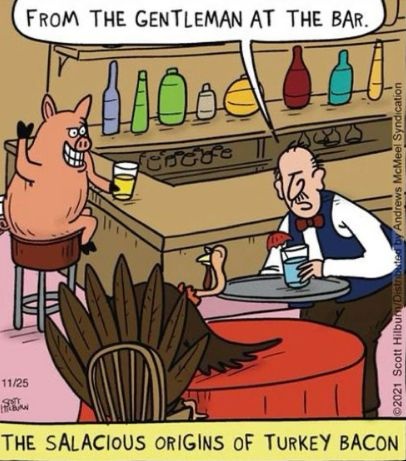
    A cartoon depicting a pig at a bar who is sending a drink to a man at a table, while a turkey sits at the table, captioned 'The salacious origins of turkey bacon.'

  • Dancing on the Watery Grave of CVOW

    By Steve Haner,

    As it becomes clear that the 90-day pause of the Dominion Energy Virginia offshore wind project is probably its final death rattle, the folks who encouraged the Trump Administration to kill it are looking to shift the blame to outgoing Virginia Republican Governor Glenn Youngkin. 

    One of the organizations that filed a federal lawsuit against the project, a lawsuit that itself proved to be a futile exercise, is promoting a letter it sent the governor demanding he rescind his previous support for the $11.2 billion facility, which was just about to enter its final stage of construction when the federal pause order came down just before Christmas.ย 

    The National Legal and Policy Center was joined in the lawsuit by the Committee for a Construction Tomorrow (CFACT) and the Heartland Institute.  All have been dancing a joyous victory jig on the projectโ€™s watery grave for about two weeks, although the Trump Administration’s pause order had nothing to do with the allegations of injury to the whales they had raised.  

    Nobody with the utility, the Commonwealth of Virginia or the federal agencies involved has formally declared the project dead. The silence is deafening.  News reports indicate Dominion is telling the federal court hearing its challenge to the order that the federal government has refused to provide details on the supposed new national security threat it has identified.  The goal of the pause apparently was not to give the utility, and the developers of four similar projects elsewhere on the East Coast, a chance to look at how to mitigate that โ€œriskโ€ after all.  More should be clear after a hearing on January 16.

    As all this unfolds, this policy group wants Youngkin to do a public mea culpa:

    (more…)

  • I Can’t Help Myself!

    This is a Virginia public policy blog. Someone please stop me before I publish more AI-generated cat videos!


  • A State Income Tax Rate to 10% for $1 Million-per-Year Households?

    A protestor holds a sign that reads 'TAX THE RICH,' with other attendees in the background, showcasing a public demonstration advocating for higher taxes on wealthy individuals.
    Image credit: Grok

    by Hans Bader

    Delegate Kelly Convirs-Fowler, D-Virginia Beach, has introduced a bill (HB 188) to increase state income taxes in Virginia, raising the marginal tax rate from 5.75% to 10% on people making over $1 million.

    Virginia already has higher state income taxes than most of its neighbors. Kentucky has a maximum tax rate of 3.5%, North Carolina has a maximum tax rate of 3.99%, West Virginia has a maximum tax rate of 4.82%, while Virginia has a maximum tax rate of 5.75%. Tennessee has no state income tax. As a result, Virginia is now one of the higher-tax states both in terms of dollars paid, and tax burdens compared to other states.

    Thatโ€™s a big change from the recent past. In 2015, Virginia had lower state income tax rates than West Virginia, North Carolina, and Kentucky. Back then, the top marginal tax rate was 6.5% in West Virginia, 6% in Kentucky, and 5.8% in North Carolina, compared to 5.75% in Virginia. And the lowest tax rate (for low-income households) was 5.8% in North Carolina, 3% in West Virginia, and 2% in Kentucky, compared to 2% in Virginia (most taxpayers pay the top marginal tax rate in each state). But since then, Virginiaโ€™s neighbors have cut tax rates a lot, unlike Virginia.

    (more…)

  • A Golden Parachute for Some

    by Dick Hall-Sizemore

    So far, Gov.-elect Spanberger has designated four members of the General Assembly for her Cabinet or high level administrative position:

    Del. Mark Sickles (D-Fairfax)โ€”Secretary of Finance

    Del. David Bulova (D-Fairfax)โ€”Secretary of Natural and Historic Resources

    Del. Candi Mundon King (D-Prince William)โ€”Secretary of the Commonwealth

    Sen. Adam Ebbin (D-Arlington)โ€”Senior Adviser to the Virginia Cannabis Control Authority

    For each legislator, particularly Sickles, Bulova, and Ebbin, the appointments will result in a financial windfall for each of them in the future. That is because members of the General Assembly are members of the Virginia Retirement System. 

    (more…)

  • The Abigail Era Begins

    A stylized illustration of a white neoclassical building with columns, set against a blue sky. The building has steps leading up to a central entrance, flanked by two smaller buildings on either side and green trees in the foreground.

    by Gordon C. Morse

    Next week, Virginia will open the 2026 regular session of the Virginia General Assembly, with the Democratic Party ruling both House and Senate, then proceed to inaugurate a new governor, Abigail Spanberger.

    How will it go?

    Ah, yes, thereโ€™s the question. You can guess, but you donโ€™t really know and that will make the weeks and months ahead โ€œinstructive.โ€

    Virginiaโ€™s cultural unity, the sureness and confidence of its political institutions, got clattered and banged in the first quarter of the 21st century. Virginia has never been more pluralistic, never more given to negotiation. We ignore the cleavages, grasp for rhetorical reassurances and, with reason, the Virginia Chamber of Commerce prefers it that way.

    But, cโ€™mon. We have a geographic, political arrangement called โ€œVirginiaโ€ you can sketch on a map and thatโ€™s about it.

    The fellow who employed me 40 years ago โ€“ Jerry Baliles โ€“ carried every Virginia congressional district in his successful 1985 bid for governor. Democratic lawmakers commanded the General Assembly then, too, but youโ€™d find them dispersed about the entire state. Their political thinking favored disparity, as well.

    Think Kipling. โ€œOh, East is East, and West is West, and never the twain shall meet.โ€ Democrats command the populous eastern half of Virginia and Republicans hold the west and trees donโ€™t vote. Where does that leave us?

    (more…)

  • A 10% Tax on Your Fantasy Football, Baseball?

    by Steve Haner,

    Forget raising the income or sales tax, it appears the 2026 Virginia General Assembly may try to balance the state budget by imposing a new 10% tax on all the sports fantasy game players in the Commonwealth.

    Just when you think you know all the nooks and crannies of state government, another surprise appears. Who else knew that Virginia had required registration of sports fantasy game operators (those offering prize money) since 2016? But proposed legislation will take that all to a new level, changing simple registration into full-scale regulation and heavy taxation.

    This is about Senate Bill 129, filed by (now departing, it seems) Senator Adam Ebbin, D-Alexandria. Ebbin is leaving at some point in the session to take a full-time job from new Governor Abigail Spanberger, but somebody else will pick up this bill. There could be some serious revenue produced by a 10% tax on all the gross receipts of these games.

    The bill also replaces a modest agency registration fee with a mandatory $50,000 license fee, something else the operators will find a way to pass onto their customer-players. This all seems aimed at the large marketplace for sports fantasy games, but the definition is broad enough that this could expand. Is anybody organizing Dungeons and Dragons tournaments for cash? Once dollars are on the table, the government gets very nosy and greedy.

    This looks and smells like plenty of other laws and regulatory structures already on the books pushed by the dominant players in an industry to discourage potential competition. The list of firms already registered in Virginia is dominated by the big gaming firms also heavy into direct sports gambling, already regulated and taxed by the state. This passes and the cost of entry alone will protect their turf, but some ominous criminal sanctions for the unlicensed included in the bill will add to their comfort zone.

    The people who care more about this than I do need to take up the battle. But step one is to warn them the bill is coming, and that is now done. Take it viral, readers. As the tribes gather down on Ninth Street for our annual festival of greed and government intrusion, this rule remains in force: No oneโ€™s life, liberty or property are safe while the legislature is in session.ย 


  • The Deadly Consequences of Non-Compliant Nursing Home Reporting

    by James C. Sherlock

    Regulators and law enforcement agencies cannot oversee what they do not understand. ย 

    They do not understand nursing home management structures, and thus, business models of chains whose facilities, due to the core role of understaffing in those models, routinely abuse and cause the untimely deaths of residents.

    Section 1124(c) of the Social Security Act is designed to provide enforcers with the data needed to understand nursing homes, their chains, and their complex relationships with other entities that provide goods and services. It instructs the Secretary of Health and Human Services (HHS) to write rules to implement the law. He has done so.

    On November 17, 2023, CMS published in the Federal Register a final rule title โ€œMedicare and Medicaid Programs; Disclosures of Ownership and Additional Disclosable Parties Information for Skilled Nursing Facilities and Nursing Facilities; Medicare Providersโ€™ and Suppliersโ€™ Disclosure of Private Equity Companies and Real Estate Investment Trustsโ€ (88 FR 80141). ย This final rule implements parts of section 1124(c) of the Act, which requires SNFs to disclose detailed information about their ownership and management as well as additional data regarding:

    (1) other parties with which the SNF is associated; and

    (2) the ownership structures of these other parties.

    Refer to Medicare Enrollment for Providers & Suppliers for more information on the SNF disclosure requirements.

    Section 6101(b) of the Affordable Care Act states that no later than one year after final regulations promulgated under section 1124(c) of the Act are published in the Federal Register, the Secretary shall make the information reported available to the public. ย On November 21, 2024, CMS updated this dataset to include the reported information.

    The Model to be Populatedย 

    Below is a notional model that the rule aims to populate. Not shown for space reasons but required for reporting are co-owned suppliers of goods and services, such as durable medical equipment for residents and non-emergency medical transportation, that are billed separately to Medicare and Medicaid.

    Many have yet to fully comply with that rule and, by extension, the law. They have claimed variously:

    • The instructions are unclear. (Not really.)
    • Compliance is a lot of work. (They have a point.)
    • Reporting would โ€œtake nurses from bedsides.โ€ (Nonsense. All nursing homes have administrators. Chain staffs are full of them.)

    An unspoken reason is that many are obsessed with secrecy. They not only do not wish to expose themselves to regulatory scrutiny and criminal investigations, but also fear that the information they are required to provide could expose them to tort claims beyond individual facilities.

    CMS last month backed off for a second time on a requirement to report additional ownership information out of cycle, meaning under a deadline, rather than waiting for a change of ownership. An industry spokesperson told McKnightโ€™s Long Term Care News that:

    Providers remain committed to transparency around ownership and to adhering to reporting requirements.

    Well. Weโ€™ll look.

    (more…)


  • 2026 Battery Bill is Still in Flux but Will Be Great!

    by Steve Haner

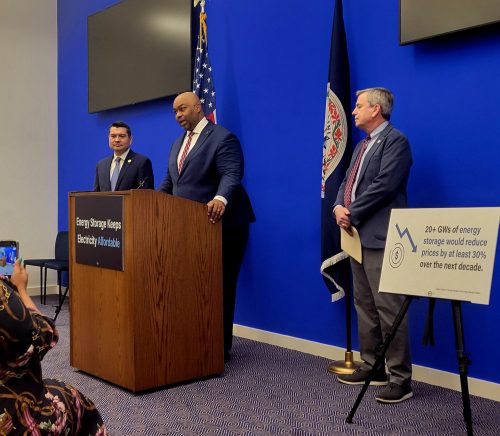
    Delegate Phil Henandez, D-Norfolk, Senator Lamont Bagby, D-Henrico and Delegate Richard Sullivan, D-Fairfax

    Advocates for adding massive amounts of battery storage to Virginiaโ€™s electric grid held a news conference Wednesday to claim again their upcoming bill will lower energy costs, not raise them, but added that the legislation they will push is still being drafted.ย 

    The 2026 General Assembly session starts in a week, and a version of the battery mandate bill was reviewed late last year by the Commission on Electric Utility Regulation (CEUR), but CEUR member Delegate Richard Sullivan, D-Arlington, said another version was coming. Whatever the changes, it is going to be great news for energy consumers, he and other legislators promised, flanked by people who are in the battery industry selling the hardware.

    It was the bill version being discussed last month that sparked this report that the capital cost of all the new battery facilities could approach $54 billion, $62 billion if you included the battery mandates already listed in the 2020 Virginia Clean Economy Act.ย  The basis for the estimate is the average cost of battery project applications now pending at the State Corporation Commission, about $675 million per gigawatt-hour.

    The advocates spoke for close to a half hour without mentioning any cost figure. If they dispute the figure published on Baconโ€™s Rebellion, they didnโ€™t say so. And none of the reporters at the event posed direct questions about the cost per megawatt or megawatt-hour that Virginia ratepayers will have to cover for Dominion Energy Virginia or Appalachian Power Company. Reporters did, and this was encouraging, understand the ratepayers will pay.ย 

    Some questions were about the cost versus benefit calculation behind the claims that adding batteries will make things cheaper. Sullivanโ€™s best answer โ€“ correct โ€“ was that batteries would allow the utilities to purchase energy for storage when the production price is low, and then use it when the price peaks, preventing the need to buy off the grid at peak price. The opportunities for that kind of arbitrage are limited.ย ย 

    (more…)