
by Steve Haner
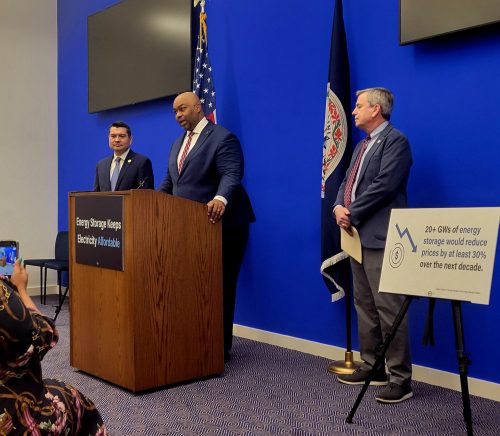
Advocates for adding massive amounts of battery storage to Virginia’s electric grid held a news conference Wednesday to claim again their upcoming bill will lower energy costs, not raise them, but added that the legislation they will push is still being drafted.
The 2026 General Assembly session starts in a week, and a version of the battery mandate bill was reviewed late last year by the Commission on Electric Utility Regulation (CEUR), but CEUR member Delegate Richard Sullivan, D-Arlington, said another version was coming. Whatever the changes, it is going to be great news for energy consumers, he and other legislators promised, flanked by people who are in the battery industry selling the hardware.
It was the bill version being discussed last month that sparked this report that the capital cost of all the new battery facilities could approach $54 billion, $62 billion if you included the battery mandates already listed in the 2020 Virginia Clean Economy Act. The basis for the estimate is the average cost of battery project applications now pending at the State Corporation Commission, about $675 million per gigawatt-hour.
The advocates spoke for close to a half hour without mentioning any cost figure. If they dispute the figure published on Bacon’s Rebellion, they didn’t say so. And none of the reporters at the event posed direct questions about the cost per megawatt or megawatt-hour that Virginia ratepayers will have to cover for Dominion Energy Virginia or Appalachian Power Company. Reporters did, and this was encouraging, understand the ratepayers will pay.
Some questions were about the cost versus benefit calculation behind the claims that adding batteries will make things cheaper. Sullivan’s best answer – correct – was that batteries would allow the utilities to purchase energy for storage when the production price is low, and then use it when the price peaks, preventing the need to buy off the grid at peak price. The opportunities for that kind of arbitrage are limited.
There was a placard in the room citing data from the PJM Interconnection that manages the grid in Virginia and a dozen other states. It said that adding 20 gigawatt hours of energy storage to the PJM system would “reduce prices” by 30% (which probably meant it would keep prices from going up as quickly as they would without the batteries.) The sign sat there for the cameras, but nobody discussed it or the accounting behind it.
That claim about the value of adding a modest amount of battery storage within the regional PJM system is reasonable. The problem is the legislation in question was envisioning more than four times that much storage just for Virginia. The bill still in drafting might demand even more.
This whole exercise points to the basic flaw in the bill: how can legislators in 2026 decide exactly how much storage makes sense for Virginia’s mix of energy generation five years from now, ten years from now or even 20 years from now? They cannot. The State Corporation Commission should decide, and it has that power to do so already. The bill is unnecessary.
One of the intermittent “renewable” generation sources that begs for battery backup to make it more valuable is offshore wind. The wind might be blowing full tilt at a time when the power simply isn’t needed and diverting it into a battery for later use could make sense. The hydro power pumped storage facility in Bath County does exactly that for the Dominion nuclear fleet, storing energy generated at low-demand times.
But the mostly finished $11.2 billion wind project off Virginia Beach, owned by Dominion Energy, is now paused and is in very great jeopardy of being cancelled outright by the Trump Administration. How that changes the energy calculus for Virginia was another major question the media just did not get around to Wednesday, unless the question was posed in private to the legislators.
Leave a Reply
You must be logged in to post a comment.