

See more memes at The Bull Elephant.
See more memes at The Bull Elephant.
From the New York Times:
“The head of the board overseeing the University of Virginia and two other top board members, including a major donor to the school, resigned on Friday under pressure from the state’s incoming Democratic governor, according to two people briefed on the matter and letters obtained by The New York Times. A fourth member said on Saturday that he had also resigned.
“The resignations came after the new governor, Abigail Spanberger, asked at least five members of the board to step aside as she takes office on Saturday. Ms. Spanberger has not said why she asked the board members to resign, but they were all involved last year when the Justice Department, in an extraordinary use of its power, bullied the university’s president into resigning. After Ms. Spanberger was elected in November, she asked the board to delay naming a replacement, but it went ahead and appointed a new president anyway.
“Those who submitted resignations on Friday were Rachel Sheridan, the head of the board, known at the University of Virginia as the rector; Porter Wilkinson, the vice rector; and Paul Manning, a board member and major donor who gave $100 million to the university just a few years ago, according to the letters.
“There are 17 seats on the Board of Visitors, which oversees the school, but before the resignations on Friday, there were only 12 members, all appointed by the outgoing governor, Glenn Youngkin, a Republican.” (Continue reading. New York Times subscription required.)
by Liberty Unyielding Staff
Bills pending in the Virginia state legislature could raise the state income tax a lot. The bill most likely to pass would increase the state income tax rate from 5.75% to 8% on incomes over $600,000 and 10% on incomes over $1,000,000. Another bill would impose an additional 3.8% tax (a “net investment income tax”) on most income above $500,000.
If both bills pass, Virginia would have a 13.8% tax rate. That would be higher than what is currently the highest state tax rate in America, the 13.3% rate in California for households with million-dollar incomes. It would be far higher than the top tax rates in the region around Virginia, such as the 3.99% tax rate in North Carolina, the 4.82% rate in West Virginia, and the zero percent tax rate in Tennessee, which has no state income tax.
The bill most likely to pass is HB 979, introduced by Delegate Vivian Watts, D-Fairfax, the powerful chair of the Finance Committee in Virginia’s House of Delegates. HB 979 “establishes two new tax brackets beginning on and after January 1, 2027, that tax income in excess of $600,000 but not in excess of $1,000,000 at a rate of eight percent and income in excess of $1,000,000 at a rate of 10 percent.”
“Something like this has an excellent chance of passing now,” said a Virginian who spent years lobbying Virginia legislators about tax and other issues.
(more…)
by Kerry Dougherty
I can’t be the only Virginian experiencing a form of PTSD after two days of the all-Democrat General Assembly session.
It’s as if the loathsome Ralph Northam was running the show again. You know, the guy who closed churches, masked toddlers and supported infanticide.
Despite all their talk about “affordability” – the new left-wing catchword for supposedly rolling back the high prices the Biden administration brought us – Virginia’s Dems immediately launched their radical plans.
Job one for the Democrats – HJ1 – is to enshrine a right to kill unborn children in Virginia, with essentially no restrictions. Oh, there’s some vague language about the 3rd trimester, but they’ll be killing babies right up until they draw their first breath in the Old Dominion once this passes.
Virginia will be an abortion destination for women from all over the South who live in states where the legislators respect life. Continue reading.
by Jon Baliles
For years we have heard the city needs more affordable housing. For years we have heard that cutting the real estate tax rate only helps the rich. And for years, anytime someone brings up the discussion about offering relief to everyone, the conversation turns to the need for “targeted relief.”
When the tax rate was being discussed in the Fall of 2024, the Stoney administration promised such relief when they announced the “Gap Grant” program, which ostensibly was going to offer up to $200 per month for six months to those who qualified and spent more than 30% of their income on housing. This was less about providing assistance and more of a diversion away from the discussion about reducing the tax rate. It succeeded in convincing Council not to lower the rate and for over a year now, no one seemed to want to try and make the new program work.
And guess what? It didn’t.
Even for a gimmicky program, Gap Grant was allocated $3.9 million that would have offered some (temporary) relief to those who met the criteria; but the city didn’t even try to seem to make the program want to work. The Avula administration could have picked it up and run with it, but instead, let it founder. In October, Graham Moomaw at The Richmonder reported that only $20,400 had been disbursed and the city had processed just 22 applications out of more than 2,300 received (around 1,100 were denied for various reasons).
The city’s new Finance Director said there had only been one staffer handling the paper applications but three people had been hired part-time to get through the backlog. At that time, the city said they would continue the program until the money was gone and then decide whether or not to fund it again. The Avula administration also said they would provide an update on the program within 60 days.
But they didn’t.
(more…)
The federal tax-credit scholarship program isn’t open yet, but Virginia’s already in line.
by Chad Aldeman
Republican Glenn Youngkin will leave office as governor of Virginia later this month. To his credit, he spent a lot of his tenure pushing for higher standards for public education. He revised the state’s accountability system to bring more transparency and urgency to school ratings. And he raised the state’s cut scores in the name of closing the “Honesty Gap” between state tests and true content proficiency.
But on January 1st, Youngkin did one more thing: He attempted to make Virginia the first state to opt in to the new federal tax-credit scholarship program created in last year’s tax bill. I use the word “attempted” here though, because his letter to the U.S. Treasury Department is not binding. In fact, the Treasury is currently in the midst of a regulatory process to define the parameters of the new program.
Why did Youngkin’s team decide to do this on their way out the door? My hunch is it was a political move to try to trap incoming Democrat Abigail Spanberger into eventually joining the program. But I don’t think it will work, and it could even backfire. (more…)
by Derrick A. Max

“Affordability” has become the most powerful word in modern politics – and nowhere more than here in Virginia. Candidates promised “affordable housing,” “affordable health care,” “affordable energy,” and “affordable childcare,” often without defining what affordability means or acknowledging the tradeoffs required to achieve it. Now in office, the progressives in the General Assembly have even crafted a slick video to show their commitment to the “affordability agenda.” No doubt, Governor-elect Abigail Spanberger will repeat the call for affordability frequently in her inaugural address tomorrow.
What is lost in this discussion is that from an economic perspective, affordability is not a universal outcome that can be mandated by law. It is a relative condition that always raises a critical question: affordable for whom, at what cost, and paid for by whom?
Consider the minimum wage. Raising it may increase take-home pay for some workers who keep their jobs, potentially making life more affordable for them. But economic reality does not allow higher wages to appear without consequence. Employers respond by cutting hours, reducing hiring, replacing workers with automation, or raising prices. For the worker who loses a job, affordability collapses entirely. For workers who get their hours cut back, affordability is cut. For low-income families facing higher prices at the grocery store, restaurant, or Walmart, affordability is reduced, not improved. The policy creates winners and losers, despite politicians speaking as if everyone wins. They don’t.
What might a 10-to-1 Virginia congressional map look like? Chaz Nuttycomb, president of State Navigate, gives it a shot:
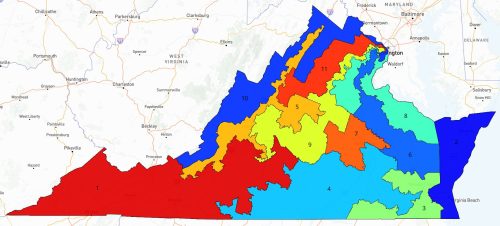
So much for congressional districts representing natural communities of interest.

VRE and Norfolk ‘Tide’ are big wastes of tax dollars.
by Ken Reid
“The Tide,” the cute name given to the 7.4 mile-Norfolk light rail now entering its 15th year of service, was dubbed in an August expose the “Worst LRT in America.”
According to Hampton Roads Transit’s 2026 budget, the annual cost of operating the Tide is $14 million and “local funding” (which means funds from HRT and City of Norfolk taxpayers) totals is $8.2 million while $4.847 million comes from federal and state sources. Only $944,567 are from fares.
This means the “farebox recovery” (to use transit parlance) is only 7 percent!!! Many of the Hampton Roads Transit buses have but 3 to 12 percent farebox recovery, according to reports, but operating costs for buses are about 50 percent less than the rail.
Monthly Tide ridership is high in the summer – about 3,000 a day — likely because Norfolk Tides minor league games get a number of passengers, but it was only about 2,200 a day in November 2025.
Assuming 2,200 riders per day, Norfolk and state taxpayers are paying $6,363 a year per passenger ($10.6 million divided by 2,000, 365 days a year) — meaning, it would be cheaper to buy each passenger a used car – or put the money into police, schools or other needy services.
(more…)
by Victoria Manning
A Virginia school district has spent precious educational funding on a controversial outside mental health counseling program for students—without parental knowledge or consent. One of the largest districts in the Commonwealth recently announced a $255,000 contract with Uwill Mental Health to provide online counseling to 35,000 students in grades 6-12. Uwill’s ideology is in clear opposition to the tenets of many faith groups, likely unknown by parents.
Telehealth provider “UWill”
Virginia Beach City Public Schools (VBCPS) spends over a half million dollars on outside mental health counseling for students — over and above more than 100 full-time school counselors employed by the division.
Uwill, the contractor used by VBCPS, brags that 25 percent of their counselors identify as LGBTQIA+ and some of their top therapists specialize in sexual identity counseling. Yet they don’t offer support based on a student’s religious beliefs, a central tenet of mental health treatment for many Christians and other faith traditions.
(more…)by Derrick A. Max

Governor Glenn Youngkin’s final State of the Commonwealth address last night offered more than a farewell. It served as an empirical rebuttal to the claim that conservative, pro-growth governance, like those supported by the Thomas Jefferson Institute, cannot deliver tangible results. By every meaningful metric — jobs, investment, education outcomes, revenue growth, and regulatory efficiency – we agree with Governor Youngkin that Virginia today stands much stronger than it did four years ago.
Business Development and Job Creation
Youngkin’s speech underscored what is probably his administration’s defining achievement: restoring Virginia’s reputation as a place where businesses can invest, expand, and hire. Since declaring Virginia “Open for Business” on Day One, the Commonwealth has:
These are real, high paying positions in manufacturing, life sciences, and advanced technology — all across the Commonwealth.
Governor Youngkin warned the incoming administration and the new General Assembly that this growth requires policy certainty, right-to-work protections, lower taxes and a government that competes rather than obstructs. His passionate warning against altering Virginia’s right-to-work law was not ideological, it was empirical, rooted in observed capital flight from high-tax, high-regulation states.
by Steve Haner

Proposed legislation to require Virginia’s two main electric utilities to load up on battery storage in the next 20 years has now been introduced, and the target battery amounts for Dominion Energy Virginia grew even larger than in the version of the bill previewed by a study commission in December. It is way larger and more expensive than the bill vetoed by Governor Glenn Youngkin (R) last year.
For Dominion and Appalachian Power Company combined, doing a bit of simple math, the bill is calling for more than 135 gigawatt hours of battery storage. That is probably enough stored electricity to meet their current customer demand three or four times over (five times on a slow day). At the estimated price per gigawatt hour used in this previous post, the capital cost (less profit and operating expenses) would surpass $90 billion.
If they existed today, they would hold enough electricity to cover the entire 13-state PJM regional transmission organization on all but a few days. These folks want to back up the entire PJM system with batteries paid for by Virginia ratepayers. (It is a bit more complicated than that, but this does indicate the scale of power involved. Their first hour of combined discharge would be 21 GW, still a stunning amount of electricity.)
Incoming Governor Abigail Spanberger (D) has since listed this $90 billion battery legislation as one part of her “energy affordability” agenda, so a veto this time seems unlikely. It is also fair to assume Spanberger or at least some of her advisors saw this new draft before it appeared as a bill in the past 24 hours. This new version is House Bill 895, from Delegate Richard Sullivan, D-Fairfax, and a Senate companion bill is expected.
Most of the capital cost and years of profit for the utilities would show up on people’s bills long after Spanberger leaves office in four years.

by Hans Bader
A progressive Virginia legislator apparently thinks the parole board isn’t releasing enough inmates. So he has introduced a bill, HB318, that would let progressive legislators, rather than the governor, pick many of the parole board’s members. His bill would also make it much easier to parole inmates serving life sentences — which could result in the release of many killers — and make it hard not to parole inmates who committed crimes as juveniles, if their continuing dangerousness is due to “the nature of the offense” they committed or other factors beyond their “demonstrated ability to control.”
Right now, the Virginia Parole Board has five members, all picked by the governor and confirmed by the General Assembly. HB318, sponsored by Delegate Patrick Hope, D-Arlington, would expand the parole board to 10 members, and let individual legislators pick five of them. “Three of” those five would “be appointed by the Speaker of the House of Delegates,” and “two of” them would “be appointed by the Chair of the Senate Committee on Rules.” (The Speaker of the House is Don Scott, who in 2020 proposed a failed bill that would have required the release of many inmates based on their age, leaving the parole board with no discretion to block their release even if they were still dangerous).
(more…)The year: 2075. The American colonies on the Moon are getting restless under Washington’s tyrannical rule….
This second edition of “Dust Mites” has a snazzy new cover, includes helpful lunar maps, and is 5,000 words tighter than the original. The sequel, “Trogs,” is scheduled for publication this summer.
Bacon’s Rebellion is Virginia’s leading politically non-aligned portal for news, opinions and analysis about state, regional and local public policy. Read more about us here.
Shake up the status quo! Your contributions will be used to pay for faster download speeds and grow readership. Make a one-time donation by credit card or contribute a small sum monthly.
Enter your email address to receive immediate notifications of new posts by email.
SUBSCRIBE
Protecting Thomas Jefferson’s Legacy at the University of Virginia

Shoot me an email and I’ll generate a new password for you.
