
by Jon Baliles
For years we have heard the city needs more affordable housing. For years we have heard that cutting the real estate tax rate only helps the rich. And for years, anytime someone brings up the discussion about offering relief to everyone, the conversation turns to the need for “targeted relief.”
When the tax rate was being discussed in the Fall of 2024, the Stoney administration promised such relief when they announced the “Gap Grant” program, which ostensibly was going to offer up to $200 per month for six months to those who qualified and spent more than 30% of their income on housing. This was less about providing assistance and more of a diversion away from the discussion about reducing the tax rate. It succeeded in convincing Council not to lower the rate and for over a year now, no one seemed to want to try and make the new program work.
And guess what? It didn’t.
Even for a gimmicky program, Gap Grant was allocated $3.9 million that would have offered some (temporary) relief to those who met the criteria; but the city didn’t even try to seem to make the program want to work. The Avula administration could have picked it up and run with it, but instead, let it founder. In October, Graham Moomaw at The Richmonder reported that only $20,400 had been disbursed and the city had processed just 22 applications out of more than 2,300 received (around 1,100 were denied for various reasons).
The city’s new Finance Director said there had only been one staffer handling the paper applications but three people had been hired part-time to get through the backlog. At that time, the city said they would continue the program until the money was gone and then decide whether or not to fund it again. The Avula administration also said they would provide an update on the program within 60 days.
But they didn’t.
Moomaw reported last Friday that the Gap Grant program had been suspended and one person who was approved and scheduled to receive a check in December to help with their January rent payment never received it. Butterfly Heart, who rents an apartment in Manchester, tried to find out what was going on. City officials first told her the check had ended up in Texas due to a mailing mishap with her application, and after more back-and-forth with no resolution and no check, Heart checked the city’s 311 Customer Portal and discovered the program had been suspended as of January 1.
“I couldn’t believe it,” Heart said. “The unprofessionalism, the unanswered questions, and now the program is suspended without even a letter?”

The city told Moomaw last week they did not know how long the program would be suspended and would try to rework the program in a worthless word salad statement. They also said they would not accept any applications after December 31st while also promising they expected the money already approved would still go out. The city told Moomaw that Heart’s original check had been voided “and will notify her” when the new one is ready (as February’s rent check will be due soon).
“Christmas went by. New Year’s Eve went by. And I am like there is no way that this is really happening,” Heart said. “Did they change their mind? Did my application get denied for some reason? Can somebody just tell me what’s going on?”
The city did change its’ mind since October — they just forgot to tell the public and even those who were expecting to get financial help they were halting the program. Why on earth is a reporter notifying the city about someone who was trying to find out what happened to their rental assistance check? Only yesterday did the city put out a press release announcing the suspension of the Gap Grant program — five days after The Richmonder article, two weeks after the program had been suspended, and almost three months after the city said they were putting on resources toward getting through the backlog.
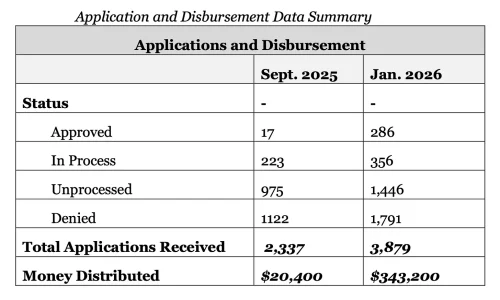
In October, Moomaw pointed out that most of the successful applications for the program went were approved in the first six months of 2025, but then slowed down significantly. Last month, a woman told CBS 6 she had applied for the program in June (with a processing time of eight weeks), but was finally notified in early December. As the chart below indicates, since that October promise to ramp up, the number of approved applications has risen sharply (from near zero) but the unprocessed applications have also increased. Out of the $3.9 million allocated, less than 9% of the total has been approved for “targeted relief.”
Mayor Avula campaigned on and has said repeatedly that affordable housing is a priority. He lectured endlessly during the tax rate debate that the city should be helping and targeting relief only to those who really need it. The Gap Grant program may have started as a diversionary gimmick, but Avula has had a year to get the program working. He has fumbled the ball repeatedly and ignored crossing the “t’s” and dotting the “i’s” and lacked the focus on the details and improving the program just as if Stoney were still in charge. The same goes for the bumbling communication (or lack thereof).
Chief Administrative Officer Odie Donald in a January 14 memo said, “This pause was not appropriately relayed to key stakeholders, notably current and potential applicants. Simply put, this pause was not communicated clearly to Richmonders in need. The best apology is often corrected behavior.” Not only was it not “appropriately relayed”, it wasn’t relayed at all until five days after The Richmonder article appeared. (You might recall last month when the city did take the time to issue a celebratory press release touting the successful mailing of 70,000+ tax bills).
As of last week, there were 1,446 applications that have yet to be processed and the average age of those applications was 92 days. It is not difficult to discover why the program was such a mess. Donald wrote: “There is no record of an implementation or standard operating procedure put in place.”
That’s how the water plant failed and how much of City Hall has broken down in recent years — no standard procedures, inadequate training, not enough staff focused on the operation at hand — and no one at the top asking questions and demanding answers. Donald wrote that there had been “significant operational challenges” with the program, like 41% of all submissions lacking the proper documentation, and almost 30% of all applications were denied because the resident applicant was ineligible.
“This pattern warrants monitoring to determine why the eligibility criteria is not operating as in line with Council’s policy goals of ensuring that individuals and households most in need of relief are able to qualify for assistance,” Donald said.
Donald said suspending the program until March 31st will allow them time to assign more staff to catch up if they are able to process 75 to 100 approvals per week. He also said this program was not a core function of the Finance Department, even though it was touted as one during the tax rate debate in 2024 (long before Donald took over as CAO). He also hinted the city might need to hire an outside vendor to process applications as it would “drastically improve the service and free up Finance staff to focus on core services.” He did not say where that money would come from, or if it would be carved out of the $3.9 million that is supposed to be used for “targeted relief.”
So once again, the ongoing debate over who needs and deserves relief the most becomes irrelevant once the political goal has been achieved (the defeat of the tax relief vote). Once that goal was reached, those that touted for “targeted relief” forgot to make sure they followed up with what they had advocated for and make sure a program providing financial assistance actually became a reality instead of an utter embarrassment.
We knew in October (and even months before that) the program was flailing, but no one in a leadership position stood up to do anything about it, and hardly any assistance has been provided because no one was paying attention and/or demanding solutions. If the Mayor is truly serious about housing and fairness and “targeted relief” and all the things he espoused on the campaign trail and for the last twelve months, then it is beyond time to be less of a happy cheerleader and more of a concerned leader with a diminishing toleration for mediocrity and failure.
Jon Baliles is a former Richmond city councilman. This column is republished with permission from his blog RVA 5X5.
Leave a Reply
You must be logged in to post a comment.