• Shoplifting for Fun and Profit

    by James A. Bacon

    The Arlington County police digital police blotter contains a report of a shoplifting arrest made on March 28. At 6:02 p.m. police were dispatched to a store on Hayes Street where an employee had confronted a man for concealing merchandise in a bag. During the course of the police investigation, the suspect provided false identifying information, acted in a disorderly manner, made threatening statements, and spit on an officer. The police arrested him and charged him on multiple counts.

    It turns out that the individual in question, 24-year-old Ronald Thomas of Brandywine, Md., had been served with outstanding warrants in a previous incident in the City of Fairfax. Thomas and another suspect had entered the Ulta Beauty store there with duffle bags and filled them with merchandise before fleeing in a car.

    Perhaps incidents like these have been occurring for years, decades, without anyone paying attention. It’s not as if Thomas shot or stabbed anyone. Perhaps these incidents are absolutely nothing to get exercised about. Or… perhaps the incidents are indicative of a troubling trend of California-style social “justice” — and attendant social disorder — coming to Virginia. (more…)


  • Details on Real Estate Assessments and the Property Tax

    by Dick Hall-Sizemore

    I am following up on James Sherlockโ€™s article on local property taxes.

    In Article X, sections 1 and 2, the state constitution requires that all property be taxed at fair market value. There are exceptions, but those are not relevant to this discussion. So, there you have it. Unless the constitution is amended, localities must tax property at fair market value.

    State law recognizes the impracticality of assessments keeping up with fair market value on a continual basis.

    One of the main reasons that assessments lag behind market value on a statewide basis is the varying frequency of reassessments by localities. State law requires cities to reassess every two years, except that cities with a population less than 30,000 can use a four-year reassessment cycle. For counties, the law allows them to go four years between reassessments, except for counties with a population under 50,000 , and the counties of Augusta and Bedford, which are allowed a five-year or six-year cycle. (more…)


  • Secular Authoritarian Religions Disgrace Virginiaโ€™s Left and Right

    Russian crowd control

    by James C. Sherlock

    Americaโ€™s freedoms, guaranteed by its Bill of Rights and its three-branch government, have been the keys to Americaโ€™s success since its founding.

    Individual freedoms, protected, unleashed the creativity of hundreds of millions of citizens to make America the most dominant nation in the history of the world.

    Broadly common moral standards have sustained support for that government. As moral standards evolved, with new concepts of morality emerging from the churches, Americaโ€™s constitution and laws changed with them.

    America has defined evil within Judeo-Christian traditions. As other religions began to be represented in America, they brought with them many of the same understandings of right and wrong.

    We have struck democratic agreements that are lasting because they have attained sufficiently balanced support. Our violent rupture, the Civil War, was fought to extend freedom and succeeded in doing so.

    Our laws have not always been just, but opposition to unjust laws generally began in the churches and attained majority approval. The great civil rights movement in the 1950โ€™s and 60โ€™s marched out of churches into history.

    All of this is changing with the precipitous decline of traditional religion in American life. This decline has created a vacuum into which extremists, both left and right, have stepped with new secular religions of their own design. (more…)


  • Commonwealth Attorney Nullification

    Steve Descano. Photo credit: WTOP

    Steve Descano has written an op-ed piece in The New York Times. Should the U.S. Supreme Court roll back Roe vs. Wade, says the Fairfax County Commonwealth Attorney, he will never prosecute a woman for having an abortion — “no matter what the law in Virginia says.”

    The CA provides several reasons for opposing blanket abortion laws, some of which I think are legitimate. He should use whatever political influence he has to ensure that draconian anti-abortion laws are never enacted in the Old Dominion.

    But I do worry when elected prosecutors pick and choose the laws they enforce. Should the Commonwealth Attorney be allowed to nullify any law he dislikes for the one-in-eight Virginians who live in Fairfax County? If so, by what logic should not every Commonwealth Attorney be allowed the same prerogative? What if, to pick an equally controversial example, CAs in conservative rural counties refused to prosecute gun-control laws?

    This is the path to anarchy.

    — JAB


  • The Long Odds in Playing Catch-Up

    by James A. Bacon

    Thanks to the Standards of Learning exams, Virginians have been able to measure the calamitous effects that the shutdown of in-person instruction had on student learning in the 2020-21 school year. From this year’s SOL exams, we will find out if students have made up for lost ground — or have fallen further behind grade level — while back in school this year.

    Over and above teaching students what they need to learn for the current school year, the great challenge for schools and teachers has been helping them catch up on what they had failed to learn during the COVID-19 shutdowns. You see, almost everyone got a special COVID-19 dispensation and was allowed to move up to the next grade.

    The Virginia Department of Education (VDOE) maintains two databases that allow us to gauge the magnitude of the challenge. One data set allows us to compute the percentage of students who fail to pass their exams. In numerous school districts, the percentage who failed their English reading exam, for example, exceeded half the student body. Once upon a time, students who failed to achieve basic mastery of core subjects were held back. A second VDOE data set tracks that number. In not one school district did the percentage exceed 3% in 2020-21.

    Thus, in the Danville public schools, 56.6% of students failed their English SOLs (and 70% failed their math SOLs), but only 1.2% of students were held back. Assuming the number of held-back students was distributed randomly across all grades, we can conclude that more than half of all Danville students were promoted to the next grade without having mastered core subject matter. (more…)


  • Home Price Volatility and Virginia Property Taxes

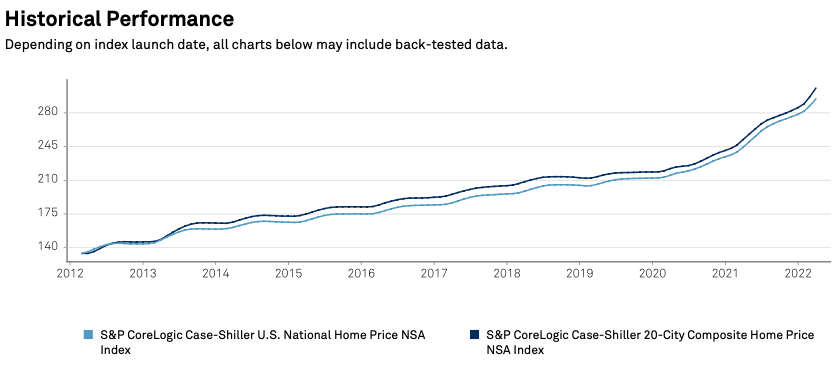
    Case-Schiller Home Price Index – National

    by James C. Sherlock

    Housing prices have more than doubled since 2012, reflecting shortages of supply and the resulting speculation. The increasing slope of those curves above is not comforting.

    Prices haveย soared over 20% in a year. Mortgage rates are up. What could possibly happen next? Most can figure that out.

    But this article is about the effects on local government property taxes of what most predict will be extreme volatility in the housing market going forward.

    How are Virginia real property taxes adjusted to mitigate the effects on both property owner tax bills and government receipts in this boom and very likely bust cycle?

    Weโ€™ll look at the law. (more…)


  • Progress: Standard Deduction Up 166% since 2018

    by Steve Haner

    First published today by the Thomas Jefferson Institute for Public Policy.

    Do not be surprised if, by the time the next Virginia General Assembly elections roll around, the Democrats who are now complaining about the level of tax relief in the pending budget compromise switch positions, and campaign as champions of the deal.

    The two key elements โ€“ a substantial increase in the standard deduction for income tax filers and a cut in sales and use tax on groceries for everybody โ€“ are ideas with long and bipartisan histories. Only the reluctance of previous governors and General Assemblies to part with the revenue stood in their way. Both are logical, populist reforms many Democrats had also championed in the past.

    The Thomas Jefferson Institute has long been an advocate for a higher standard deduction, and the proposed 78% increase from $4,500 to $8,000 per person (up to $16,000 for a couple) falls just short of the recommended 100% increase.ย  Remember, as recently as tax year 2018 it was only $3,000 (or $6,000 per couple) and raising it in 2019 was also a major recommendation of ours that was adopted.

    This new amount will apply to this tax year. So in two steps over three years, the standard deduction has risen by $10,000 for a working couple. That 166% increase saves most of them $575 per year. (more…)


  • Johnny Depp and Amber Heard: Wasting the Court’s Time and Our Tax Dollars

    by Kerry Dougherty

    Anyone remember John Allen Muhammed?

    In 2002, with the country still on edge from the terror attacks of 2001, Muhammed and a young accomplice, Lee Boyd Malvo, began shooting innocent civilians from the trunk of a car in the suburbs around Washington D.C. In all, the two psychopaths killed 10 random strangers. Some victims were pumping gas, others were crossing strip mall parking lots or loading groceries into their cars.

    The capriciousness of the killings terrified Virginians and Marylanders. After-school activities were cancelled in some places and people were wary of getting out of their vehicles.

    When the two were finally apprehended, authorities decided that Muhammedโ€™s first trial should be in Virginia. After all, they reasoned, he was charged with capital murder in the Old Dominion. If convicted and sentenced to die, the sentences in Maryland wouldnโ€™t really matter.

    The trial was held in Virginia Beach Circuit Court. As is usual in that city, the case was handled professionally and with dispatch. (more…)


  • How are Virginians Preparing for the Coming Food Price Shocks?

    by James C. Sherlock

    Virginians have only begun to experience price inflation at the grocery store.

    Price increases are in the food pipeline that will be a much bigger problem starting this summer.

    Farmers and ranchers invest up front. They borrow money to do it. They are incredibly efficient at what they do, but are at the mercy of input prices. They must wait until their crops and animals are sold to recoup their investments.

    Everything farmers and ranchers do with their farm machinery requires diesel. So do the trucks that move crops to those who prepare them for our use and then to market. Diesel prices are expected to reach more than $6 per gallon this summer, a 35% increase from current prices. Inventories are low.

    Most fertilizer is an oil derivative and has skyrocketed up to 300% since early 2021. On average, fertilizer in March of this year was 35% more expensive than it was in the fall of 2021, with Roundup up nearly 90%. In six months.

    Of course, the feed ranchers buy for their animals comes from the produce of America’s farmers.

    Producer prices that reflect what they have paid for diesel and fertilizer and the trucking costs of moving those crops are predicted to reach grocery stores in the summer and fall. That hardly suggests that the 9% inflation recently seen in retail food prices is the end of it.

    It is important to ask what our governments and our best charities are doing to prepare. (more…)


  • SOLs: Disentangling Race, Socioeconomic Status, and English Learning

    by Carol J. Bova

    Many politicians, activists and media commentators persist in the conviction that Virginia’s schools are systemically racist. The main evidence to support such a proposition is the reality of disparities of educational outcomes between racial/ethnic groups, like those summarized in the chart at right. If Blacks and Hispanics pass their Standard of Learning exams at lower rates than Asians, Whites and others, that in itself is deemed to be proof that the system is biased against non-Whites.

    However, that logic fails to take into account that racial/ethnic groups vary by at least three factors known to affect educational outcomes: socioeconomic status, English as the primary language, and chronic absenteeism.

    The table tells an incomplete story. True, the average pass rate for 4th-grade English SOLs is 14% and 11% lower for Blacks and Hispanics, respectively. But Asians pass at a 12% higher rate than the statewide average — more than Whites. Also, multiracial students, who also are classified as “people of color” supposedly subject to discrimination, passย  at a 5% higher rate than the overall average. Clearly, there are other factors than skin color at play. (more…)


  • Faithless Electors, Faithless Congresspersons

    by Jim McCarthy

    โ€œWith what shall I fix it, dear Liza, dear Liza, with what shall I fix it, dear Liza, with what?โ€ May 30th is National Hole in the Bucket Day offering the states and Congress the opportunity to fix the hole in the bucket of Presidential electoral processes and procedures.

    At present, members of Congress are unrestrained from voting to accept or reject the certified state electoral votes and slates of electors for the Electoral College. This hole in the bucket has largely been deflected by emphasis upon election integrity, a meme for voter fraud by the voters themselves (or, occasionally groups).

    The names of presidential electors may or may not appear on the ballot in most states; voters by and large believe they are casting a vote directly for the president and vice president. The U.S. Supreme Court (Chiafalo v Washington, 2020) unanimously ruled that states have the constitutional authority to force electors to vote in accordance with their stateโ€™s popular vote. The opinion, while recognizing state power in this regard, does not require states to prevent faithless electors. At the time of the decision, 33 states, including Virginia, had adopted legislation binding electors. (more…)


  • Every Day Is Memorial Day in Normandy

    by Kerry Dougherty

    My most memorable Memorial Day did not take place on Memorial Day at all, but a few weeks earlier. In May of 1982.

    But then again, every day is Memorial Day when you stand on those beaches at Normandy. It was a glorious spring morning on the coast of France. The sky was the deepest shade of blue. A gentle wind made the American flags flutter. And I was there with 52 Irish boys. Bad boys.

    I’m getting ahead of myself.

    Twenty-one years ago, I lived in Dublin, where I attempted to eke out a living as a freelance writer in the dingy offices of the now-defunct Irish Press. While back home, American newsrooms were swapping their IBM Selectrics for computers, this one was stuck in another era. Manual typewriters created a chattering cacophony, cigarette smoke turned the air blue, greasy chip wrappers littered the floors. Everyone was known by their last name.

    Except me. I was The Yank. (more…)


  • What’s Causing Virginia’s Excess Deaths? Whatever It Is, It’s Not Just COVID


    Virginia has high vaccination rates, and deaths from COVID-19 are a small fraction of what they were at the height of the pandemic. Yet “excess” deaths in Virginia — the number that would be predicted based upon projections from pre-COVID years — are running 13.4% higher than expected this year.

    According to Centers for Disease Control data, excess mortality shot higher during the first year of the pandemic, ran even higher in the second year, and continues without let-up in the third year. Is there a common thread underlying this threat to the public health? Could the increase in non-COVID deaths be tied to how American society responded to the pandemic?

    In a newly releasedย video Delegate Karen Greenhalgh, R-Virginia Beach, who sits on the Joint Commission on Health Care, says she wants to understand these numbers better. (more…)


  • Who Needs the General Assembly? Let the Budget Conferees Do It.

    Sen. Janet Howell (D-Fairfax), chair of Senate Finance and Del. Barry Knight (R-Virginia Beach), chair of House Appropriations. Photo credit: Richmond Times Dispatch

    by Dick Hall-Sizemore

    Although legislating through the budget, a practice that used to be frowned upon, is not new, this yearโ€™s budget conferees are taking the practice to a new dimension.

    The amendments released by the budget conferees include the following new provisions in the โ€œGeneral Provisionsโ€ section. In most cases, the Code of Virginia is amended. The remaining cases involve just language in the Appropriation Act.

    1. Changes to the tax code. These have become a standard practice.ย  This year there are provisions to increase the standard deduction, eliminate the state portion of the sales tax on groceries, increase income tax credits for military benefits, and make significant changes to the statutory ย language regarding housing opportunity credits.
    2. University housing. To the extent that institutions of higher education operate student housing during breaks, requires them to allow eligible foster students to stay in them free of charge.
    3. Casino referendum. Prevents the city of Richmond from having a second referendum on casinos until November 2023.
    4. Private school. Exempts a private school from licensing requirements.ย  (The school was previously exempted until repeal of the applicable statutory provision in 2020.)
    5. Games of skill. Changes the definition of games of skill.
    6. Marijuana and hemp. Establishes a criminal penalty for possession of four ounces to one pound of marijuana. Changes requirements for labeling of products including industrial hemp. This is the first time that I remember the budget bill being used to amend the criminal code and impose a new criminal penalty.

    (more…)


  • A Gun Ownerโ€™s Suggestion for Virginia Gun Laws

    By James C. Sherlock

    I was a career military man.

    I am a conservative and a gun owner. As a younger man, I won competitive awards for marksmanship with both rifle and pistol.

    I own a semi-automatic Glock for home protection. ย I train regularly and at almost 77 can still hit what I aim at.

    With that introduction, I have a couple of suggestions for gun legislation in Virginia that I hope will draw condemnation from both the left and the right so that I know I have it roughly right.

    I have four criteria for firearms legislation:

    • changes that can matter to the safety of children and law enforcement officers;
    • changes that can deter criminals from use of a firearm in the commission of a crime;
    • changes that do not disadvantage the average citizenโ€™s possession and use of firearms; and
    • changes that can pass Second Amendment review in federal court.

    Those are, as a group, difficult needles to thread simultaneously. ย They should be.

    This article involves semi-automatic long guns – rifles and shotguns.

    (more…)