• The Fight Against Invasives

    Image credit: National Geographic

    by Dick Hall-Sizemore

    One fascinating aspect of the General Assembly is legislation that does not make headlines but is important to a fervent group of Virginians and that could have an impact on the state as a whole.

    In recent years, the problem of invasive plants has gained the attention of legislators. In 2009, the General Assembly defined an invasive plant as one โ€œthat is not native to the ecosystem and whose introduction causes or is likely to cause economic harm or harm to human health.โ€

    The requirement that an introduced plant must cause harm in order for it to be considered invasive is the key to the definition. That means the daffodils that are now adding some cheer to my backyard in the middle of winter are not invasive. On the other hand, the English ivy in my yard is invasive.


    That statutory definition does not identify the specific plants that should be considered invasive. Consequently, there could be disagreements among โ€œplant peopleโ€ and confusion in the general public. Last year, the General Assembly directed the Department of Conservation and Recreation (DCR) to โ€œcreate a list of invasive plant speciesโ€ by January 1, 2024. It also prohibited any state agency from planting, selling, or propagating any plant on that list, except under narrowly defined situations. (The Virginia Mercury has described this years-long history in detail.) (more…)

  • Progressive Legislators Declare “Profound Solidarity” with Criminals

    from the Liberty Unyielding blog

    Killings and violence have risen in the U.S. over the last decade, as some government officials have come to sympathize more with criminals than their victims. The Virginia Legislative Black Caucus recently said it is โ€œin profound solidarityโ€ with Virginiaโ€™s prison population, and that its members โ€œwork to dismantle the unjust criminal system.โ€ They said the criminal-justice system has the โ€œrole of dehumanizing, abusing and punishing Black America.โ€

    Thirty-two of Virginiaโ€™s 140 state legislators belong to the Virginia Legislative Black Caucus, including the speaker of Virginiaโ€™s House of Delegates, Don Scott; the president pro tempore of the state Senate, Louise Lucas; the head of the House Appropriations Committee; and the head of the Senate Rules Committee.

    On February 14, the VLBC issued a statement that began:

    The Virginia Legislative Black Caucus (VLBC) remains in profound solidarity with the 122,500 Virginians who are actively trapped in our stateโ€™s criminal justice system, nearly half of whom are Black. When slavery was abolished by the 13th Amendment, it was qualified with โ€œexcept as a punishment for crime whereof the party shall have been duly convicted.โ€ With that, mass incarceration was born and the criminal justice system absorbed the role of dehumanizing, abusing and punishing Black America. (more…)


  • Weโ€™re Doctors. Implicit Bias Training Has No Place in Medicine.

    by Martin Caplan, MD, and Kenneth Lipstock, MD
    Apparently, Virginiaโ€™s doctors and nurses are racist.

    This is the message ofย twoย bills that are moving through the state legislature. The bills would force medical professionals to take ongoing โ€œimplicit bias trainingโ€ to get and keep their license. The problem is that such training is insulting, dangerous, and scientifically indefensible. Itโ€™s grounded in the false idea that people mistreat and even oppress others, especially those of a different race.

    Itโ€™s a popular narrative, but there is no sound evidence to support it. What is clear is that if our lawmakers pass these bills, theyโ€™ll encourage racial division and tribalism, while undermining the medical profession and hurting patients who need our help. (more…)


  • Floyd Judge Ponders Order to Return RGGI Tax

    The states in the Regional Greenhouse Gas Initiative tax compact before Virginia withdrew.

    By Steve Haner

    A circuit court judge in Floyd County may soon order Virginia to rejoin the Regional Greenhouse Gas Initiative and to reimpose the related carbon tax on Virginiaโ€™s electricity consumers.

    Judge Kenneth โ€œMikeโ€ Fleenor Jr. ruled earlier this month that a suit seeking reinstatement of RGGI could continue and held a hearing on February 5 on the question of โ€œimmediate relief.โ€ย  The plaintiff, a group of energy efficiency and insulation contractors using the RGGI tax dollars for their programs, has claimed it will suffer immediate and irreparable harm unless Virginia returns to collecting a carbon tax on coal and natural gas used by utilities. (more…)


  • A Traditional Conservative Issues Warning

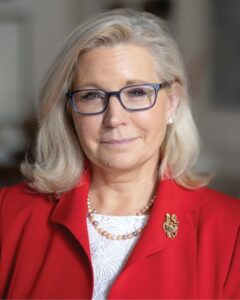
    Liz Cheney Photo credit: Richmond Forum

    by Dick Hall-Sizemore

    Liz Cheney was in Richmond Saturday night delivering her warning about Donald Trump.

    Cheney represented Wyoming in the U.S House of Representatives and held the No. 3 leadership position in the Republican caucus.ย  She served on the Select Committee to Investigate the January 6th Attack on the United States Capitol.

    Her speech was this monthโ€™s offering of The Richmond Forum, a long-running public subscription lecture series.ย  According to the president of The Forum, Cheney was booked about a year ago, before her high-profile role in the 2024 Presidential election campaign could have been known.

    Cheneyโ€™s message was simple:ย  if elected President this year, Donald Trump will destroy constitutional democracy in the United States.

    Another takeaway:ย  congressional Republicans have been infected by a โ€œplague of cowardice.โ€

    For her Virginia audience, Cheney had effusive praise for U.S. Representative Abigail Spanberger.ย  She said that Spanberger was only the second Democrat she had ever endorsed.

    Apparently, all the media outlets in the Richmond area were asleep.


  • Jeanine’s Memes

    From The Bull Elephant


  • Bacon Meme of the Week


  • Judge Uses Crude Statistics to Find Racial Profiling by Richmond Police

    by Hans Bader

    A judge recently found that the City of Richmond racially profiles black motorists, dismissing the indictment of a black convicted felon accused of illegally possessing a gun. The judge did not find that defendant Keith Moore had been treated differently than a similarly situated white motorist. Instead, he ruled that Richmond police stops are racially discriminatory, based on statistics showing blacks are stopped and arrested at much higher rates than whites; and based on Richmond’s past “history of discrimination,” such as racialized zoning and redlining, and the “Confederate foundations” of the Richmond Police Department. “The Court will not require Moore to provide evidence of similarly situated individuals to prove his selective enforcement claim,” wrote the judge.

    This is likely to create big problems for the City of Richmond, potentially leading to many criminals being released from jail. If a judge claims racial discrimination happened, he should identify what policies are racially discriminatory, or give concrete examples of discrimination, so that the problem can be fixed.ย  But Judge Gibney failed to do that in his February 12 ruling in United States v. Keith Rodney Moore. So now the City is deemed guilty of discrimination, based on things no individual police officer can change (such as city-wide statistics), and things that literally no one can change (such asย  the confederate origins of the police department and Richmond’s segregated past). If other judges follow this flawed ruling, other criminals can also have their indictments dismissed based on city-wide statistics, even if it is undisputed that they committed the crime for which they were arrested.

    Although the judge cited statistical disparities, he did not cite any specific police practices that led to blacks being stopped at higher rates, as he should have done if police were actually at fault. In Smith v. City of Jackson (2005), the Supreme Court ruled that even unintentional discrimination (disparate-impact) cannot be proved through statistics unless “specific” practices are identified that caused the “statistical disparities.” The disparities themselves are not enough. (more…)


  • Nasty Social Media Message Attacks Virginiaโ€™s Speaker of the House

    Speaker Don Scott

    by Kerry Dougherty

    Great. Just what embattled Virginia Republicans need now: an ugly social media post attacking the new speaker of the House of Delegates over a crime he committed and did time for almost 30 years ago.

    Itโ€™s no secret that Portsmouth Democrat Don Scott was convicted on drug charges in 1994 and served seven years in prison for his crime. He was released, turned his life around, became a lawyer, a member of the House of Delegates and was elected speaker this year.

    The Washington Post sums up Scottโ€™s biography this way:

    Scott was convicted of carrying drug-related money across state lines just as he finished law school in Louisiana. Years after his release, Scott had his Virginia voting rights restored by then-governor Robert McDonnell (R), got his law license and has risen rapidly through the ranks at the General Assembly to become the first Black speaker in state history.

    Oh, and when his friend and neighbor, Portsmouth Circuit Court Judge Johnny Morrison, needed a kidney, Scott donated his.

    Thatโ€™s an extraordinary act of generosity.

    Look, I donโ€™t agree with Scottโ€™s politics and I think that most of the initiatives Virginia Democrats are pushing are radical and bad for the commonwealth. The partyโ€™s soft-on-crime positions are long-standing and detrimental to public safety.

    But that has nothing to do with Scottโ€™s past. (more…)


  • Dartmouth Reinstated the SAT. Will Virginia Universities Follow Suit?

    by Nancy Almasi

    Dartmouth College is making news regarding its return to using the SAT/ACT scores once again as a part of its admissions process. The policy will become effective in 2025 for the incoming class of 2029.

    Many colleges and universities decided to make the SAT/ACT test optional during the COVID-19 pandemic when health protocols made taking these tests more difficult for students. This came on the heels of many years of pressure from those who believe that SAT and ACT tests are biased towards those who are wealthy and/or white, arguing that those who can afford SAT prep classes, tutoring, and books have an unfair advantage.

    Dartmouthโ€™s policy reversal came as the result of a faculty study prepared by three economists and one sociologist. The professors compared the admissions data from the years when the standardized tests were optional with the data when the tests were required. They concluded that the scores were helpful in finding well-rounded, academically prepared students from diverse backgrounds.

    Dartmouth President Sian Leah Birlock wrote the following in her email to the Dartmouth campus about the policy change.

    SAT and ACT scores reflect inequality in society and in educational systems across the nation. The research does not dispute that. Crucially, though, the research shows that standardized test scores can be an important predictor of academic success at a place like Dartmouth and beyondโ€”more so even than just grades or recommendations, for exampleโ€”and with a test-optional policy, prompted by the pandemic, we were unintentionally overlooking applicants from less-resourced backgrounds who could thrive here.

    (more…)


  • Doing the Math

    Image credit: National Review

    by Dick Hall-Sizemore

    I have a dilemma. I canโ€™t decide if I am just like most old farts who think โ€œthe way I used to do itโ€ is the right way and the modern way is all screwed up, or if I am just out of touch with the modern way.

    Here is the situation. As I have mentioned before, I volunteer in the local elementary school. I meet with a group of fifth-graders twice a week for about 25 minutes to help them with math. Most of the students in the group last fall simply did not know the multiplication tables well.ย  Therefore, I decided to drill them on those tables.

    After their mid-year assessment, I got a different group of students. Almost all of these students know the multiplication tables. I realized I need to give them something more challenging. I asked a couple of students to show me how they would go about multiplying a double-digit number and a single digit, such as 14 x 7. One boy did the calculation in his head. The other student wrote it out.

    The approach goes like this: multiply 7 times the number in the โ€œonesโ€ columnโ€”28. Multiply 7 times the number in the โ€œtensโ€ columnโ€”70. Add the two: 98.ย  This is done with a matrix of boxes into which the 28 is placed in one box, and 70 in the other and the two sums are then added. The โ€œoldโ€ way of putting 8 in the โ€œonesโ€ column and โ€œcarryingโ€ the 2 to the โ€œtensโ€ column is totally foreign to these students. (more…)


  • Moving the Goalposts (for Banning Books)

    by Joe Fitzgerald

    Everybody probably already knew what moving the goalposts meant, but with Taylor bringing in a new set of football fans, the sports-related metaphors can probably be used more widely.

    Moving the goalposts is of course a reference to changing the standards in the middle of a process. Latest example: the Rockingham County School Boardโ€™s half-assed approach to banning books.

    We all know the things wrong with their approach. Some of the books arenโ€™t in the library; they havenโ€™t read them; they canโ€™t substantiate their claims of parental complaints; theyโ€™ve over-ruled a policy they didnโ€™t know existed; and theyโ€™ve interfered in an educational process in which they have no training.

    Two writers in The Harrisonburg Citizen have recently suggested that there are two sides to the issue or that the problem is not the book-banning but the way itโ€™s being discussed. Giving the Fahrenheit 451 crowd this benefit of the doubt moves the goalposts toward censorship and religious domination of public discussion. Thereโ€™s a reason the First Amendment is the first one, and thereโ€™s a reason its first clause says the nation wonโ€™t give special respect to an establishment of religion. (more…)


  • Four Major Progressive Goals Still Advancing

    By Steve Haner

    The aggressive progressive agenda working its way through the 2024 Virginia General Assembly has lost some steam at the halfway point, but at least four of the major Democratic goals discussed earlier are still advancing.ย ย ย 

    The two bills which will have the greatest impact on the Virginia economy are the proposed minimum wage increase and a new state-managed employee benefit for workers taking time off under the Family and Medical Leave Act. The two other bills the Democratic majorities in both the Virginia Senate and House of Delegates have now approved are a major expansion of procurement preferences for minority vendors and allowing class actions in civil litigation.ย ย  (more…)


  • The Speaker Rules

    Del. Don Scott (D-Portsmouth), Speaker of the House of Delegates Picture credit: Axios

    by Dick Hall-Sizemore

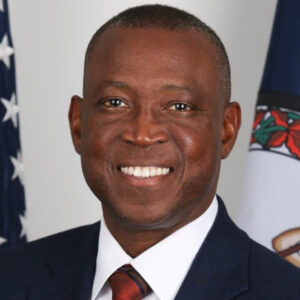
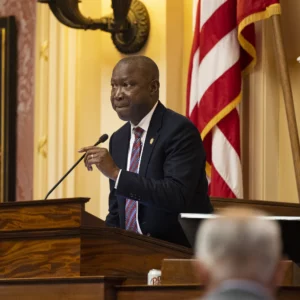
    The Speaker of the Virginia House of Delegates is widely regarded as the second-most powerful figure, after the Governor, in Virginia state government. Speaker Don Scott (D-Portsmouth), elevated to the position this session after only two terms in the House, has let the power go to his head. Rather than acting like the presiding officer of the whole House, he is behaving like a partisan dictator.

    Two events, perhaps related, earlier this week illustrate this attitude.

    To help with the understanding of these events, it would be best to state some of the ground rules:

    • The Speaker appoints delegates to committees;
    • The Speaker assigns bills to committees;
    • The Speaker chairs the House Rules Committee;
    • The Rules Committee, unlike other committees, can send bills to the Floor without recommendation;
    • House Rules require that no amendment to a bill can be on a subject that is different from the one under consideration. This is known as the โ€œgermaneness ruleโ€;
    • The Speaker can rule on questions of parliamentary procedure;
    • The Speakerโ€™s rulings can be challenged. (Invariably, the members of the majority party, the Speakerโ€™s party, will vote to uphold the Speakerโ€™s rulings.);
    • The federal Hyde amendment prohibits the use of federal funds to pay for abortions except in cases of life endangerment, rape, or incest.

    (more…)


  • Swallow the Money, Part 3 of 3

    by Joe Fitzgerald

    VPAP and CFReports let you go from โ€œHow about that?โ€ to โ€œOh, my God!โ€ in 5.2 seconds. Theyโ€™re attractive to the kind of nerds who used to go through the encyclopedia or the World Almanac. Yes, I did. Why do you ask?

    One local PAC became a subject for a dive into CFReports and VPAP when someone asked if it was true they paid for health insurance for one of their principals. The answer is that with Virginiaโ€™s campaign finance reporting rules, itโ€™s hard to say.

    VPAP and CFReports are explained in Part 1 of this series. A PAC, as explained there, is a political action committee. It raises money from political donors and spends it on political candidates or causes.

    That cause for Rural Ground Game, RGG, is electing rural Democrats. The perceived need for the PAC is the myth that the Democratic Party ignores rural areas and therefore doesnโ€™t win rural elections. The actual case is that Democrats donโ€™t win rural elections because rural voters vote overwhelmingly Republican, but the myth is popular among those who run better against their fellow Democrats than against Republicans. (more…)