• Bloat Watch

    Bloated whale carcass. Photo credit: CBC

    by James A. Bacon

    I have frequently observed (1) that the University of Virginia, for all its many fine qualities is subject to mission creep and administrative bloat; and (2) payroll expansion is the major driver of higher tuition & fees.

    Just how bad is administrative overhead? It’s difficult to say. Hard numbers are difficult to come by. Published statistics are slippery things. There are full-time employees and there are part-time employees. Some “employees” are interns or graduate students on fellowships. The criteria for classifying employees as faculty, administrative staff, or “other” are subject to change. Frankly, the size and scope of the administrative apparatus at UVA is a subject the Ryan administration studiously avoids.

    But a revealing statistic surfaced in a document, an update to the UVA Health Plan, shared Friday with the Board of Visitors. Here’s the bottom line: “UVA had 20,084 benefits-eligible employees [in FY 2023], a 9% increase over the prior year; 90% of the benefits-eligible workforce were enrolled in the health plan.

    A 9% increase in benefits-eligible employees in a single year is more than “bloat” — it’s a dead whale carcass on the beach. Surely, one would think, someone on the Board of Visitors would have asked for an explanation. As we have become accustomed to observing, however, there was no opportunity for board members to ask the question even if they had been inclined to.

    (more…)


  • Louise Lucas, Do Better.

    by Kerry Dougherty

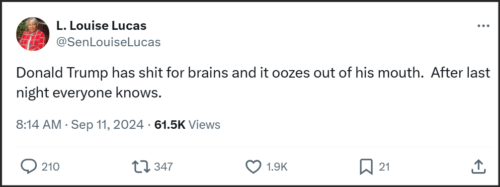
    Virginia, I give you Louise Lucas, your President Pro Tempore of the State Senate:

    Such eloquence! Such a command of the English language! Positively pithy!

    Doesnโ€™t she make you proud?

    Consider: this is an 80-year-old grandmother. The boss of Portsmouthโ€™s Democrat political machine. A former shipyard worker turned politician who hasnโ€™t lost an election since her first victorious run for the state legislature in 1991.

    Sheโ€™s always been a tough politician, a pit bull even. But the appearance of Donald Trump on the national stage and especially GOP Gov. Glenn Youngkin on Virginiaโ€™s has turned her into a bitter, foul-mouthed swamp monster.

    Consider what this woman had to say when she began using a cane this summer due to a bum knee. Read the whole thing.


  • Bacon Meme of the Week


  • Atlantic Park Part 6: Vote for Change

    Atlantic Park Part 6:  Vote for Change

    by James C. Sherlock

    Updated Sept. 14 at 11:14 AM and September 18 at 4:40 PM

    If an infrastructure project is assessed to be a potential commercial success, that judgement is based on a business plan. 

    Inevitably, because they are very good at what they do, the developers of Atlantic Park had one that would have served as the basis for a proposal.

    If the numbers worked, private money would have designed and built it to maximize return on investment.  It turned out that the developer team may not have accurately estimated the cost/demand/pricing/revenue case for the surf park, but that would have been their problem.

    But the city owned the land, so developers needed city participation.

    Providing public land under those circumstances could have been a good deal. Under the original cost sharing concept, Atlantic Park likely would have returned taxes and fees over its lifetime that, as city manager Dave Hansen wrote in 2018, would โ€œlet us tell them it will pay for itself”.

    But neither the council nor the its development authority asked for a proposal to lease the land.  And at least a couple of them did not share the city managerโ€™s vision on taxpayer value.

    The public private project got way out of hand early and everything about the process and its public funding was wrong.  Over the seven years of the process they chose, council and the development authority socialized costs and risks and privatized profits.

    The concert hall was not part of the developerโ€™s original plan.  The city shoehorned it into the deal.  Since it was city requirement, the city should have paid for that and has.  The parking garages owned by the city in the resort area make that district function.  The ones at Atlantic Park are just two more.  So those reasonably are city assets in the deal.

    The cost to the city for what it owns should have been about $100 million in construction costs plus the land to which it still holds title.  

    Yet today total city commitments exceed $300 million plus the land.ย 

    The developerโ€™s promised expenditures are down today about $125 million from the inflation-adjusted $282 million ($230 million in 2019) agreed to in the โ€œfinalโ€ agreement.

    That is a colossal obligation swap accomplished incrementally over five budget years.

    Budgets are adopted in May for the fiscal year that starts July 1. The budgets that moved the money were adopted in May of 2019 through May of 2023.

    Members in office for all of those votes annotated with the percentage of their total campaign donations that have come from real estate and construction interests were Barbara Henley (28%) Rosemary Wilson (46%), Sabrina Wooten (56%) and Mayor Bob Dyer (47%). That does not count contributions from real estate and land use lawyers and the bankers who lend to developers.

    That does not mean the money affected their votes, but it is not healthy in a representative body.

    (more…)

  • UVA Board Endorses Institutional Neutrality

    https://www.youtube.com/watch?v=ql80D7gYlUc

    by James A. Bacon

    The University of Virginia adopted a resolution Friday backing a statement of institutional neutrality on events taking place outside the University.

    “The University of Virginia should express no opinions about social and political questions except as those questions directly affect its mission or operations,” said the key paragraph of the statement, written by an 11-person group chaired by political science professor John Owen.

    Owen described the UVA statement as similar to the famous University of Chicago Kalven Report, released during the turmoil of the 1960s and adopted by some universities since, “but better.”

    Board members engaged in considerable dialogue over the resolution. The commentary was overwhelmingly positive.

    President Jim Ryan had appointed the statement committee after getting sucked into the polarized rhetoric that followed the Oct. 7 terror attacks on Israel. Ryan expressed sympathy for the victims, but he was criticized by some for showing insufficient remorse for the plight of the Palestinians that prompted the attacks.

    (more…)


  • What If They Gave a Sit-In and Nobody Came?

    by James A. Bacon

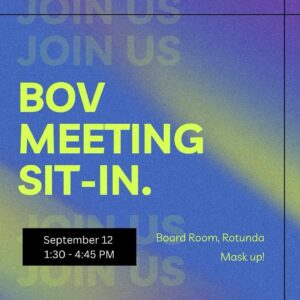
    Militant groups at the University of Virginia tried to organize a “sit in” at the Board of Visitors meeting yesterday, but the event fizzled. A dozen or so local radicals showed up at the Rotunda, where the board meeting was held, but they were met by a strong force of uniformed University police. The entrances to the Rotunda were closed to the public, and visitors had to gain clearance to enter.

    The board meeting proceeded without disruption.

    Organizers announced their intentions on the Instagram page of the Dissenters, a member of the leftist student coalition protesting against UVA policy toward Israel and Palestine. Students have called for UVA to end relations with the U.S. “war machine” supplying weapons to Israel and also for the University to divest its $14 billion endowment of companies doing business with the Jewish state.

    (more…)


  • Atlantic Park Part 5: Economic Risks

    Atlantic Park Part 5: Economic Risks

    by James C. Sherlock

    In Bloomberg, author Allison Nicole Smith commented on the Atlantic Park bonds. She wrote:

    Muni deals funding tourist attractions have a checkered past. The list of defaulted bonds is a long one, including a water park in Edinburg, Texas, and an iron and steel manufacturing-themed park in Bessemer, Alabama.

    Like the development in Virginia Beach, those parks were speculative bets conceived to invigorate local economies. But many have gone under because success was reliant on enough people consistently showing up, year after year.

    The โ€œspeculative betโ€ part was never communicated to Virginia Beach taxpayers. Not In a hundred print and TV news reports over seven years. Not in press releases. Not in the records of public sessions of City Council or its development authority.

    Extensive risks are described buried deep in Atlantic Park bond documents prepared for investors because they are required to be there. The investor prospectus for the state’s surf park bonds is 616 pages long. The one for the cityโ€™s parking garage bonds issued on the same day is over 1,000 pages long. Each of those issues were revenue bonds, requiring listing of risks to revenue.

    Even those lists are incomplete.

    (more…)

  • UVA May Resume Mandatory SATs

    by James A. Bacon

    The University of Virginia is considering reinstituting mandatory submission of standardized test scores in admissions applications, Provost Ian Baucom told the Board of Visitors Thursday.

    Many elite universities scrapped the mandatory SAT and ACT scores during the COVID epidemic in favor of “wholistic” admissions criteria. Now some are re-evaluating the decision. Citing the recent actions of peer institutions regarding the tests, Baucom said, the University was engaging a group of economics-department faculty with research expertise in higher education to “advise us whether to return to standardized tests in admissions processes” while still considering a “broader set of factors.”

    The goal is to recruit and admit “extraordinary students who will flourish at the university,” Baucom said. The economists are gathering data right now, he added, and he promised to keep the board updated.

    Baucom gave no explanation of why the University was considering doing an about-face on its decision four years ago to make the SAT-score submissions voluntary — roughly half of applicants continued to provide them — nor did he elaborate upon what “broader set of factors” might be in store.

    (more…)


  • Advocates for the Energy Poor Want to Make Them Poorer

    By Steve Haner

    A national industry group that advocates for home energy efficiency contractors has produced another report on how energy costs squeeze the poor the hardest, with Richmond one of its examples. The data was then used as an excuse to call for (you guessed it) the return of an energy carbon tax which paid those same contractors to do energy home improvements.

    The American Council for an Energy Efficient Economy (ACEEE) is correct that the lowest income households struggle with basics like electricity, natural gas and other fuels, along with food, rent and clothing. It sucks to be poor.ย My big concern with the new report (full text here) is it doesnโ€™t seem to account for the various government and private programs that provide hard cash to help with these bills, including the nascent Percentage of Income Payment Plan. ย 

    Richmond has a slightly deeper problem than the nation as a whole.ย Nationally 15% of low-income households face an โ€œenergy burdenโ€ because they spend more than 6% of their income on it, but in Richmond that exceeds 17%. The big disparity is among renters (13% nationally but 16% in Richmond.)

    The pitch of RGGI as the solution came Thursday morning in this from Virginia Mercury, which outlined the problem and then spent the final three paragraphs on the suspended Regional Greenhouse Gas Initiative, or RGGI. Mercury did a similar story back in April, based on a state report about energy assistance programs, and it also ended with a hard pitch for RGGI dollars to return. From the April report:

    ‘Since the first RGGI auction that Virginia participated in back in 2021, RGGI has provided nearly $400M for low-income energy-efficient housing,’ said Chelsea Harnish, executive director of the Energy Efficiency Council, a group that supports RGGI involvement and backed a bill this session that would increase transparency in energy efficiency program determinations. ‘There are no alternative funding options available at either the state or federal level for these programs in terms of program design nor funding levels.’

    (more…)

  • How Wise County Schools Excel

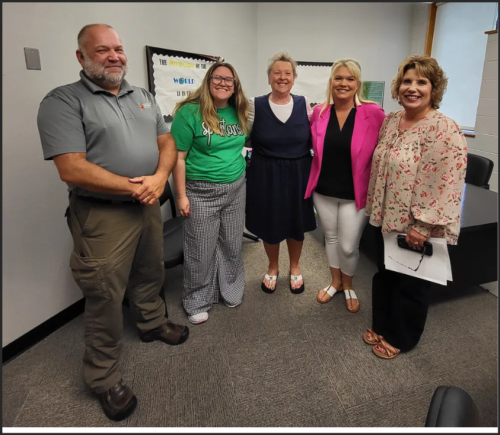
    From left to right: Matt Hurt, director of the CIP program; Hannah Perrigan, assistant principal at St. Paul’s Elementary School; Marcia Shortt, director of elementary and middle schools; Amber Boggs,ย director of federal programs and preschool; and Karen Dickenson, principal at St. Paul’s Elementary School.

    by Martin Davis
    Editor-in-Chief, FXBGAdvance

    Fat Boyโ€™s restaurant in St. Paul, Virginia, is well-known โ€” at least in Wise County โ€” for the two BBQ items that sit atop its menu hanging behind the counter. The Heart Attack, and the Stroke.

    This 1930โ€™s-era diner, marked by low-rent flooring, plain tables, and chairs that are best described as sturdy but hardly comfortable, proved a more-than-suitable place to sit down and reflect on a day seeing first-hand what makes one of the poorest places in Virginia one of its most academically successful, at least when the measuring stick is Standards of Learning scores.

    For the second year in a row, Wise County schools have had the third-best overall SOL pass rate in the state of Virginia. It hasnโ€™t ranked lower than eighth since 2013.

    An impressive feat considering itย spends less per student thanย Fredericksburgย city,ย Spotsylvaniaย County, orย Staffordย County public schools; is riddled with a meth epidemic that has led to a startlingly high incarceration rate ofย 721 per 100,000ย people (Virginiaโ€™s rate is notoriously high atย 679 per 100,000 people); and nearlyย 20% of its citizens live in povertyย (more than 25% of children grow up in poverty).

    In the Richmond halls of the Virginia Department of Education, and among education policy wonks, the reason for the countyโ€™s success is captured in a simple acronym โ€” CIP, which stands for โ€œComprehensive Instructional Program.โ€

    The program alone, however, doesnโ€™t explain why Wise County, where CIP was born, has proven so successful.

    There are 65 Virginia school districts participating in the program, says CIP Director Matt Hurt, and โ€œwe have 10 years of data showing that some school districts adopting the program have great success, while in other districts CIP hardly moves the needle.โ€

    (more…)

  • Atlantic Park Part 4: Seven Years of Negotiations

    Atlantic Park Part 4: Seven Years of Negotiations

    by James C. Sherlock

    Atlantic Park should prove a first-rate attraction when it opens next May.

    The design is attractive, quality should be good, and the surf park will be unique in the mid-Atlantic, at least for a while.

    But it has taken what seems like forever to get the deal done, and taxpayers got our hats handed to us.

    Developers can expect profitability on their $116 million investment because:

    • Council members intervened to both drive down developers’ costs and drive up their returns on those costs;
    • The developers have paid a very low price for 309 apartments; more than 100,000 square feet of retail, restaurants and office spaces; and food and drink concessions that should yield steady rents; and
    • they were paid to design and build the entire complex and will be paid to operate it.

    City Council will pay almost $300 million and own a concert hall and parking.

    The surf park has taken on so much debt that professional investors question if it will be able to pay it back.

    This is the story of a deal that was never final. A brief history of the years-long procurement will indicate how City Council led citizens to where we are, but not why.

    (more…)

  • Hurricane Hustlers Rooting For Deadly Storms

    by Kerry Dougherty

    You would think that the 2024 hurricane season, which just set a record for the longest stretch in more than 50 years without a single late-summer cyclone, would be a cause of celebration.

    Until this week there wasnโ€™t a named storm since August.

    Those of us who live along the coast are delighted that our roofs are still intact, we arenโ€™t doing the backstroke in our living rooms and Jim Cantore, the Weather Channelโ€™s โ€œHurricane Hunk,โ€ hasnโ€™t lashed himself to a lamppost on Atlantic Avenue.

    You know who isnโ€™t celebrating?

    Climate alarmists. You know, those unwashed sourpusses who cheer for violent and especially deadly storms so they can point fingers at those of us who drive gas-powered cars to work. Itโ€™s all our fault. There were never hurricanes or tornadoes until the invention of the combustion engine.

    Oh, and one other group is mopey: hurricane hustlers.

    You know, those soothsayers who publish scary predictions every year about how many Category 5 โ€˜canes will be buzz-sawing through our towns. Read the whole thing.


  • Virginia AI Hiring Is On Fire

    by James A. Bacon

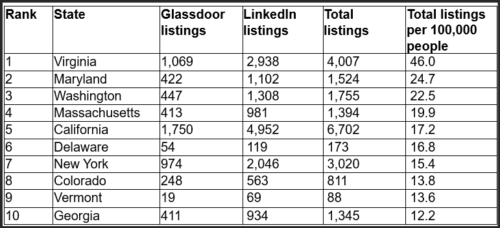
    Based on a tally of listings in online job sites, AI-related job offerings expressed as a percentage of the population are higher in Virginia than any other state. In absolute numbers, California employers have 6,702 listings on LinkedIn and Glassdoor, more than the 4,007 counted in Virginia. But AI listings per 100,000 people are the highest in Virginia at 46.0 — more than double that of the runner-up, Maryland.

    The data come from a study by Getac, a “rugged computing solutions specialist,” which scraped the listings on LinkedIn and Glassdoor. I can’t vouch for the methodology, but it seems valid as a rough indicator of relative intensity of AI-related job offerings.

    The jobs on offer in Virginia include “Artificial Intelligence (AI) Pilots Project Manager,” “AI Technical Writer,” and “AI Solution Sales Specialist,” stated the Getac press release.ย 

    (more…)


  • Atlantic Park Part 3: The Deal of the Century

    Atlantic Park Part 3: The Deal of the Century

    By James C. Sherlock

    Updated September 18, 2024 at 10:07 AM and 3:27 PM

    Atlantic Park is due to open on nearly 13 acres of city land near the Virginia Beach oceanfront in May of 2025. The new entertainment district is the largest public-private partnership project in the history of the Commonwealthโ€™s biggest city.

    It is striking in concept. There was real vision behind Atlantic Park. Readers are urged to read a 2019 article in Virginia Living to get a sense of it.

    The idea for execution of the concept was simple at first.

    • The city owned land that had been a surface parking lot in the 25 years since the old Dome concert hall was torn down;
    • In the winter of 2016-17, several developers submitted proposals to redevelop the property;
    • At that same time, the city wanted to build a new concert hall;
    • The cityโ€™s development authority issued a request for qualifications to fold its requirement into a broader plan that would redevelop the entire property.

    In 2017 the city planned to provide the land (now $40 million value) and pay for the concert facility and a parking garage.

    In 2020, dollar costs after the final agreement with the developer were planned to be $95.6 million. Developers would pay for the rest. The original concept evolved under redesigns, delays and constant renegotiations. Seven years later Atlantic Park is under construction.

    Today it is considered by municipal bond professionals to be a major risk – a โ€œspeculative betโ€ of

    • over $300 million in equity and Virginia Beach Development Authority (VBDA) and Atlantic Park Community Development Authority (the CDA) revenue bond obligations that will be made by city council appropriations; and
    • two city properties, the land and a package of 400 parking places, worth a total of $52 million leased to the developer at a dollar a year for up to 100 years.

    Two major story lines have emerged. One is about the deal between developers and the City Council. The other is about the surf park venue, its owner and its funding and its economic risks. Each is complex and costly enough and brings enough risk to warrant telling in this multi-part series.

    This is the lead article about the developer-city deal.  And how so much money was shifted from developer obligations to city obligations in the four years after the 2020.

    Later in the series we will discuss how tax exempt municipal bonds were issued for the surf park by the state with VBDA authorization.

    (more…)

  • Docs Up in Arms

    by James A. Bacon

    A letter from 128 physicians to the University of Virginia Board of Visitors has urged the Board to uphold academic freedom, free speech and patient safety by replacing UVA Health Systems CEO Craig Kent and medical school Dean Melina Kibbe.

    In the letter issued last week, the physicians accused Kent and Kibbe of compromising patient safety, spending excessively on the C-Suite, and creating a culture of fear and retaliation, among other abuses. The signatories withheld their names from the public but said they were willing to reveal them to select members of the board.

    The Board of Visitors is scheduled to meet Thursday morning to discuss health system business, but there is no mention in the board agenda, typically prepared by Rector Robert Hardie and President Jim Ryan, that the issues raised by the letter will be addressed. It is an open question whether other members of the board will attempt to shoehorn a discussion into what is a time-constrained and carefully scripted two-day meeting.

    In a letter to the medical school faculty, Ryan expressed his skepticism about the charges but promised to look into them. Every organization has malcontents, and the letter signatories represent only 9% of the medical school faculty, he wrote. Moreover, the charges in the letter are vague, and the signatories are unwilling to reveal their names. He wrote:

    (more…)