

by James C. Sherlock
Updated Sept. 14 at 11:14 AM and September 18 at 4:40 PM
If an infrastructure project is assessed to be a potential commercial success, that judgement is based on a business plan.
Inevitably, because they are very good at what they do, the developers of Atlantic Park had one that would have served as the basis for a proposal.
If the numbers worked, private money would have designed and built it to maximize return on investment. It turned out that the developer team may not have accurately estimated the cost/demand/pricing/revenue case for the surf park, but that would have been their problem.
But the city owned the land, so developers needed city participation.
Providing public land under those circumstances could have been a good deal. Under the original cost sharing concept, Atlantic Park likely would have returned taxes and fees over its lifetime that, as city manager Dave Hansen wrote in 2018, would “let us tell them it will pay for itself”.
But neither the council nor the its development authority asked for a proposal to lease the land. And at least a couple of them did not share the city manager’s vision on taxpayer value.
The public private project got way out of hand early and everything about the process and its public funding was wrong. Over the seven years of the process they chose, council and the development authority socialized costs and risks and privatized profits.
The concert hall was not part of the developer’s original plan. The city shoehorned it into the deal. Since it was city requirement, the city should have paid for that and has. The parking garages owned by the city in the resort area make that district function. The ones at Atlantic Park are just two more. So those reasonably are city assets in the deal.
The cost to the city for what it owns should have been about $100 million in construction costs plus the land to which it still holds title.
Yet today total city commitments exceed $300 million plus the land.
The developer’s promised expenditures are down today about $125 million from the inflation-adjusted $282 million ($230 million in 2019) agreed to in the “final” agreement.
That is a colossal obligation swap accomplished incrementally over five budget years.
Budgets are adopted in May for the fiscal year that starts July 1. The budgets that moved the money were adopted in May of 2019 through May of 2023.
Members in office for all of those votes annotated with the percentage of their total campaign donations that have come from real estate and construction interests were Barbara Henley (28%) Rosemary Wilson (46%), Sabrina Wooten (56%) and Mayor Bob Dyer (47%). That does not count contributions from real estate and land use lawyers and the bankers who lend to developers.
That does not mean the money affected their votes, but it is not healthy in a representative body.
Transactional politics. Voters are transactional. They expect their candidates to vote the way they would.
Big donors are also transactional.
Virginia Beach spends about $350 million annually on capital improvement projects (CIP).
Real estate and construction interests contributed $3.34 million, about $500,000 a year in total, to sitting Council members over the seven years of Atlantic Park procurement. That bought at least returned phone calls concerning $2.5 billion in CIP appropriations over the same time frame.
Return on investment: too high to calculate.
The author will interject that had he been in the development business, he likely would have donated, if only to avoid being on some private list of those who did not.
Virginia Beach City Council. The city conducted a seven-year procurement process.
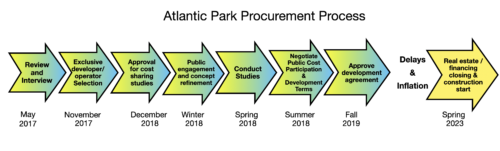
Without structural safeguards, it takes a lot of skill and a lot of work driven by strong commitment and overseen by ethics to understand the details of complex matters and to then vote for the common good if it conflicts with the wishes of the biggest donors.
Commitment and ethics proved not up to the task. Or perhaps skill did not – the complexities were great. Perhaps corporate memory of the history of the project was an issue – mayors and members came and went over those years. More likely those varied in their effects on individual members and on the outcome.
“I don’t understand” is a principled position. Council could always have returned questions to the city manager for more information. Perhaps none of them had big picture of the obligations transfer, just parts of it.
Maybe they did asked the right questions in closed-door session, but we have no public record of it. If so, maybe one or more of them did indeed understand the big picture.
The General Assembly is on the hook as well.
It doesn’t permit us to pay our city council members enough to attract regularly people capable of doing the kind of work required by the Virginia Beach state Charter (the Charter). Council member salaries were capped by state law at $28,000 a year during the Atlantic Park procurement. The Assembly is also responsible for the lack of campaign donation limits.
The combination proved fatal to citizen expectations of competent and principled representation in the Atlantic Park deal.
Direct evidence shows that at least a couple of council members took the side of their donors.
It would take an official investigation to find out why.
Councilman John Moss, skilled by virtue of managing a $22 billion budget in his day job with the Navy, committed to the job (he annually produced an alternative budget to that presented by the city manager) and manifestly ethical, was by those ethics excluded from the inside of the deal.
He proved repeatedly to be the only member publicly cautionary about Atlantic Park.
Change recommendations. The author recommends structural safeguards that are within council’s authority under the Charter.
1. Adopt the Virginia Public Procurement Act. That Act’s § 2.2-4302. Implementation invites local governments to do so. The largest city in the Commonwealth clearly requires it.
Under those rules and procedures, Atlantic Park would have been under construction in two or three years, mostly at developer expense. The Procurement Act will create an acquisition system more complete, transparent, efficient, effective and resistant to the interference than that which was resulted in the Atlantic Park debacle.
2. In the same ordinance:
- direct the city manager to conduct all procurements and the Planning Commission to participate in support. Council should continue to review and approve the initiation of major procurements, the results of key decisions and any expenditure of funds or debt; but not otherwise participate in procurement. It is worth writing and passing that.
- emulate federal government practice and direct the city manager to hire a contractor with relevant experience to help represent the government in large contract negotiations and oversight.
4. By ordinance change the council conflict of interest form to require members to disclose donations before votes whose outcomes affect parties from whom members have received more than $500. Petition the General Assembly if necessary to require recusal under that circumstance.
6. Exercise Charter § 6.05:1. Authority for issuance of bonds through the city’s Department of Finance exclusively. That action requires no new ordinance, though one stating that intention may prove useful to future councils.
5. Disestablish the Virginia Beach Development Authority and assume those responsibilities to the council. Assign ownership of city land to the city manager.
6. The Atlantic Park procurement exposed weaknesses in the Department of Economic Development that provided staff to both the council and VBDA on Atlantic Park. It was a very troubled organization over that time period, and is awaiting its fourth Director in seven years. One previous Director pled guilty to embezzlement. In coordination with the City Auditor, make use of council’s powers of investigation in § 3.10. of the Charter to determine what changes may prove necessary in that department.
7. Disestablish all of the fenced funding for tourism and development, including the Tourism Investment Program Fund (TIP) generating more than $40 million annually. Reroute those revenue streams to the General Fund. Those functions are very important, but the city manager’s budget submittal should reflect overall city priorities in the annual competition for funding.
8. Investigate and reform the Economic Development Investment Program (EDIP) as recommended by the City Auditor at the link.
7. Disestablish the Atlantic Park Community Development Authority. The City Council already has authority to establish special tax districts and the Finance Department can issue necessary bonds.
Voter action. Those changes, while straightforward in implementation, appear unlikely to be enacted by the current mayor and council. Perhaps they will surprise. We will watch for that.
But sample ballots will be available very soon.
Vote against the current mayor and all incumbent city council members. They have been in office for at least four years.; Mayor Dyer for 20. Whatever good things they may have done, they also have voted for the Atlantic Park debacle. Remember the $300 million.
Check campaign websites for policy positions of the challengers. Ask candidates to explain their positions on council and procurement reforms.
Vote for John Moss for mayor.
He has been the council unicorn on the side of the citizens. In previous procurements, he has held developers to their commitments. In open meetings, he consistently opposed the Atlantic Park giveaways.
We need him at the helm.
Voters in the future will need to decide whether we will pay council members $55,000 a year, the new state cap. The evidence suggests that is not nearly enough to demand the full time executive-level skill and performance required by the job.
We may need to pay them four times the cap to get the job done better. The cost would be 1/1000th of the annual $3 billion budget that they must consider and approve.
Public debate is needed. Followed by a ballot initiative.
Updated to reflect assessment of costs provided by 2024 bond documents.
Leave a Reply
You must be logged in to post a comment.