• A Higher Price for a Cold Shower

    With drought conditions firmly in place, a number of localities are instituting mandatory water restrictions.

    But rather than writing piddling fines for violating what are rather lax restrictions, how about using prices to address the problem? Over at the Economist blog, that’s exactly what they propose:

    …water utilities are not equipped to respond to similar supply shocks to water reserves with demand-limiting measures. As such, all that stands between a homeowner and his green lawn is a sense of civic duty. Powerful stuff, on occasion, but not powerful enough to keep those reservoirs full.

    Allowing water prices to vary with supply would encourage consumers to make their own decisions about how much water they really need. If adopted on a long-term basis, and not just in response to crises, water pricing would allow communities to avoid future price spikes by investing the increased water revenues in additional supply capacity. Pricing in a region’s particular susceptibility to drought might also slow growth in areas of the country ill-equipped to provide for massive populations.

    Hmm. Maybe there really is a market for everything.


  • ENERGY CONSERVATION AND HUMAN SETTLEMENT PATTERNS

    So many things to address as summer lingers on and gas prices rise.

    Due to a number of requests by readers who have been confused by unfounded comments concerning energy conservation and human settlement patterns, our next column will provide a brief primer on that topic.

    One cannot blame those who are trying to protect their Business-As-Usual turf and their ideological icons for attempting to obfuscate the issues. The inevitable need for Fundamental Change is well settled. We are now just quibbling over the price โ€“ how long the inevitable can be denied and who bears the burden of past misdeeds.

    Unfortunately, several recent comments on energy conservation and human settlement patterns has confused some who thought they had a good grasp on reality. By not responding to these comments, these readers suggest that we are conceding that these commentors (rhymes with “tormentors”) have a basis for their postings beyond short-term self-interest.

    As you might guess, many of the erroneous posters are afflicted with Geographic Illiteracy and an addiction to confusing Vocabulary. This includes the well known and highly respected “Anon 1:47 PM” commenting on Sundayโ€™s “THIS JUST IN.” He/She/It touted Joel Kotkinโ€™s latest contribution to confusion: “Hot World? Blame Cities” in the Sunday WaPo Outlook. For a refresher on Joelโ€™s misuse of words see our columns #s 71 thru 74 starting with “The Foundation of Babble” 28 November 2005.

    Actually Joel Kotkin and Ali Modarres make many good points in the op ed and repeat things we have been saying for years. You would not (and Anon 1:47 did not) know it because of confusing Vocabulary.

    By the way, who is ripping off whom? We heard and recycled the Supreme Court joke re the Nobel prize early Saturday morning, long before Saturday Night live.

    EMR


  • More Nuanced (Confused?) Thoughts on the Illegal Immigration Issue

    Hmm… Seems that xenophobic racists on the right wing of the political spectrum aren’t the only ones who have a problem with the behavior of illegal immigrants. Even enlightened lovers of diversity and openness are drawing the line with Rosita Lim Ong Chang.

    The 66-year-old woman was arrested Friday and sent to jail for contempt of court, according to Amy Gardner with the Washington Post. She had been cited for illegally boarding tenants in her single-family home near George Mason University, and had failed to comply with court orders to move an illegal kitchen in her basement and notify the county when she leased a room to a new tenant. County officials said she had carved up her four-bedroom home into as many as seven bedrooms, charging up to $800 per month each.

    Gerald E. Connolly, chairman of the Board of Supervisors, announced the arrest at a board meeting. Observed Gardner in her story: “Connolly, who is seeking reelection next month, has come under fire for not taking a tougher stand against illegal immigrants.” Please note: Connolly is a Democrat. Please note also: His Fairfax County constituents are not poor, ignorant, xenophobic, snake-handlers and know-nothings — they have about the highest level of education anywhere in the country.

    I’m of two minds on this issue. On the one hand, I’m sympathetic to the neighbors, who have complained about noise, upkeep and the number of cars parked out front. I would not like a noisy, unkempt house with cars parked all over located next door to me, not in my quiet, well-tended neighborhood. These are not frivolous nuisances — unlike the flap-doodle here in Henrico County, where Jimmy and Alicia Fox have been convicted of a misdemeanor for using an old metal bathtub as a back-yard flower planter. (See Bart Hinkle’s column skewering the county for trampling on property rights.)

    On the other hand, why shouldn’t an elderly woman be allowed to take in boarders to supplement her income? What right does Fairfax County have to tell Ms. Chang, whose property taxes have probably escalated way beyond the point where she could pay for them otherwise, to confiscate her income-generating potential?

    As the blogger Freedom Works, who brought this article to my attention, notes: “Every American should be outraged at this assault on private property rights and the dignity of the working poor. We have now officially criminalized providing housing for poor people.”

    Yeah, I kind of agree with that. While I don’t think illegal immigrants ought to be here in the first place, that doesn’t mean we should abuse them while they’re here. Illegals need somewhere to live, and it’s not easy finding a place in Fairfax County when you’re working for $10 an hour.

    To sum up the theme of previous posts: The issues surrounding illegal immigration are complex and cut many ways. People concerned about illegal immigration cross the political spectrum. Not everyone is a racist or xenophobe. Maybe we should update the old joke, “The definition of a conservative is a liberal who’s just been mugged” to “the definition of a conservative is a liberal whose next-door neighbor opened a boarding house for illegal immigrants.”


  • Why the Abuser Fee Issue is Fizzling

    What role will outrage over Abuser Fees play in the fall General Assembly elections? Some interesting clues emerge from the latest opinion poll conducted by Christopher Newport University’s Quentin Kidd….

    Republicans got more agitated about the Abuser Fees than either Democrats or independents. While a majority of all three political groupings expressed dissatisfaction with the driving penalties, Republicans and independents were the most distressed. Negative Dems outnumbered positive Dems by a mere eight-percentage point margin. By contrast, independents responded negatively by a 23-percentage point margin and Republicans by a 28-percentage point margin.

    Hard pressed as it is to hang on to its majorities in the House and Senate, however, the Elephant Clan has no motive to turn the issue against candidates who supported the fees. The GOP would simply like to see the issue disappear. Meanwhile, given the relative ambivalence that Democrats feel about the fees — and the fact that the Governor, a Democrat, supported them — Donkey Clan candidates haven’t pushed the issue as hard as they might.

    Another reason the issue has stopped simmering may be that voters don’t know whom to blame for the fees. Statewide, eight percent said Gov. Timothy M. Kaine was the most responsible, nine percent blamed Republicans, and two percent blamed Democrats. Seventy percent said it was a mix, and 12 percent said they didn’t know. With legislators promising to fix the most egregious aspects of the Abuser Fees, the issue seems to be fast sinking out of sight and out of mind.


  • New Price Is Right Host on Gridlock

    Drew Carey talks about transportation as only a comedian can.

    Hey, it’s not Bacon-level material, but it does have a few chuckle-worthy moments. Plus, Carey discusses some ideas that ought to sound very familiar to the transpo groupies around here.


  • Taxes, Government and Prosperity

    To many readers of the Bacon’s Rebellion blog, the connection between low taxes and economic prosperity is so manifestly evident that it doesn’t need defending. But there are many advocates of expansive government who advance arguments to the contrary. Indeed, as evidenced by the steady increase in state/municipal spending in Virginia and the rising tide of taxes, fees and penalties to pay for it, the Axis of Taxes is in the ascendancy.

    In my latest contribution to the “Economy 4.0” series, “Taxes, Government and Prosperity,” I make the case that lower taxes create a business climate more hospitable to economic prosperity (defined as per capita income) than higher taxes do. As evidence, I tracked the growth in per capita income of the 50 states between 2000 and 2005. Look at the results: You’ll see that low-tax states clearly out-performed the high tax states. (I found the same pattern over longer time frames as well.)

    Of course, the correlation between low taxes and income growth is far from perfect. Equally clearly, there are other factors at work. One of those factors, I suggest, is how states and municipalities use their tax revenues. If they squander it on bureaucracy, pork barrel projects, public sector unions and inefficient human settlement patterns, high taxes are destructive. If states invest their tax revenues in education, the environment, infrastructure and public amenities that add to the quality of life, high taxes can contribute to prosperity.

    Bottom line: The central challenge for Virginia government is to keep taxes as low as possible while continuing to deliver the core public services required to sustain prosperity and a high standard of living.

    Yes, Virginia must invest in the public sector. But we cannot tolerate Business As Usual thinking. If Virginia wants to prosper in the 21st century, we have to systematically reinvent our schools, universities, government agencies, transportation systems and human settlement patterns. Tinkering on the margins won’t cut it. Businesses have transformed themselves. Not-for-profits have transformed themselves. Now Virginians must transform their old, outmoded, Industrial Wave governmental institutions (to borrow a phrase from Alvin and Heidi Toffler) into Knowledge Wave institutions.


  • Now For Something a Little Left of Center

    Just to show what a broad-minded guy I am, I’m going out of my way today to promote a column that skewers Bacon’s Rebellion. Peter Galuszka, a regular contributor to our Road to Ruin transportation news coverage, criticizes blogs generally, tossing a few barbs Bacon’s Rebellion’s way, in his opinion piece this week, “Plato’s Cave.”

    Peter objects to the triumphalism that blogs display regarding the slow-motion demise of the “Mainstream Media.” His main point is undeniable: Traditional media such as newspapers, magazines and television provide the news content that blogs feed off. Few blogs conduct much first-hand reporting. Without the Mainstream Media, bloggers would have little to comment upon.

    The decline in journalistic coverage is especially marked overseas — foreign correspondents are being laid off in droves. That’s of particular concern to Peter, who ran the Moscow bureau for BusinessWeek during the transition between Gorbachev and Yeltsin. Americans are ignorant enough of foreign politics, economics and culture as it is, he argues, and the situation will likely get worse.

    (Peter doesn’t care for xenophobia either, a tendency he sees in the reaction of many Virginians to illegal immigration and explores in a previous column, “Virginia Is for Gulags.” He also gets pieved when I use the term “Euro-weenies.” He probably won’t like it when I refer to him as a “Euroweeniephile.”)

    If you’d like to see more left-of-center commentary in the Bacon’s Rebellion e-zine, give Peter some positive reinforcement in the comments section.


  • Raise Them Pitchforks High! The Rebellion is Back!

    Bacon’s Rebellion’s rebels are back, branding their metaphorical pitchforks and gesticulating alarmingly! You can read the Oct. 15, 2007 edition here. The website contains archives of five years’ worth of back columns, profiles of our contributors, and a search tool.

    Make sure you don’t miss an issue of our in-depth columns and articles — sign up for a free subscription here.

    If you’re too darned lazy to click over to the website, well, we still aim to please. Here are today’s featured columns:

    Taxes, Government and Prosperity
    Virginia can’t tax its way to prosperity, but starving critical assets like roads and schools won’t create wealth either. The solution: Demand productivity and innovation from state and municipal government.
    by James A. Bacon

    A Bottle of Exhaust
    An innovative Virginia could use a state R&D tax credit and a global view.
    by Doug Koelemay

    Tulips and the Maritime Highway
    Moving goods on water rather than roads can be a good thing, but it’s only a tiny part of the solution. Creating a sustainable trajectory for civilization requires shipping goods shorter distances.
    by EM Risse

    There They Go Again
    The Fairfax County staff used every trick in the book rebutting the Thomas Jefferson Institute’s analysis of the county budget, but there’s no hiding the fact that spending needs outside oversight.
    by Michael Thompson

    Election Pre-Mortem
    It’s looking grim for General Assembly Republicans in this November’s election. Here’s why they’re likely to lose — and how losing can be the best thing that happens to them.
    by Norm Leahy

    Plato’s Cave
    Some may rejoice at the decline of the “Mainstream Media” but cuts in news staffs threaten to leave us ill informed about what’s happening around the world. No number of blogs can make up for it.
    by Peter Galuszka

    Nice & Curious Questions
    Anglers in Virginia: From Roanoke Bass to Green Sunfish
    by Edwin S. Clay III and Patricia Bangs


  • Metro Needs to Come Clean on Deferred Maintenance

    How much does the Washington Metro system spend on maintenance, how much maintenance is it deferring, and how big are the liabilities that are accumulating? If Metro officials know the answers, they aren’t saying.

    According to Examiner.com, Metro budget director Richard Harcum noted back in 2004 on the Metro Matters website that the transit agencyโ€™s annual maintenance budget was only one percent of the total value of the infrastructure, instead of the three percent needed to keep the system in tip-top shape. Writes Examiner.com: “How long maintenance has been seriously underfunded is anybodyโ€™s guess.”

    Harcum’s comment prompted Fairfax County taxpayer gadfly Arthur Purves to ask for the cumulative cost of Metro’s deferred maintenance, which he speculates is on the order of $5 billion — comparable to the cost of building the proposed Rail to Dulles extension. Despited repeated requests for information, Purves has yet to receive an answer.

    Virginians are being asked to raise $5 billion (including federal funds) to build the Metro extension through the Dulles Corridor. We need to know what we’re getting into. With more miles of track, it stands to reason that we’ll be taking on a larger share of the cost of maintaining the system. The true cost of the Rail to Dulles project entails more than the up-front capital cost of construction: It includes ongoing obligations for operations and maintenance. We need to know what those obligations will be.

    If Purves is anywhere in the ballpark and deferred maintenance for Metro approaches $5 billion, what’s Virginia’s share under current funding agreements? And how much will Virginia’s share increase if Rail to Dulles gets built? Does anybody know? Does anybody besides Purves, Examiner.com and Bacon’s Rebellion care?


  • THIS JUST IN

    The United States Supreme Court by a vote of 6 to 3 has overturned the decision of the Norwegian Nobel Committee and awarded the 2007 Peace Prize to George W. Bush and the US of A Environmental Protection Agency (EPA). The Courts decision turned on the fact that Bushโ€™s calling and performing at the September climate change “Summit” together with EPA granting exceptions and waivers for coal fired Big Grid power plants has done more to energize citizens concerning Global Climate Change than any slideshow, book or world-wide research report could accomplish.

    On a related note: the Nobel Committeesโ€™ attempt to further raise the profile of Al Gore after he had already won an Academy Award and an Emmy demonstrates how the massive hurdle to overcome Business-As-Usualโ€™s media campaign to obfuscate the real causes for concern about the trajectory of contemporary civilization. The success of the MainStream Media efforts sponsored by supporters of Mass OverConsumption is documented by the September 2007 WaPo-ABC News poll that found less than one percent of US of A voters thought Global Climate Change was an important issue for the 2008 presidential election.

    In our column tomorrow at Baconโ€™s Rebellion (“Tulips and the Maritime Highway”), we list 18 (there are more) reasons why Fundamental Change in human settlement pattern, Fundamental Change in governance structure and the overarching need for Intelligent Management of Civilization are imperative. Global Climate Change is only one of the 18 key issues. As Jim Bacon likes to point out, there are far better reasons to be concerned about the reported causes and effects of Global Climate Change than the oft oversold direct impacts.

    EMR


  • Virginia’s Native Wildlife in Jeopardy

    While Virginians get increasingly worked up over the impact of Global Warming on Virginia’s climate and coastlines some 70 to 80 years from now, cricical environmental problems demand our attention right now.

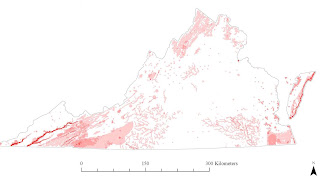
    The Virginia Department of Inland Game and Fisheries has published the State Wildlife Action Plan, the most comprehensive investigation into the status of Virginia wildlife ever conducted. The encyclopedic, 900-page plan assigns 925 species of mammals, fish, birds, amphibeans, reptiles and other creatures to one of four tiers of conservation need — critical, very high, high and moderate — and maps the locations of their habitats.

    The plan, the culmination of a Warner administration initative, identifies two major threats to native Virginia species, as well as several deficiencies in wildlife conservation programs. The threats are:

    Unprecedented fragmentation and development of habitat. This is one of the most frequently identified problems facing wildlife. To address it, those responsible for land planning will need to be more fully engaged in wildlife conservation efforts.

    Invasive exotic plants and animals negatively impacting native wildlife and habitats. Even though they are already widespread, the prevalence of invasive species is increasing in both aquatic and terrestrial communities. From exotic common reed (Phragmites) in coastal marshes to crayfish introduced through the bait trade, this is a crucial statewide conservation issue.

    You see, folks, we don’t have to wait for global warming to witness the widespread extinction of native species. Five species of mammals, 15 of birds, 11 of fish and countless more are designated Tier I, facing “an extremely high risk of extinction or extirpation.”

    So, what can we do? Combatting invasive species is incredibly difficult — foreign marauders don’t respect state lines. The challenge of invasive species can be addressed systematically only at the level of the federal government. On the other hand, Virginia can do a lot to preserve wildlife habitat.

    And that raises an interesting issue — the prioritization of Virginia’s conservation easement tax credits. Demand for the tax credits has taken off, but for reasons of fiscal prudence the General Assembly has clamped a lid of $100 million a year upon the program. I’m not sure what the criteria are now for awarding the credits, whether applicants join a queue and wait their turn, or whether some other factors come into play. But it strikes me that not all conservation easements are created equal. Easements that preserve vital wildlife habitat, I would suggest, should have a higher priority over easements that preserve significant viewsheds, which should have priority over easements that preserve some random property owner’s farm land.

    Inland Game and Fisheries has published a map (see above — click on the image for greater detail) that shows where the most critical habitat is located. If Virginia is going to expend $100 million a year in tax credits, some portion of that sum should be used to secure the habitat of Virginia’s threatened species. The greater the threat to the species, the higher the priority for habitat conservation.

    Additionally — and this was a major point raised during a meeting in Prince William County I attended recently on the topic of land conservation — local governments should integrate the Inland Game and Fisheries data into their comprehensive plans. We know where the threatened species live now. There is no excuse for waiting until a developer blunders upon a piece of critical habitat to do something about it.

    Finally, Virginia needs to look at the full panoply of its land management practices. States the report:

    Pollution, sedimentation, and nutrient overloads are causing changes in water quality that negatively impact aquatic wildlife and habitats. Such aquatic degradation is caused mainly by certain agricultural and forestry practices, industrial and municipal development, and certain industrial practices, such as mining. Rivers in southwestern Virginia experienced degradation from certain mining practices, certain agricultural practices, and creation of downstream dams.

    Virginia’s wildlife constitute one of the state’s most precious and irreplaceable assets. This superb study gives us a powerful tool to conserve this heritage. The Department of Game and Inland Fisheries deserves praise for a job well done.



  • CNU Takes Virginia’s Public Pulse

    Education, health care, illegal immigration and crime are the areas that Virginians would most like to see the General Assembly address in the 2008 session, according to a new omnibus poll conducted by Christopher Newport University. Picking from a list of pre-defined topics, respondants ranked the issues as follows (by the percentage who identified it as the No. 1 or No. 2 priority):

    Public Education (40)
    Health Care (29)
    Illegal Immigrants (25 )
    Crime (25)
    Jobs (18)
    Property Taxes (14)
    Higher Education (16)
    Veterans (12)
    Abortion (7)
    Virginia Tech Mental Health Recommendations (6)

    The poll also identified a high level of discontent in Hampton Roads over taxes — 62 percent believe that “Virginia’s overall level of state taxes” is too high, and 72 percent believe that property taxes are too high. Northern Virginians were the most complacent about their tax level. If these poll results are any indication, Republican candidates running on tax-cutting platforms should enjoy a significant advantage in Hampton Roads but find their appeals falling flat in Northern Virginia.

    In dealing with the current budget shortall, 58 percent of Virginians supported holding the line on taxes, differing mainly on where to cut spending. Remarkably, 37 percent of the population appears to be believe, even after two rounds of tax increases since 2004, that Virginians aren’t taxed enough.

    P.S. Notice what’s not on the list? Transportation. Refreshing, huh?


  • AREVA Ponders Monster Investment in Lynchburg

    The rising price of uranium may lead to more than a renewed interest in mining North America’s richest uranium reserves in Pittsylvania County. AREVA, the French nuclear power giant, is “talking with Virginia officials” about a location for the uranium enrichment plant, according to the Danville Register & Bee. And Lynchburg is at the top of the list.

    According to a “Walter Cole,” identified only as a resident of Chatham, โ€œAREVA has visited Virginia and theyโ€™re interested in building an enrichment plant, and it would be the second one in the United States, and itโ€™d cost $2 billion to $3 billion.โ€ Not only is Lynchburg located just up U.S. 29 from the Chatham uranium deposits, AREVA’s Framatome ANP already fabricates nuclear fuel rods there.

    This story is huge: It’s looking increasingly likely that nuclear power will become the catalyst for the economic revitalization of Central/Southside Virginia, a region whose traditional mill-town economy has been devastated by globalization and the decline of the tobacco/cigarette industry. (See “Virginia: A World-Class Player in Nuclear Power?”) Let’s hear it for nuclear power, electric cars, energy independence and a reduction in fossil fuel pollution!


  • Divest Iran? Ehhhh, Maybe. But Maybe Not

    California Gov. Arnold Schwarzenegger has signed a bill that would require the state’s public retirement pension fund to divest itself of holdings in foreign companies that invest in Iran. Said the Governator shortly before signing: “California has a long history of leadership and doing what’s right with our investment portfolio. Last year, I was proud to sign legislation to divest from the Sudan to take a powerful stand against genocide. I look forward to signing legislation to divest from Iran to take an equally powerful stand against terrorism.”

    While the Iranian regime arms Iraqi militias with deadly roadside bonds and ships weapons to the Taliban in Afghanistan, argues Christopher Holton, director of the “Divest Terror” initiative at Center for Security Policy, it makes no sense for an American to invest in companies that do business with Iran.

    Which brings us to the question, well, what’s happening in Virginia? According to “The Terrorism Investments of the 50 States,” the Virginia Retirement System has invested $4.3 billion of its $24.7 billion in equity assets in some 213 companies with ties to terrorist-sponsored states. The largest exposure was Iran, with 154 companies. Other such states, according to this 2004 document, which is based on 2003-2004 data, included Sudan, Libya, North Korea, Syria and “Saddam’s Iraq.”

    Sample holdings included Alcatel SA (French), BNP Paribas (French), ENI (Italian), Hyundai Heavy Industries (Korean) and Total SA (French). Companies with terror ties contituted more than 17 percent of the VRS equity portfolio.

    This January, Sen. Ken Cuccinelli, R-Fairfax, sponsored legislation that would have required VRS to divest itself of companies with active business operations in the Sudan, on the grounds that they directly or indirectly enabled the genocide in Darfur. As I interpret the General Assembly bill tracking, the House and Senate passed separate bills but conferees could not reconcile the two versions. No one, to my understanding, has yet proposed ordering the VRS to divest itself of companies doing business in Iran.

    I’m of mixed minds on whether Virginia should follow in California’s footsteps. On the one hand, I approve of any measure designed to punish Iran economically. Not only is the Mullahcracy killing American soldiers, it is developing nuclear weapons and the means to deliver them long distances, oppressing its people and exporting instability to neighboring states like Azerbainjan. Furthermore, economic sanctions would have an effect. More moderate elements of the regime (if you can call them “moderate,” perhaps it would be better to say, “less odious”) want to dial back tensions with the United States and other western countries on the very grounds that its confrontational diplomacy is isolating the country.

    On the other hand, I am reluctant to set a precedent for requiring the VRS to pursue socially conscious investing. Today the Sudan and Darfur, tomorrow Iran. What’s next? Divest companies that do business with Israel, as some leftist groups are agitating for? Divest from companies that pollute? Divest from companies that fail to pay a “living wage?” Divest from companies that peddle alcohol, smut and rap lyrics? At some point, you’ve narrowed the field so much that the VRS has very few companies to choose from. Then investment returns suffer — and taxpayers are on the hook to make up the difference.


  • Good, We’ve Got the Metrics, Now Give Us the Numbers.

    Gov. Timothy M. Kaine’s “Transportation Accountability Commission” has issued its final report, detailing 34 performance measures to rate the effectiveness of Virginia’s transportation system. The measures cover such topics as safety, maintenance, mobility, environmental stewardship, economic vitality, program delivery, and coordination of transportation and land use.

    Compiling metrics won’t patch potholes or build new roads. But they may help guide Virginia policy makers in their decision making. Without answers to basic questions — are roads getting safer or deadlier? Is congestion getting worse or better? Are we catching up on our maintenance backlog or losing ground? Are people driving more or less? — we are fumbling in the dark.

    As Commission Chairman James A. Squires said in a press release: โ€œA set of overarching goals and performance measures … are critical to a transportation program that not only delivers high-quality projects, but the right projects.โ€

    There isn’t anything earth-shaking in the report, but the effort was worthwhile. My only frustration: While the report recommends a set of metrics, it doesn’t provide the actual numbers. At some point, someone will have to gather and format the data. When that happens, I’ll report back to you on this blog.
