

By Steve Haner
Democrats who run Maryland have passed major energy legislation calling for expanded electricity generation in the state, including potential fast track approvals of new natural gas plants. They are considered “dispatchable energy generation” under the new law’s definitions, and more than 3 gigawatts of new dispatchable generation is called for.
Maryland’s 2025 session was focused on the same set of issues that dominated the energy front in Virginia this past winter, but the outcome was quite different. Before Governor Wes Moore (D) signed the Next Generation Energy Act, critics were gearing up to start a referendum campaign against it, but so far that has not materialized.
The omnibus bill includes several compromises and tradeoffs, many highly popular with the environmental lobbyists. The larger bill includes provisions dealing with the growing energy demand created by the data center industry and changes in ratemaking rules. A second successful bill, the Renewable Energy Certainty Act, did what Virginia’s Democrats failed to do with their majority. It overrides local government zoning authority to block controversial solar projects.
Like Virginia, Maryland is imposing fines on utilities that fail to meet its carbon emissions targets, and the bill also takes $200 million from that pot of money to use for customer refunds.
Maryland is the bluest of blue states, with minor Republican representation in its Assembly. With zero background in Maryland’s laws, I cannot claim to understand the nuances of the 75-page package, but the tacit acceptance of added natural gas generation for the state stands in complete contrast to Virginia’s Clean Economy Act.
Another impression left by a quick read of the bill is that the legislature in our nearest northern neighbor is more willing to let its regulatory body handle the details. Their section calling for expanded battery installations, for example, lacks the complex, aggressive mandates and timelines that made the 2025 Virginia counterpart such a terrible piece of legislation and ripe for veto. Maryland’s language gives its regulators more discretion.
Maryland was under public pressure to act because of major electricity price increases kicking in this month. The state’s leaders would like to blame it on last year’s auction for energy capacity contracts and has appealed the results.
The bid price for firm capacity in the Baltimore Gas and Electric territory was even higher than the cost imposed in Dominion Energy Virginia’s territory, but the PJM auction price also jumped in the other utility zones serving Maryland.
The only reason BG&E or Dominion are vulnerable to the capacity prices is they do not have enough reliable – “dispatchable” – capacity of their own. Unlike Dominion and the Virginia General Assembly, Maryland’s Democrats see that and seem to have acted with intelligence. Perhaps Maryland was more willing to face facts because it has an independent Office of People’s Counsel to represent consumers, and it issued a frank report on the problem last year after the PJM auction.
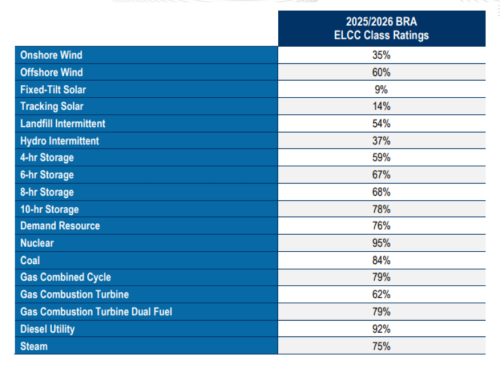
The most remarkable element of the new Maryland law is how it ties the definition of “dispatchable energy generation” to the regional grid operator PJM Interconnection’s judgement on which generation sources have high “effective load carrying capability” or ELCC. To be considered under the bill the new generation source must hit at least 65% on that ELCC measure.
As you can see on a table below which PJM recently showed Virginia legislators, the renewable generation sources – wind, solar, and short-term storage – fail that test. Even offshore wind fails, with a 60% rating. For that matter, the natural gas combustion turbine technology Dominion is proposing to build in Chesterfield County also fails that test. PJM lists its ELCC at 62% unless it is a dual fuel facility, and while Dominion may be able to also use hydrogen there someday, it will not be doing so in the beginning.
The dispatchable sources using Maryland’s definition and PJM’s list are (in descending effectiveness) nuclear (95%), diesel (92%), coal (84%), gas combined cycle (79%), gas combustion turbine dual fuel (79%), 10-hour battery storage (78%), steam (75%), 8-hour storage (68%) and 6-hour storage (67%). PJM also rates demand response high, at 76%. During the discussion of the bill, and scanning some of the comments filed (many highly critical), the assumption is more gas and nuclear will be proposed.
The door is open for the utilities to propose and make the case for additional natural gas. The willingness to not just reject the idea out of hand, and to allow an unfettered regulatory process to consider gas, marks the path Virginia will have to follow to avoid its own future of energy shortages.
Leave a Reply
You must be logged in to post a comment.