
by Kerry Dougherty
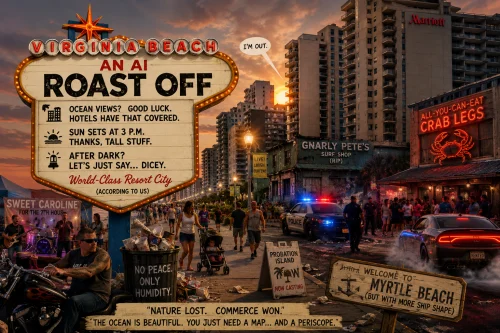
Scrolling through X the other day I stumbled on an amusing post by someone who asked AI to “roast” Virginia Beach. The result was spot on.
Impossibly accurate.
So I decided to give it a try.
I asked ChatGPT to produce a “roast” of Virginia Beach. The prompts I gave only mentioned that all of the ocean views are obscured by hotels, that the sun sets at 3 p.m. on the resort strip beach as it slips behind the buildings and that the beachy atmosphere is a little dicey after dark.
In under one minute, this is what our friendly bot created:
Virginia Beach is what happens when a city looks at a gorgeous stretch of Atlantic coastline and says, “You know what this needs? More timeshare architecture.” Somewhere along the way, local planners decided the best use of priceless oceanfront property was to line it with towering concrete hotel blocks that resemble a mid-budget casino district fleeing inland from Atlantic City. The result is a beach where the ocean is technically visible, provided you are standing at a precise 14-degree angle between a Marriott parking garage and a frozen daiquiri stand.
The city’s zoning philosophy appears to have been developed by a committee whose only guiding principle was: “What if absolutely everything cast a shadow?” By mid-afternoon, the resort strip darkens like an eclipse simulation at a science museum. The sun doesn’t so much set in Virginia Beach as file a noise complaint and leave early. Families arrive expecting golden coastal sunsets and instead spend half their vacation wrapped in damp towels beneath the looming silhouette of twelve stories of discounted balcony suites and an abandoned surf shop called something like “Gnarly Pete’s.” Continue reading.
Leave a Reply
You must be logged in to post a comment.