
by Steve Haner
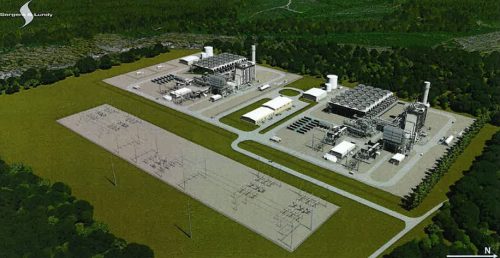
The 1540-megawatt natural gas generation unit approved last week by the Fluvanna County Board of Supervisors has already been identified by the regional PJM Interconnection electricity grid operator as a key reliability asset.
The Expedition Generation Station is proposed by independent power producer Tenaska, which already has the 940-megawatt Virginia Generation Station at the same location. Approval of the special use permit needed from the county will trigger a series of additional applications at the State Corporation Commission and the Virginia Department of Environmental Quality. The goal is to start construction in 2028.
The battle now moving to Richmond is likely to be as fierce as the contest over Dominion Energy Virginia’s proposed 944-megawatt natural gas plant for Chesterfield County. The state’s approval of that project is about to be challenged in the Virginia Supreme Court, the SCC has been notified.
When Dominion ran the same permitting gauntlet, DEQ boards like the Air Pollution Control Board were dominated by former Republican Governor Glenn Youngkin’s appointees, and those board will now be appointed by Democratic Governor Abigail Spanberger.
Former Republican Attorney General Jason Miyares hired a witness who favored approval of Dominion’s application, but the position of new Democratic Attorney General Jay Jones could differ. In theory, elections don’t change the rules on environmental permitting. It’s a nice theory.
Dominion’s proposed facility in Chesterfield is designed to run only when needed to meet peak demand, while the new Tenaska station will provide baseload power for Virginia and the rest of PJM. There are 51 projects projected to come online by 2030 that PJM has identified as crucial to maintaining reliability, but only twelve are entirely new plants. This is one of the twelve.
The Board of Supervisors 4-1 vote last week overturned a recommendation from the county’s Planning Commission that the application be denied. Tenaska apparently added several promises to address some of the concerns raised by opponents. The location is rural, heavily wooded, and another 325 acres will be added for buffering, but there are unhappy neighbors.
The opponents have focused on noise from the operation and claims of damaging health impacts, asserting it will cause two or three additional deaths per year and up to $50 million in additional health costs.
Last fall, Tenaska produced this presentation as part of its pitch to the community. The existing plant already brags of a good record of meeting the emissions standards for its permit. The presentation argues that it is also producing at levels well below those set by federal safety standards. All of that will now get relitigated in front of the SCC and the DEQ permit reviewers.
No surprise, much of the focus from proponents – and despite the media tilt there are proponents – is on the revenue the county will reap, with some discussion of Virginia’s need for added generation. In the fall, Tenaska was talking about $14 million per year in county taxes during the construction phase and then an average of about $8 million annually. The 29 new jobs and spending on services and supplies will also generate economic benefit.
Tenaska might as well go ahead and add into the tax column the carbon taxes they would be paying the state through the Regional Greenhouse Gas Initiative (RGGI). The current Tenaska plant in Fluvanna generated 5.2 million megawatt hours of electricity in 2025, emitting just over 2 million tons of carbon dioxide.
Given that the new plant will be 60 percent larger, it will likely emit closer to 3 million tons, thus needing 3 million annual RGGI allowances. Using the price set at the RGGI auction two weeks ago, those would cost the company $75 million annually, far more than the local taxes it would pay. Whether all that comes to Virginia may depend on the number of annual allowances RGGI grants it to sell.
Along with producing big bucks for RGGI beneficiaries, the plant also meets other goals the Democrats in the General Assembly set in 2026 legislation. It will take advantage of the existing transmission and interconnection network serving the initial Tenaska plant and other existing rights of way. That is not likely to quiet the storm about to break over this plant, because the bottom line is some people don’t want any natural gas used at all.
The argument against this in front of the SCC will also be that solar is the better choice. No, it is not If the existing Tenaska plant produced and sold more than 5 million megawatt hours of electricity in 2025, this larger plant could be expected to produce at least 8 million annually, which would assume it also runs at about 60 percent of its total capacity.
It would take 15,000 acres of solar panels to match the potential 1,540-megawatt output of this gas plant, and the best capacity factor possible for them would be about 25 percent. More than 20 square miles of panels would produce less than half of the electricity of this 50-acre gas plant and would produce that power only when enough sunshine fell on the panels.
Leave a Reply
You must be logged in to post a comment.