
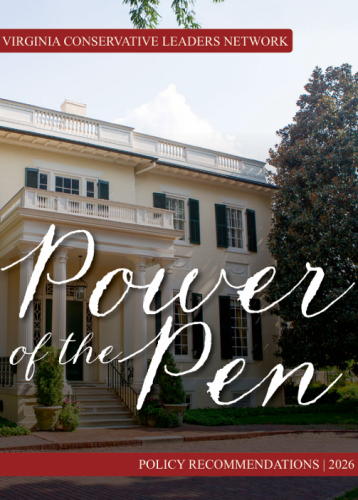
“Power of the Pen” details bills on energy, healthcare, the economy, and more that conservatives can get behind.
by Lynn Taylor
Every April, Virginia observes a particular kind of anniversary — not just of battles, but of decisions. It was in April 1865 that General Lee signed the surrender at Appomattox, bringing the bloodiest chapter in American history to a close. But even in that moment of exhaustion and loss, Virginians understood that the real work of self-governance does not end with the laying down of arms. It begins again.
That spirit of beginning again feels especially appropriate this month. On March 14, the Virginia General Assembly adjourned Sine Die, closing the books on the 2026 legislative session. More than 3,600 pieces of legislation were introduced — a staggering volume that reflects both the ambition and the appetite of those who believe the government should reach ever further into the lives of Virginia families. Now, roughly 20–22% of those bills sit on the Governor’s desk, awaiting her signature, her amendments, or her veto.
This is the moment the Founders understood well: lawmaking is only one act in the drama of governance. The executive pen is the next. And in a Commonwealth that prizes individual liberty, limited government, and fiscal responsibility, that pen carries enormous weight.
In response, the Virginia Institute for Public Policy and the Virginia Conservative Leaders Network have delivered the third annual Power of the Pen briefing to Governor Abigail Spanberger — an 80-page document reflecting months of collaborative input and careful policy analysis.
Last year, 86.2% of our recommendations were adopted by the Governor — a result that speaks to the depth of analysis and the concerted effort behind each one. We are hopeful, and we are watchful. The full Power of the Pen document is available for your review in the link below, and we encourage you to explore the recommendations and understand what is at stake for Virginia’s future in the weeks ahead.
The stakes are clear. Legislation now before the Governor could meaningfully increase the cost of hiring, raise household energy bills, and further centralize decisions that belong with parents, not the state. At the same time, promising measures on housing affordability, healthcare access, and educational flexibility deserve careful consideration and our full support. As I noted publicly: if Governor Spanberger is truly the moderate she considers herself to be, we stand ready to work with her toward genuine affordability, support for Virginia businesses, and a better education system for every child in this Commonwealth. This is not about Left or Right — it is about Virginia’s future, and the kind of Commonwealth we choose to leave behind for the next generation.
On the election integrity front, the April 21 redistricting referendum looms large. Virginia Fair Elections has been working tirelessly — training poll watchers every Monday through April 13, mobilizing volunteers, and making the case that the proposed congressional maps represent a cynical power grab that contradicts the redistricting amendment Virginia voters approved just four years ago. The legal and civic stakes could not be higher. Entire regions of the Commonwealth risk being drawn into irrelevance on the congressional map, and the timeline for legal remedy now extends past Election Day itself. We are deeply grateful for the extraordinary dedication of every volunteer and coalition member engaged in this cause.
Our education coalition continues to document troubling trends — from legislation that effectively treats public schools as psychological clinics, to discipline reforms that tie the hands of the very teachers closest to our children. We remain committed to the alternative vision: one where parents choose, innovation thrives, and students are seen as individuals rather than data points in a centralized system. Virginia’s children deserve better than a cradle-to-grave government model that sidelines the families who know and love them best.
And the Virginia Microschools Network is showing, in community after community, that this alternative vision is not theoretical. It is being built right now, by founders and families across the Commonwealth who refused to wait for permission — creating student-centered environments that are meeting real needs in real places. Their work is a testament to what becomes possible when citizens are free to act.
The Founders of this Commonwealth did not simply win independence — they built institutions designed to sustain it. They understood that self-governance is not a gift that, once received, requires no further tending. It is a practice. A discipline. A choice made again and again by citizens who are paying attention.
That choice belongs to us, this April. Please make your voice heard.
The Virginia Institute for Public Policy, in partnership with the Virginia Conservative Leaders Network, delivered its third annual Power of the Pen briefing to the Governor.
This 80-page resource provides detailed recommendations on which bills should be signed, amended, or vetoed. Built through months of coalition input and policy analysis, it reflects a shared commitment to advancing liberty, affordability, and responsible governance.
Last year, 86.2% of these recommendations aligned with gubernatorial action. While each administration brings a different approach, the goal remains the same: to provide clear, principled guidance at a decisive moment. (View Power of the Pen: Explore the recommendations and see what’s at stake for Virginia’s future – click here.)
Key Policy Considerations
While the session included some constructive proposals, several measures now before the Governor warrant close attention for their potential impact on Virginia families, workers, and businesses.
Economic & Workforce Impacts: Legislation advancing this year could significantly increase the cost of hiring, placing new strain on small businesses and potentially limiting job growth across the Commonwealth.
Energy & Cost of Living: Energy policy proposals may contribute to rising utility costs over the coming years, adding pressure to household budgets—particularly for those in rural communities and on fixed incomes.
Healthcare Access: Several proposals aim to address healthcare access challenges, particularly in rural and underserved areas where provider shortages remain a persistent concern. While implementation will require careful oversight to avoid cost increases or unintended strain on providers, these measures represent a meaningful step toward expanding access to care.
At the same time, many proposals to impose sweeping artificial intelligence regulations did not advance this session—an outcome that reflects the importance of measured policymaking in rapidly evolving sectors.
What Comes Next
With the legislature adjourned, responsibility now rests with the Governor.
This is a pivotal moment. The volume and scope of legislation demand careful, measured decision-making—guided not by partisanship, but by what best serves Virginia’s long-term prosperity and stability.
As President Lynn Taylor noted: “If the Governor is truly the moderate she considers herself to be, we stand ready to work with her to find a path forward that ensures genuine affordability, supports business, and improves every part of Virginia’s education system. This is not about Left or Right—it is about Virginia’s future.”
In the weeks ahead, those decisions will define the direction of the Commonwealth.
Lynn Taylor is president, CEO and co-founder of the Virginia Institute for Public Policy. This column has been republished with permission from The Virginia Crier.
Leave a Reply
You must be logged in to post a comment.