

by Todd Truitt
The Virginia joint conference committee budget report contains an additional $12 million intended to bring much needed improvement to Virginia K-12 math education.
The budget language is purported to be a first step to repeat the great improvements that the Virginia Literacy Act is making with evidence-based instructional methods. However, the wording does nothing of the kind. The budget provides blank checks totaling almost $10.2 million to school districts to continue promoting the math-ed equivalent of whole language/balanced literacy.
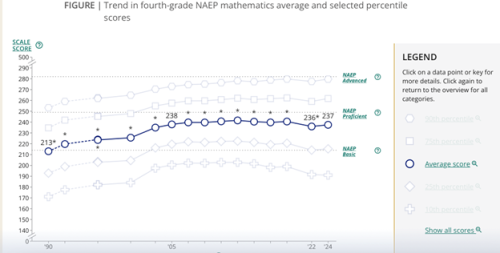
These non-evidence-based math instructional methods have led to flat National Assessment of Educational Progress (NAEP) math scores for decades. Activities based on math “reform” ideology — predominant in K-12 math ed for the past 30+ years — still lacks any evidence basis.
As I detail below, the Virginia K-12 math ed establishment has been fervently promoting non-evidence-based instructional methods to Virginia school districts and teachers. Virginia had the worst NAEP math recovery in the nation. Conversely, Alabama had the best NAEP math recovery in the country after enacting legislation promoting evidence-based instructional methods.
The budget language also funds math improvement task forces that do not (i) limit their recommendations to evidence-based curriculum or interventions, as the Alabama legislation does, or (ii) include key K-12 math ed stakeholders (STEM professors at 4-year universities, math-oriented parents, the business community), repeating a fundamental error of the loathed Virginia Math Pathways Initiative (VMPI).
If Governor Glenn Youngkin and the legislature want to improve Virginia children’s math performance, this budget language must be amended.
Bleak NAEP Math Recovery vs. Reading Raises Questions about Math Instructional Methods
Virginia’s worst NAEP math recovery is especially notable compared to reading. Virginia had the 14th best NAEP reading recovery in the nation between 2022 and 2024, after only having the 46th best reading recovery between 2019 and 2022.
Clearly something is amiss in Virginia’s math classrooms, raising questions about the instructional methods being used in them.
Looking at this issue nationally, Amanda VanDerHeyden, one of the leading cognitive psychologists in K-12 math education, told me:
“When we see that the average 4th grader in the U.S. scores in the non-proficient range on the NAEP and that there has been no improvement in 2 decades, we have to ask how our systems of instruction are failing our students. One of those ways is the undue, unsupported ardent belief in specific tactics or pedagogies that have not demonstrated benefit to students.”
Budget Language on Extra Math Ed Funds Provides Blank Checks to Districts
#1. The budget language devotes almost all of the additional funds to improving classroom instruction on math education. The Virginia Department of Education will:
- establish and implement professional development for teachers and schools;
- collaborate with school boards and division superintendents on math learning.
- manage and provide teacher training programs for math teachers.
#2. School districts will get $10.2 million for “mathematics curriculum support and innovative strategies to improve student performance in mathematics.”
Markedly, “evidence-based” is missing throughout most of the sub-provisions of #1, a loophole enabling the VDOE to devote nearly all its work to non-evidence-based instructional methods.
More importantly, over 90% of this extra funding for next school year, or $10.2M, is for grants to school districts in #2, which has no “evidence-based” limitation and even uses the word “innovative” (i.e., no empirical evidence). Notably, neither the Alabama math legislation nor the Virginia Literacy Act provide funding for “innovative” instructional activities.
Omission of “Evidence-Based” Limitation Appears Intentional
The budget language is based on parts of a bill sponsored by state Senator Ghazala Hashmi, D-Powhatan, and Delegate Shelly Simonds, D-Newport News. That bill would have also, among other things, created a new VDOE division called the “Office of Mathematics Improvement,” requiring 13 full time employees. That bill died in the finance committees.
Hashmi testified to the Senate Public Education Subcommittee that the bill was based on legislation in Alabama. However, the Alabama legislation strongly emphasizes evidence-based instructional methods to improve math education, and the legislative text uses “evidence-based” throughout.
Conversely, Hashmi’s and Simonds’ bill instead used “best practices” throughout, except for one use of “evidence-based” regarding a teacher micro-credential.
Evidence-Based Math Instruction Is Well-Documented But Often Ignored
Evidence-based instructional methods have been demonstrated by scientifically designed studies to improve the educational achievement of children.
In 2008, the U.S. Department of Education documented math evidence-based practices in the Final Report of the National Mathematics Advisory Panel (NMAP). Additionally, the U.S Department of Education has subsequently produced What Works Clearinghouse guides on evidence-based math practices.
For instance, the What Works Clearinghouse’s latest elementary math guide includes the following evidence-based instructional methods:
- Explicit instruction – fully explaining concepts and fully modeling procedures before asking students to use or apply those concepts or procedures
- Timed exercises to memorize math facts, such as via flash cards and timed tests
However, the U.S. Department of Education’s evidence-based recommendations have largely been ignored by the math ed establishment, as reported by journalist Holly Korbey:
“[A]ll of the available evidence on what works in teaching is contained in the final report of NMAP similar to the National Reading Panel, but no one ever reads it or references it, especially advocacy organizations like the National Council of Teachers of Mathematics (NCTM)…“The report in general just collected dust on bookshelves,” says panel member and former Brookings Institution scholar Tom Loveless…”
All the while, more and more public school students with resources are getting educated with evidence-based math instructional practices via private math supplement classes like Art of Problem Solving, Kumon, Mathnasium and Russian Math.
Ideological and Financial Interests in Non-Evidence-Based Practices
Numerous evidence-based instructional methods are rejected by the predominant math “reform” ideology in favor of non-evidence-based instructional methods ideologically consistent with its romantic educational roots. Similarly, Ken Goodman, advocate for romantic-based whole language, famously said “my science is different.”
As described by math curriculum expert Barry Garelick, math “reform” ideology gained prominence with the 1989 NCTM Standards, which promotes:
- students learning new material via their own exploration and talking in groups,
- minimal explicit instruction of new material from a teacher, and
- a contempt for standard algorithms (i.e., conventional borrowing and carrying calculation procedures) and routine problem practice.
University of Winnipeg math professor Anna Stokke told me she witnessed the result firsthand when her daughter was in elementary school:
“I discovered over 10 years ago that what were called “best practices” in K-12 math often weren’t best practices at all. They included things like not teaching standard algorithms, disparaging times table memorization and eschewing practice – some of the very things that provide the necessary foundation for success in later math.”
Additionally, prominent Virginia math teacher Vern Williams told me that he saw as a member of NMAP that “many best practices at that time actually led to decreased student learning.”
Meanwhile, as Korbey reported, many are profiting handsomely with today’s supposed “best practices,” just like Lucy Calkins and others did with literacy:
“Jo Boaler is like the Lucy Calkins of math, but there are many others,” Stokke wrote in an email. She included Peter Liljedahl’s popular teacher guide Building Thinking Classrooms, which also claims a research base. “He hasn’t done a single study that actually measures whether students learned any math with the program. Nonetheless districts are buying into it.”
For instance, Boaler charged $5,000 per hour for virtual professional development to a 97% non-white, 88% socioeconomically disadvantaged school district.
Virginia Math Ed Groups Avidly Promote Non-Evidence-Based Practices
The past conventions and statements of the two main Virginia K-12 math organizations ardently promote non-evidence-based education fads, and reject empirically proven instructional methods.
These organizations are:
- Virginia Council for Mathematics Supervision (VCMS), the largest Virginia organization of K-12 math leaders (e.g., those in charge of math curriculum at Virginia school districts);
- Virginia Council of Teachers of Mathematics (VCTM), the state branch of the controversial NCTM and which runs the likely largest annual Virginia math teacher professional development conference.
Remarkably, only one of the numerous sessions at the 2022 VCTM annual convention was solely devoted to addressing COVID-era learning loss when learning loss was at its peak. (National “reform” thought leader Boaler opposed focusing on “so-called learning loss”.)
At the 2023 convention, one of its four categories of professional development sessions was based on the fad “Building Thinking Classrooms.” (The only studies on it have been conducted by its author, which merely looked at engagement and not actual learning). VCTM’s 2024 convention also devoted six sessions based on the same non-evidence-based fad.
A featured speaker at this year’s convention is Jennifer Bay-Williams, who writes books and provides professional development rejecting the evidence-based recommendation for kids to memorize their times table via timed exercises.
Moreover, VCMS wrote a scathing letter to the Virginia Board of Education opposing the 2023 math standards’ pro-acceleration provisions and evidence-based statement that memorizing the times table is foundational math knowledge (since I detailed these issues and the letter’s misleading citations, VCMS’ website no longer permits the general public to access it).
VCMS and VCTM were also fervent supporters of VMPI, which proposed to de-emphasize computation and routine practice to “modernize” mathematics. Such de-emphasis has no evidence basis and was tried in California and elsewhere in the 1990s with disastrous results (where kids as young as kindergarten used calculators for computation based on the 1989 NCTM Standards).
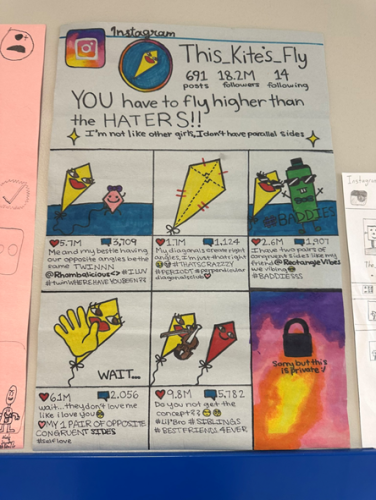
Lastly, above is a middle-school math (not art) project touted on X (f/k/a Twitter) by a prominent Virginia K-12 math ed consultant (a prior VCMS award-winner) who sells professional development to Virginia school districts. A math-curriculum expert told me that he estimates this project is, in terms of instructional time, 10% math and 90% art (while encouraging harmful social media usage in middle schoolers).
In sum, one can easily imagine what instructional methods the Virginia K-12 math establishment and their favored professional development providers will promote with blank checks going to school districts totaling $10.2M.
Todd Truitt is a parent of two school-age children in Arlington County, Virginia. He is also the Chair of the Math Advisory Committee for Arlington Public Schools and active in the Arlington Democrats. He is a business transactions attorney and a Certified Public Accountant.
Leave a Reply
You must be logged in to post a comment.