
By Derrick Max
Virginia’s education system is in crisis. The most recent National Assessment of Educational Progress (NAEP) scores are a wake-up call: only 31% of Virginia’s fourth graders are proficient in reading and only 40% in math, and just 29% of eighth graders meet proficiency standards in both reading and math. Worse, nearly one in three Virginia students can’t demonstrate even the partial mastery in reading necessary to demonstrate grade level proficiency.
Yet our state Standards of Learning (SOL) tests tell a very different – and dangerously misleading – story. While NAEP exposes the truth, Virginia’s SOL tests label students “proficient” even when their skills are far below grade level. Parents are left in the dark, believing their children are on track when they are not.
Virginia can – and must – do better.
The Thomas Jefferson Institute for Public Policy’s Vision for Virginia 2025: Education Policy lays out a plan to finally hold schools accountable, restore parents’ trust, and put our students back on the path to excellence.
Here’s how:
- Raise Standards and Close Learning Gaps. The plan supports Virginia’s new transparency and accountability framework, which sets rigorous standards and ensures struggling schools receive targeted interventions.
- Empower Parents with Real Choices. Families shouldn’t be trapped by their zip code. This vision expands opportunity scholarships, strengthens and extends the Education Improvement Scholarship Tax Credit, and embraces the new federal Education Choice for Children Act (ECCA) that helps lower-income students attend schools that meet their needs.
- Foster Innovation and Competition in Public Schools. By authorizing more charter schools, funding magnet schools and lab schools, and expanding online learning options, Virginia can unlock the creativity and flexibility that one-size-fits-all public schools often lack.
- Reform School Funding. Instead of a complicated and outdated formula, a weighted student funding model would ensure that dollars follow the student – and that the hardest-to-serve students receive the most resources. Schools would also be rewarded for their success.
- Restore Local Control. In addition to participating in the new Educational Choice for Children Act (ECCA), support the closure of the Federal Department of Education and block grant those funds to states and local schools.
- Restore Parental Rights and Local Control. Parents must be active participants in their children’s education — from being allowed to opt their children out of offensive classes and lessons, to protecting their children from age-inappropriate literature in their school libraries, to keeping gender specific sports and spaces safe from the opposite biological sex. The sad culture wars have become a distraction in our schools.
This is not about ideology; it’s about results. Our children are falling further behind every year, and the status quo is unacceptable.
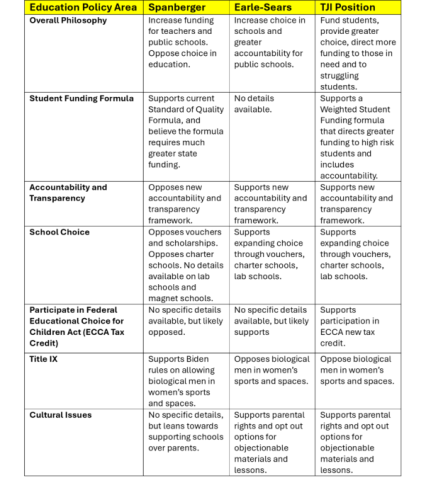
This year’s race for governor only heightens the stakes. The Thomas Jefferson Institute’s side-by-side comparison of Abigail Spanberger and Winsome Earle-Sears’ education positions make the differences clear. Spanberger supports doubling down on the current public school system with more funding and opposes school choice, charter schools, and scholarships for families who want alternatives. Earle-Sears, by contrast, champions parental empowerment, school choice, and expanded charter and lab school opportunities while supporting the state’s new accountability standards.
Voters should press both candidates to answer tough questions: Will they accept or reject the Educational Choice for Student Act funding to provide scholarships to lower income students in Virginia? Will they reform the student funding formula to more closely follow students instead of systems? Will they empower parents with real educational choices, or preserve a system that traps our most vulnerable children in failing public schools? Will they support the new accountability standards and ensure accurate data is provided to parents, or will they cave to political pressure to delay and dumb down these standards?
The full set of recommendations from the Thomas Jefferson Institute offers a detailed, actionable blueprint for turning Virginia’s schools around. These reforms would not only close achievement gaps but also give every child – regardless of income or background – a real shot at success.
Virginia voters face a clear choice in the coming elections. If you care about your child’s future, I urge you to read the full Vision for Virginia 2025 Education Policy recommendations and see for yourself how we can rebuild our schools, restore accountability, and renew excellence in education.
Where we see the candidates standing on several important issues:
First published this morning by the Thomas Jefferson Institute for Public Policy.
Leave a Reply
You must be logged in to post a comment.