
By Chris Braunlich
Governor Glenn Youngkin’s Executive Order for developing policies restricting or eliminating cell phones in schools – a concept garnering widespread support among parents, with 61 percent favoring requiring students to leave their phones in secured locations during the day – responds to a clear and rising mental health, academic and behavioral problem.
Seventy-two percent of high school teachers say cell phones in the classroom are a major distraction. Ninety percent of principals support restrictions on middle- and high-school cell-phone use during the day. And 68 percent of all American adults believe that smart phones should not be allowed in school.
The reason for this level of support is self-evident: more than 80% of American adults – young and old – are concerned about the impact of social media on today’s children. This concern is supported by the evidence.
According to the American Psychological Association, 41% percent of teens with the highest social media use rate their overall mental health as poor or very poor, compared with 23% of those with the lowest use. Ten percent of the highest use group expressed suicidal or self-harm intent in the past 12 months compared with 5% of the lowest use group; and 17% of the highest users expressed poor body image compared with 6% of the lowest users.
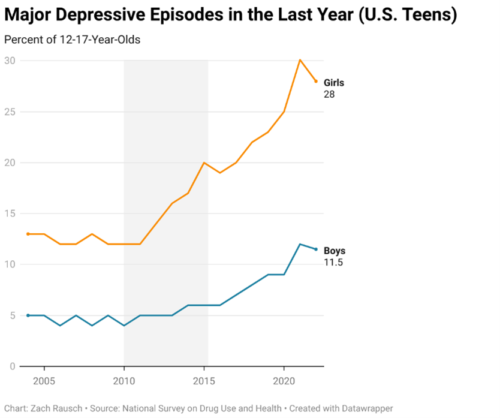
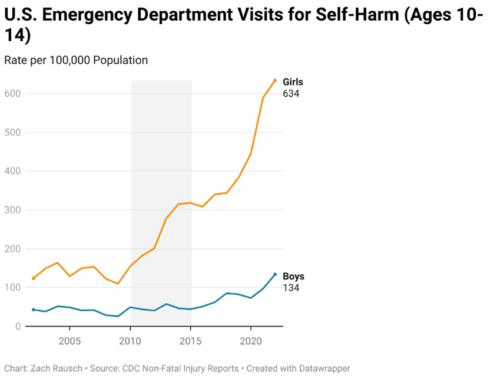
These figures have risen rapidly – not just because of the pandemic (being shut out of classes was surely a factor) but since teenage ownership of smartphones passed the 50% mark in 2012 (the iPhone was not released until 2007). The evidence for overwhelming increases in self-harm, clinical depression, adolescent anxiety, and suicide is clear.
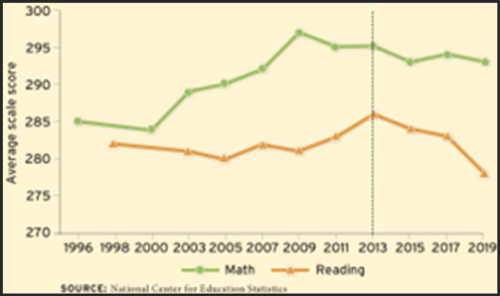
But it’s not just teen mental health. Learning and grades have also dropped dramatically during this period of time as well. Over at the Thomas B. Fordham Institute, President Mike Petrilli tracked test score changes on the National Assessment of Educational Progress with distracting smartphone usage: The more cell phones were used during the school day, the more test scores dropped. Virginia is no exception.
Elsewhere, policies to establish cell phone-free education have attracted bipartisan support. Governors from New York’s Kathy Hochul (D) to California’s Gavin Newsome (D) are proposing restrictions on cell phones in schools.
Here in Virginia, at least 16 school divisions have already taken steps to restrict cell phones in their schools. Governor Youngkin’s Executive Order is merely a smart way to accelerate this trend.
Because politics in Virginia are ever-present, and perhaps finding intolerable the notion that a Republican Governor might have a good idea, Senate Majority Leader Scott Surovel, D-Fairfax, immediately leapt to the fore to drag the issue into the wonderful world of partisan politics. Saying he “appreciated” the Youngkin Executive Order, Surovell promptly created a “working group” of legislators to formulate a “consensus solution” through state legislation. He appears to define “consensus” as “only Democrats need be involved.”
Republicans are uninvited and persona non grata, including Senator Bill Stanley (R-Franklin) who this year introduced a bill clarifying that local school boards explicitly have the power to enact cellphone restrictions during school hours. Only three Senators voted against it, so Stanley may have some idea of how to develop genuinely bipartisan legislation.
One of the three Senators to vote “no” is Senator Stella Pekarsky, D-Fairfax, a former school board member and also one of three Democrats appointed to Surovell’s working group. One suspects that if she found empowering her former colleagues on local school boards unacceptable, her real objective may be simply to write the law herself, her way.
It’s not as if Youngkin’s order is writing the specifics.
It doesn’t even “ban” cell phones. It simply makes the point that the objective of school is the education of children, that ubiquitous social media has been harmful to the mental health and academic advancement of children, and steps need to be taken to eliminate distracting and negative influences in the classroom.
It doesn’t dictate details, but instead directs the Virginia Department of Education to facilitate listening sessions with the public (eight are scheduled so far), utilize the feedback to develop and publish draft guidance and implementation plans for local school boards (meaning that they are options localities can choose … or not), establish definitions, and ensure any such guidelines preserve for parents the ability to communicate with their children – especially in emergencies.
What Senator Surovell finds objectionable in that is hard to see. The Executive Order leaves the implementation of any local policies up to … localities. Fairfax County is not Richmond City. Prince William County is not Amherst County. The diversity of Virginia’s school systems and population – in culture, technology, and resources – can’t be written in a single document applicable to all.
Which is not to say there won’t be obstacles to finding solutions.
Prime among them will be the natural desire of parents to reach their children (and have their children reach them) in an emergency. That’s understandable, and parents will need to feel secure about that ability, although school security consultants warn that student access in an emergency can worsen a situation by distracting children’s attention from safety and emergency response directions or overwhelm a school’s limited Wi-Fi capacity or draw parents to run into an already chaotic situation adding complexity to first responders and staff.
The other issues will be administering and enforcing any restrictions and financing additional costs. Teachers want to teach, not be the “cell phone police” and take time away from teaching. If there are consequences, they need to be determined and made clear. If phones are locked up and released each day, more time will be required to process students in and out of school. And mere locked pouches may not work: it doesn’t take long for students to figure out ways around them.
All of those are issues best worked out at local jurisdictions, and the Youngkin Executive Order encourages that. Legislation, on the other hand, traditionally tries to impose a “one-size-fits-all” solution (or directs the state Board of Education to impose a “one-size-fits-all” solution). That won’t work.
This is not something that can be solved immediately or without difficulty. But the devastating effects of social media on our children and its negative impact on learning make cell phone access in the classroom worthy of debate and an eventual solution.
And do so by leaving partisanship at the schoolhouse door.
Interested Virginians can sign up to attend the “Commonwealth Conversations” on Cell Phone-Free Education or submit their opinions by clicking here.
Chris Braunlich is senior advisor to the Thomas Jefferson Institute for Public Policy (TJIPP_, a former member of the Fairfax County School Board and former president of the Virginia State Board of Education. He may be reached at [email protected]. This column is republished with permission from TJIPP.


Leave a Reply
You must be logged in to post a comment.