
By Steve Haner,
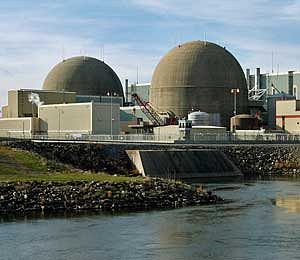
If or when Dominion Energy Virginia complies with the Virginia Clean Economy Act (VCEA) and closes its hydrocarbon generation units, the best way to power Virginia will be a truly massive amount of new nuclear power.
That comes from the latest iteration of Dominion’s ever-adjusting integrated resource plan (IRP), filed with the State Corporation Commission last week. In July the SCC accepted but did not really endorse the company’s 2024 IRP, following a long battle with environmental activists upset about its reliance on new natural gas generators.
One criticism of the 2024 proposal was that it covered only 15 years and thus did not reach 2045, the deadline in the VCEA for the retirement of all the company’s coal, oil and natural gas plants. In 2024 the company still operated about 12 gigawatts of powerplants burning those fuels, mostly natural gas.
This document does project to 2045 and like previous IRPs offers several scenarios for maintaining reliable service to the company’s growing customer base, now about 2.8 million customers. One scenario marked “forced retirements” has a plan for full VCEA compliance. It adds more than 12 gigawatts of nuclear, more than three times the size of the company’s current four-reactor nuclear fleet.
It would build about eight more reactors the size of North Anna or Surry’s and add several small modular reactors per year for 12 years, starting operation in 2034. The big reactors would begin operation in 2044 and 2045.
The company also proffered what it called its preferred plan. That showed no hydrocarbon retirements come 2045, and added only 2 gigawatts of nuclear power, all if it from small modular reactors. It showed the first of those coming online in 2040, not what advocates of that energy source are hoping for.
Both plans still assume, as did the 2024 document, that Dominion will be able to proceed with two more major offshore wind projects, adding 3.4 gigawatts to the 2.6 gigawatts now under construction. The current administration in Washington won’t let that happen but it should be long gone before those applications proceed. The 2028 election may be dispositive there.
Both plans would add additional natural gas generation between now and 2045, but the VCEA full compliance plan would then retire it early. The company preferred plan adds about 8.5 gigawatts of natural gas and the “forced retirement” plan about 3.8 gigawatts.
The preferred IRP plan was projected to be less expensive than the nuclear-based carbon-free alternative. Using a complicated “net present value” calculation of the capital cost, the preferred plan would need $122 billion and the “no hydrocarbon plan” $144 billion. Projecting costs out 20 years is guessing, not accounting, but there is no question that adding that level of nuclear generation will be expensive.
Customer bills rise and rapidly no matter what options the company chooses.
In both plans the company would still add substantial new solar assets, 17.5 gigawatts in the preferred plan and 19.75 gigawatts in the hydrocarbon free plan. The preferred plan adds only another 2 gigawatts of energy storage, none of it long-duration batteries. That is just the minimal compliance with the VCEA’s current battery mandate.
But the hydrocarbon free plan is more battery dependent, adding more than 9,000 megawatts of battery storage, with 3,500 of those being batteries capable of discharging 10 hours rather than four. That is approaching the level of battery power mandated for Dominion by the vetoed 2025 legislation adding more battery mandates to the VCEA, a bill expected to return in 2026.
Exactly what cost estimates the company applied to those battery projects is not immediately clear in the application but might be in supporting documents. The company has now also filed a new application to build or lease additional solar and battery storage in the near term, and that does include details on current battery capital costs.
This most recent application for battery projects lists two proposals. Drake Storage in Middlesex County would use 80 four-hour batteries (an output of 320 megawatt hours), with a capital cost of $640,000 per megawatt hour of output. The Mulberry Storage project in Richmond County would use 75 of the four-hour batteries (300 MW hours) at a cost of $716,000 per megawatt hour.
The combined $417 million for the two projects does not include the financing costs or company profit over 20 years. Remember, batteries do not make electricity, they just store it. The cost of making the electricity also falls on ratepayers and must be considered in addition to the battery storage cost. The true cost is both combined.
Based on those numbers, the capital cost that Bacon’s Rebellion estimated for that 2025 bill earlier this year was low. Rather than $18 or $29 billion (based on $300,000 to $500,000 per megawatt hour), the number should have been closer to $35 billion. A new version of the bill will be discussed at the November 6 meeting of the Commission on Electric Utility Regulation. Will a cost estimate be included?
Writing about the IRP is to ride a merry go round. Reading it is incredibly informative, but we’re not really getting anywhere and will be back here again soon. The direction for Virginia’s energy future will depend more on the coming SCC decision on Dominion’s first application to build a new natural gas plant, in effect waiving the VCEA, with the justification being the threat to system reliability. If the SCC agrees, the VCEA just lost much of its punch and the company preferred IRP plan gains credibility.
The other key decision on the energy future will be provided by the voters in two weeks.
Leave a Reply
You must be logged in to post a comment.