

Commentary by James C. Sherlock
People hate to be strung along. Especially for years.
Atlantic Park wasn’t a “Nigerian prince” scam. No one told us there were millions of dollars unclaimed in a Western Union account. But it was close. A lot of us who do not follow anything but news accounts of City Council activities fell for it repeatedly.
One of the reasons it has been so hard for citizens to follow the public costs of Atlantic Park is because of the way the city has presented them. We have been misled unfailingly. Still are.
Consider the city claims made before a council session in 2019 that took public comment on the pending “final” agreement with the developer.
In an October/November 2019 report by TV 10 news.
The city’s cost for the project would be roughly $96 million and would be used to construct the parking garages, entertainment venue and common spaces.
The city would pay off its debt by using the Tourist Investment Program, which is made up of mostly hotel, restaurant, amusement and cigarette taxes. The lead partner, Virginia Beach-based Venture Reality, would secure financing for the remaining $230 million ($282 million in 2024 dollars).
Developers and city staff have pitched making the dome property a special district to be governed by a “Community Development Authority.” …
The authority has power to issue bonds, but since it is an “independent authority,” it wouldn’t impact the city debt. Those bonds would be paid through revenues and additional taxes levied on the project.
Let’s look:
- Those cost, cost share and sources of payment claims all turned out to be inaccurate in amounts that cannot on the public side be explained by inflation. No cost of capital was mentioned.
- On the other side of the ledger, developer costs plummeted.
- And the debt albatross around the neck of the surf park was not on the table.
A fatally flawed seven-year procurement process. Council, VBDA and the developer could have forecast costs far better had the city insisted on formal proposals as in standard acquisitions, even in negotiated procurements as practiced by capable governments.
But of course the city did not use a standard procurement, and proved incompetent at the one they did choose.
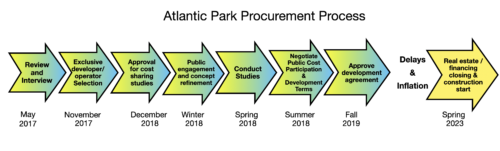
An email produced recently in response to a FOIA request showed that in 2018 two councilmen rejected the city manager’s suggestion of a development budget that would allow Council to “tell them it will pay for itself.” and interposed their own.
In 2019, to encourage citizens to support Atlantic Park, Council still told us all it would return money to the city in excess of costs.
Council literally never looked back to see how out of control public costs got.
Public costs. The city did not spend $96 million as was forecast after the 2019 agreement. It raised the official costs to $153 million and borrowed the money with bonds to drive the total costs to over $330 million. Council was presented a slide by a Deputy City Manager in May of 2024 that did not count interest in any of three city Authority bond series in 2023 and 2024 – or the the principal of the 2023 bond issue.
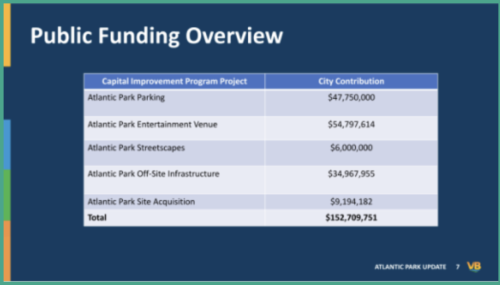
Below were the costs available from bond documents:
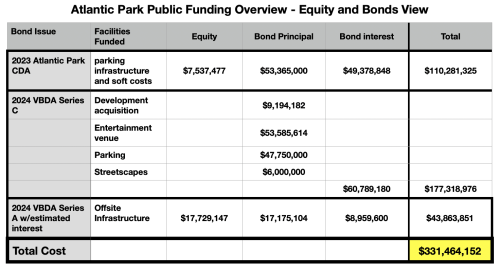
The 2019 estimate of city spending was $96 million. The final figure is 3 1/2 time that. (note: the figures on 2024 series bonds interest were received via FOIA response on Sept 20. This is a higher cost update to previous slides.)
The Council presentation ignored both all bond interest and the CDA bond principal. The author does not know why.
Developer costs. The developer team:
- did not spend the $282 million promised in 2019, but rather $116 million in equity ($30 million) and debt principal;
- committed to interest costs which are not available for this report;
- spent overhead for seven years; and
- suffered the opportunity costs of being tied up with Atlantic Park for all of that time.
Costs of the surf park. In the author’s view the developer team made a major mistake in 2022. Rather than finance the surf park, it gave the facility away to a 501(c)(3) with a negative net worth. Then the developer and VBDA helped that organization borrow far too much money from a state bond authority.
The surf park bond deal left Atlantic Park’s signature venue under great financial stress — it owes $207 million in principal and interest after it pays the normal operations and maintenance costs.
The city and developers have invested hundreds of millions of dollars in Atlantic Park. Yet they left its signature feature under so much debt that Wall Street demanded bond yields that price in default.
The Virginia Small Business Financing Authority was left looking foolish. The Virginia Beach Development Authority more so.
Speculative bet. The simultaneous market appearance on March 30 of 2023 of the state’s surf park bonds and CDA bonds for Atlantic Park led bond professionals at Bloomberg to deem the whole project a “speculative bet.” It listed a defaulted surf park in Edinburg, Texas, as an example.
Citizens were never informed of the speculative nature of Atlantic Park. Or of the earlier failure of another American surf park.
Default on “revenue” bonds not an option. The city’s bond service will be paid by appropriations provided from revenue sources designated in the CDA and VBDA bond issues. The assessment provided for the 2019 article cited above that default “wouldn’t impact the city debt” will not prove accurate. If the city defaults on its revenue bonds it will crush its overall debt rating.
So, try to imagine a scenario in which the City Council asserts that the revenue sources won’t pay the debt service and defaults on the bonds. Yeah. Me neither.
Bottom line. The city counts “contributions” for public consumption differently than most people would. When citizens borrow money for a mortgage, they are under no illusion that the principal is all we need to pay back. The author suggests council be transparent and change its information briefings so citizens and the press can see total costs of capital.
The council needs to take one step immediately to show good faith. Adopt the state Public Procurement Act as that law invites municipalities to do. It is very good law that is very prescriptive as to process. It will prevent many of the failures exposed in the Atlantic Park deal.
In the best case Council completely lost track of costs and cost shares. If they blame that on the Department of Economic Development they should do something about it going forward. But if they just did not keep track we need better people on council and may have to pay members far more to get them.
Mayor Dyer once suggested that Atlantic Park will be the subject of a “lessons learned” study. Indeed, Council obviously hopes that will be the end of it. It won’t.
Some of this fiasco can be written off to incompetence, including Council incompetence, but that will never be cited in a city lessons learned study.
So why an eleven part series? Because details matter and there are at least three audiences for this level of detail.
- The first is reformers including council and citizens who need to know exactly who is responsible and what needs to be reformed. The author hopes that exposure of what has happened in Virginia Beach causes Virginians in other municipalities to enquire how development is treated by their own local governments. He also hopes it shapes the votes in Virginia Beach elections in November. All city council incumbents have been in office at least four years – the mayor for 20 – and deserve to be defeated.
- The second is the state – the Virginia Small Business Financing Authority needs reform including perhaps reassignment to the Treasury Department.
- The third is federal enforcement agencies.
This series has only been worth the work if reform is accomplished.
Leave a Reply
You must be logged in to post a comment.