
by James A. Bacon
Is the level of crime in Virginia getting worse or getting better? The answer depends largely on what metric you use. If you focus on the declining number of homicides between 2022 and 2023 (the year for which statewide Virginia data have just been released), then it definitely looks like violent crime is heading down. But if you focus instead on the number of aggravated assaults, violent crime is up. The fact is, according to the statistics published by the Virginia State Police in its “Crime in Virginia 2023” report, last year was a mixed bag, with some categories of crime logging fewer offenses and some more.
The numbers matter because people want to know if their communities are getting safer or less safe. Is society trending toward order or disorder?
To address those questions, I look at two sets of statistics that reflect police interactions with the public: the number of police-involved shootings and the number of assaults on police officers. If society is trending toward order and stability, police will have fewer violent encounters with the public. If society is trending toward disorder, people will be more likely to confront police and/or resist arrest, leading to more such encounters.
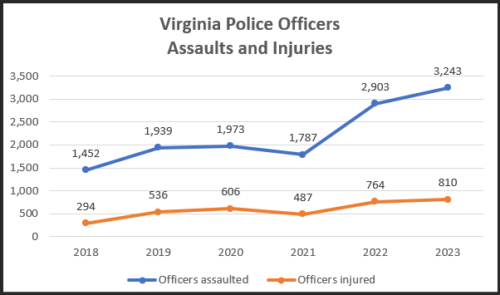
Over the five years between 2018 and 2023, the number of assaults on Virginia police officers more than doubled to 3,243, and injuries (mostly minor) almost tripled. Fortunately, the number of Virginia officers killed in the line of duty remains fairly low at one or two per year (although the only acceptable number is zero).
The number of assaults reported has leaped in the past two years, although the “Crime in Virginia” report notes that a “new method of data aggregation” reflects a higher number of assaults than in previous years. I have no way of gauging the impact of that methodological change. What we do know is that the number of injuries to police officers rose, which suggests that the increase in the number of assaults on officers was not entirely a statistical mirage.
These numbers suggest one of three things: either (1) the police are getting more aggressive in their interactions with the public; (2) the public is getting more aggressive in their interactions with the police; or (3) the frequency of potentially fraught encounters between police and the public is increasing.
We can easily dispense with the first hypothesis. Providing context is the second data series I look at: the number of incidents of police-involved shootings.
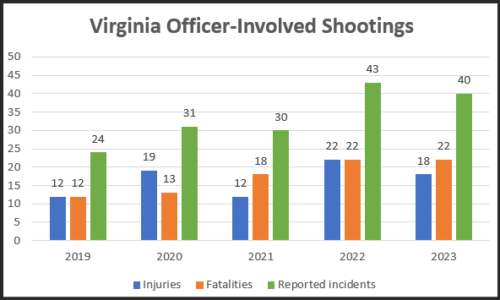
There was a slight year-to-year decline in the number of such shootings in 2023, but the number remains significantly elevated compared to 2019.
What is behind that long-term increase? Have policing methods become more aggressive in the wake of the George Floyd shootings, defund-the-police backlash, and election of “progressive” prosecutors intent on implementing their visions of social justice? Most people (including myself) would say no.
But I suppose a conclusive answer to the question requires a deeper drilldown into the data and a department-by-department analysis of policing practices in cities and counties accounting for most of the incidents. Conducting such an exercise is on my to-do list.


Leave a Reply
You must be logged in to post a comment.