

by James A. Bacon
One of the seven families filing a lawsuit against Albemarle County to end the county’s “anti-racist” school policies came to the United States from Panama. The father of another student listed in the lawsuit hailed from Turkey. Sometimes it takes an immigrant to see clearly just how racist “anti-racist” policies are when put into practice.
In 2019 the Albemarle County School Board adopted an “Anti-Racism Policy” with the stated purpose of eliminating “all forms of racism in Albemarle County Public Schools,” asserts the lawsuit, which was heard by the Virginia Supreme Court last week.
“Defendants claim that they want to stand against racism,” the lawsuit says. “But rather than eliminate racism from the School district, Defendants have done the opposite…. The policy is racist at its core.”
The suit continues:
The Policy and the curriculum it mandates indoctrinate children in an ideology (sometimes called “critical race theory,” or “critical pedagogy”) that views everyone and everything through the lens of race. Far from exploring ideas or philosophies surrounding justice and reconciliation, that ideology fosters racial division, racial stereotyping, and racial hostility.
“In direct conflict with the U.S. Supreme court precedent, the Virginia Constitution, and state law, the Albemarle policy treats students differently based on race,” the lawsuit argues.
The parents are represented by the nonprofit Alliance for Defending Freedom. Albemarle County judges dismissed the suit on the grounds that the families failed to prove that their constitutional rights were infringed upon. The suit was dismissed again by the Virginia Court of Appeals in February.
According to Luca Powell with the Richmond Times-Dispatch, the Virginia Supreme Court panel hearing the case “expressed skepticism” about the legal standing of the seven students.
I have no informed opinion on whether the suit will succeed or fail. But the moral and ethical issues raised in the lawsuit need to be heard. The “anti-racism” ideology that animates policy in Albemarle County is increasingly widespread in blue localities across Virginia. If you’re happy with your public schools teaching your kids about White privilege and systemic racism, as a third or so of the population apparently is, you might have no problem with what’s happening in Albemarle. But if you reject the overt politicization of what your kids are taught — not just by some random teacher but with the sanction of the administration — then you’d better pay attention.
Do the seven students have standing? Well, they do (or did) attend Albemarle County public schools, and they were exposed to formal “anti-racism” indoctrination at odds with their personal beliefs.
Parents C. and T., identified only by their initials in the redacted version of the lawsuit I read, immigrated to America from Panama. Through hard work and dedication, the suit avers, they built successful careers and a successful business. “Based on that experience, [they] believe that in America, hard work will lead to success and that anyone, regardless of race, color, or creed can accomplish his or her dream. Likewise, they believe in the country’s foundational principle that all are created equal and, in accord with their religious beliefs, that all persons are equal before God. They object to Albemarle schools indoctrinating their children in contrary views.”
Their children, identified as R.I. and V.I., share their beliefs, so they have found their school instruction confusing and at times disturbing. “They … do not know where they fit into this new ‘anti-racism’ ideology. Their racial background would render them underprivileged by Defendants’ standards, but their religious beliefs and economic status would suggest privilege instead.”
The lawsuit cites similar stories for the families of the other six defendants. K.G., a Turkish immigrant who was the first in his family to attend college, started with little but believed “hard work was the key to success” and built a successful medical career. “He instilled in his children the idea that achievement comes from individual effort. Race was never considered a moderator for success.”
Another defendant, L.R., is of mixed racial heritage — half White/Native American and half Black. His parents are concerned that Albemarle’s policy will “encourage children to focus on race in a way that makes [him] feel uncomfortable and will put false ideology in his mind about being targeted because he is black.” The parents don’t want the schools to change the way he views himself, his racial background, or that of his family members, including his White/Native American mother.
Some plaintiffs are practitioners of Catholicism, some of Protestant Christianity. Their faith governs the way they think about human will, human nature, morality, and identity. Their faith, says the suit, teaches that every person is “made in the image of God, possesses inherent dignity, and must be treated accordingly.” They endeavor to treat every person, regardless of race, “with dignity, love and care.”
Their religious world view came into direct conflict with Albemarle County’s “anti-racism” policy.
The Defendants incorporate their “pathological teachings” into the schools’ programming and treat students differently based on their race, says the suit, which continues:
Defendants have [embraced] a radical new understanding of ‘racism’ that harms and denigrates everyone. This new understanding classified all individuals into a racial group and identifies them as either perpetually privileged oppressors or perpetually victimized members of the oppressed, denying agency to both. It assumes that racism terminally infects our social institutions, requiring their dismantling. And it imputes racism not only to those who consciously discriminate based on race, but also to those of certain race (white) who do not actively participate in the prescribed dismantling.
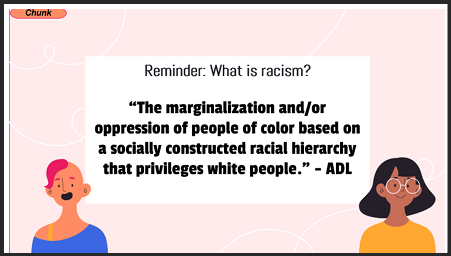
That ideology has informed the curriculum that instructs students that “racism” is “the marginalization and/or oppression of people of color based on a socially constructed racial hierarchy that privileges white people.”
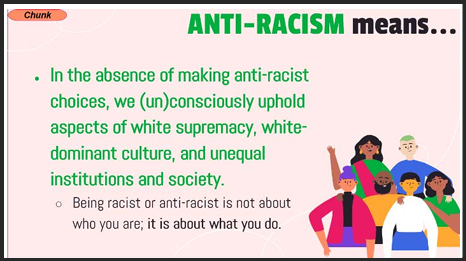
Albemarle schools also urge students to consider their privilege, or lack of it, and strive to be “anti-racists,” because in the absence of making anti-racist choices “we (un)consciously uphold aspects of white supremacy, white-dominant culture, and unequal institutions and society.” (Emphasis added in suit.)
Albemarle schools also conducted division-wide training instructing teachers about white privilege. “The training explained that white teachers must be pushed to consider ‘privilege systems, whiteness, [and] race,’ to realize that the ‘myth of meritocracy … isn’t true,’ to recognize ‘systemic white racism,’ and to move from color-blindness to racial consciousness.”
The plaintiffs asked the Court to halt that portion of the policy that indoctrinates Albemarle students “in an ideology that denigrates students — all students — based on their race.” Albemarle’s policy, the suit contends, forces the plaintiffs to violate their sincerely held religious beliefs, and it interferes with the right of parents to direct their children’s upbringing and education.
The lawsuit also calls for an end to “a disciplinary system designed to silence and punish students who disagree with Defendants’ hostile racial stereotypes and race-based discrimination. That system rests on vague disciplinary standards that vest Defendants with unbridled discretion to arbitrarily prohibit and punish any speech or action that is inconsistent with Defendants’ orthodoxy.”
Leave a Reply
You must be logged in to post a comment.