About Those Police Manpower Shortages…

by James A. Bacon

Virginia voices calling for the defunding of police departments have quieted in the past year or two, but the manpower shortage in Virginia’s law-enforcement agencies persists.

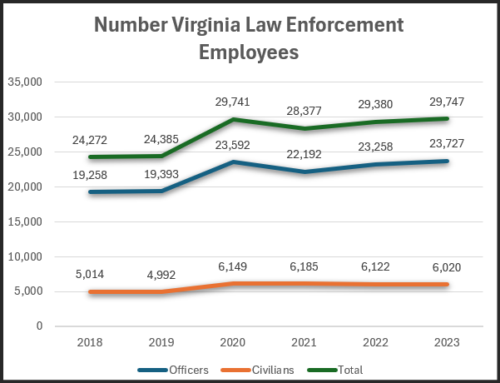
According to data released in the Virginia State Police “Crime in Virginia 2023″ report, police and sheriff departments, the state police, university police, and miscellaneous agencies managed to increase their ranks by 347 officers, or about 1.2% compared to the year before. (The number of civilian employees actually declined by about 100.)

But local media report that law-enforcement agencies are still lamenting their inability to fill their ranks. The City of Richmond, down 160 employees, graduated only 10 recruits from the city’s police training program in March, according to WWBT. The Fairfax County Police Department has more than 200 vacancies, reported WJLA in June. Schools across Hampton Roads are complaining of a shortage of school resource officers, said WTKR earlier this week.

The annual Crime in Virginia reports contain a section on the level of law-enforcement staffing. The number of law enforcement employees tallied in 2023 stood at almost exactly the same number as in 2020, the year of the George Floyd protests/riots and the outbreak of the COVID-19 epidemic.

If the overall level of law-enforcement employees in Virginia remains the same as in 2020, the big public-policy question is why so many departments are struggling with manpower shortages.

The level of hostility toward law enforcement in 2020 was intense. Politicians and pundits called for cutting police funding and “reimagining” law enforcement. Prosecutors promised to combat systemic racism in the criminal justice system. Protesters spray painted the ubiquitous slogan, “All Police Are Bastards.” In some localities, police chiefs were cashiered.

Law-enforcement morale plummeted. The number of officers — the men and women in the field — shrank by 1,400, or 6%, the following year, even as the number of civilians working in offices stayed roughly the same.

(It is impossible to tell from the data if current numbers represent an increase or decrease from before the riots and epidemic. In its “Crime in Virginia 2000” report, VSP began counting categories of employees that it had omitted previously.)

While the overall numbers show an incremental gain in the number of law-enforcement employees since 2000, different law-enforcement categories fared differently.

The biggest loss occurred in the county/town category: down 2,327, or 15%. It is impossible to tell from the VSP data if the decline was seen across the board or was concentrated in particular localities (such as Fairfax County).

City police departments actually gained 77 employees overall, or about 1%.

College and university police grew significantly, adding 183 positions for a gain of 19%.

The number of Virginia State Police employees declined by 25, or about 1%.

The biggest gainer was the miscellaneous category of “other,” adding 444 employees, or 25%.

(The Crime in Virginia report does not define “other,” but it likely includes some or all of law-enforcement employees with the Department of Wildlife Resources Conservation, the Alcoholic Beverage Control Authority, the Department of Motor Vehicles, the Marine Resources Commission, Capitol Police, port authorities, and tribal police.)

One hypothesis for the perception of manpower shortages is that between 2000 and 2003 many officers abandoned traditional law enforcement roles with city and county departments in favor of less stressful positions with campus police departments and low-profile state agencies. In this view, the positions hardest to fill — thus, the locus of the shortages — are the ones most likely to expose officers to hostile elements in the population more likely to hurl insults, resist arrest, and even assault them.

Another hypothesis is that increased crime spurred localities to fund an increased number of law-enforcement positions that departments have been unable to fill. The anti-police clamor has died down and, amidst higher crime rates, local governments reversed course. In this view, the shortage reflects not so much a decrease in the supply of police officers but an increased demand. Unfortunately, the Crime in Virginia report does not include the locality-by-locality budgetary data that would allow us to evaluate the proposition.

One of the few things that can be said with certainty is that, despite the widespread perception of police manpower shortages, the actual number of law-enforcement employees is little changed from 2000.


ADVERTISEMENT

(comments below)


Comments


Comments

22 responses to “About Those Police Manpower Shortages…”

  1. Nancy Naive Avatar
    Nancy Naive

    Never let a crisis go to waste, even if just a perceived crisis.

  2. Lefty665 Avatar

    The idea that we are so very predictable is depressing, and a commentary on how trite we tend to be. Spell check on my phone does crazy things to text messages. I find I have to reread carefully before I hit send, always a good idea. "On second thought" is my friend. ๐Ÿ™‚

    After "reboot" (the first rule of computer support) "reinstall Windows" is the second rule if the first rule doesn't fix the problem. ๐Ÿ™‚ Alas, I am always profoundly behind on maintaining recovery points.

  3. Nancy Naive Avatar
    Nancy Naive

    Do they prevent any of those? Really PREVENT those crimes? They may catch the perpetrators in the act, but prevent? Prove it.

  4. Lefty665 Avatar

    <i>"It is impossible to tell from the data if current numbers represent an increase or decrease from before the riots and epidemic." </i>

    If the numbers do not represent what has happened, they're not very useful to draw conclusions from. I don't doubt that there are changes in the mix that leave some forces short, but if you can't tell it from the numbers it's a pretty shaky foundation for conclusions.

    While I deplore the defund movement as much as you, there is apparently little numeric basis to conclude that it had much impact in Virginia.

    Are we to assume that all the references to 2000 reports are actually 2020 reports and not millennium to current era?

    The 2023 Crime in Virginia report does not address a prior year change in reporting that the graph highlights. Is it easy to provide a link that reports that change?

    Edit: The 2020 Crime Report https://vsp.virginia.gov/wp-content/uploads/2022/02/Crime_In_Virginia_2020.pdf (pages 80+) does not note any change in methodology of counting officers.

    Neither does the 2019 report https://vsp.virginia.gov/wp-content/uploads/2021/08/Crime_In_Virginia_2019.pdf also page 80.

    Neither does the 2018 report https://vsp.virginia.gov/wp-content/uploads/2021/08/Crime_in_Virginia_2018.pdf page 78.

    The number of officers in those reports correspond to the numbers in the graph. I don't doubt there was a change in reporting, but am not finding it documented in the State Police reports that the graph numbers appear to be drawn from. It would be especially nice if there was a reconciliation of a change in reporting so we could evaluate the impact on the reported numbers.

  5. Lefty665 Avatar

    You might want to take a look at your post. In multiple instances it appears 2020 is stated as 2000 and in at least one case 2023 is shown as 2003.

    I mourn not having someone check things before I post them any more. I am my own worst editor and often surprised at how often things appear to me as I wanted rather than how it is subsequently very clear they actually came out. I'm not doing so well on orientation to time and place either.

    Police show a 23% increase since 2018. So even if flat since 2020, that's a far larger percentage increase than Virginia's population in the last 5 years. Was Virginia so under policed and crime ridden in 2018 that it is woefully understaffed with almost a 1/4 increase since then?

    Statistics can show very different things with a simple change in the choice of starting point of a number series.

  6. DJRippert Avatar
    DJRippert

    Officers up 23% since 2018?

    Time to look for a new problem.

    1. Lefty665 Avatar

      19,258 in 2018 and 23,727 in 2023. My spreadsheet says that's 23.2%

      Interesting that in 2020, the G. Floyd year Virginia police were up 22.5% over 2018, (that's 23,592 to 19258). It would be interesting to know what drove that also nearly 1/4 increase over those two years.

      The increase 2020 to 2023 is 135 or .5%. That's not a big increase. Perhaps the big increase from 2018 to 2020 pretty much met the need for the foreseeable future. As you said, "time to look for a new problem".

    2. I think they're counting all persons employed by law enforcement agencies, not just police officers.

  7. Nancy Naive Avatar
    Nancy Naive

    Cops donโ€™t prevent crime, they investigate it.
    Good social safety nets and a healthy economy mitigates crime.

    1. Cops donโ€™t prevent crime, they investigate it.

      Or at any rate, that is how it should be.

  8. Teddy007 Avatar

    The contractor who put the PDF together that is at the link in the post needs a remedial class in online document production. In the 21st century, there is no reason to do the Roman numerals for the intro pages and then start with page 1. That means that page 1 is really page 8 in the PDF. In addition, the table of contents should be linked to the section of the documents. I could do that 15 years ago with older versions of Adobe. Everyone document should look like state.

  9. Super Brain Avatar
    Super Brain

    Outside of arts and entertainment, most professions and trades are short of applicants.
    I guess you can add politics as a profession that has too many applicants. That's the one you can go into if you cannot make it in anything else.

  10. LarrytheG Avatar
    LarrytheG

    The problem is not unfilled slots per se. The problem is a shortage of people who are qualified and fit to be a cop as we have learned much in the past few years about that aspect and how some folks ought not be cops – even if there are "shortages".

    More cops = less crime? nice try! That should be an "easy" study, no?

    more cops = more arrests but no effect on crime? got data for that study also.

    Here's a thought – do people who have good paying jobs commit crime at the same rate as people who don't and/or cannot find employment for their
    level of education?

    1. Teddy007 Avatar

      Having a good paying job is a sign that a person has some level of discipline and has a future time orientation. Both of those push against being a criminal. But as many athletes and black celebrities have shown, being wealthy does not eliminate criminal tendencies.

      1. Just black celebrities?

  11. The threat of being caught and punished does prevent some crime.

    Right, but that results from the police adequately performing their primary mission, which is investigating crimes and arresting those suspected of being guilty. The deterrent is not a result of "crime prevention" programs.

  12. Dick Hall-Sizemore Avatar
    Dick Hall-Sizemore

    Neither of your hypotheses works. 1. Officers abandoned traditional law enforcement for more cushy assignments in campus police, etc. The 2020 and 2023 numbers for counties, cities, and towns show filled law-enforcement positions as of Oct. 31 of each year. About the same. If officers did abandon traditional law-enforcement for other position, their positions were filled with new recruits.

    No.2–There are a lot of funded, but unfilled positions. Again, the data reflects "officer counts" on Oct. 31. That is the number of bodies actually on the job, virtually the same in 2023 as in 2020.

    Like you, I am puzzled by the reports of shortages of recruits and unfilled positions in some localities. If you wanted to pursue it, the VSP would probably provide you the raw data by locality.

    There is another hypothesis that you did not mention: rather than "defunding police", some localities increased funding and added positions, but have not been able to fill all those new positions. If those new positions had been filled, the total number in 2023 would have been significantly higher. Thtt would explain the reports of unfilled positions.

    There is another wrinkle that these total statewide numbers don't captue–sheriffs' deputies. Officer counts include "full-time, sworn personnel that
    possess full arrest powers, and carry a weapon." Sheriffs' deputies fit that definition. In rural counties, deputies are the principal law-enforcement. In town, cities, and urban counties, they are not the "cops on the street." They staff the jails, although they fit the definition of law-enforcement officers. Breaking down the data to reflect those realities would likely shed more light on the law-enforcement staffing situations.

  13. Harvey Weinstein comes to mind.

    Also Jeffrey Epstein.

  14. Teddy007 Avatar

    How many minors with Harvey Weinstein. And Sean Combs is going through what Weinstein went through.

  15. LarrytheG Avatar
    LarrytheG

    in terms of overall numbers. I would doubt we have as many Doctors do illegal stuff that drugs street crime. And most drug street crime attracts the cops whereas those docs don’t attract the street cops.

    When we do Crime reports – Not sue I see the “docs” doing crime… or white collar in general.

  16. LarrytheG Avatar
    LarrytheG

    It’s not intended to be clever. It’s more of asserting a question that also represents my view.
    I can break it apart into a declarative statement and then ask your view – a question. Is asking
    that question passive-aggressive “nitpicking”. I just think if I am going to give my view, I expect yours in return or
    else we really don’t have much of a real dialogue. And I give many CITES also to support my view.

    so .. generic.. “I tend to think this” … “what’s your view” ?

  17. Teddy007 Avatar

    One may want to ask the physicians who were criminally indicted over the Matthew Perry’s overdose who it feels to be in the back of a police cruiser.

Leave a Reply


ADVERTISEMENT