
Rising electricity costs impact local government cost structure. Are higher property taxes coming next?
-
Trickle Down Unaffordability
-
Arlington Tops National Fitness Rankings

Bikers along the W&OD trail make the turn on Simpson Circle next to Route 9, just west of Leesburg, Virginia. (Tracy A Woodward/The Washington Post) by Rich Tucker
Things are really shaping up in the commonwealth. Arlington was selected again this year as the nation’s fittest city by the American College of Sports Medicine.
“Arlington, Virginia, continues its long-standing position as the nation’s fittest city, reflecting strong performance across multiple indicators including physical activity levels, access to parks and recreational facilities, and supportive transportation infrastructure,” the group said.
The American College of Sports Medicine’s index measures personal health behaviors, chronic disease outcomes, community infrastructure, and environmental factors to “provide a comprehensive picture of how well cities promote fitness and well-being.”
Arlington is noted for its network of bike and pedestrian pathways that make it easy to get around by biking, walking, or running.
(more…)
-
Nominated!

I am delighted to announce that my soon-to-be-published novel, “Trogs” has been nominated for the Prometheus Best Novel Award. Established in 1979, the Prometheus Awards recognize the best in libertarian-oriented science fiction and classic fiction.
“Trogs,” the sequel to “Dust Mites,” is scheduled for release Sept. 8. Set in the year 2075, both novels chronicle the stirrings of a second American revolution in colonies on the Moon.
There are several steps on the way to winning the award. I’ll keep Bacon’s Rebellion readers posted as to my progress — assuming I progress, that is. (If I don’t make the cut, I’ll just drop the subject!) — JAB
-
This Explains a Lot…
No wonder state/local politics has become nationalized in the Old Dominion.
-
Spanberger’s Soft Numbers Signal GOP Opportunity for 2026 Midterms
After getting dinged by one referendum and with sagging poll numbers, Spanberger is set to get dinged by three more. So, where’s the moderate?

Squishy poll numbers. Image by Grok by Shaun Kenney
The VCU Wilder Center released its post mortem poll results for Virginia Governor Abigail Spanberger and the results are not good for Democrats heading into the midterm elections.
Not only do 47% believe the Commonwealth is headed in the wrong direction (as opposed to the 39% who believe everything is on the right track), Spanberger’s approval ratings are 44-46% with a massive 35% of Virginians strongly disapproving of her tenure thus far — that’s 1 in 3. Only one in five Virginians strongly support.
Read the full VCU Wilder School poll here.
Making matters worse, 31% of Virginians are concerned about inflation and the cost of living — the marquee issue Spanberger ran upon before delivering a 300% pay increase to the Democratic-controlled General Assembly. Another 11% are concerned about housing affordability. While campaigning on such things in 2025 sounds politically smart, governing on such issues in 2026 uncovers all sorts of landmines — not just the fact that state governors can only make the problem worse and not better in terms of fees and taxes, but that until Virginia gets serious about the disconnect between local land use, state transportation dollars, regional economic development, and above all else energy infrastructure. Things are only set to become more — and not less — expensive when it comes to the things under Richmond’s control.
(more…)
-
Virginia: a True BANANA Republic Now?

Below is a selection of headlines from today’s Virginia Public Access Project state news compilation, which really could be replicated on many days now. What a change in the state’s economic (and media) climate. This will not end well.
Warner proposes link of data center tax break to environment
State senator opposed to data center tax break to bring listening tour to Danville
Loudoun Supervisor Eyes Data Center Generator Regulations
Application for proposed battery storage facility in Chesapeake withdrawn
Clarke School Board OKs resolution against transmission line
Pittsylvania County advances $100B data center campus proposal despite resident concerns
Residents want Buckingham Co. board to oppose gas plant
Franklin County supervisors agree to more discussion on data centers after outcry
Franklin County residents bash supervisors on data center discussions
Transmission lines, battery storage, a new gas plant, and data centers — all subject to pressure as NIMBY transforms to BANANA (build absolutely nothing anywhere near anything.) I left out the stories about the growing opposition to NextEra Energy’s acquisition of Dominion, which in my opinion is mainly fueled by the environmental movement’s fear that the combined entity will bypass the Virginia Clean Economy Act and push successfully to build additional natural gas generation, and also their concerns that they will have less political influence on a Florida-based entity.
Nope, not going to end well at all, Virginia. — SDH
-
Oh, the Joys of Motor Voter
by Kerry Dougherty
Whaddya know. That thing that never happens, happened.
New Jersey Gov. Mike Sherrill admitted yesterday that a “software error” within the Garden State’s Department of Motor Vehicles, registered 6,600 non-citizens to vote even though they self-attested that they aren’t American citizens.
Not to worry, though. “Fewer” than 400 of these foreigners actually voted.
So those 399 illegal voters effectively cancelled out the votes of New Jersey citizens who went to the polls and cast their ballots.
How often does this happen?
Not never, that’s for sure.Oh, and the New York Post reports that several local NJ elections saw winners win by fewer than 400 votes.
Seems like it was just last week that America’s lefties were mocking President Trump’s speech in which he claimed thousands of non-citizens were on voter rolls. In fact, the Department of Homeland Security indicates that Sherrill may be drastically undercounting illegal voter registrations. The Feds claim they’ve found 35,152.
So far.
If that many illegals were on the NJ voter rolls, imagine how many are on California’s.
Or Virginia’s. Continue reading.
-
Toward a More Perfect Meritocracy
Virginia’s Left and Right agree that merit matters. They disagree about what merit is—and how institutions should recognize it.
by Kenrick N.G. Brown
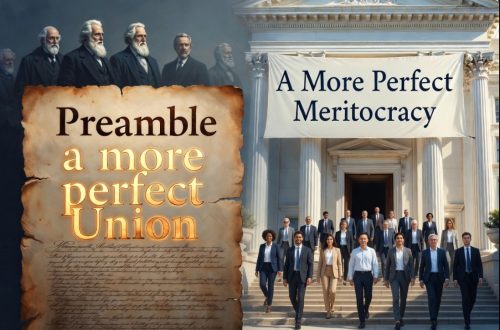
Image credit: Grok The Constitution begins with an aspiration. “We the People,” it declares, seek to form “a more perfect Union.” The wording matters. The Framers did not announce that they had created a perfect country. They described political union as an unfinished project—something capable of improvement, correction, and refinement.
Virginia should think about meritocracy in much the same way.
Nearly everyone claims to support merit. Republicans support merit. Democrats support merit. University administrators, civil-rights organizations, business leaders, public employees, and taxpayers all invoke merit when defending their preferred systems of hiring, promotion, and admission.
Yet agreement on the word disguises disagreement over its meaning.
The political Right generally locates merit in common and measurable indicators: grades, examinations, professional credentials, technical qualifications, work experience, and demonstrated performance. The political Left generally defines merit more contextually, placing greater weight on unequal opportunity, obstacles overcome, historical exclusion, personal experience, and demographic inclusion.
The resulting debate is not always a conflict between supporters and opponents of meritocracy. More often, it is a conflict between rival conceptions of merit.
(more…)
-
Frustrated in Fairfax
by Chap Petersen
Last week, my “Sleepless in Stafford” newsletter detailed how County officials had ignored state law in restricting a homeowner’s right to use her own private residence via short term rental.
It’s not confined to Stafford County, folks.
Two years ago, a Fairfax County resident purchased a 4-acre undeveloped property off Wolf Run Shoals Road in Clifton for his dream house. If you know the area, it’s the “rural” part of the County, with two-lane roads and natural spaces. The residential property he purchased was primarily open space — like in “Field of Dreams” — perfect for a soccer pitch or baseball diamond.
The resident hired an architect, obtained plans and approached the County with a site plan to begin construction. They informed him that he needed to plant 239 mew trees — at a cost of nearly $300,000 — before he would be allowed to begin construction. Alternatively, he could make a direct contribution to the County’s coffers.
(more…)
-
Not Corruption, Just Raw Political Power
by Steve Haner

I have been charged with defaming a great Virginia company and major employer. One of my regular readers high up in Dominion Energy Virginia, someone often complimentary of my efforts, called yesterday to push back on any implication from me that the company is corrupt or engages in corrupt practices.
The basic point of the column from four days ago, “Dominion Sale is a Warning Sign on Virginia’s Weak Ethics Laws”, was that Virginia’s General Assembly should impose campaign finance limits across the board, along with other specific legal recommendations to limit corporate influence at the Capitol or improve utility regulation. The focus was indeed on Dominion.
After pointing out that many of the methods of political persuasion used by NextEra Energy and Dominion are similar, methods I and others have complained about, I wrote “Virginia must fight the corruption across the board.” Yep, with that I applied the word to the company. “Guard against” would have been a better choice than “fight.” Or “overwhelming special interest influence” could have replaced “corruption.”
-
Mark Warner: Spreading Falsehoods On National TV
by Kerry Dougherty
My, my, my. Who would have guessed?
Seems ABC’s White House Correspondent, Jonathan Karl is more familiar with Virginia voting laws than Mark Warner, Virginia’s senior senator. You know, the guy who pledged to serve just two terms but is now running for his fourth.
Here’s Warner getting schooled by Karl on ABC’s Sunday show, “This Week”:
-
Virginia Beach Reneges on Vow to Compensate Business Owners
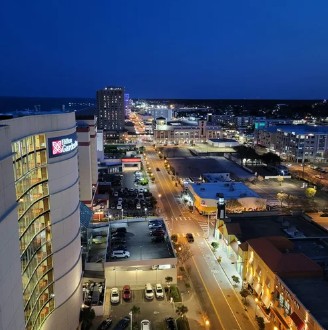
by Kerry Dougherty
Just when you thought the midwits running Virginia Beach had reached peak incompetence with this spring’s idiotic resort-area shutdown, this happens:
After inviting businesses to file for compensation if they lost revenue during the moronic closure of the resort area in April, the city has denied every single claim.
Color me unsurprised.
A city that showers its favorite developers with loot, that helped build a wave park two blocks from the ocean as a playground for wealthy surfers, is giving the middle finger to the little guys struggling to stay afloat along the lawless stretch of Atlantic Avenue from Rudee Loop to 31st Street.
Let’s back up.
There were two mass shootings at the oceanfront this spring. One in March, another in April. A total of 14 people were injured.
What the council won’t say out loud, but I will, is that spring is Thug Season at the Beach. Gang bangers, urban youth and college students descend on the resort area, fights break out and so do guns.
Instead of wading into the crowds, making arrests and taking the guns from the miscreants, Virginia Beach police are what they call (behind the chief’s back) “blue scarecrows.” They stand, adjacent to the hairballs, hoping their mere presence will be a deterrence.
It isn’t.
Instead of rounding up kids with guns on the resort strip, the city boasts state-of-the-art “shot spotter” technology that tells authorities where shots were fired so that ambulances can get there quickly to transport the wounded to the hostpial.
Frankly, that’s embarrassing.
Wringing their helpless hands in April, city council members decided that the couldn’t control the undesirables that swarm the beach every spring – hey, no one wants to be called racist – so they instituted a 9:30 adult curfew on weekends. Continue reading.
-
Jeanine’s Memes
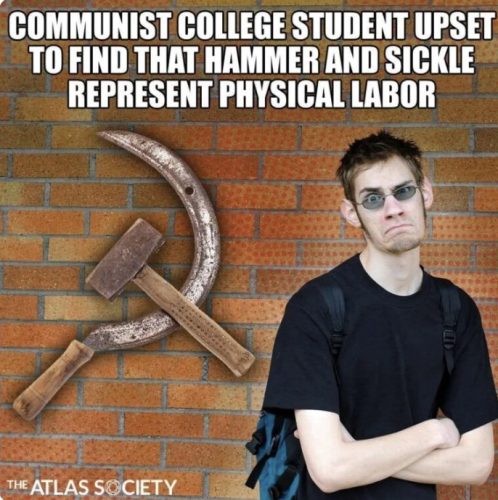
View more memes at The Bull Elephant.
-
Smoke Does Not Stop at the Border.
Neither does the climate.
by Derrick Max
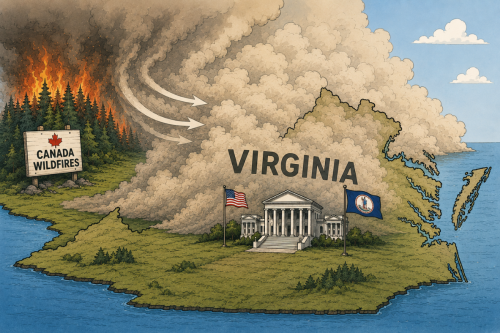
The thick haze now covering much of the East Coast arrived without requesting a permit from Virginia regulators.
It did not stop at the Canadian border. It did not recognize state lines. It did not distinguish between jurisdictions that have adopted aggressive renewable-energy mandates and those that have not. It did not care if it was over a red or a blue state.
Smoke from Canadian wildfires is degrading air quality across large portions of the United States. The fires themselves are in another country, but their consequences are visible in Virginia’s skies and felt in the lungs of all Virginians.
The lesson to be drawn from this smoke should produce some humility in Richmond: Atmosphere is global.
Virginia has just authorized a new State Climate Office at George Mason University. Yet, as these fires reinforce, there is no Virginia climate. There is only a shared atmosphere in which smoke, emissions and weather systems move freely across state and national boundaries. That reality should make policymakers skeptical of expensive new state climate offices and environmental mandates presented as though Virginia can regulate its way to a different climate from the rest of the planet or even impact the global climate.
(more…)
-
Jefferson and the Cheap Bait of White Nationalism
Peter Onuf and Francis Cogliano’s latest book slander defenders of Thomas Jefferson in the worst possible manner. Was it really necessary?
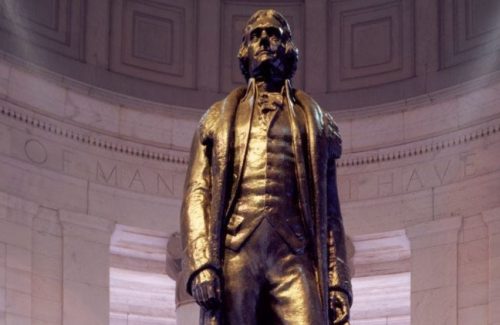
by Shaun Kenney
I was looking forward to reading Peter Onuf and Francis Cogliano’s Thomas Jefferson Survives right up until page 12 of the Introduction.
Once upon a time, I had the pleasure of reading Jeffersonian Legacies in my younger days as a consumer of all things Virginia history, which was the result of a conference on Jefferson headed up by Onuf.
The late Daniel P. Jordan — whose long tenure with the Thomas Jefferson Foundation helped shape the Jeffersonian renaissance — capstoned the conference celebrating Mr. Jefferson’s 250th birthday with the following tribute:
While the conference and essays allow fresh voices to be heard on aspects of the Jefferson legacy, good and bad, at times they merely echo partisan arguments about Jefferson’s life and politics going back to his own era; in other ways they provide a 1990s standard of judgment. The centrality and complexity of Jefferson’s ideas and career, his extraordinary versatility, his gift of felicitous prose, and the exceptional corpus of letters he left behind will assure that Jefferson will remain a fascinating and compelling subject to examine and ponder for edification and inspiration, for admiration and admonishment, for generations to come.
For those interested in how profound the shift has been on Jefferson from paragon to parasite, Ken Burns is your answer. His 1997 Thomas Jefferson documentary treats Jefferson as a Founding Father, yet his 2026 documentary on The American Revolution only begrudgingly admits George Washington as the indispensable man. In fact, all of the accomplishments of the Founding Fathers are footnotes rather than pivotal moments in history — and if pivotal, then most certainly imperfect. From this treatment, Jefferson has provided a deep mine from which countless historians have delved and picked apart to exhibit and even invent the very worst of imperfections in an industry rewarding grievance. God forbid to see what a Ken Burns documentary on Jefferson would look like today.
What should fascinate and compel us presently at the 200th anniversary of Jefferson’s death and the 250th birthday of these States United is that Jordan’s commitment to pluralism and the collision of ideas has been eclipsed by a 2020-ish standard of judgment seeking to recapture Jefferson for the 21st century political left — or worse still, abandon Jefferson to a caricature and label it as “far right”, a tactic which has proven to be very useful to organizations such as the SPLC.
(more…)

