
Shown the door, Gen. Wins Vents
by Gordon C. Morse
When it comes to angry exits, you really cannot beat Woody Allen’s close in the 1976 film, “The Front.”
Ordered to testify before a congressional committee of some sort, Allen’s character faces a demand to cough up the names of communists among his friends and colleagues. The committee wished to keep America “just as pure as we can possibly make it.”
Allen holds his head in his hands. He’s in agony. How can this be happening?
Suddenly, Allen smiles to himself and stands up at the witness table. He firmly denies the committee’s authority to do what it’s doing and “furthermore” invites the members to have sex with themselves.
It’s more crudely expressed than that, which only makes it better. Everyone’s dream moment.
The next scene finds Allen kissing his girl good-bye at the train station, handcuffed to a U.S. Marshall.
Exits can be entertaining. “Exit, pursued by a bear” is Shakespeare’s stage direction in “The Winter’s Tale.”
The other day, while saying a few things about VMI, I brought up Gene Nichol’s 2008 exit from the William & Mary presidency. Denied a contract renewal, Nichol gave contemporaneous expression to his displeasure but waited until 2023 to fully clear his throat.
In his introduction to “Lessons From North Carolina,” Nichol declared that North Cackalacky was his “place” and “not Virginia, whose fawning embrace of its past, stifling and self-deluding classism and noblesse oblige which turns out to carry neither nobility nor obligation but only pretense and privilege, is the opposite of uplifting.”
So, we’re lowlifting or something.
Funny guy, Gene, and clearly proud to join a category of persons (highly educated ignoramuses) now in surplus within the Democratic Party. You need only peruse North Carolina politics in recent years to discover that it’s been in the throes of some pretty vicious and lunkheaded politics.
By comparison with NC, VA is a paragon of political virtue and liberality. That’s called “irony.”
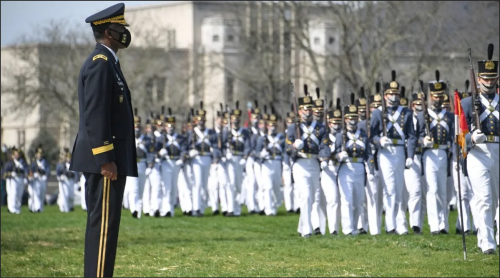
Now comes VMI Superintendent Gen. Cedric Wins and his exit, announced last week by the VMI board while Wins stoically sat there. His contract would not be renewed.
Wins, it seems, thunk on it for a while and then issued a statement yesterday.
“Furthermore,” he said.
“My tenure will end because bias, emotion, and ideology rather than sound judgment swayed the board. Their actions undermine the rich legacy of VMI for political gain.”
O.K. You’re unhappy. But is that accurate? Does that explain the VMI board’s decision?
The part about “political gain” is a puzzlement. What possible political advantages could accrue to anyone involved in this?
As for “bias, emotion, and ideology,” try this:
“Black cadets at VMI have long faced repeated instances of racism on campus, including horrifying new revelations of threats about lynching, vicious attacks on social media, and even a professor who spoke fondly of her family’s history in the Ku Klux Klan—to say nothing of inconsistent application of the Institute’s Honor Code. In addition, VMI cadets continue to be educated in a physical environment that honors the Confederacy and celebrates an inaccurate and dangerous ‘Lost Cause’ version of Virginia’s history. It is long past time to consign these relics to the dustbin of history.”
Yes, the Lost Cause. The magic phrase meant to halt all further discussion.
This was Gov. Ralph Northam’s response following the investigation of VMI, right?
No. You find this paragraph in the letter Northam signed authorizing a third-party investigation.
Sentence first; verdict later.
That letter, sent out Oct. 19, 2020, precipitated the resignation of former Superintendent J.H. Binford Peay III (General, U.S. Army-ret.) and was received without complaint.
Of all the participants in this protracted tale, it is Peay alone who seems to fully understand the fulfillment of institutional and patriotic “duty.” It’s simple. If you profess to love an institution, you do not do things that hurt it.
Northam’s signature to the 2020 letter, ostentatiously underscored with “VMI Class of 1981, Former President of VMI Honor Court,” appeared with company: The sitting lt. governor and attorney general and eight members of the General Assembly also signed it.
Every one of them was a Democrat. You can spend a lifetime searching the records in the State Library and you will not find another gubernatorial letter resembling this.
It’s not just the overcooked language and the stagey parade of partisan bravado; it’s the conclusions that had already been reached. If you’ve made up your mind, why investigate?
You do so to perform a ritualistic political dance – lookihere, we’re investigating – and to establish plausible objectivity.
It also allows news outlet with an interest in this subject to cite an “investigation” and skip all further explanation and context. Which is precisely what occurred following Wins’ statement on Thursday.
The investigation begun in 2020 moved a million Virginia tax dollars to the banking account of an Indiana law firm. The firm proceeded at quick pace and, you must say, with some nice symmetry.
Because if you’re interested in the KKK, Indiana is the place to go. At one point, the Governor of Indiana, Edward L. Jackson, and half the state legislature were members. In the mid-1920s, Klan Grand Dragon D.C. Stephenson claimed to be “the law in Indiana” and history confirms that to be no exaggeration.
More irony, huh?
George Kennan, the storied diplomat and writer, was invited to the University of Chicago in 1950 to explain how the first half of the 20th century became such a lovely experience in human endeavor.
Kennan worked through it with remarkable intelligence and insight, but reached a point where you can almost see his shoulders shrug as he says, “one thing leads to another.”
It’s true. You immediately face the chicken-and-the-egg argument – but things do tend to follow in sequence.
So why don’t people wonder about what happens next? What will stage two look like? No one asks.
Instead, they shoot the Archduke and say, “Well, that’s done.”
In 2020, Gov. Ralph Northam put a lot of things in motion and, to this day, I doubt he asked a single question about where it was all headed.
Since any investigation requires investigators, Northam’s staff in late 2020 drew up a “request-for-proposal” (RFP) and had the Virginia Council for Higher Education transmit it.
As a leading objective, the RFP sought a “Special Investigation Team” to conduct “an equity audit to identify possible equity gaps in VMI’s culture, policies, practices, and traditions.”
“Are VMI’s current efforts at Diversity, Equity and Inclusion (DE&I) effective?” The RFP wanted that question answered and more. “Are VMI’s admissions and financial aid policies implemented to promote and effectuate racial equity?”
The Indiana law firm responded enthusiastically.
“We see this investigation and audit as an opportunity not only to identify areas of improvement,” it wrote back, “but also to underscore the institution’s commitment to diversity, equity, and inclusion and chart a clear course for the future.”
All the subsequent reports and recommendations operated within a DEI structure. There were more than four dozen specific references in the final report. It was explicit. It was DEI morning, noon and night. A DEI festival.
For the progressive Virginia Democrats who received that report in 2021, that was just swell. Doing a DEI fix on VMI was just what they had in mind. Goodness would result.
To this day, a great many people believe in DEI and perhaps even more applaud the general purposes residing within.
Only, now, DEI no longer commands the same, broad level of political fealty. It has stopped being “untouchable.”
Why? Because the American body politic spent recent years watching the DEI phenomenon grow and metastasize and opinion divided.
It divided dramatically. It shaped the results of the 2024 presidential election.
So, presently, we continue to work through it and that is what democracies do.
To put this whole thing another way, in 2020 Ralph Northam and his merry progressives thought shooting the Archduke was a swell idea. The sun would surely come out.
Instead, one thing led to another.
How did it happen that the VMI Board of Visitors parted company with Gen. Wins? It’s more prosaic than advertised, I imagine. They wanted to go one direction, and he wished to go another.
Gordon C. Morse has been writing commentary and speeches in Virginia since 1983. This column his republished with permission from his Substack account Heart’s Desire.
Leave a Reply
You must be logged in to post a comment.