
by Gordon C. Morse
Loved the headline over an opinion in The Washington Post last Sunday morning: “The beginning of the end of the Trump era.”
Well, that was easy. What a relief! And I was beginning to worry.
The argument contained within the Post piece, such as it is, seems to recognize that something fundamental has occurred, that the writer thought (along with his friends and colleagues, he says) that it was a sea-change of sorts. Trump über alles, but then, no, he realized he was wrong. It was just a passing Trump moment, a phase of sorts, now already hung on its depraved techniques and implausible assertions.
The Post ran this piece, in all likelihood, because it yearns for it to be true. Likely the paper put the headline on the thing, not the writer. Thus people open the paper and see that the storm has passed and a new, better day beckons. It was all just a bad dream.
The single best advice that any Democrat can receive these days? Come to grips with the world on your own. Do your own homework. Think for yourself. And, for the sake of all that’s holy, put aside most anything you find in The Washington Post or The New York Times these days.
If you want to contemplate something, consider a tipping point that could knock the Trump administration back. At that moment, public attention will turn to the Democrats in the hope that they will offer a reasonable alternative. Should that hope be frustrated by the Democrats dancing about, doing all the things they were doing prior to November, with little amendment, American political frustration will become acute.
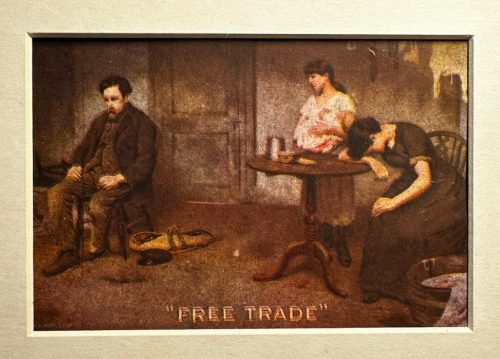
It’s not easy to diagnose events as they occur and understand what they may mean down the road. In 1988, I was in Oxford, England, rummaging about the odds and ends of a basement church sale and spotted a post card that I’ve kept on an office bookshelf ever since.
Four people are depicted in what appears to be a drab living room: A father and mother, perhaps, a daughter and an infant child. They all carry the look of despair, of economic desolation and hope lost.
The card has a two-word caption: “Free Trade.”
Only a few days prior to my purchase of this prized item, I’d parted company with Governor Jerry Baliles at the conclusion of a Virginia trade mission. We’d first been in Israel and then Europe for more than two weeks, lugging briefing books, making presentations, running through non-stop meetings, all in the cause of expanding Virginia’s economic horizons, bringing more trade through the ports of Virginia and encouraging foreign investment within the state’s borders.
This work found its first apostle in Governor Mills E. Godwin, and in 1969, he personally cut the ribbon on a new Virginia Foreign Trade Office in Brussels. The Associated Press cited this as the “only one of its kind by one of the United States in Europe.”
It didn’t stay that way. In the 1980s, it was not uncommon to encounter other American state governors in the lobbies of European and Asian hotels, out and about to beat the drum on behalf of their own state’s interests. No one questioned whether this was the right road to take. No one challenged the basic premises of economic development, the free trade principles underlying them and the work continued to inspire other Virginia governors to hit the road.
Then, in December, 1992, President Bill Clinton signed the North American Free Trade Agreement (NAFTA). It took effect in January, 1994.
In 1999, roughly a dozen or so years after Baliles’ globe-trotting, more than 1,700 people lost their jobs when Tultex — a prominent textile and apparel company — shuttered its facility in Martinsville.
In business since the 1930s, Tultex was one of the first companies in the South to manufacture sweatshirts, challenging the dominance of northern manufacturers at the time. At its peak, Tultex employed thousands across facilities in Virginia, North Carolina, and beyond. Martinsville claimed to be the “Sweatshirt Capital of the World” and Tultex employees took the bow.
Tultex disappeared. So did Stanley Furniture and American. Between 2000 and 2010, more than 40 furniture plants in Virginia shut down, eliminating nearly 8,000 jobs.
Now, here we are, more than a quarter century later, and we see President Trump celebrating “Liberation Day.” It’s a different approach to global trade, and we’ll see. He may well be laying the basis for something even worse than the Democrats conjured up. Trump would claim otherwise.
In effect, the Democratic Party served up their working class voters to the GOP. Trump has been beating this drum for decades. He figures he’s in a position to collect and could be correct.
Or, maybe all this is too simplistic; that other things contributed to the decline of Virginia’s furniture and textile businesses, and the recovery will not be a matter of throwing free trade to the winds.
However, the basic political dynamic – based on a straightforward narrative of cause and effect – is difficult to counter. Trump is on to a few, basic things and they’re not just economic. Courtesy of Democratic Party excesses and its tendency to defend everything, the president is also scoring on the cultural front.
What contribution will Virginia make to Trump’s soaring trajectory? There will be a contribution, no question, based on how the statewide and legislative races are fought. The Democrat-led General Assembly will leave an impression today, as it considers the governor’s vetoes and budget amendments.
To this point, a solid whack to Gov. Glenn Youngkin, on some basis, by some means, defines a good day for the Democrats. They never let up on the ol’ boy and I’m sure, from their perspective, it seems like a swell and just thing to do.
But it’s peculiar where you contemplate the political circumstances. As best I can tell, Virginia is the only Southern state (defined in a traditional sense, which does not include Maryland and Delaware, thank you) where Democratic Party lawmakers outnumber their Republicans counterparts.
And, in Virginia, the “outnumbering” is but a single chair in each legislative chamber. These conditions would seemingly invite some measured conduct, even at the risk of being humble and generous to a chief executive barred by law from seeking re-election.
The Democrats do stridency instead. Every email asking for dollars arrives with a snarl for the other side. Every GOP objection gets the word “Trump” for a response.
“Here in Virginia, we are the last firewall against their dangerous agenda,” say the Democrats, in a recent fund-raising pitch. “We must hold our Democratic majority in the House, take back the Governor’s Mansion, and stop the Republican attacks on working families, public education, and our fundamental rights.”
Democrats have moderation (restraint, self-discipline, un-looney) as an option. But, no. To date, it’s been more of the same. Virginia’s Democrats – the ones in the General Assembly – have embraced the national liberal agenda in toto. If there’s any open space between Democratic Party lawmakers and their counterparts in Washington, D.C., it’s hard to discern.
Collectivist urges? Unbound environmentalism? Cultural excess? Unembarrassed redistribution? Virginia Democrats have points enough for platinum membership on all of it. And they believe their agenda reflects the values of a majority of Virginians, especially in the more urbanized precincts.
Are they right? Certainly in Ballston. Maybe not in Galax.
Here’s the funny thing: the budget Gov. Youngkin just put out, even with all his many amendments, would have produced howls of outrage from within his own party a generation ago.
No one – not in the legislature, not in the press – has much of a perspective anymore on where things are and where they have arrived. Youngkin is spending money. Perhaps not in the amounts or in the places that the Democrats would prefer, but he’s shown only modest restraint on the concept of an active, engaged state government.
Not to put too fine a point on it, but in 1983, when I first started writing for the Daily Press in Newport News, Virginia’s budget was approximately $6 billion. By FY2023, the budget had grown to $81.1 billion, representing a total increase of about 1,252% over this period, unadjusted for inflation.
Youngkin just added more, while making some relatively modest trims in places. The Democrats have been apocalyptic in response.
President Trump has uncovered political support for some drastic changes. But he has yet to unveil any gift for implementing those changes. A little finesse, a little patience, a little appreciation for the jolt people are feeling, might do wonders.
That may be Trump’s great weakness. He likes the jolting part — and doing so on a huge scale.
But should the moment come – the turning point – it will still be a matter of what the Democrats have to offer as an alternative. The Democrats presently offer the status quo ante and it’s not much of an alternative.
Gordon C. Morse has been writing commentary and speeches in Virginia since 1983. This column his republished with permission from his Substack account Heart’s Desire.
Leave a Reply
You must be logged in to post a comment.