
by Gordon C. Morse
In roughly six months, Virginia will elect a new governor, and her name is Abigail Spanberger.
That appears to be the consensus view and, based on the circumstances (money, history, money, Trump, and money), the logic favoring Spanberger, a Democrat, appears convincing.
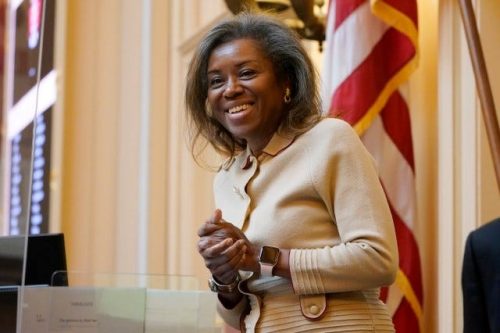
So where does that leave Spanberger’s GOP opponent, current Lt. Gov. Winsome Earle-Sears? In need of a compelling, un-risk-averse message. She will have to take some chances. A formulaic, by-the-numbers campaign will likely not get it done for Earle-Sears.
Let me first attempt a description of the overall situation.
“Virginia does presidential reactions,” a seasoned, wise and experienced chum said on Thursday, while we sat eating lunch in bucolic Charles City County. It’s less and less about Virginia, per se, in other words.
My friend pegs the shift to year 2016, when Donald Trump first ascended to the White House. America suddenly and urgently needed to channel its response – as felt by those, of course, who did not care for Trump – and Virginia promptly offered an electoral opportunity to do so the following year.
The theory behind Virginia’s offset elections, so we’re told, once sat in the notion that the commonwealth should avoid entanglements. No one in Virginia (if it was to remain Virginia) would benefit from state politics getting too tied up in national politics. Keep the two separate.
Well, so much for that.
People get this –- but it’s less sure whether they fathom what it means for running the state.
So, allow me a semi-fearless explanation.
If you take the peopled universe of Virginia state politics –- inhabited by the three statewide office holders (governor, lt. gov. and attorney general), the 40 members of the Virginia Senate and 100 members of the House of Delegates -– you can safely say that, historically, there’s always existed a percentage of office-holders (you can argue about the number, but not its existence) who found their way to elected office but simply did not have a clue why they were there or what they were supposed to do.
Okay? The descriptive word that comes to mind is “oblivious” and it’s a reliable constant in democratic systems.
These people were not accidental officeholders exactly, because they all had to fill out the forms and buy bumper stickers with their name on them. They didn’t just wake up in the morning, after a long, festive night of carousing, and find themselves with a seat in the House of Delegates.
But they may as well have done just that.
And, once in Richmond, they realized, there was free food, a comfy chair and a surprising amount of fawning in their direction. They liked all that well enough to hang around.
Again, that particular subset of elected officeholders has always been there.
The difference today? The percentage they represent –- the number -– is much larger now.
“They don’t know anything.” That’s what you hear from those who presently work the halls of the General Assembly. A growing portion of the Senate and the House membership do not know anything about the issues and particulars that drive and shape state government.
They open the hood of the thing, blink a couple of times in befuddlement at the wires, valves and spark plugs, and quietly close the hood. Just changing the oil is a test for them.
There’s another piece to this, equally important and explanatory.
These people not only do not know anything, but they are also not interested in knowing.
That’s the part I struggle with, because it seems counterintuitive. It’s alien to my experiences in the General Assembly, albeit long ago. Why wouldn’t you want to know what you need to know to do the work?
The answer goes back to the overwhelming nationalization of Virginia politics and the principles of political economy. That was what my very smart friend said at lunch. The political market -– as supply and demand play out in a Virginia political setting -– supports and encourages a constant focus on the national debate.
To put it another way, if voters intensely demand responses on national issues from state officeholders, then the latter will supply that. In this respect, the pols do know what they need to know -– it’s just that what they need to know has very little to do with Virginia state government.
As a result, you end up – in Richmond – with a limited number of elected officials who can easily tell you how Virginia pays for K-12 public education. Or how it governs higher education. Or the way it manages state and local powers and responsibilities. Or how the state tax system works and why. On and on.
If you ask about public safety, for example, you may very well get an informed discussion on guns. Just don’t ask them for the theoretical basis of state-administered punishment, parole, probation, etc.
And how does all this get me back to Lt. Gov. Winsome Earle-Sears’s campaign challenge?
I will address that next time, but here’s a hint: Earle-Sears may very well be the one candidate for governor of Virginia this year who knows something about state government and how it works.
Gordon C. Morse has been writing commentary and speeches in Virginia since 1983. This column his republished with permission from his Substack account Heart’s Desire.
Leave a Reply
You must be logged in to post a comment.