
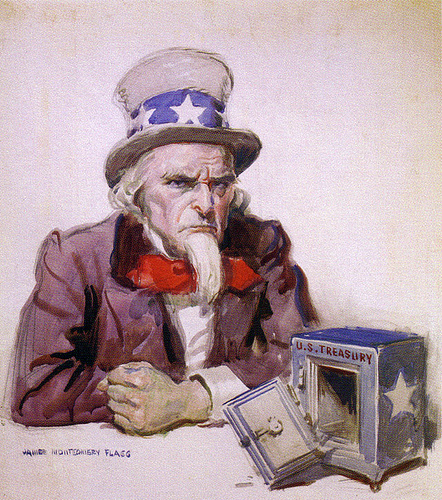
Wow, the negative shift in investor sentiment has come faster and harder than I ever imagined. When I started writing “Boomergeddon” about a year ago, the U.S. economy was growing briskly and the stock market was rising. I certainly wasn’t alone as a pessimist, but I didn’t have much company. Indeed, I sometimes wondered if I was testing peoples’ credulity by suggesting that the U.S. might default on its debt within 15 to 20 years.
Now I’m getting trampled by the stampede for the exits. Fear of inflation has turned into fear of deflation. Hopes for a strong recovery have morphed into worry about a double-dip recession. Sentiment gets worse by the day. Now there’s this: Gluskin Sheff economist David Rosenberg says the U.S. economy has entered a 1930s-style depression. Reports CNBC:
The 1929-33 recession saw six quarterly bounces in GDP with an average gain of 8 percent, sending the stock market to a 50 percent rally in early 1930 as investors thought the worst had passed.
“False premise,” Rosenberg said. “And guess what? We may well be reliving history here. If you’re keeping score, we have recorded four quarterly advances in real GDP, and the average is only 3%.”
According to CNBC, major analysts from Goldman Sachs, JPMorgan and others have slashed 2010 GDP projections to the 1.5- to 2-percent range. Meanwhile, Morgan Stanley now says that global investors face defaults on government bonds, given the burden of aging populations and difficulty of generating more tax revenues. Reports Bloomberg:
“Governments will impose a loss on some of their stakeholders,” Arnaud Mares, an executive director at Morgan Stanley in London, wrote in a research report today. “The question is not whether they will renege on their promises, but rather upon which of their promises they will renege, and what form this default will take.” The sovereign-debt crisis is global “and it is not over.” …
“Outright sovereign default in large advanced economies remains an extremely unlikely outcome, in our view,” the report said. “But current yields and break-even inflation rates provide very little protection against the credible threat of financial oppression in any form it might take.” …
“The conflict that opposes bondholders to other government stakeholders is more intense than ever, and their interests are no longer sufficiently well-aligned with those of influential political constituencies,” such as elderly voters and their claims on pensions and health insurance, Mares wrote.
The sentiment is getting so negative, I’m tempted to become a contrarian. Sure, fellas, the situation is bad, but it isn’t that bad. We’ve still got 15 years before Uncle Sam goes broke. Give it a rest, already! (Original post on the Boomergeddon blog.)
In all seriousness, Virginians need to pay heed. Time is running out to get our fiscal house in order and wean ourselves from the federal teat. The job of governance will not get any easier in the years ahead. It will only get harder.

Leave a Reply
You must be logged in to post a comment.